
RTX 3080 Ti vs 4070 Super: Performance, Price, and Specs Comparison
RTX 3080 Ti vs RTX 4070 Super – Background Comparison
| Brand | Series | Model | Release Year | Official Positioning | Market Price (USD) |
|---|---|---|---|---|---|
| NVIDIA | GeForce | RTX 3080 Ti | 2021 | The GeForce RTXTM 3080 Ti graphics cards deliver the performance that gamers crave, powered by Ampere—NVIDIA’s 2nd gen RTX architecture. It is built with dedicated 2nd gen RT Cores and 3rd gen Tensor Cores, streaming multiprocessors, and G6X memory for an amazing gaming experience. | $1,199 |
| NVIDIA | GeForce | RTX 4070 Super | 2024 | Get equipped for supercharged gaming and creating with NVIDIA® GeForce RTX 4070 Ti graphics cards. It is built with the ultra-efficient NVIDIA Ada Lovelace architecture. Experience super fast ray tracing, AI-accelerated performance with DLSS 3, new ways to create, and much more. | $599 |
NVIDIA RTX 3080 Ti vs RTX 4070 Super– Specifications Comparison
The RTX 3080 Ti vs RTX 4070 Super comparison reflects a clear shift in generational priorities rather than a simple performance upgrade.
The nvidia 3080 ti was launched as a near-flagship GPU of the Ampere generation, built to maximize raw rasterization performance and memory throughput. With a wider memory bus and significantly higher bandwidth, its strengths lie in classic rendering pipelines, high-resolution 4K gaming, and bandwidth-heavy workloads where brute force still matters. These characteristics are well represented in the 3080 ti specs, which emphasize sustained throughput over efficiency.
The nvidia 4070 super, by contrast, represents a modern upper-mainstream design based on the Ada Lovelace architecture. While its memory subsystem is narrower, architectural improvements, higher clock speeds, and newer Tensor and RT cores allow it to deliver strong real-world results in modern titles. Many 4070 super benchmark results show competitive performance at 1440p and even 4K when paired with DLSS and newer rendering techniques, all while operating at much lower power.
As a result, the 4070 super vs 3080 ti discussion often comes down to workload focus. The 3080 Ti continues to excel in traditional, bandwidth-intensive scenarios, while the 4070 Super is optimized for AI-assisted rendering, ray tracing, and efficiency-focused modern engines. From a value perspective, differences in 3080 ti price and 4070 super price further reinforce this divide between legacy high-end performance and next-generation efficiency.
Core Specs Comparison between RTX 3080 Ti vs RTX 4070 Super
| Specification | RTX 3080 Ti | RTX 4070 Super |
|---|---|---|
| Architecture | Ampere | Ada Lovelace |
| CUDA Cores | 10240 | 7168 |
| Memory Type | GDDR6X | GDDR6X |
| Memory Capacity | 12 GB | 12 GB |
| Memory Bus | 384-bit | 192-bit |
| Memory Bandwidth | 912 GB/s | 504 GB/s |
| Core Frequency (Boost) | ~1.67 GHz | ~2.48 GHz |
| TDP (Power) | ~350 W | ~220 W |
| Interface / Bus | PCIe 4.0 x16 | PCIe 4.0 x16 |
| FP32 Performance | ~34.1 TFLOPS | ~35.5 TFLOPS |
| Ray Tracing / Tensor | 2nd-gen RT, 3rd-gen Tensor | 3rd-gen RT, 4th-gen Tensor |
| PCIe Version | PCIe 4.0 | PCIe 4.0 |
Key Differences: RTX 3080 Ti vs RTX 4070 Super
Architecture
The nvidia 3080 ti, based on the Ampere architecture, was designed to maximize raw throughput and memory performance, especially for high-resolution and traditional rendering workloads. In contrast, the nvidia 4070 super adopts the newer Ada Lovelace architecture, introducing improved scheduling, cache efficiency, and more advanced RT and Tensor cores. This architectural shift is a key reason why many 4070 super benchmark results remain competitive despite fewer hardware resources.
CUDA Cores, Clocks & Compute Behavior
From a specs perspective, the 3080 ti specs show a clear advantage in CUDA core count, which benefits rasterization, brute-force rendering, and sustained compute-heavy tasks. However, the 4070 super specs emphasize higher boost clocks and architectural efficiency, allowing the GPU to deliver strong real-world performance in modern games and applications. As a result, the 4070 super vs 3080 ti comparison often shows smaller gaps than raw core numbers would suggest.
Memory Bus & Bandwidth
Memory configuration plays a major role in the 3080 ti vs 4070 super discussion. The RTX 3080 Ti’s wider memory bus and much higher bandwidth directly improve performance in 4K gaming, large texture streaming, and bandwidth-sensitive engines. The RTX 4070 Super, with its narrower bus, relies on architectural optimizations and cache behavior, which can reduce performance in memory-bound scenarios but improves efficiency overall.
RTX 3080 Ti vs RTX 4070 Super Performance Across Different Scenarios
AI / Deep Learning Performance Comparison
LLM Inference (7B-class models, FP16)
In local large language model inference (such as LLaMA-2 7B or similar decoder-only models), the RTX 3080 Ti typically delivers around 5–10% higher token throughput than the RTX 4070 Super.
This advantage comes primarily from the 3080 Ti’s much higher memory bandwidth, which benefits attention-heavy andbandwidth-sensitive inference stages. In tokens-per-second terms, the 3080 Ti usually stays slightly ahead, though the margin is modest rather than decisive.
Text-to-Image Generation (Stable Diffusion 1.5 / SDXL)
In image generation workloads such as Stable Diffusion, the trend often reverses. Thanks to newer Tensor Core optimizations and improved scheduling, the RTX 4070 Super is commonly 5–10% faster than the RTX 3080 Ti when generating images at standard resolutions.
Here, architectural efficiency matters more than raw bandwidth, which is why many 4070 super benchmark results show a small but consistent lead in generation speed.
AI Performance per Watt
Where the difference becomes substantial is efficiency. Across common AI inference tasks, the RTX 4070 Super delivers roughly 40–50% better performance per watt compared to the RTX 3080 Ti.
While absolute throughput between the two GPUs is often close, the 3080 Ti typically consumes over 300 W under AI load, whereas the 4070 Super operates closer to ~200 W. For long-running AI services or shared GPU servers, this efficiency gap can outweigh small performance differences.
Overall AI Takeaway
In summary, the nvidia 3080 ti remains slightly faster in bandwidth-heavy LLM inference, while the nvidia 4070 super tends to be faster in generation-based AI workloads and clearly superior in efficiency. In most real deployments, the 4070 super vs 3080 ti decision for AI comes down to whether peak throughput or long-term operating cost is the higher priority—especially given today’s 4070 super price versus used 3080 ti price.
4K Gaming Performance
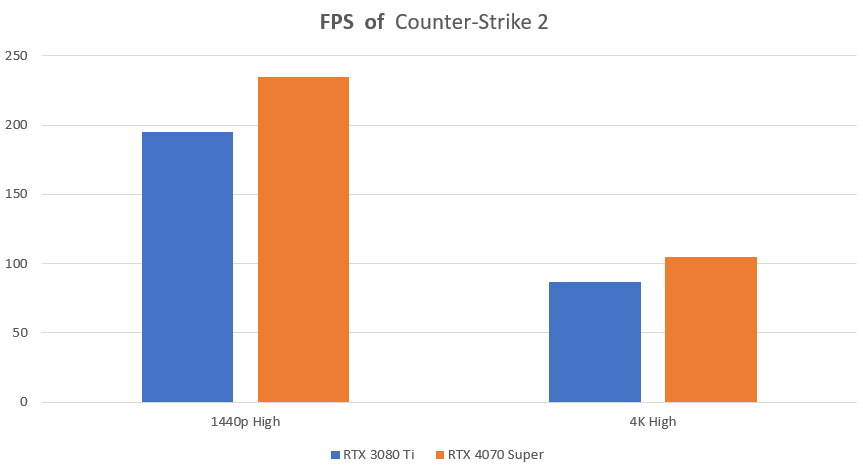
In Counter-Strike 2, the performance gap between the RTX 3080 Ti vs RTX 4070 Super is both clear and consistent across resolutions. At 1440p High, the RTX 4070 Super averages 235 FPS, compared to 195 FPS on the RTX 3080 Ti—a lead of roughly 20%. The advantage remains at 4K High, where the RTX 4070 Super delivers 105 FPS, about 21% higher than the RTX 3080 Ti’s 87 FPS.
These results highlight how modern, high-FPS esports titles favor architectural efficiency and scheduling improvements over raw memory bandwidth alone. Despite the RTX 3080 Ti’s higher theoretical bandwidth, the newer Ada Lovelace design of the RTX 4070 Super translates into higher real-world frame rates in CS2. For players targeting high refresh rates or competitive gameplay, this makes the RTX 4070 Super the more effective choice, even against a former flagship-class GPU.
3D Rendering / Content Creation
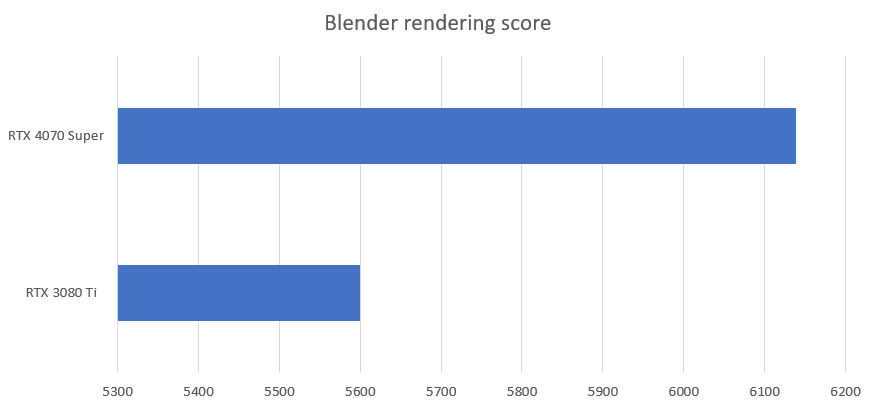
In 3D rendering workloads, the performance gap between the RTX 3080 Ti vs RTX 4070 Super is relatively narrow and depends on the rendering engine and scene complexity. The RTX 3080 Ti, with its higher raw compute scale and significantly wider memory bandwidth, can be around 5–10% faster in complex, bandwidth-heavy renders such as high-sample Cycles scenes or large offline projects.
The RTX 4070 Super, however, benefits from a newer architecture with improved scheduling and efficiency, allowing it to deliver very similar render times at much lower power draw, and in some modern or optimized render pipelines the difference can shrink to within a few percent. Overall, the RTX 3080 Ti favors peak throughput in demanding 3D scenes, while the RTX 4070 Super offers a more balanced approach, combining near-equivalent rendering performance with substantially better efficiency for long or repeated rendering tasks.
Price & Value: RTX 3080 Ti vs RTX 4070 Super
Official MSRP — Why RTX 4070 Super launched far cheaper than RTX 3080 Ti
The RTX 3080 Ti debuted with a much higher official MSRP (US $1,199) than the RTX 4070 Super (US $599) largely due to product positioning and launch context, not just raw performance. The 3080 Ti was introduced as a halo-tier Ampere GPU, aimed at enthusiasts during a period of extreme demand and constrained supply. In contrast, the 4070 Super was positioned by NVIDIA as a new-generation upper-midrange Ada Lovelace product, designed to deliver strong efficiency, modern features, and accessible pricing for mainstream upgrades. Advances in manufacturing efficiency, better yields, and a more competitive market allowed NVIDIA to price the 4070 Super aggressively. In the broader 3080 ti vs 4070 super discussion, this highlights how MSRP reflects launch-era strategy and market conditions, not a linear mapping from performance alone.
Second-hand Market — Why used RTX 3080 Ti can still rival or exceed RTX 4070 Super pricing
In the resale market, actual transaction prices are driven by perceived performance headroom, memory bandwidth, and buyer demand, rather than original MSRP. Despite being older, the nvidia 3080 ti still appeals to users prioritizing raw rasterization performance, wider memory bandwidth, and high-end workloads, which sustains demand on platforms like eBay. Meanwhile, the nvidia 4070 super benefits from newer architecture, better power efficiency, and modern features, but its stronger availability and lower launch price help cap second-hand premiums. As a result, depending on condition and market timing, 3080 ti price listings can overlap with—or even exceed—used 4070 super price offers. This dynamic explains why the 4070 super vs 3080 ti comparison in the used market often reflects supply-and-demand balance and workload preference, rather than generational age alone.
Price Comparison
| Platform | RTX 3080 Ti | RTX 4070 Super | Price Difference (USD) | Price Difference (%) |
|---|---|---|---|---|
| Official MSRP | $1,199 | $599 | $600 | 50% |
| eBay (Used / Mixed) | $400–$550 | $450–$600 | +$50* | +10–15% |
| Amazon (New) | ~$850–$1,200+ | ~$600–$850+ | –$200 to –$350 | –25% to –40% |
User Value-for-Money Feedback
The 3080 ti vs 4070 super comparison receives broadly consistent feedback across popular benchmark platforms, highlighting the balance between raw performance and new-generation efficiency.
On UserBenchmark, aggregated real-world data shows the nvidia 3080 ti maintaining a slight lead in effective 3D gaming speed, largely due to its wider memory bus and higher bandwidth. However, the margin is small and varies by title.
On Technical.City, overall synthetic scores place the two GPUs very close, with the 4070 super benchmark results benefiting from architectural efficiency improvements rather than raw throughput gains.
In practice, the 4070 super vs 3080 ti decision often comes down to priorities. The RTX 3080 Ti still excels in bandwidth-heavy and traditional rendering workloads, while the RTX 4070 Super delivers better power efficiency, newer features, and a far more accessible 4070 super price compared with the original 3080 ti price. As a result, users frequently view the 4070 Super as the better value-for-money choice, despite the 3080 Ti’s marginal performance edge in select scenarios.
RTX 3080 Ti vs RTX 4070 Super – Pros & Cons
| GPU | Pros | Cons |
|---|---|---|
| RTX 3080 Ti | ✅ Higher memory bandwidth and wider bus, giving it an edge in bandwidth-heavy and classic rasterization workloads ✅ Still delivers strong 1440p and capable 4K performance in many traditional titles ✅ Well-suited for rendering pipelines and older engines that favor raw throughput ✅ Widely available on the used market, often with negotiable 3080 ti price |
❌ Very high power consumption and lower efficiency compared to newer GPUs ❌ 12GB VRAM can feel limiting in modern AAA titles and AI workloads ❌ Older Ampere RT/Tensor cores lag behind Ada in ray tracing and AI efficiency ❌ Original MSRP was high, reducing value outside the used market |
| RTX 4070 Super | ✅ Newer Ada Lovelace architecture delivers much better power efficiency and thermals ✅ Improved RT and Tensor cores provide stronger ray tracing, DLSS, and AI performance in modern engines ✅ Excellent 1440p performance with stable results in most 4070 super benchmark tests ✅ Lower launch and retail 4070 super price offers stronger value-for-money today |
❌ Narrower memory bus and lower bandwidth than the 3080 Ti can limit some workloads ❌ Raw raster performance advantage over the 3080 Ti is small in classic games ❌ Not designed as a flagship-tier GPU for sustained 4K workloads ❌ Gains are most noticeable in modern engines, less so in older titles |
RTX 3080 Ti vs RTX 4070 Super GPU Hosting
When comparing the RTX 3080 Ti vs RTX 4070 Super, the most significant differences come from architecture generation, power efficiency, and performance focus. The RTX 3080 Ti, built on the Ampere architecture, emphasizes raw rasterization performance and high memory bandwidth, making it well suited for bandwidth-heavy workloads, classic rendering pipelines, and scenarios where peak throughput matters more than efficiency. By contrast, the RTX 4070 Super is based on the newer Ada Lovelace architecture, delivering much better power efficiency, improved RT and Tensor cores, and stronger performance in modern games, ray tracing, DLSS, and AI-accelerated workloads.
Although Database Mart does not currently offer servers with these exact GPUs, we provide a wide range of GPU servers across different performance tiers and price points. From low-end to high-end configurations, users can choose the right server for AI, deep learning, rendering, or general GPU workloads, with scalable single- or multi-GPU setups, 99.9% uptime, and 24/7 professional support, allowing you to focus on your projects without worrying about hardware management.
Conclusion
Both GPUs remain competitive choices in 2025, but they are clearly designed for different priorities and usage scenarios.
Choose the RTX 3080 Ti GPU if you prioritize raw rasterization performance and memory bandwidth. As a former high-end flagship from NVIDIA, it delivers strong throughput in classic rendering pipelines, bandwidth-sensitive workloads, and many traditional 1440p to 4K gaming scenarios. For users who value proven performance characteristics, stable drivers, and who can accommodate higher power draw, the RTX 3080 Ti remains a solid option—especially when the 3080 ti price on the secondary market is competitive.
Choose the RTX 4070 Super GPU if you value power efficiency, modern features, and long-term usability. Built on the newer Ada Lovelace architecture, it offers significantly better performance per watt, more advanced RT and Tensor cores, and stronger results in modern engines, DLSS-enabled titles, and AI-accelerated workloads. With a lower power envelope and a much more accessible 4070 super price, it is often the better fit for users upgrading today who want balanced performance without the thermal and energy costs of older high-end GPUs.
In summary, while the RTX 3080 Ti still excels in raw, bandwidth-heavy workloads, the RTX 4070 Super stands out as the more well-rounded and efficient choice for modern gaming and mixed workloads—making the 4070 super vs 3080 ti decision largely a question of peak performance versus efficiency and value.
3080 ti vs 4070 super, 4070 super vs 3080 ti, 3080 ti price, 4070 super price, nvidia 3080 ti, nvidia 4070 super, 3080 ti specs, 4070 super specs, 4070 super benchmark