
NVIDIA A100 vs RTX 4090: Performance and Use Cases
NVIDIA A100 vs RTX 4090 – Background Comparison
| Brand | Series | Model | Release Year | Official Positioning | Market Price (USD) |
|---|---|---|---|---|---|
| NVIDIA | Data Center | NVIDIA A100 | No data | Built for large-scale AI training, inference, and high-performance computing, the NVIDIA A100 is a data center–class GPU powered by the Ampere architecture. It delivers massive parallel compute performance, industry-leading Tensor Core acceleration, and high-bandwidth HBM2 memory, making it the backbone of modern AI data centers, cloud platforms, and enterprise workloads. | No data |
| NVIDIA | GeForce RTX 40 Series | RTX 4090 | 2022 | Designed as NVIDIA’s flagship consumer GPU, the RTX 4090 is built on the Ada Lovelace architecture and targets high-end gaming, creative workloads, and local AI acceleration. With exceptional rasterization performance, advanced ray tracing, and powerful Tensor Cores, it delivers outstanding performance for gamers, creators, and developers seeking extreme desktop GPU power. | $1,599 |
NVIDIA A100 vs RTX 4090 – Specifications Comparison
The NVIDIA A100 vs RTX 4090 comparison highlights a clear divide between data center–class acceleration and consumer flagship performance. The A100 was released as a purpose-built accelerator for enterprise AI and HPC, emphasizing massive memory bandwidth, ECC-protected HBM, and Tensor Core efficiency for large-scale training and inference workloads.
The RTX 4090, by contrast, represents NVIDIA’s latest-generation consumer GPU, delivering dramatically higher FP32 throughput and clock speeds. Its architecture favors rendering, real-time graphics, creative workloads, and local AI tasks, where raw compute and responsiveness matter most.
While the A100 remains dominant in scalable, memory-bound AI pipelines, the RTX 4090 excels in compute-heavy and graphics-driven scenarios. As a result, the A100 vs RTX 4090 comparison reflects not just performance differences, but fundamentally different design priorities: enterprise reliability and bandwidth versus raw compute and versatility.
Core Specs Comparison between NVIDIA A100 vs RTX 4090
| Specification | NVIDIA A100 (PCIe) | RTX 4090 |
|---|---|---|
| Architecture | Ampere | Ada Lovelace |
| CUDA Cores | 6,912 | 16,384 |
| Memory Type | HBM2 | GDDR6X |
| Memory Capacity | 40 GB | 24 GB |
| Memory Bus | 5,120-bit | 384-bit |
| Memory Bandwidth | ~1,555 GB/s | ~1,008 GB/s |
| Core Frequency (Boost) | ~1.41 GHz | ~2.52 GHz |
| TDP (Power) | 250 W | 450 W |
| Interface / Bus | PCIe 4.0 x16 | PCIe 4.0 x16 |
| FP32 Performance | ~19.5 TFLOPS | ~82.6 TFLOPS |
| Ray Tracing / Tensor | No RT, 3rd-gen Tensor | 3rd-gen RT, 4th-gen Tensor |
| PCIe Version | PCIe 4.0 | PCIe 4.0 |
Key Differences: NVIDIA A100 vs RTX 4090
Architecture & Design Goal
The NVIDIA A100 is built on the Ampere architecture with a data center–first design, prioritizing stability, scalability, and sustained throughput for long-running AI and HPC workloads. The RTX 4090, based on Ada Lovelace, targets maximum single-GPU performance, emphasizing high clock speeds and responsiveness for graphics, rendering, and desktop AI acceleration.
Memory Type & Bandwidth
A100 uses HBM2 memory with an extremely wide 5,120-bit bus, delivering over 1.5 TB/s of memory bandwidth. This massive bandwidth is critical for large models, batch processing, and memory-bound AI training. In contrast, RTX 4090 relies on GDDR6X with lower bandwidth, which is sufficient for most desktop workloads but less optimal for large-scale data movement.
CUDA Cores & FP32 Compute
RTX 4090 features significantly more CUDA cores and far higher FP32 throughput, giving it a strong advantage in rendering, rasterization, simulation, and compute-heavy desktop workloads. The A100’s lower FP32 performance reflects its focus on efficiency and parallel throughput rather than peak single-precision compute.
Tensor Cores & AI Acceleration
A100’s third-generation Tensor Cores are optimized for mixed-precision (FP16, BF16, TF32) AI training and inference, delivering consistent performance at scale. RTX 4090’s newer Tensor Cores are faster for local AI inference and creative workflows, but lack data center features such as ECC-protected memory and multi-instance GPU (MIG).
Power & Deployment Environment
A100 operates at a much lower power envelope and is designed for dense server deployments with predictable thermal behavior. RTX 4090 consumes significantly more power, trading efficiency for peak performance in workstation and enthusiast environments.
NVIDIA A100 vs RTX 4090 Performance Across Different Scenarios
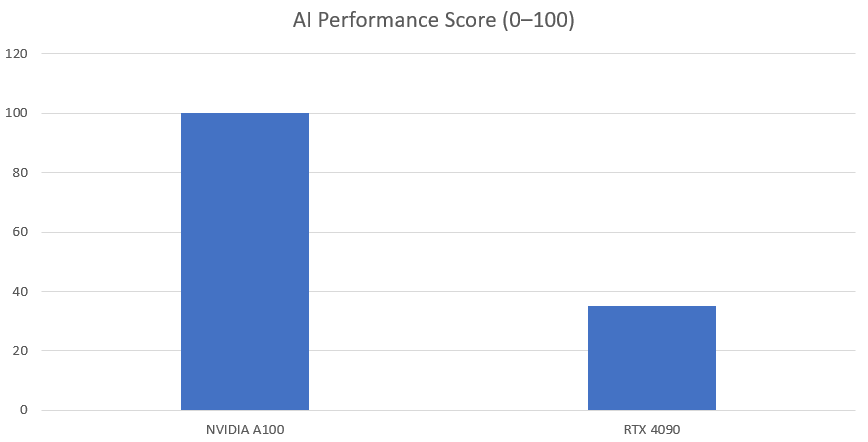
AI / Deep Learning Performance Comparison
In AI training and inference, the NVIDIA A100 scores 100, far surpassing the RTX 4090’s 35. This is because the A100 is a data-center GPU designed for large-scale AI workloads, featuring Tensor Cores, massive HBM2e memory, and highly optimized multi-GPU scaling. These features enable extremely high throughput for training and inference of deep learning models, making it ideal for research and enterprise AI tasks. The RTX 4090, while capable of smaller-scale desktop AI projects, has fewer Tensor Cores and lower memory bandwidth, which limits its performance for large models or multi-GPU training setups.
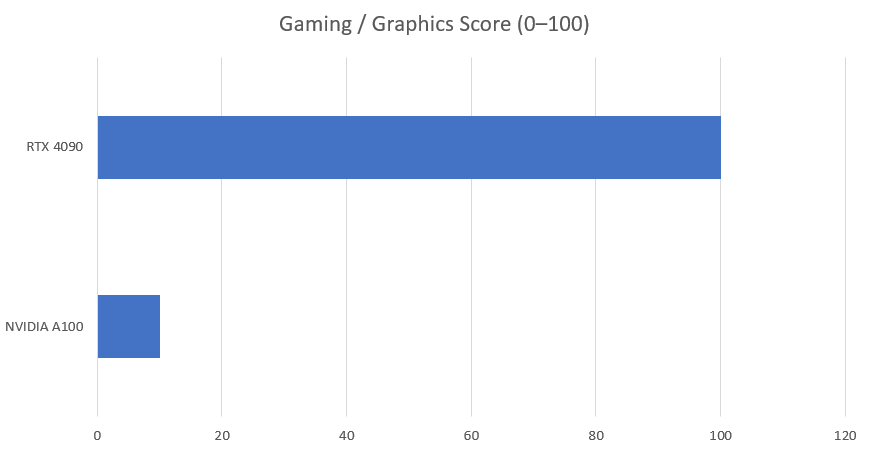
4K Gaming Performance
In gaming and real-time graphics, the RTX 4090 again achieves 100, providing excellent FPS performance in modern 4K AAA titles and real-time graphics applications. The A100, designed for server and AI tasks, scores only 10 in this category because it lacks consumer drivers, game optimizations, and real-time rendering capabilities. This highlights that while the A100 excels in AI workloads, the RTX 4090 is the superior choice for gaming, 3D rendering, and general desktop graphics tasks.
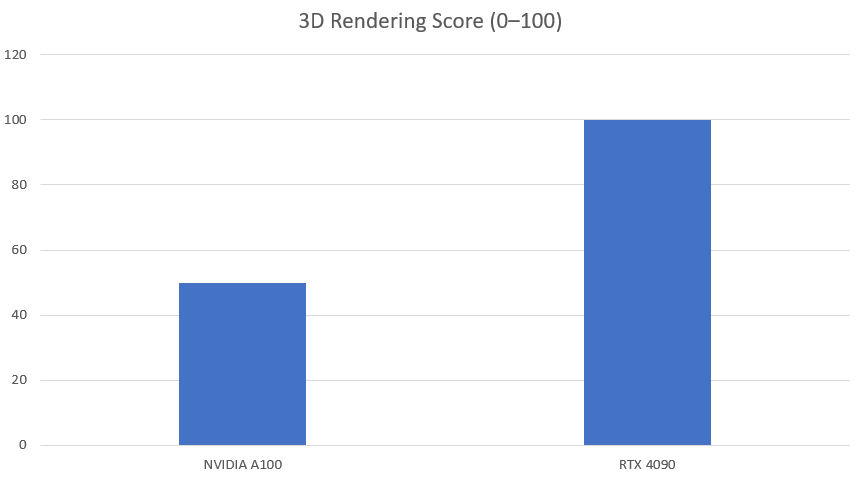
3D Rendering / Content Creation
In 3D rendering and creative workloads, the RTX 4090 dominates with a score of 100, while the A100 reaches only 50. The 4090’s high FP32 throughput, desktop-optimized drivers, and wide software support make it perfect for applications such as Blender, Octane, and other rendering software. It can deliver fast rendering times and smooth viewport performance for creative professionals. Conversely, the A100, although capable of performing rendering tasks, is not optimized for desktop creative workflows and its lower FP32 efficiency leads to slower performance in these scenarios.
Price & Value: NVIDIA A100 vs RTX 4090
Official MSRP — Why the RTX 4090 launched far cheaper than the A100
The RTX 4090 launched with a much lower official MSRP (US $1,599) than the NVIDIA A100, largely because the A100 is a data center–class accelerator rather than a consumer GPU. NVIDIA does not publish a fixed MSRP for the A100, as it is sold through enterprise and OEM channels with pricing tied to contracts, volume, and deployment scale. The A100’s cost reflects its positioning for AI training, HPC, ECC-protected memory, and 24/7 reliability, not consumer performance metrics. In short, the price gap exists because these products target entirely different markets, not because of a linear performance difference.
Second-hand Market — Why used A100 prices remain dramatically higher than RTX 4090
In the secondary market, pricing is driven by enterprise demand and limited supply rather than gaming or creator value. The A100 remains in high demand for AI infrastructure, cloud services, and research workloads, where features like HBM memory, ECC support, and data center certification are critical. Meanwhile, the RTX 4090, despite its strong compute performance, is primarily a consumer GPU and is more widely available through retail and resale channels. As a result, used A100 units continue to command several times the price of RTX 4090 cards, reflecting their ongoing role in production AI environments rather than desktop use.
Price Comparison
| Platform | NVIDIA A100 | RTX 4090 | Price Difference (USD) | Price Difference (%) |
|---|---|---|---|---|
| Official MSRP | Not officially disclosed | $1,599 | — | — |
| eBay (Used) | ~$7,000–$12,000 | ~$1,800–$2,500 | +$5,200–$9,500 | +210%–+380% |
| Amazon (Retail / Reseller) | ~$9,000–$15,000 | ~$1,700–$2,200 | +$7,300–$12,800 | +430%–+750% |
User Value-for-Money Feedback
Unlike consumer GPUs, enterprise accelerators such as the NVIDIA A100 are not widely covered by user-driven benchmark platforms. Popular sites that aggregate real-world gaming and desktop performance data primarily focus on consumer graphics cards, which means direct A100 vs RTX 4090 user score comparisons are generally unavailable.
The RTX 4090, as a consumer flagship GPU, receives extensive coverage across gaming, creative, and desktop benchmark platforms, where feedback consistently highlights its exceptional FP32 performance, high clock speeds, and strong value for local rendering and AI inference.
By contrast, the A100 is evaluated mainly in enterprise, cloud, and research environments, where performance is measured through AI training throughput, memory bandwidth efficiency, and long-term stability, rather than gaming or synthetic desktop benchmarks. As a result, user feedback on the A100 is typically found in data center case studies, cloud performance reports, and AI workload benchmarks, not consumer review platforms.
In practice, this means the lack of side-by-side platform scores reflects product segmentation rather than missing data. The RTX 4090 is judged by desktop performance and value metrics, while the A100 is assessed by scalability, reliability, and efficiency in production AI workloads.
NVIDIA A100 vs RTX 4090 – Pros & Cons
| GPU | Pros | Cons |
|---|---|---|
| NVIDIA A100 | ✅ Designed for data center and enterprise AI workloads, optimized for large-scale AI training and inference ✅ Extremely high memory bandwidth (HBM) benefits large models and memory-bound tasks ✅ ECC-protected memory and data center–grade stability for 24/7 operation ✅ Strong mixed-precision performance with Tensor Cores, well suited for deep learning pipelines |
❌ No official MSRP and very high acquisition cost ❌ Lower FP32 performance compared to modern consumer flagships ❌ No ray tracing support, making it unsuitable for graphics or gaming ❌ Limited availability outside enterprise and cloud environments |
| RTX 4090 | ✅ Exceptionally high FP32 compute and CUDA core count, ideal for rendering, simulation, and creative workloads ✅ Advanced RT and Tensor cores enable strong ray tracing, DLSS, and local AI acceleration ✅ Much lower price than data center GPUs, offering strong price-to-performance for desktop users ✅ Widely available through consumer retail and second-hand markets |
❌ Lower memory bandwidth and no ECC support compared to A100 ❌ Not designed for large-scale or multi-tenant AI training environments ❌ Higher power consumption under sustained load ❌ Lacks data center features such as MIG and enterprise-level certifications |
NVIDIA A100 vs RTX 4090 GPU Hosting
When choosing between the NVIDIA A100 and RTX 4090, the decision mainly depends on workload scale. The A100 is better suited for large-scale AI training, enterprise workloads, and data center environments that require high memory bandwidth and long-term stability. The RTX 4090, on the other hand, is a stronger choice for small to mid-sized workloads, including gaming, rendering, creative tasks, and local AI inference, where raw compute performance and cost efficiency matter more.
Database Mart offers GPU server solutions featuring both platforms. You can deploy high-performance workloads using our RTX 4090 GPU hosting for cost-effective acceleration, or scale demanding AI and training tasks with our NVIDIA A100 GPU rental solutions. With flexible configurations, 99.9% uptime, and 24/7 expert support, Database Mart helps you choose the right GPU without hardware complexity.
Conclusion
Both GPUs remain relevant in 2025, but they serve very different priorities:
Choose the NVIDIA A100 if your focus is large-scale AI training, enterprise workloads, or data center deployments. Its design emphasizes massive memory bandwidth, ECC protection, and long-term stability, making it ideal for training large models, handling memory-intensive pipelines, and running sustained AI workloads at scale.
Choose the RTX 4090 if you are targeting small to mid-sized workloads, including gaming, rendering, creative applications, and local AI inference. With extremely high FP32 performance, advanced RT/Tensor cores, and strong price-to-performance, it excels in modern engines, graphics-heavy tasks, and desktop-based acceleration.
In short, the A100 is the right choice for production-level AI and enterprise computing, while the RTX 4090 stands out for compute-heavy, graphics-focused, and cost-efficient performance in non–data center environments.
nvidia a100 vs rtx 4090, a100 vs 4090, nvidia a100 vs 4090, a100 vs rtx 4090, nvidia a100 price, rtx 4090 price, nvidia a100, nvidia 4090