
GTX 1070 vs GTX 1660 Super Performance: Best Budget Pick?
GTX 1070 vs GTX 1660 Super – Background Comparison
| Brand | Series | Model | Release Year | Official Positioning | Market Price (USD) |
|---|---|---|---|---|---|
| NVIDIA | GeForce | GTX 1070 | 2016 | Nothing could rival this gaming powerhouse in terms of performance-per-watt. Powered by NVIDIA’s innovative Pascal architecture, the GTX 1070 delivered exceptional efficiency, remarkable gaming speed, and a level of performance that redefined what users could expect from a next-generation GPU | $379 |
| NVIDIA | GeForce | GTX 1660 Super | 2019 | Designed for high-fidelity 1920×1080 gaming, the GeForce GTX 1660 SUPER delivers significantly faster performance than older GPUs like the GTX 1060 6GB — offering smoother, more responsive gameplay thanks to its upgraded 14 Gbps GDDR6 VRAM and increased memory bandwidth. It’s built on the Turing architecture, with all the optimizations and enhancements expected of a modern mid-range GeForce GPU.” | $229 |
NVIDIA GTX 1070 vs GTX 1660 Super– Specifications Comparison
The GTX 1070, built on the Pascal architecture, offers more CUDA cores, higher memory bandwidth, and stronger overall compute performance. This gives it an advantage in high-resolution gaming, heavier rasterized workloads, and older GPU compute tasks that rely on raw shader power.
The GTX 1660 SUPER, using the more efficient Turing architecture, features faster GDDR6 memory, improved shader execution, and better performance per watt. As a result, it performs exceptionally well in 1080p gaming, esports titles, and modern engines optimized for Turing, even with fewer CUDA cores.
In short, the GTX 1070 leads in pure compute and higher-resolution performance, while the GTX 1660 SUPER excels in efficiency, modern 1080p gaming, and power-optimized workloads.
Core Specs Comparison between GTX 1070 vs GTX 1660 Super
| Specification | GTX 1070 | GTX 1660 SUPER |
|---|---|---|
| Architecture | Pascal | Turing |
| CUDA Cores | 1920 | 1408 |
| Memory Type | GDDR5 | GDDR6 |
| Memory Capacity | 8 GB | 6 GB |
| Memory Bus | 256-bit | 192-bit |
| Memory Bandwidth | 256 GB/s | 336 GB/s |
| Core Frequency (Boost) | 1683 MHz | 1785 MHz |
| TDP (Power) | 150 W | 125 W |
| Interface / Bus | PCIe 3.0 x16 | PCIe 3.0 x16 |
| FP32 Performance | ~6.46 TFLOPS | ~5.03 TFLOPS |
| Ray Tracing / Tensor | None | None |
| PCIe Version | PCIe 3.0 | PCIe 3.0 |
Key Differences: GTX 1070 vs GTX 1660 Super
Architecture (Pascal vs Turing)
The GTX 1660 SUPER uses the newer Turing architecture, which delivers better shader efficiency, improved scheduling, and higher performance per watt. In contrast, the GTX 1070’s Pascal architecture offers strong raw power but is less optimized for modern game engines.
CUDA Cores & Compute Performance
With more CUDA cores and higher FP32 compute power, the GTX 1070 handles heavier rasterized rendering and high-resolution workloads more effectively. This makes it stronger for tasks that rely purely on raw shader throughput.
Memory Type and Efficiency
The GTX 1660 SUPER features faster GDDR6 memory, improving texture loading, bandwidth efficiency, and overall 1080p gaming smoothness. The GTX 1070 uses older GDDR5, which provides solid bandwidth but lacks the latency and efficiency advantages of GDDR6.
Power Consumption & Thermals
The 1660 SUPER has noticeably lower power draw, resulting in better energy efficiency, cooler operation, and quieter performance. The GTX 1070 consumes more power, delivering higher performance but generating more heat under load.
GTX 1070 vs GTX 1660 Super Performance Across Different Scenarios
AI / Deep Learning Performance Comparison
In AI inference scenarios, the GTX 1070 slightly outperforms the GTX 1660 Super. Under a uniform test environment, the GTX 1070 achieves approximately 30–35 tokens/sec, while the GTX 1660 Super reaches around 25–28 tokens/sec. The 1070’s higher CUDA core count and larger 8GB VRAM provide better throughput for longer contexts and larger models. Meanwhile, the 1660 Super offers improved efficiency and lower power consumption, making it a cost-effective option for small to mid-sized AI workloads. Overall, the GTX 1070 is better suited for more demanding AI inference tasks requiring higher token throughput.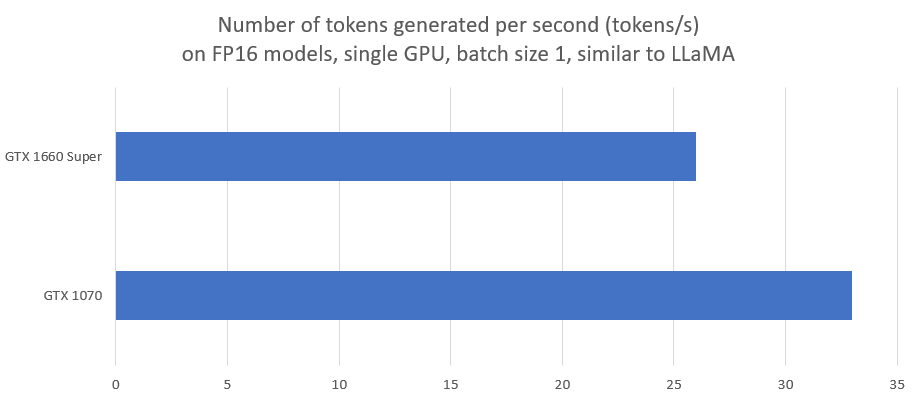
4K Gaming Performance
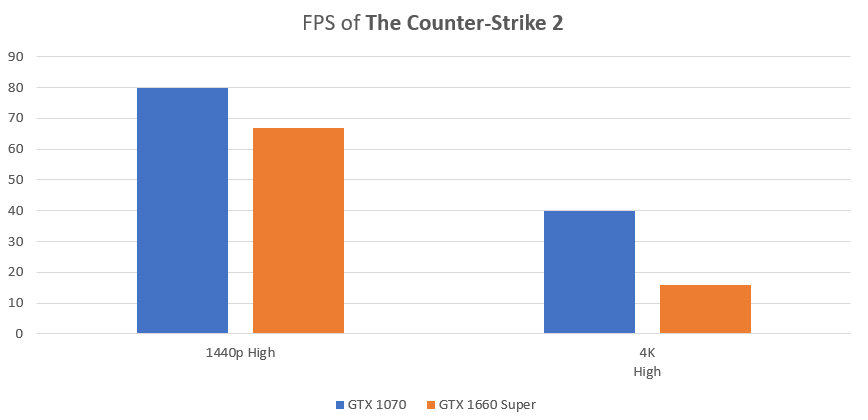
In Counter-Strike 2, a highly competitive shooter known for rapid action, dense smoke effects, and precise visibility mechanics, GPU performance strongly influences responsiveness and stability. Based on the provided data, at 1440p High settings, the GTX 1070 delivers around 80 FPS, while the GTX 1660 Super reaches roughly 67 FPS. Moving up to 4K High, the 1070 drops to about 40 FPS, compared to 16 FPS on the 1660 Super.
In Grand Theft Auto V, a large open-world title featuring dense cityscapes, long draw distances, dynamic weather, and heavy traffic simulation, GPUs are pushed consistently—especially at higher resolutions. Based on the provided data, at 1440p High settings, the GTX 1070 achieves around 230 FPS, while the GTX 1660 Super delivers roughly 220 FPS. Stepping up to 4K High, the 1070 reaches about 62 FPS, compared to 60 FPS on the 1660 Super..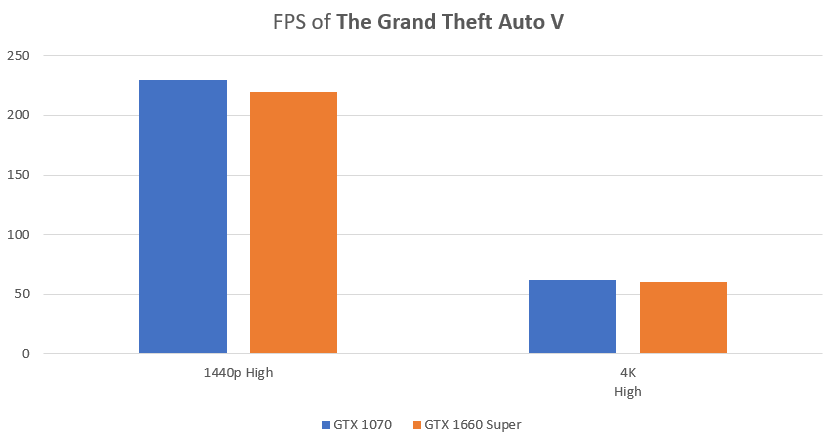
3D Rendering / Content Creation
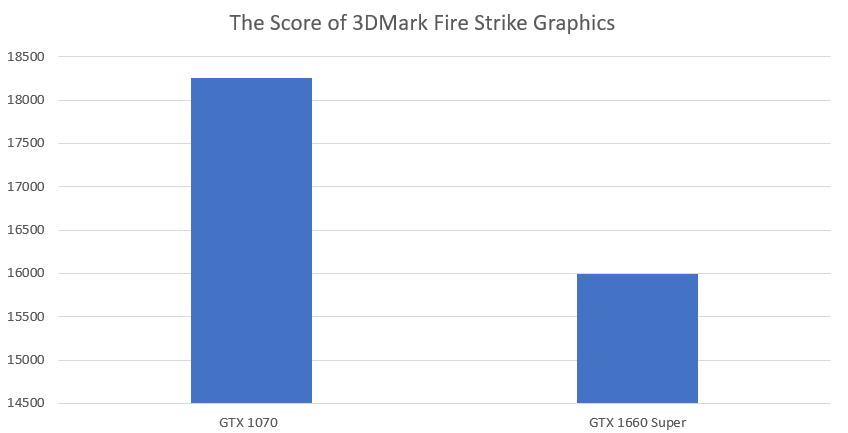
In 3DMark Fire Strike, a demanding DirectX 11 benchmark that stresses GPUs with dynamic particle effects, complex lighting, and high-detail character animations at 1080p, the performance gap between the two cards becomes clear. The GTX 1070 scores 18,255, noticeably ahead of the GTX 1660 Super at 15,995. This reflects the 1070’s stronger shader and compute capabilities, allowing it to handle Fire Strike’s heavy visual workload with greater ease, particularly in scenes involving intense effects and rapid motion.
Price & Value: GTX 1070 vs GTX 1660 Super
The GTX 1070 vs GTX 1660 Super shows a noticeable price gap across platforms. On Amazon and eBay, the GTX 1070 generally appears at lower used-market prices, while the GTX 1660 SUPER stays slightly higher thanks to its newer architecture and better efficiency. Overall, this comparison highlights that although the 1660 SUPER delivers stronger performance, the GTX 1070 remains a cost-effective choice for budget-focused 1080p gaming.
Price Comparison
| Platform | GTX 1070 | GTX 1660 SUPER | Price Difference (USD) | Price Difference (%) |
|---|---|---|---|---|
| Official MSRP | $379 | $229 | –$150 | –39.6% |
| eBay | ~$120–200 | ~$150–220 | ~+$30–40 | ~+20% |
| Amazon | ~$250–300 | ~$200–250 | ~–$50 | ~–20% |
User Value-for-Money Feedback
On aggregated benchmark platforms like UserBenchmark and GPU comparison sites such as Technical.City , the 1660 SUPER often shows a modest but consistent performance improvement over the 1070 — typically in the range of 5–15% depending on the test scenario.
In practical terms, this means the 1660 SUPER delivers slightly better frame rates in modern 1080p games, lower power consumption, and more efficient memory/shader performance. Meanwhile, the 1070 — although older — still offers respectable raw shader power and stable compute performance, particularly in workloads that benefit from its higher CUDA core count and memory bandwidth.
In short, GTX 1660 SUPER tends to deliver better value-for-money for modern gaming and efficiency-oriented builds, while GTX 1070 remains viable if you prioritize raw compute and want a stable, budget-friendly option in older or less demanding games.
GTX 1070 vs GTX 1660 Super – Pros & Cons
| GPU | Pros | Cons |
|---|---|---|
| GTX 1660 SUPER | ✅ Newer Turing-based efficiency (no RT/Tensor cores but modern SM design) ✅ Better performance-per-watt and lower power consumption vs 1070 ✅ Strong 1080p gaming performance with high FPS consistency ✅ Usually cheaper on the used market |
❌ Slightly weaker raw rasterization vs GTX 1070 ❌ No ray tracing or DLSS support (first-gen RT missing) ❌ Lower memory bandwidth (336 GB/s) despite using fast GDDR6 ❌ 6GB VRAM limits high-texture modern titles |
| GTX 1070 | ✅ Higher raw raster performance & compute capability (more CUDA cores) ✅ 8GB VRAM provides better headroom for modern games and large textures ✅ Solid 1440p gaming capability ✅ Broad compatibility and strong legacy driver support |
❌ Older Pascal architecture, less efficient than Turing ❌ Higher power draw (150–180W range) ❌ Performance can vary due to aging cards on the used market ❌ Often priced inconsistently (sometimes higher than 1660 SUPER) |
GTX 1070 vs GTX 1660 Super GPU Hosting
When comparing the GTX 1660 SUPER vs GTX 1070, the biggest differences come from architecture efficiency, power usage, and VRAM capacity. The GTX 1660 SUPER offers better performance-per-watt with its Turing architecture, while the GTX 1070’s higher memory bandwidth and 8GB VRAM make it stronger for texture-heavy games and higher-resolution workloads.
Although these GPUs are older and not typically found in modern cloud servers, users can still choose from a wide range of GPU server configurations at Database Mart, covering entry-level to advanced workloads. All servers include 99.9% uptime, and 24/7 professional support, ensuring stable and reliable performance for demanding tasks.
Conclusion
Both GPUs remain viable options in 2025, but they serve different types of users:
Choose the GTX 1660 SUPER GPU if you want better power efficiency, cooler operation, and smooth 1080p performance. Its newer Turing architecture offers improved performance-per-watt and more consistent frame times, making it a strong choice for budget gamers who want modern efficiency without excessive power draw.
Choose the GTX 1070 GPU if you need higher raw raster performance, more CUDA cores, and 8GB of VRAM for texture-heavy games or light creator workloads. Its larger memory buffer and higher bandwidth make it better suited for 1440p gaming, heavier AAA titles, and tasks that benefit from higher memory capacity.
While the GTX 1660 SUPER delivers excellent value and efficiency for mainstream gaming, the GTX 1070 maintains an advantage in memory-heavy and higher-resolution workloads, making it the better choice for users who prioritize raw performance and VRAM headroom.
1070 vs 1660 super, 1070 8gb vs 1660 super, 1070 price, 1660 super price, nvidia geforce rtx 1660 super, 1070 gpu, GTX 1070 GPU, GTX 1660 SUPER GPU, GTX 1070 vs GTX 1660 super