
RTX 3060 vs 3060 Ti – Which GPU Should You Choose for Gaming and Content Creation?
Compare the RTX 3060 and 3060 Ti and discover which GPU offers the best value for your needs—whether it’s smooth 1080p/1440p gaming, content creation, or everyday multitasking, this guide will help you choose the right card and get the best deals before you buy!
Summary Light of RTX 3060 & 3060 Ti
- Key Features: The RTX 3060 and RTX 3060 Ti are built on NVIDIA’s Ampere architecture, supporting real-time ray tracing and DLSS. The RTX 3060 comes with 12 GB GDDR6 VRAM and 3584 CUDA cores, offering solid 1080p and 1440p gaming performance and good support for light creative workloads. The RTX 3060 Ti features 8 GB GDDR6 VRAM and 4864 CUDA cores, delivering higher FPS and stronger performance, making it ideal for gamers and creators who prioritize frame rates and visual quality.
- Industries: These GPUs are widely used in gaming and eSports, digital content creation such as video editing and 3D rendering, AI/ML light workloads, and everyday multitasking or professional workstation applications.
- Popular Software: hey excel in popular games like Cyberpunk 2077, Call of Duty, Fortnite, and Minecraft RTX, as well as creative applications including Adobe Premiere Pro, DaVinci Resolve, Blender, and Autodesk Maya. They also support productivity and AI tools like Photoshop, Illustrator, and TensorFlow for lighter models.
RTX 3060 vs RTX 3060 Ti – Background Comparison
| Model | Brand | Series | Architecture | Release Year | Official Positioning | Current Market Price (Approx.) |
|---|---|---|---|---|---|---|
| RTX 3060 (8 GB / 12 GB) | NVIDIA | GeForce RTX 30 Series | Ampere | 2021 | Mid-range / Mainstream gaming card; ideal upgrade from GTX 1060 or older; brings Ampere features to most gamers | $330–$400 USD |
| RTX 3060 Ti (8 GB) | NVIDIA | GeForce RTX 30 Series | Ampere | 2020 | Upper mid-range / High-performance gaming card; stronger than 3060, aimed at gamers seeking higher FPS and better quality; also suitable for creative workloads | $400–$500 USD |
The RTX 3060 comes in 8 GB and 12 GB versions, offering a lower entry price for mainstream gaming, with the 12 GB variant suited for larger workloads. The RTX 3060 Ti has 8 GB of VRAM and a higher memory bandwidth, reflecting its stronger performance and higher price for gamers and creators seeking smoother FPS and more demanding tasks.
3060 vs 3060 Ti Specification Comparison
Core Specs: RTX 3060 vs 3060 Ti
| Specification | RTX 3060 (12 GB) | RTX 3060 (8 GB) | RTX 3060 Ti (8 GB) | Difference / Advantage |
|---|---|---|---|---|
| Architecture | Ampere | Ampere | Ampere | Same architecture |
| CUDA Cores | 3584 | 3584 | 4864 | 3060 Ti has 36% more cores → higher performance |
| Memory Type | GDDR6 | GDDR6 | GDDR6 | Same |
| Memory Capacity (VRAM) | 12 GB | 8 GB | 8 GB | 3060 Ti has less VRAM than 12 GB 3060, sufficient for most games |
| Memory Bus | 192-bit | 128-bit | 256-bit | Wider bus → 3060 Ti has higher memory throughput |
| Memory Bandwidth | 360 GB/s | 224 GB/s | 448 GB/s | 3060 Ti is faster → better for high-res textures and demanding tasks |
| Core Frequency (Boost) | 1777 MHz | 1777 MHz | 1665 MHz | Slightly lower, offset by more cores |
| TDP (Power) | 170 W | 170 W | 200 W | Higher TDP → needs better cooling, but higher performance |
| Interface / Bus | PCIe 4.0 x16 | PCIe 4.0 x16 | PCIe 4.0 x16 | Same |
| FP32 Performance | 12.7 TFLOPS | 12.7 TFLOPS | 16.2 TFLOPS | 3060 Ti ~ 27% faster FP32 performance |
| Ray Tracing / Tensor Cores | 28 / 112 | 28 / 112 | 38 / 152 | More cores → better RT & AI performance |
| PCIe Version | 4.0 | 4.0 | 4.0 | Same |
Key Differences: RTX 3060 vs RTX 3060 Ti
CUDA Cores:
The 3060 Ti has 36% more CUDA cores than the RTX 3060, providing significantly higher processing power and gaming performance.
Memory Capacity (VRAM):
The 3060 comes in 8 GB and 12 GB versions, while the 3060 Ti 8GB offers stronger overall performance, making it well-suited for most modern games and workloads.
Memory Bandwidth:
With 448 GB/s, the 3060 Ti has 24% higher bandwidth than the 12 GB 3060 (360 GB/s) and 100% higher than the 8 GB 3060 (224 GB/s), enabling faster data handling for high-res textures and demanding tasks.
FP32 Performance:
The 3060 Ti delivers 16.2 TFLOPS, ~ 27% more than the 3060’s 12.7 TFLOPS, resulting in smoother frame rates and better performance in demanding games and creative workloads.
RTX 3060 vs 3060 Ti Benchmark: Performance Across Different Scenarios
RTX 3060 Ti vs RTX 3060 Gaming Performance
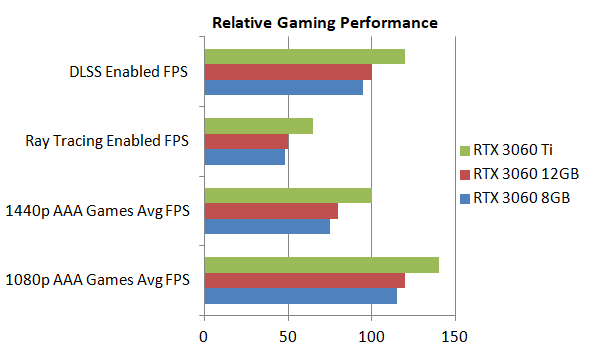
Across most benchmarks, the RTX 3060 Ti delivers 20–30% higher performance, giving it noticeably smoother gameplay and more headroom for modern titles. Meanwhile, the RTX 3060 12GB is 4–8% faster than the 8GB version, mainly helping in VRAM-heavy games.
1080p: The 3060 Ti is ~ 16% faster than the 3060 12GB and ~ 22% faster than the 8GB model, resulting in higher FPS in competitive titles and fewer dips during action-heavy moments.
1440p: At this resolution, the 3060 Ti’s 25–33% lead becomes more visible, allowing it to maintain stable 60–100+ FPS in many AAA games.
The 3060 12GB’s ~8% advantage over the 8GB version helps avoid VRAM-related stutters in newer titles.
Ray Tracing: With a 30–45% advantage, the 3060 Ti handles ray tracing noticeably better, keeping playable frame rates without relying heavily on DLSS.
The 12GB model’s ~5% uplift over 8GB helps prevent VRAM saturation when RT is enabled.
DLSS: Even with DLSS boosting all three GPUs, the 3060 Ti still leads by 15–28%, giving it enough performance to push higher resolutions or quality modes.
The 12GB version remains ~5% ahead of the 8GB, offering slightly more consistency in DLSS Quality mode.
Video Editing / 3D Rendering
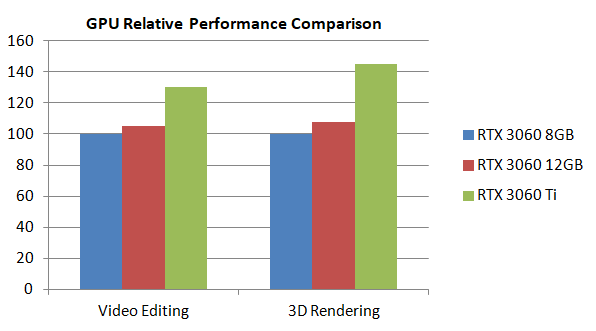
RTX 3060 (8GB) vs 3060 (12GB): The 3060 12GB delivers ~5–8% better performance than the 8GB version, offering smoother playback, faster timeline handling, and more stability when working with high-resolution video and complex 3D projects.
RTX 3060 (12GB) vs 3060 Ti: The 3060 Ti outperforms the 12GB by 25–45%, providing faster exports, smoother timeline performance, and significantly improved efficiency in 3D rendering and GPU-accelerated tasks.
Price & Value: 3060 vs 3060 ti
| Platform | RTX 3060 8GB (USD) | RTX 3060 12GB (USD) | RTX 3060 Ti (USD) | Price Difference: 3060 12GB vs 3060 8GB (%) | Price Difference: 3060 Ti vs 3060 12GB (%) |
|---|---|---|---|---|---|
| Official MSRP | $329 | $349 | $399 | +6% | +14% |
| Amazon | $280–$330 | $300–$360 | $380–$430 | +7–12% | +19–27% |
| Third-Party Resellers (eBay etc.) | $250–$340 | $290–$380 | $360–$420 | +12–20% | +11–24% |
The RTX 3060 price generally sits in the low-to-mid $300 range, with the 12GB model costing about 6–12% more than the 8GB version. This small increase mainly reflects the added VRAM.
Meanwhile, the 3060 Ti price is typically 14–27% higher than the RTX 3060 12GB, but the performance uplift makes it a stronger value for gamers and creators who need more power.
3060 vs 3060 12GB vs 3060 Ti – Pros & Cons
| Model | Pros | Cons |
|---|---|---|
| RTX 3060 (8GB) | - Lowest price, great entry-level option for budget gamers. - Good efficiency for 1080p gaming and eSports titles. - Widely available in the used and new markets. |
- 8GB VRAM can be limiting in modern AAA titles. - Noticeably weaker performance in 1440p and ray tracing workloads. - Not ideal for GPU-accelerated 3D or AI tasks. |
| RTX 3060 (12GB) | - Extra VRAM improves stability in AAA games and large-texture workloads. - Better performance headroom for 1080p/1440p gaming vs. 8GB model. - More suitable for light content creation and rendering tasks. |
- Slightly higher price than the 8GB version (6–12% depending on market). - Still not a major leap in raw performance vs. 3060 8GB. - Can struggle with heavy ray tracing without DLSS. |
| RTX 3060 Ti (8GB) | - Clear performance upgrade over both 3060 versions (20–35% faster). - Ideal for high-FPS 1080p & smooth 1440p AAA gaming. - Much stronger for 3D rendering and GPU compute workloads. |
- Higher upfront cost (typically 14–27% above 3060 12GB). - 8GB VRAM may be limiting for future AI and 3D workloads. - Runs hotter and consumes more power. |
Overall, the RTX 3060 8GB and 12GB deliver good mid-range value, with the 12GB model offering smoother performance in VRAM-heavy tasks. The RTX 3060 Ti, however, clearly leads with stronger 3060 Ti specs and consistently higher scores in most RTX 3060 Ti benchmark tests. Even with the same 3060 Ti VRAM capacity as the 3060 8GB, its superior GPU architecture makes it the best choice for high-FPS gaming and faster rendering workloads.
RTX 3060 Ti Server Hosting
“3060 Ti hosting” means renting cloud servers powered by NVIDIA RTX 3060 Ti GPUs, letting you run heavy workloads without buying or maintaining hardware. Database Mart offers stable RTX 3060 Ti servers with 99.9% uptime, strong multi-core CPUs, and fast NVMe storage—ideal for gaming, video editing, 3D rendering, AI image generation, and other GPU-intensive tasks.
Compared to a local PC, hosting cuts hardware costs, electricity, and maintenance while providing easy remote access and scalability. Database Mart also supports 1× RTX 3060 Ti, 2× RTX 3060 Ti, and 3× RTX 3060 Ti configurations, allowing users to choose the right GPU power for any workflow.
Conclusion
In the end, the difference between 3060 and 3060 Ti comes down to performance, efficiency, and workload needs. The RTX 3060 (8GB/12GB) is a solid choice for 1080p gaming and everyday creative tasks, while the RTX 3060 Ti delivers a noticeable jump in FPS, faster rendering, and better stability for heavier workloads or 1440p gaming. Understanding these differences makes it easier to choose the GPU that fits your budget and performance goals, whether for gaming, content creation, or professional use.
3060 vs 3060 ti, RTX 3060 vs RTX 3060 Ti, RTX 3060 vs 3060 Ti, rtx 3060 ti vs rtx 3060, 3060 ti specs, 3060 ti price, rtx 3060 price, 3060 ti vram, 3060 ti 8gb, rtx 3060 ti benchmark, nvidia geforce rtx 3060 ti 8gb, difference between 3060 and 3060 ti