
RTX 4060 vs RTX 5060: Which GPU Wins the Battle?
In this detailed comparison of RTX 4060 vs RTX 5060, we take a closer look at how NVIDIA’s next-gen 5060 GPU stacks up against the proven 4060 GPU. From architecture improvements and ray tracing capabilities to AI-powered rendering, the new generation promises noticeable advancements in efficiency and performance.
Through real-world 4060 benchmark and 5060 benchmark results, we uncover how each GPU performs across gaming and creative workloads. We also break down the RTX 4060 price and RTX 5060 price to help you determine which card offers the best balance between performance and value. Whether you're exploring 4060 Specs or 5060 Specs, this 5060 vs 4060 guide gives you everything you need before upgrading.
RTX 4060 vs RTX 5060 – Background Comparison
| Brand | Series | Model | Release Year | Official Positioning | Market Price (USD) |
|---|---|---|---|---|---|
| NVIDIA | GeForce | RTX 4060 | 2023 | Game, stream, create. The GeForce RTX 4060 let you take on the latest games and apps with the ultra-efficient NVIDIA Ada Lovelace architecture. Experience immersive, AI-accelerated gaming with ray tracing and DLSS 3, and supercharge your creative process and productivity with NVIDIA Studio. | $299 |
| NVIDIA | GeForce | RTX 5060 | 2025 | The NVIDIA® GeForce RTX 5060, powered by the NVIDIA Blackwell architecture, enables game-changing AI capabilities in the latest games and apps. Multiply performance with NVIDIA DLSS 4, enjoy realistic graphics with ray tracing, and take your creativity further with NVIDIA Studio. | $299 |
NVIDIA RTX 4060 vs RTX 5060 – Specifications Comparison
Since its release, the RTX 5060 has established itself as a powerful mid-to-high-end GPU, offering faster GDDR7 memory, higher CUDA core counts, and improved FP32 performance compared to the RTX 4060. While the 4060 features GDDR6 memory, fewer shading units, and a lower TDP (~115 W), the RTX 5060’s Blackwell architecture delivers superior ray tracing, AI acceleration, and enhanced rasterization performance, making it better suited for high-resolution gaming, demanding rendering, and AI-intensive workloads.
Despite its higher power consumption (~145 W), the RTX 5060 excels in next-generation features, including advanced RT and Tensor cores, DLSS 4, and PCIe 5.0 support. Meanwhile, the RTX 4060 provides a solid, energy-efficient option for mainstream gaming and creative tasks.
In short, the RTX 5060 targets users seeking maximum performance and future-proof features, while the RTX 4060 appeals to those prioritizing efficiency and value.
Core Specs Comparison between RTX 4060 vs RTX 5060
| Parameter | RTX 4060 | RTX 5060 |
|---|---|---|
| Architecture | Ada Lovelace | Blackwell |
| CUDA Cores | 3,072 | 3,840 |
| Memory Type | 8 GB GDDR6 | 8 GB GDDR7 |
| Memory Capacity | 8 GB | 8 GB |
| Memory Bus Width | 128-bit | 128-bit |
| Memory Bandwidth | ~272 GB/s | ~448 GB/s |
| Core Frequency (Boost) | ~2.46 GHz | ~2.50 GHz |
| TDP (Power) | ~115 W | ~145 W |
| Interface / Bus | PCIe 4.0 x8 | PCIe 5.0 x8 |
| FP32 Performance | ~15.1 TFLOPS | ~19.2 TFLOPS |
| Ray Tracing / Tensor Cores | 3rd-Gen RT Cores, 4th-Gen Tensor Cores | 4th-Gen RT Cores, 5th-Gen Tensor Cores |
| PCIe Version | PCIe 4.0 | PCIe 5.0 |
Key Differences: RTX 4060 vs RTX 5060
Architecture
– RTX 4060 uses Ada Lovelace, while RTX 5060 uses Blackwell. Blackwell brings newer RT and Tensor cores, higher CUDA core count, and improved FP32 performance, resulting in better ray tracing, AI acceleration, and compute throughput.
Core Frequency (Boost)
– Both cards have similar boost clocks (~2.46–2.50 GHz), but RTX 5060 achieves higher parallel compute performance due to 3,840 CUDA cores vs 3,072 in the 4060, enabling faster rendering and gaming performance.
Memory Type, Bandwidth & Capacity
– Both cards have 8 GB VRAM with a 128-bit bus. RTX 4060 uses GDDR6 ( ~272 GB/s), whereas RTX 5060 uses GDDR7 ( ~448 GB/s). The faster memory and higher bandwidth of RTX 5060 significantly improve high-resolution gaming, ray tracing, and data-intensive tasks.
TDP / Power Consumption
– RTX 4060 consumes ~115 W vs RTX 5060’s ~145 W. The higher power allows RTX 5060 to reach higher sustained performance levels.
Ray Tracing / AI Acceleration
– RTX 4060 features 3rd-gen RT cores and 4th-gen Tensor cores. RTX 5060 features 4th-gen RT and 5th-gen Tensor cores, enabling faster and more efficient ray tracing, DLSS, and AI tasks.
Advanced Features & Performance Comparison
| Parameter | RTX 4060 | RTX 5060 | Difference / Advantage |
|---|---|---|---|
| Memory Speed | 17 Gbps | 28 Gbps | Faster memory increases bandwidth and improves high-resolution gaming and ray tracing |
| Memory Bandwidth | 272 GB/s | 448 GB/s | ~65% higher bandwidth accelerates textures, rendering, and AI tasks |
| Shading / TMU Units | Lower count | Higher count | More shading units improve rasterization and compute performance |
| DLSS / AI Features | DLSS 3 | DLSS 4 + AI frame generation | Newer AI tech boosts frame rates and visual fidelity |
| Real-World Performance | Baseline | ~20–30% faster | Significant uplift in gaming, creative, and AI workloads |
The RTX 4060 vs RTX 5060 comparison shows a clear performance leap. The 4060 uses GDDR6 ( ~17 Gbps) with ~272 GB/s bandwidth, fewer shading units, and supports DLSS 3, handling mainstream gaming and creative tasks well. The 5060, with faster GDDR7 ( ~28 Gbps), ~448 GB/s bandwidth, more shading units, and DLSS 4, delivers significantly higher rasterization, ray tracing, and AI performance. Overall, 5060 vs 4060 offers roughly 20–30% better real-world performance, making the 5060 ideal for high-resolution gaming and demanding workloads.
RTX 4060 vs RTX 5060 Performance Across Different Scenarios
AI / Deep Learning Performance Comparison
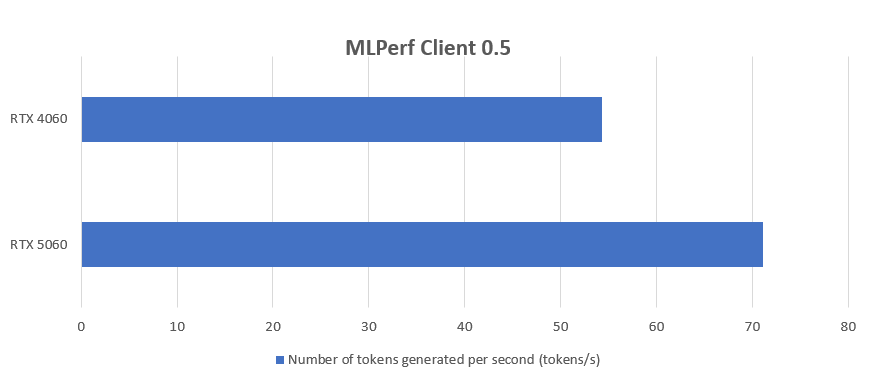
Under the MLPerf Client 0.5 benchmark, the RTX 5060 outperforms the RTX 4060 in AI inference, delivering 71.1 tokens/sec versus 54.3, a 31% gain. Thanks to Ada Lovelace architecture improvements—higher CUDA core density, better Tensor efficiency, and faster memory—the 5060 processes neural networks faster with lower latency.
4K Gaming Performance
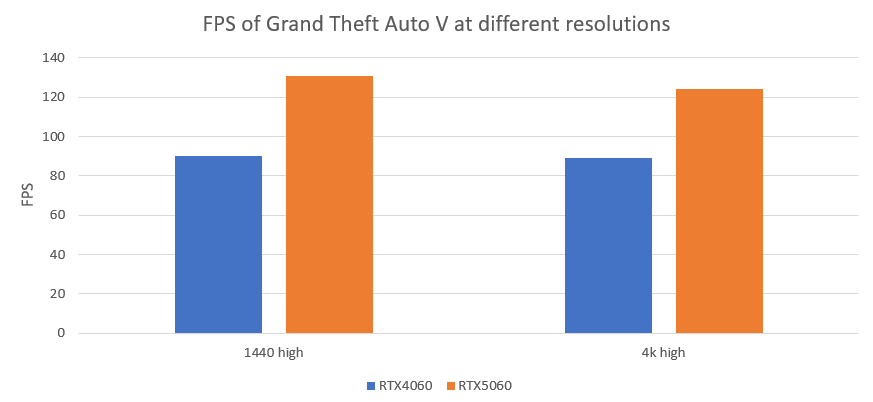
Grand Theft Auto V tests GPUs with vast open-world scenes, dense traffic, and complex lighting effects. Both the RTX 4060 and RTX 5060 handle 1440p and 4K Ultra settings well, but the RTX 5060 pulls ahead thanks to its higher CUDA core count, improved memory bandwidth, and enhanced ray tracing support. At 1440p, it achieves 131 FPS versus the 4060’s 90 FPS, and at 4K, 124 FPS versus 89 FPS, delivering noticeably smoother gameplay in crowded, high-detail scenes.
In Metro Exodus, with its demanding global illumination and ray-traced effects, both cards remain playable, but the RTX 5060 again leads. At 1440p, it hits 80 FPS versus the 4060’s 63 FPS, and at 4K, 50 FPS versus 38 FPS. The architectural improvements of the 5060 allow it to process complex shaders and lighting more efficiently, giving players a more fluid experience even at ultra settings.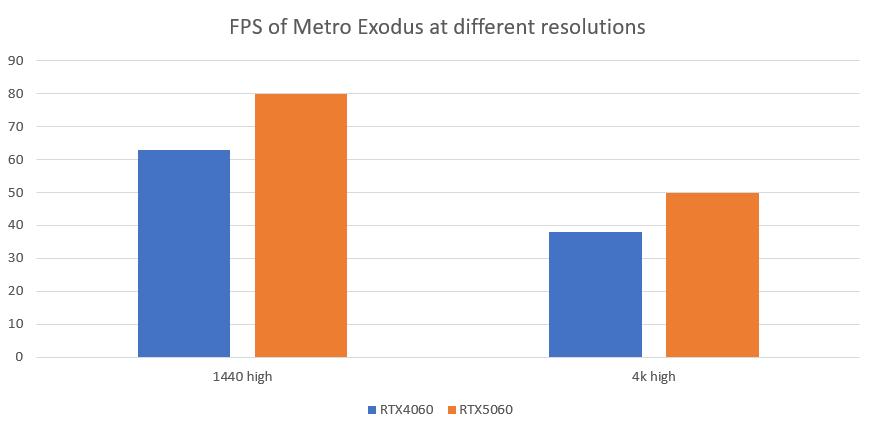
3D Rendering / Content Creation
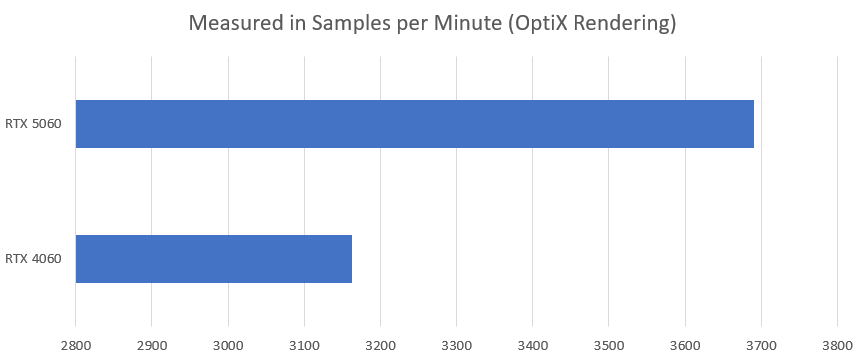
The RTX 5060 outpaces the RTX 4060 in Blender rendering workloads. With its enhanced shader performance and improved architecture, the RTX 5060 delivers approximately 17% faster real-time render throughput, achieving 3,691 samples per minute compared to the RTX 4060’s 3,163. This improvement comes without an increase inOptiX acceleration continues to be a major advantage for NVIDIA creators, ensuring smoother and more responsive 3D rendering performance.
Price & Value: RTX 5060 vs RTX 4060
The RTX 5060 vs RTX 4060 shows a clear price difference across platforms. On Amazon, the RTX 5060 price is $290, slightly above the RTX 4060 price at $289. On eBay, the gap widens with the RTX 5060 listed at $482.80 versus $395.99 for the RTX 4060. This 4060 vs 5060 comparison highlights that while both GPUs share similar MSRP, the secondary market and platform-specific pricing create notable differences for gamers and creators seeking cost-effective options.
Price Comparison
| Platform | RTX 4060 (USD) | RTX 5060 (USD) | Price Difference (USD) | Price Difference (%) |
|---|---|---|---|---|
| Official MSRP | $299 | $299 | $0 | 0% |
| Amazon | $289 | $290 | +$1 | +0.3% |
| eBay | $395.99 | $482.80 | +$86.81 | +22% |
User Value-for-Money Feedback
On UserBenchmark, the RTX 4060 shows strong consistency in its results across multiple runs—its score range is notably narrow.
Meanwhile, the RTX 5060 records an average result of about 61.2% of the benchmark leader (based on UserBenchmark’s data).
On Technical.City, the RTX 4060 records an aggregate performance score of approximately 44.23 (on their 0‑100 scale), whereas the RTX 5060 scores around 47.31, representing roughly a 7 % uplift.
In real‑world usage and user feedback, this translates to the RTX 5060 offering marginally higher performance, slightly better future‑proofing (via newer architecture/features), and incremental gains in ray tracing and AI tasks. The RTX 4060, on the other hand, remains a more value‑oriented option, delivering solid performance with lower investment.
RTX 5060 vs RTX 4060 – Pros & Cons
| GPU | Pros | Cons |
|---|---|---|
| RTX 5060 | ✅ Slightly higher performance than 4060 in gaming and creative workloads (5060 benchmark) ✅ Supports newer features and improved ray tracing / AI acceleration ✅ Future-proof architecture for upcoming titles ✅ Compact design for easier installation |
❌ Higher market price ($290–$482.80), may be costly for budget users ❌ 8GB VRAM may limit very high VRAM workloads ❌ Limited availability in some regions ❌ Incremental performance gains over 4060 may not justify price for casual users |
| RTX 4060 | ✅ Solid performance for 1080p/1440p gaming (4060 benchmark) ✅ More budget-friendly ($289–$395.99) ✅ Lower power consumption for energy efficiency ✅ Compact form factor, easier for small builds |
❌ Lower performance than 5060 for demanding tasks ❌ Older or fewer next-gen features compared to 5060 ❌ Limited future-proofing for very high-end gaming ❌ 8GB VRAM may be restrictive for large datasets or heavy AI workloads |
RTX 4060 vs RTX 5060 GPU Hosting
When comparing the RTX 4060 vs RTX 5060, the differences are most noticeable in gaming and AI workloads. The RTX 5060 offers higher framerates in demanding games at 1080p and 1440p, improved ray tracing performance, and faster AI training and inference, making it ideal for creators and developers who need extra computing power. The RTX 4060 provides solid performance for mid-range gaming and lighter AI tasks, delivering reliable 4060 benchmark results at a lower cost.
With Database Mart, you can access RTX 4060 and RTX 5060 through dedicated servers without the hassle of hardware management. Enjoy scalable single- or multi-GPU setups, 99.9% uptime, and 24/7 professional technical support, letting you focus entirely on your projects.
Conclusion
Both GPUs remain strong contenders in 2025, but they cater to different priorities:
Choose the RTX 5060 GPU if you want higher gaming framerates at 1080p/1440p, faster AI training and inference, and slightly improved ray tracing performance for demanding workloads. Its newer architecture and incremental performance gains make it suitable for creators, developers, and gamers who need extra computing power and future-proof features.
Choose the RTX 4060 GPU if you’re looking for a more budget-friendly option with solid mid-range gaming performance, reliable 4060 benchmark results, and efficient AI capabilities for lighter workloads. It’s ideal for gamers and developers who want good performance without overspending.
While the RTX 4060 offers strong value and efficiency, the RTX 5060 delivers measurable gains in gaming and AI performance, making it the better choice for users who prioritize raw speed and future-proofing.
rtx 4060 vs rtx 5060, 5060 vs 4060, 4060 vs 5060, RTX 4060 vs RTX 5060, rtx 5060 price, rtx 4060 price, 4060 gpu, 5060 gpu, 5060 benchmark, 4060 benchmark, 4060 Specs, 5060 Specs