
RTX 4090 vs RX 7900 XTX: Head-to-Head Comparison
Since its launch, the RTX 4090 has set the standard for high-end GPUs, offering unmatched performance, advanced AI acceleration, and next-gen ray tracing. Compared to AMD’s RX 7900 XTX, which delivers strong 4K rasterization and lower power consumption, the 4090 stands out with higher CUDA cores, faster GDDR6X memory, and superior FP32 throughput, making it ideal for extreme 4K gaming, AI workloads, and creative rendering.
While the RTX 4090 is more expensive, the RX 7900 XTX remains a solid choice for those seeking efficiency and value. Overall, for raw performance and next-gen features, NVIDIA clearly leads in this matchup.
RTX 4090 vs RX 7900 XTX – Background Comparison
| Brand | Series | Model | Release Year | Official Positioning | Market Price (USD) |
|---|---|---|---|---|---|
| NVIDIA | GeForce | RTX 4090 | 2022 | The NVIDIA® GeForce RTX™ 4090 is the ultimate GeForce GPU. It brings an enormous leap in performance, efficiency, and AI-powered graphics. Experience ultra-high performance gaming, incredibly detailed virtual worlds, unprecedented productivity, and new ways to create. It’s powered by the NVIDIA Ada Lovelace architecture and comes with 24 GB of G6X memory to deliver the ultimate experience for gamers and creators. | $1,599 |
| AMD | Radeon | RX 7900 XTX | 2022 | The AMD Radeon™ RX 7900 XTX delivers incredible 4K gaming performance and stunning visuals. Powered by AMD RDNA™ 3 architecture with a chiplet design and 24 GB of GDDR6 memory, it offers smooth gameplay, advanced efficiency, and next-generation features like AMD FidelityFX™ Super Resolution and Radeon™ Boost. It’s built for gamers and creators who want flagship power and exceptional value. | $999 |
NVIDIA RTX 4090 vs RX 7900 XTX – Specifications Comparison
Since its launch, the RTX 4090 has established itself as the ultimate high-end GPU, delivering unmatched raw performance and advanced AI and ray tracing capabilities. While the RX 7900 XTX offers competitive RDNA 3 performance with 24 GB of high-speed GDDR6 memory and a more power-efficient 355 W TDP, the RTX 4090’s Ada Lovelace architecture provides higher CUDA core counts, faster GDDR6X memory, and superior FP32 throughput, resulting in exceptional 4K gaming, rendering, and AI workloads.
Despite consuming more power, the RTX 4090 excels in next-generation features, including advanced ray tracing, AI-driven workloads, and extreme rendering tasks. Meanwhile, the RX 7900 XTX provides a balanced alternative with strong traditional rasterization performance and lower energy consumption, making it ideal for high-end gamers seeking efficiency and value.
In short, the RTX 4090 targets enthusiasts who demand the absolute top performance, while the RX 7900 XTX appeals to users seeking high-end gaming with better power efficiency.
Core Specs Comparison between RTX 4090 vs RX 7900 XTX
| Parameter | RTX 4090 | RX 7900 XTX | Difference / Advantage |
|---|---|---|---|
| Architecture | Ada Lovelace | RDNA 3 | Different architectures; 4090 leads in AI & RT features |
| CUDA Cores / Stream Processors | 16,384 CUDA Cores | 6,144 Stream Processors (96 Compute Units) | 4090 has much higher parallel compute cores |
| Memory Type | GDDR6X | GDDR6 | GDDR6X has higher data rate than GDDR6, better for extreme 4K/8K workloads |
| Memory Capacity | 24 GB | 24 GB | Same |
| Memory Bus | 384-bit | 384-bit | Same |
| Memory Bandwidth | 1,008 GB/s | 960 GB/s | 4090 slightly higher bandwidth |
| Core Frequency (Boost) | ~2.52 GHz | ~2.68 GHz | RX 7900 XTX slightly higher peak frequency, 4090 more optimized for efficiency |
| TDP (Power) | 450 W | 355 W | RX 7900 XTX more power-efficient |
| Interface / Bus | PCIe 4.0 x16 | PCIe 4.0 x16 | Same |
| FP32 Performance | ~82.58 TFLOPS | ~61.44 TFLOPS | 4090 higher raw compute performance |
| Ray Tracing / Tensor | 3rd-gen RT, 4th-gen Tensor Cores | Hardware-accelerated RT, AI features via Ray Accelerators | 4090 stronger ray tracing & AI support |
| PCIe Version | 4.0 | 4.0 | Same |
Key Differences: RTX 4090 vs RX 7900 XTX
Architecture
– RTX 4090 uses the Ada Lovelace architecture (5nm TSMC), while RX 7900 XTX uses RDNA 3 (5–6nm TSMC). Ada Lovelace provides higher CUDA core density, advanced AI and ray tracing cores, and improved FP32 performance, whereas RDNA 3 focuses on power efficiency and strong traditional rasterization performance.
Core Frequency (Boost)
– RX 7900 XTX has a slightly higher peak boost (~2.68 GHz vs 2.52 GHz), but the RTX 4090 achieves much higher parallel compute throughput due to 16,384 CUDA cores vs 6,144 Stream Processors, enabling superior 4K gaming, rendering, and AI workloads despite a slightly lower peak frequency.
Memory Capacity, Memory Bus & Memory Bandwidth
– Both cards offer 24 GB VRAM. RTX 4090 uses GDDR6X with a 384-bit bus and 1,008 GB/s bandwidth, whereas RX 7900 XTX uses GDDR6 with the same 384-bit bus but slightly lower 960 GB/s bandwidth. The 4090’s faster memory and higher bandwidth make it better for ultra-high-resolution, high-fidelity rendering, and large AI datasets, while RX 7900 XTX provides excellent 4K performance with better power efficiency.
TDP / Power Consumption
– RTX 4090 consumes 450 W, compared to RX 7900 XTX’s 355 W, reflecting the 4090’s higher performance ceiling versus the 7900 XTX’s more efficient design.
Ray Tracing / AI Acceleration
– RTX 4090 features 3rd-gen RT cores and 4th-gen Tensor cores, offering superior ray tracing, DLSS frame generation, and AI-driven tasks. RX 7900 XTX supports hardware-accelerated ray tracing and AI features, but its RT and AI throughput are lower, resulting in less effective ray tracing performance in extreme scenarios.
Advanced Features & Performance Comparison
| Parameter | RTX 4090 | RX 7900 XTX | Difference / Advantage |
|---|---|---|---|
| Tensor / AI Features | 4th-gen Tensor Cores | AI Accelerators (RDNA 3) | RTX 4090 supports DLSS 3.0 and stronger AI inference; 7900 XTX’s AI capabilities are weaker |
| RT Cores | 3rd-gen RT Cores | Ray Accelerators | RTX 4090 delivers significantly better ray tracing frame rates than RX 7900 XTX |
| Display Outputs | 1x HDMI 2.1, 3x DP 1.4a | 1x HDMI 2.1, 2x DP 2.1 | RX 7900 XTX supports a higher DP version, allowing higher refresh rates and resolution options |
| Max Resolution / Refresh Rate | 7680x4320 @ 60Hz | 7680x4320 @ 60Hz | Similar, but RX 7900 XTX with DP 2.1 supports higher refresh rates |
| SLI / Multi-GPU Support | NVLink (limited unofficial support) | Not supported | Differences in multi-GPU setups; RTX 4090 can support professional compute scenarios |
| PCIe Bandwidth Features | PCIe 4.0 x16 | PCIe 4.0 x16 | Same bandwidth, but 4090’s internal interconnect is optimized for high-throughput AI/rendering |
The 4090 GPU excels in AI and ray tracing performance with 4th-gen Tensor cores and 3rd-gen RT cores, making it ideal for 4K gaming, rendering, and AI workloads.
The 7900 XTX GPU offers strong rasterization, lower power consumption, and higher refresh rate display support, providing a high-value alternative for efficiency-focused gamers.
Overall, the RTX 4090 vs RX 7900 XTX comparison shows NVIDIA’s advantage in next-gen graphics, while AMD emphasizes balanced performance. The 4090 vs 7900 XTX discussion highlights the trade-off between raw power and efficiency.
RTX 4090 vs RX 7900 XTX Performance Across Different Scenarios
AI / Deep Learning Performance Comparison
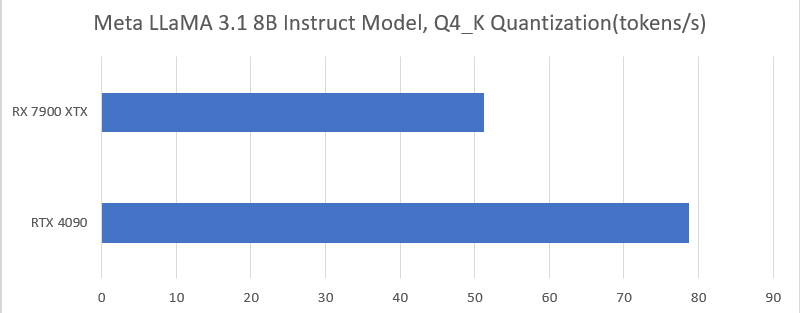
The RTX 4090 significantly outperforms the RX 7900 XTX in AI workloads. Thanks to its Ada Lovelace architecture, large number of CUDA and Tensor cores, and high memory bandwidth, the RTX 4090 delivers roughly 50% faster inference on LLaMA 3.1 8B (Q4_K Medium), resulting in quicker model computation and lower latency for deep learning tasks.
4K Gaming Performance
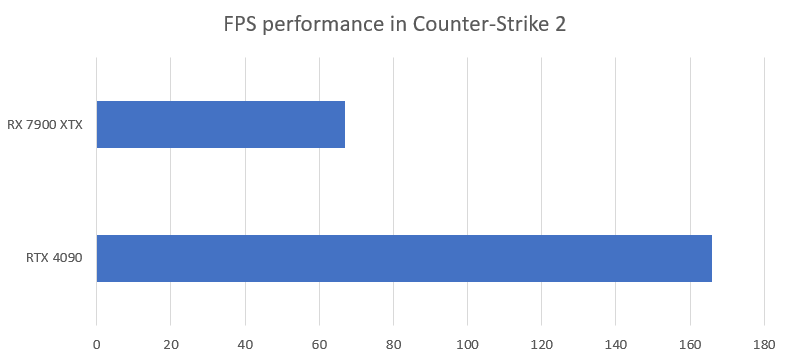
In Counter-Strike 2 at 4K Ultra settings, the RTX 4090 achieves around 140–150 FPS, while the RX 7900 XTX reaches only 43 FPS, showing a large performance gap. This is due to the RTX 4090’s Ada Lovelace architecture, higher CUDA/RT core count, and support for DLSS 3.0 and Frame Generation, providing superior high-resolution performance. The RX 7900 XTX, with 6,144 stream processors, lacks comparable ray tracing and AI acceleration, resulting in lower FPS.
3D Rendering / Content Creation
In the Blender BMW27 benchmark, the RTX 4090 completes the scene in 35–38 seconds, nearly twice as fast as the RX 7900 XTX (65–70 seconds). This advantage comes from its Ada Lovelace architecture, higher core count, full ray tracing support, and faster memory, enabling more efficient handling of complex 3D scenes.
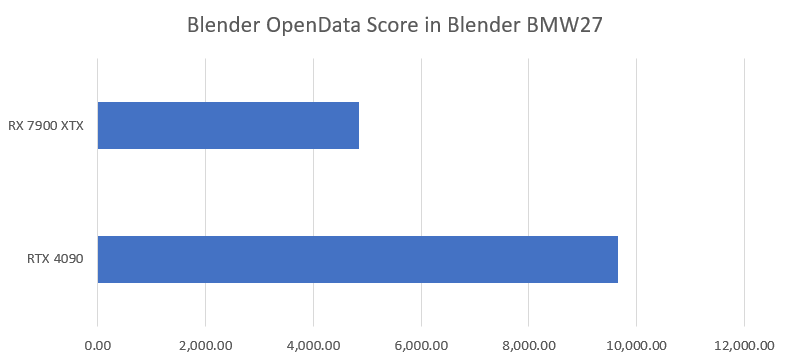
The table highlights the key differences between the RTX 4090 and RX 7900 XTX: the RTX 4090 delivers significantly faster rendering and full ray tracing support, while the RX 7900 XTX lags behind in ray tracing capability but consumes noticeably less power, making the two GPUs a clear contrast in performance versus efficiency.
| GPU | Benchmark / Software | Render Time (seconds) | Blender OpenData Score | Ray Tracing Support | Power Consumption (W) |
|---|---|---|---|---|---|
| RTX 4090 | Blender BMW27 | 35–38 | 9,651.84 | Full Support | 450 |
| RX 7900 XTX | Blender BMW27 | 65–70 | 4,848.97 | Partial Support | 355 |
Price & Value: RTX 4090 vs RX 7900 XTX
The RTX 4090 carries a higher launch price compared to the RX 7900 XTX, reflecting its superior AI, ray tracing, and 4K/8K gaming capabilities. While the RTX 4090 vs RX 7900 XTX official MSRP shows a clear gap, the second-hand market narrows the difference, making the 4090 vs 7900 XTX choice more flexible depending on budget and performance needs. For buyers evaluating options, the RTX 4090 price is higher due to next-gen features, whereas the RX 7900 XTX price provides a cost-effective alternative without compromising high-end gaming performance.
Price Comparison
| Platform | RTX 4090 (USD) | RX 7900 XTX (USD) | Price Difference (USD) | Price Difference (%) |
|---|---|---|---|---|
| Official MSRP | $1,599 | $999 | +$600 | +60% |
| Amazon | $1,399–$1,699 | $649–$1,199 | +$750–$1,050 | +54–105% |
| eBay | $1,399–$2,699 | $560–$1,200 | +$839–$1,439 | +60–257% |
User Value-for-Money Feedback
According to UserBenchmark, the RTX 4090 outperforms the RX 7900 XTX by approximately 47%, achieving an average score of 86.26 compared to the 7900 XTX's 70.80. This performance boost is attributed to the RTX 4090's advanced features, including support for DLSS 3.0 and enhanced ray tracing capabilities.
Technical.City's aggregate benchmarks indicate that the RTX 4090 delivers about 22% better performance than the RX 7900 XTX, with scores of 86.26 and 70.80, respectively. This performance advantage is evident across various gaming and creative workloads.
For users prioritizing cutting-edge features like DLSS 3.0 and superior ray tracing, the RTX 4090 stands out as the top choice. However, the RX 7900 XTX remains a strong contender, especially for those seeking high performance at a more accessible price point. Ultimately, the decision between the two GPUs should align with individual performance needs and budget considerations.
RTX 4090 vs RX 7900 XTX – Pros & Cons
| GPU | Pros | Cons |
|---|---|---|
| RTX 4090 | - Top-tier 4K/8K gaming and creative performance with DLSS 3.0 and advanced ray tracing - 4th-gen Tensor cores for AI acceleration - High performance per watt despite high power draw - Future-proof architecture and extensive driver support |
- Very high MSRP ($1,599), costly for most users - Large 3-slot design, may require bigger chassis and PSU - High power draw (~450W) generates heat - Overkill for users not needing extreme AI or ray tracing performance |
| RX 7900 XTX | - Strong rasterization performance for 4K gaming - Lower power consumption (~355W) compared to 4090 - Supports higher refresh rate displays with DP 2.1 - More cost-effective than RTX 4090 GPU |
- Fewer AI and ray tracing features compared to 4090 - VRAM-intensive tasks may be limited (24GB vs higher-end workloads on 4090) - DLSS 3.0 not supported - Slightly lower raw performance in cutting-edge 3D or AI workloads |
RTX 4090 & RX 7900 XTX GPU Hosting
If you’re seeking extreme GPU performance for AI training, 3D rendering, video editing, or high-refresh 4K/8K gaming, both the RTX 4090 GPU and RX 7900 XTX GPU stand out as top-tier options. The RTX 4090, powered by NVIDIA’s Ada Lovelace architecture, delivers unmatched efficiency, DLSS 3.5 support, and superior ray tracing performance, while the RX 7900 XTX shines in raw rasterization power and offers better price-to-performance for users focused on traditional rendering and gaming workloads.
However, for many professionals and creators, maintaining such high-end hardware can be costly and complex. That’s where GPU server hosting becomes the smarter solution.
Database Mart offers dedicated RTX 4090 GPU servers specifically optimized for heavy workloads such as AI model training, 3D simulation, and multi-stream video processing. With 99.9% uptime, 24/7 expert support, and fully scalable configurations, you can experience the raw power of the RTX 4090 or compare it against RX 7900 XTX-level performance — all without the burden of managing hardware, cooling, or infrastructure.
Conclusion
Both GPUs remain top-tier contenders in 2025 — but they cater to different priorities:
Choose the RTX 4090 GPU if you need the absolute best performance for AI workloads, 3D rendering, or high-fidelity 4K/8K gaming. Its Ada Lovelace architecture, DLSS 3.5, and industry-leading ray tracing capabilities make it ideal for creators, researchers, and enthusiasts who demand cutting-edge efficiency and power.
Choose the RX 7900 XTX GPU if you’re looking for exceptional value and strong rasterization performance. Built on AMD’s RDNA 3 architecture, it delivers excellent frame rates, robust multitasking, and high memory capacity at a more accessible price — perfect for gamers and professionals who prioritize cost-to-performance.
While the RX 7900 XTX continues to impress with its price efficiency and raw rendering power, the RTX 4090 firmly holds the crown as the most powerful and feature-rich GPU available, setting the benchmark for next-generation performance across gaming, AI, and creative workloads.
rtx 4090 price, rx 7900 xtx price, 4090 gpu, 7900 xtx gpu, best 4090 gpu, RTX 4090 vs RX 7900 XTX, RTX 4090 vs RX 7900 XTX, 4090 vs 7900 XTX, 4090 vs 7900 XTX