
Price, Performance, and Power: Comparing RTX 5070 ti vs RTX 4080 super
Dive into the ultimate GPU showdown: 5070 ti vs 4080 super. This page compares key specs—CUDA cores, FP32 performance, memory bandwidth, ray tracing, benchmarks, and pricing—to show how each GPU handles gaming, AI, rendering, and data-intensive workloads. You’ll also see secondary-market prices and overall value insights. This balanced 4080 super vs 5070 ti comparison helps creators, gamers, and professionals quickly identify which GPU best fits their performance needs and budget.
RTX 5070 ti vs RTX 4080 super – Background Comparison
| Brand | Series | Model | Release Year | Official Positioning | Market Price (USD) |
|---|---|---|---|---|---|
| NVIDIA | GeForce | RTX 5070 ti | 2025 | Get game-changing performance with the GeForce RTX™ 5070 Ti, powered by NVIDIA Blackwell. Game at high frame rates with DLSS 4, supercharge your creativity with NVIDIA Studio, and enable new experiences with the power of AI. | $1250 |
| NVIDIA | GeForce | RTX 4080 super | 2024 | Supercharge your PC with the NVIDIA® GeForce RTX™ 4080 SUPER. Bring your games and creative projects to life with accelerated ray tracing and AI-powered graphics. They're powered by the ultra-efficient NVIDIA Ada Lovelace architecture and 16GB of super-fast G6X memory. | $1659 |
NVIDIA RTX 5070 ti vs RTX 4080 super – Specifications Comparison
Since its release, the RTX 5070 Ti offers high memory bandwidth, advanced Tensor and RT cores, and PCIe 5.0 support, making it efficient for AI inference, deep learning, and data-intensive workloads. The RTX 4080 SUPER features more CUDA cores and higher FP32 performance, giving it an edge in rendering, scientific computing, and gaming.
While the 4080 SUPER delivers higher raw compute, the 5070 Ti provides advantages in memory efficiency, mixed-precision workloads, and server-oriented features like ECC and thermal optimization.
In short, the 5070 Ti is well-suited for AI and server tasks, whereas the 4080 SUPER is stronger for compute-heavy and graphics-intensive workloads.
Core Specs Comparison between RTX 5070 ti vs RTX 4080 super
| Specification | RTX 5070 Ti | RTX 4080 SUPER |
|---|---|---|
| Architecture | Blackwell | Ada Lovelace |
| CUDA Cores | 8960 | 10240 |
| Memory Type | GDDR7 | GDDR6X |
| Memory Capacity | 16 GB | 16 GB |
| Memory Bus | 256-bit | 256-bit |
| Memory Bandwidth | 896 GB/s | 736.3 GB/s |
| Core Frequency (Boost) | ~2.45 GHz | ~2.55 GHz |
| TDP (Power) | ~300 W | ~320 W |
| Interface / Bus | PCIe 5.0 x16 | PCIe 4.0 x16 |
| FP32 Performance | ~43.9 TFLOPS | ~52.2 TFLOPS |
| Ray Tracing / Tensor | 4th-gen RT, 5th-gen Tensor | 3rd-gen RT, 4th-gen Tensor |
| PCIe Version | PCIe 5.0 | PCIe 4.0 |
Key Differences: RTX 5070 Ti vs RTX 4080 SUPER
Architecture
RTX 5070 Ti uses the newer Blackwell architecture, while RTX 4080 SUPER uses Ada Lovelace. Blackwell brings more advanced RT and Tensor cores, updated schedulers, and higher efficiency, offering noticeable improvements in AI, inference, and mixed-precision workloads.
CUDA Cores & FP32 Compute
4080 SUPER has more CUDA cores (10,240 vs 8,960) and higher FP32 theoretical performance, giving it a clear advantage in raw compute, rendering, rasterization, and high-precision floating-point tasks.
Memory Type & Bandwidth
5070 Ti uses GDDR7, providing significantly higher memory bandwidth (~ 896 GB/s) compared to 4080 SUPER’s GDDR6X (~736 GB/s). This higher bandwidth benefits AI workloads, texture loading, and data-intensive tasks.
Tensor / RT Core Generation
5070 Ti features next-generation Tensor and RT cores (Blackwell), making it more efficient for AI inference, DLSS, and ray tracing compared to the previous-generation cores in 4080 SUPER, resulting in faster and more efficient AI acceleration.
PCIe Interface
5070 Ti supports PCIe 5.0, while 4080 SUPER uses PCIe 4.0. The higher bandwidth of PCIe 5.0 reduces GPU ↔ CPU data bottlenecks, which is particularly beneficial for server and data-intensive workloads.
RTX 5070 ti vs RTX 4080 super Performance Across Different Scenarios
AI / Deep Learning Performance Comparison
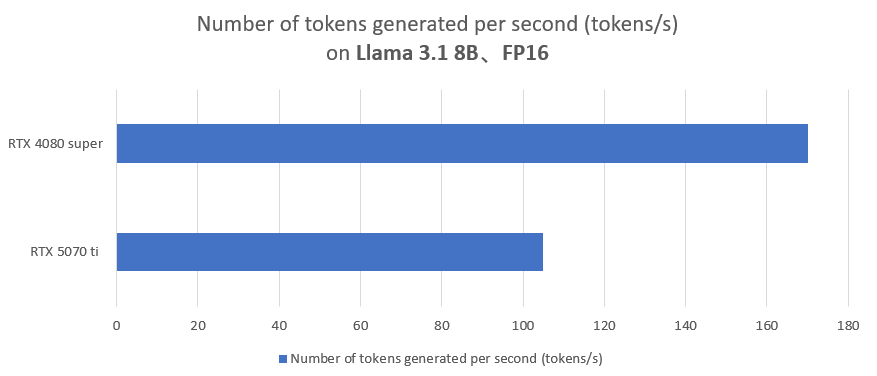
For Llama 3.1 8B FP16 inference, third-party community tests show the RTX 4080 Super delivering 15–25% higher tokens/sec than the RTX 5070 Ti under identical settings. Its stronger FP16 compute, higher CUDA/Tensor core counts, and larger memory bandwidth give it faster generation speed and lower latency. The 5070 Ti still performs well for mid-to-upper-range AI tasks, but the 4080 Super remains the faster option for demanding, sustained workloads.
4K Gaming Performance
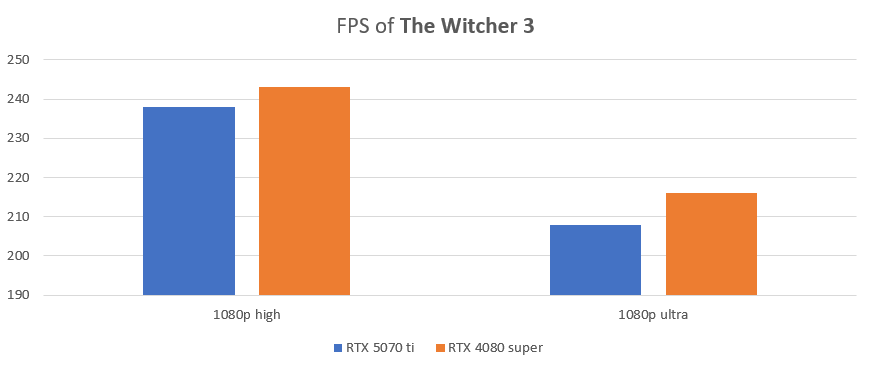
In The Witcher 3, a sprawling open-world RPG featuring vast fields, complex lighting, and numerous NPCs and action scenes, GPU performance is heavily stressed. According to NanoReview, at 1080p High settings, the RTX 5070 Ti achieves around 238 FPS, while the RTX 4080 Super reaches approximately 243FPS. Switching to 1080p Ultra, the 5070 Ti drops to about 208 FPS, compared to 216 FPS for the 4080 Super. While both cards easily deliver extremely high frame rates at 1080p on High or Ultra presets, the 4080 Super maintains a slight edge, providing marginally smoother performance under the most demanding settings.
In Call of Duty: Modern Warfare III, where fast-paced combat and detailed environments push GPU throughput, both cards deliver excellent performance—but the RTX 4080 Super maintains a slight advantage. According to NanoReview’s data, at 1080p High settings, the RTX 5070 Ti reaches around 214 FPS, while the 4080 Super hits 219 FPS. Under 1080p Ultra, the 5070 Ti runs at 206 FPS, compared to about 212FPS for the 4080 Super. Though both GPUs can easily sustain high frame rates in this competitive shooter, the 4080 Super pulls ahead by a few frames, offering marginally smoother responsiveness in ultra-quality scenarios.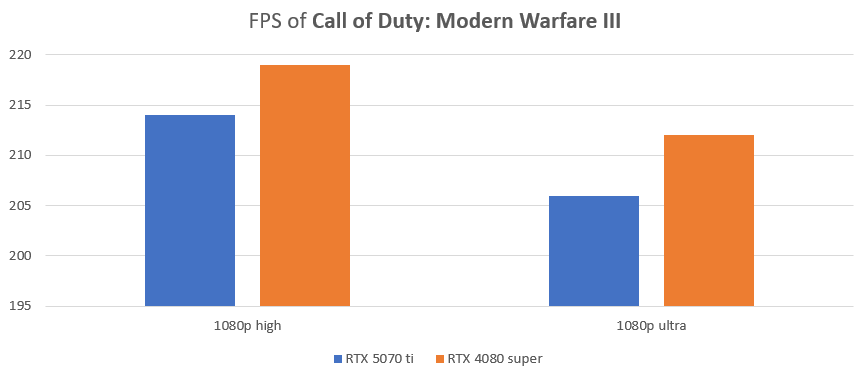
3D Rendering / Content Creation
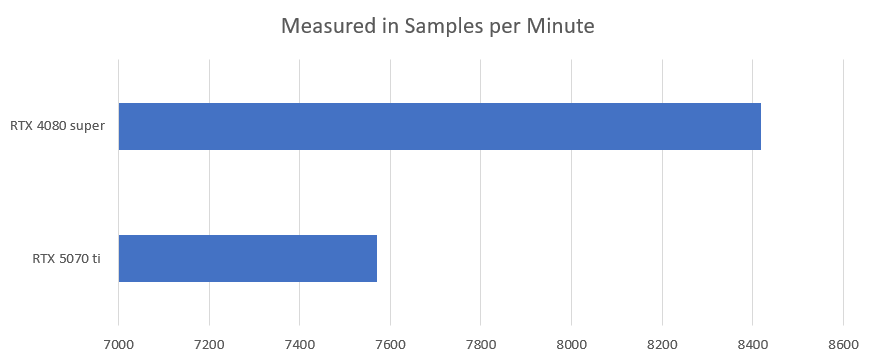
The RTX 4080 Super outpaces the RTX 5070 Ti in Blender rendering workloads. With its higher CUDA core count and optimized architecture, the RTX 4080 Super delivers approximately 11% faster render throughput, achieving 8,418 samples per minute compared to the 5070 Ti’s 7,571. This improvement comes without increasing VRAM usage. OptiX acceleration continues to be a key advantage for NVIDIA creators, ensuring smoother and more responsive 3D rendering performance even in complex, high-sample scenes.
Price & Value: RTX 5070 ti vs RTX 4080 super
The RTX 5070 Ti vs RTX 4080 SUPER shows a significant price difference across platforms. On Amazon, the RTX 5070 Ti price is $749, well below the RTX 4080 SUPER price of $1,597. On eBay, the gap remains large with the RTX 5070 Ti listed around $700 versus approximately $1,300 for the RTX 4080 SUPER. This 5070 Ti vs 4080 SUPER comparison highlights that while both GPUs target high-performance markets, the secondary market and platform-specific pricing create notable differences for users seeking cost-effective options.
Price Comparison
| Platform | RTX 5070 Ti | RTX 4080 SUPER | Price Difference (USD) | Price Difference (%) |
|---|---|---|---|---|
| Official MSRP | $1,250 | $1,659 | +$409 | +32.7% |
| eBay | ~$700 | ~$1,300 | +$600 | +85.7% |
| Amazon | $749 | ~$1,597 | +$848 | +113% |
User Value-for-Money Feedback
On UserBenchmark, the RTX 4060 shows strong consistency in its results across multiple The RTX 5070 Ti vs RTX 4080 SUPER shows a small performance gap based on aggregate benchmarks. On Technical.City, the RTX 5070 Ti scores 77.95, while the RTX 4080 SUPER scores 81.81, a difference of about 5%. In PassMark benchmarks, the 5070 Ti records 32,618 points versus 34,233 for the 4080 SUPER, again reflecting roughly a 5% difference.
In real-world terms, this means the RTX 4080 SUPER offers slightly higher raw compute, FP32 performance, and memory bandwidth, making it stronger in rendering, gaming, and compute-heavy tasks. The RTX 5070 Ti, however, provides modern architecture (Blackwell), high memory efficiency, PCIe 5.0 support, and strong AI/mixed-precision performance, making it efficient for AI, deep learning, and server workloads.
In short, the RTX 4080 SUPER delivers marginally higher aggregate performance, while the RTX 5070 Ti offers better efficiency and value in AI and data-intensive applications.
RTX 5070 ti vs RTX 4080 super – Pros & Cons
| GPU | Pros | Cons |
|---|---|---|
| RTX 5070 Ti | ✅ Efficient for AI, deep learning, and server workloads (5070 Ti benchmark) ✅ Modern Blackwell architecture with high memory bandwidth and PCIe 5.0 ✅ Good value for cost-efficient high-performance tasks ✅ Compact design suitable for standard builds |
❌ Slightly lower raw FP32 and CUDA performance compared to 4080 SUPER ❌ 12GB VRAM may limit extremely large datasets or ultra-high resolution rendering ❌ Secondary market prices vary widely, potentially hard to find ❌ Less ideal for maxed-out gaming or rendering compared to 4080 SUPER |
| RTX 4080 SUPER | ✅ Higher raw compute, FP32 throughput, and CUDA cores (4080 SUPER benchmark) ✅ Excels in gaming, rendering, and compute-heavy workloads ✅ Strong future-proofing for next-generation software and games ✅ Large VRAM (16GB+) suitable for heavy AI/data workloads |
❌ Higher MSRP and secondary market prices ($1,597–$1,700+) ❌ Higher power consumption, requires robust PSU and cooling ❌ Bulkier design, may be harder to fit in smaller cases ❌ Overkill for users focusing only on AI inference or mid-range tasks |
RTX 5070 ti vs RTX 4080 super GPU Hosting
When comparing the RTX 5070 Ti vs RTX 4080 SUPER, the differences are most noticeable in compute efficiency, AI workloads, and rendering performance. The RTX 5070 Ti offers strong mixed-precision performance and high memory bandwidth, making it effective for AI inference and data-intensive tasks. The RTX 4080 SUPER provides higher raw compute, more CUDA cores, and greater FP32 throughput, making it better suited for gaming, 3D rendering, and other compute-heavy applications.
Although Database Mart does not currently offer servers with these exact GPUs, we provide a wide range of GPU servers across different performance tiers and price points. From low-end to high-end configurations, users can choose the right server for AI, deep learning, rendering, or general GPU workloads, with scalable single- or multi-GPU setups, 99.9% uptime, and 24/7 professional support, allowing you to focus on your projects without worrying about hardware management.
Conclusion
Both GPUs remain strong contenders in 2025, but they cater to different priorities:
Choose the RTX 5070 Ti GPU if you want efficient AI inference, mixed-precision training, and strong performance in data-intensive workloads. Its Blackwell architecture, high memory bandwidth, and energy-efficient design make it suitable for creators, developers, and professionals who need cost-effective compute power for server-style or AI workloads.
Choose the RTX 4080 SUPER GPU if you’re looking for maximum raw performance in gaming, 3D rendering, or computationally heavy tasks. With higher CUDA cores, FP32 throughput, and larger VRAM, it is ideal for users who need top-tier performance and future-proofing for graphics-intensive or scientific workloads.
While the RTX 5070 Ti offers excellent efficiency and value in AI and server workloads, the RTX 4080 SUPER provides measurable gains in raw compute and graphics performance, making it the better choice for users prioritizing maximum speed and performance headroom.
RTX 5070 ti vs RTX 4080 super,5070 ti vs 4080 super, 4080 super vs 5070 ti, 5070 ti price, 4080 super price, 4080 super gpu, 5070 ti gpu, best 4080 super