
RTX A4000 vs RTX 4090: Key Differences, Performance & Price Comparison
RTX A4000 vs RTX 4090 – Background Comparison
| Brand | Series | Model | Release Year | Official Positioning | Market Price (USD) |
|---|---|---|---|---|---|
| NVIDIA | RTX Professional | RTX A4000 | 2021 | Positioned as a professional workstation GPU, the RTX A4000 targets creators, engineers, and enterprise users who prioritize certified drivers, long-term stability, and optimized performance for CAD, 3D rendering, AI inference, and visualization workloads. Built on the Ampere architecture, it focuses on efficiency and reliability rather than raw gaming performance, making it a common consideration in RTX A4000 vs RTX 4090 evaluations for professional environments. | Official pricing not disclosed by NVIDIA |
| NVIDIA | GeForce RTX | RTX 4090 | 2022 | Marketed as NVIDIA’s flagship consumer GPU, the RTX 4090 delivers extreme performance for 4K gaming, real-time ray tracing, AI acceleration, and high-end content creation. Powered by the Ada Lovelace architecture, it dominates RTX A4000 vs RTX 4090 comparisons where maximum throughput, CUDA performance, and future-proofing are prioritized over power efficiency and price. | ~$1,599 |
NVIDIA RTX A4000 vs RTX 4090– Specifications Comparison
Since its release, the RTX A4000 emphasizes efficiency, stability, and reliability rather than peak performance. With ECC-supported GDDR6 memory, lower power consumption, and professional-grade drivers, it is well suited for AI inference, CAD workflows, 3D visualization, and long-running workstation or server deployments. Its Ampere architecture delivers consistent CUDA and Tensor performance while maintaining thermal efficiency in enterprise environments.
In contrast, the RTX 4090 offers a massive increase in CUDA cores, memory bandwidth, and FP32 throughput, making it dominant in rendering, large-scale AI workloads, scientific computing, and high-end gaming. Powered by the Ada Lovelace architecture, it excels at raw compute tasks where maximum performance and throughput are critical.
While the RTX 4090 clearly leads in raw performance and scalability, the RTX A4000 provides advantages in power efficiency, memory reliability, and professional stability. In short, the RTX A4000 is optimized for professional and enterprise workloads that prioritize consistency and efficiency, whereas the RTX 4090 is the superior choice for compute-heavy, performance-driven tasks.
Core Specs Comparison between RTX A4000 vs RTX 4090
| Specification | RTX A4000 | RTX 4090 |
|---|---|---|
| Architecture | Ampere | Ada Lovelace |
| CUDA Cores | 6,144 | 16,384 |
| Memory Type | GDDR6 (ECC supported) | GDDR6X |
| Memory Capacity | 16 GB | 24 GB |
| Memory Bus | 256-bit | 384-bit |
| Memory Bandwidth | 448 GB/s | 1,008 GB/s |
| Core Frequency (Boost) | ~1.56 GHz | ~2.52 GHz |
| TDP (Power) | ~140 W | ~450 W |
| Interface / Bus | PCIe 4.0 x16 | PCIe 4.0 x16 |
| FP32 Performance | ~19.2 TFLOPS | ~82.6 TFLOPS |
| Ray Tracing / Tensor | 2nd-gen RT, 3rd-gen Tensor | 3rd-gen RT, 4th-gen Tensor |
| PCIe Version | PCIe 4.0 | PCIe 4.0 |
Key Differences: RTX A4000 vs RTX 4090
Architecture & Compute Scaling
The RTX A4000 is built on the Ampere architecture, while the RTX 4090 uses the newer Ada Lovelace architecture. Ada introduces major efficiency and scheduling improvements, allowing significantly higher compute density and better scaling in modern AI and server workloads. This architectural leap is a fundamental reason why RTX 4090 delivers a large performance advantage in RTX A4000 vs RTX 4090 comparisons.
CUDA Cores and Tensor Performance
RTX 4090 features nearly three times the CUDA cores of RTX A4000, combined with a newer generation of Tensor cores. This directly translates into much higher throughput for AI inference, parallel computation, and batch processing on servers. While RTX A4000 provides stable and predictable performance, RTX 4090 is designed to maximize raw compute output.
Memory Bandwidth Impact on Server Workloads
Memory bandwidth is another major differentiator. RTX 4090 offers more than double the memory bandwidth of RTX A4000, enabling faster data movement for large models, high-resolution datasets, and concurrent workloads. In contrast, RTX A4000 focuses on memory reliability with ECC support, which benefits long-running enterprise tasks but limits peak throughput.
RTX A4000 vs RTX 4090 Performance Across Different Scenarios
AI / Deep Learning Performance Comparison
In AI inference scenarios, the RTX A4000 and RTX 4090 show a clear performance difference. Based on public online benchmarks and community test data (not results from a single controlled test environment), the RTX A4000 achieves around ~35 tokens/sec, while the RTX 4090 reaches approximately ~140 tokens/sec under similar model settings.
This gap mainly comes from the RTX 4090’s much stronger compute and Tensor core performance, enabling roughly 4× higher inference throughput. The RTX A4000 remains a solid option for moderate AI workloads, offering stable performance and better efficiency, while the RTX 4090 is the better choice for large models and high-throughput AI inference tasks.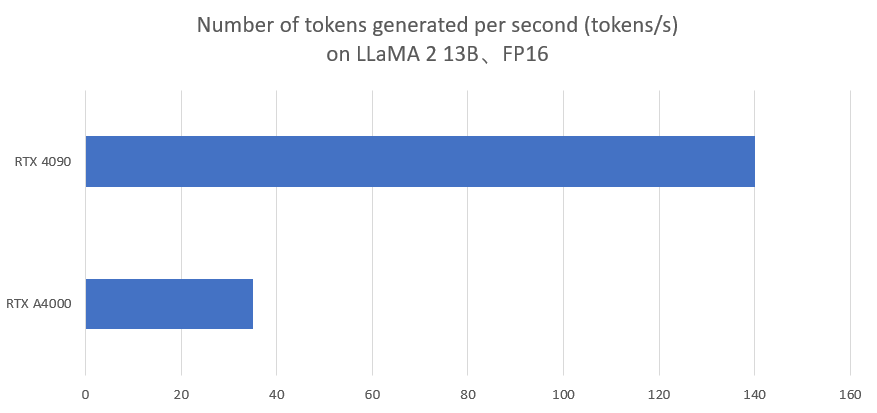
4K Gaming Performance
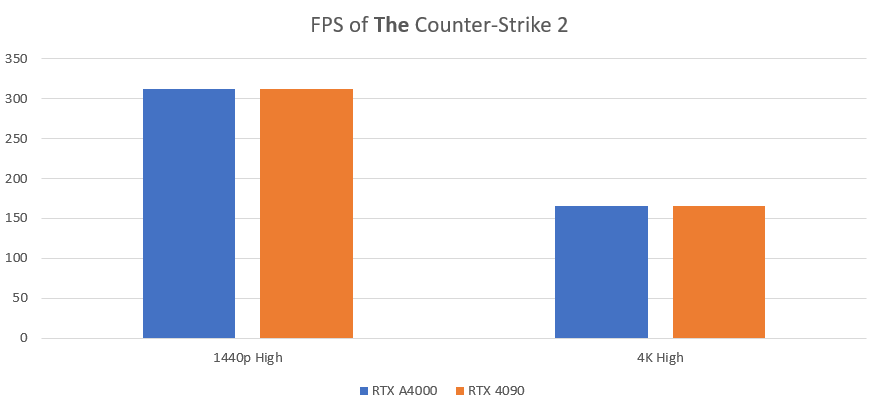
In Counter-Strike 2, a highly competitive shooter that emphasizes fast reactions, heavy smoke effects, and visual clarity, GPU performance plays a key role in maintaining high and stable frame rates. Based on the provided data, at 1440p High settings, both the RTX A4000 and RTX 4090 achieve around 312 FPS, indicating that the game is largely CPU-bound at this resolution. When moving to 4K High, performance drops to approximately 166 FPS on both GPUs, but still remains exceptionally smooth and well above competitive play requirements.
Overall, this comparison shows that in esports-focused titles like CS2, both GPUs deliver more than enough performance, and the difference between them is minimal due to engine and CPU limitations rather than raw GPU power.
3D Rendering / Content Creation
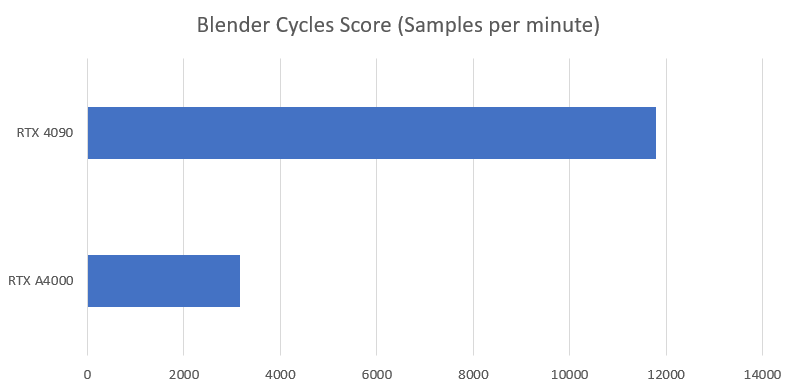
In Blender Cycles, a widely adopted path-tracing benchmark used to evaluate GPU rendering throughput under complex lighting and ray-tracing workloads, the performance difference between the two GPUs is clearly reflected in benchmark scores. Based on actual Blender Cycles test results, the RTX A4000 records a score of 3,158, while the RTX 4090 achieves a much higher score of 11,794.
It is important to note that these values represent benchmark scores derived from real rendering workloads, not the number of fully rendered scenes or instances produced per minute. The substantially higher score of the RTX 4090 indicates significantly greater rendering throughput, translating to much shorter render times in real-world projects. In comparison, the RTX A4000 delivers stable and efficient professional performance, but at a considerably lower overall rendering capacity.
Price & Value: RTX A4000 vs RTX 4090
The RTX A4000 vs RTX 4090 shows a clear and consistent price gap across platforms. In both resale and retail markets, the RTX A4000 is generally positioned at a significantly lower price tier, reflecting its role as a professional, efficiency-focused workstation GPU. In contrast, the RTX 4090 maintains a strong premium due to its flagship-level performance, higher demand, and unmatched compute throughput. Overall, while the RTX 4090 commands a much higher cost in exchange for maximum performance, the RTX A4000 remains the more cost-effective option for users prioritizing stability, efficiency, and controlled server budgets.
Price Comparison
| Platform | RTX A4000 | RTX 4090 | Price Difference (USD) | Price Difference (%) |
|---|---|---|---|---|
| Official MSRP / Official Manufacturer Pricing | Official pricing not disclosed by NVIDIA (professional lineup typically not published) | $1,599 MSRP for RTX 4090 Founders Edition (typical reference MSRP from launch; many cards retail near this level) | — | — |
| eBay (Used / Resale) | ~$900–$1,200* (used A4000 listings on eBay range broadly depending on condition) | ~$2,000–$2,400* (used RTX 4090 listings often sell around this range) | ~+$1,100–$1,400 | ~+90%–+155% |
| Amazon (New / Current Listings) | ~$1,300–$1,600* (Amazon A4000 new/open-box listings) | ~$2,400–$3,000* (RTX 4090 current Amazon offers) | ~+$800–$1,400 | ~+60%–+110% |
User Value-for-Money Feedback
On Technical.City, the RTX 4090 consistently ranks far above the RTX A4000 in aggregated benchmark scores. The platform’s overall performance index shows that the RTX 4090 delivers a dramatically higher combined score, reflecting its substantially greater compute resources, memory bandwidth, and newer architecture. This positioning clearly establishes the RTX 4090 as a top-tier GPU in general-purpose and performance-oriented evaluations.
Community-oriented benchmark summaries also indicate that the RTX A4000 is evaluated from a different perspective. Rather than competing for top scores, it is commonly categorized as a workstation-class GPU, where stability, predictable behavior, and professional workload suitability are weighted more heavily than peak benchmark numbers. As a result, its rankings remain lower, but aligned with its intended enterprise and professional use cases.
Taken together, feedback from both UserBenchmark-style comparisons and Technical.City evaluations highlights a clear distinction in user perception. The RTX 4090 is widely recognized for overwhelming raw performance and benchmark dominance, while the RTX A4000 is consistently viewed as a specialized solution optimized for efficiency, reliability, and professional environments rather than maximum throughput.
RTX A4000 vs RTX 4090 – Pros & Cons
| GPU | Pros | Cons |
|---|---|---|
| RTX A4000 | ✅ Professional-grade stability with certified workstation drivers ✅ ECC-supported GDDR6 memory improves reliability for long-running server and enterprise workloads ✅ Much lower power consumption (~140W), ideal for dense servers and thermally constrained environments ✅ Consistent performance for CAD, 3D rendering, and AI inference tasks |
❌ Significantly lower raw compute performance compared to RTX 4090 ❌ Older Ampere architecture with fewer CUDA, Tensor, and RT cores ❌ Limited scalability for large AI models and bandwidth-intensive workloads ❌ Official pricing not disclosed, making cost comparison less transparent |
| RTX 4090 | ✅ Flagship-level performance with massive CUDA core count and FP32 throughput ✅ Extremely high memory bandwidth and 24GB GDDR6X, ideal for large AI models and data-intensive workloads ✅ Newer Ada Lovelace architecture with advanced Tensor and RT cores for AI acceleration and rendering ✅ Dominates gaming, rendering, and compute-heavy server tasks |
❌ Very high power consumption (~450W), increasing cooling and infrastructure requirements ❌ Significantly higher cost across retail and resale markets ❌ Not designed for ECC or professional certification-focused environments ❌ Overkill for workloads that prioritize efficiency and stability over peak performance |
RTX A4000 vs RTX 4090 GPU Hosting
When comparing the RTX A4000 vs RTX 4090, the biggest differences come from architecture generation, compute scale, and power envelope. The RTX A4000 is optimized for efficiency and reliability, offering ECC-supported memory and lower power consumption that make it ideal for professional, long-running server workloads. By contrast, the RTX 4090 delivers dramatically higher raw compute performance, memory bandwidth, and AI acceleration, making it better suited for performance-intensive tasks such as large-scale AI workloads, rendering, and high-throughput compute scenarios.
For users evaluating these GPUs in real-world deployments, Database Mart offers dedicated GPU server solutions featuring both RTX A4000 and RTX 4090. Customers can choose RTX A4000 GPU servers for efficiency-focused professional workloads or RTX 4090 GPU servers for maximum performance and AI-driven applications.
All GPU servers include 99.9% uptime and 24/7 professional support, ensuring stable and reliable performance for demanding compute, rendering, and AI workloads.
Conclusion
Both GPUs remain strong options in 2025, but they are designed for very different types of users and workloads.
Choose the RTX A4000 GPU if you prioritize power efficiency, long-term stability, and professional reliability. Its lower power consumption, ECC-supported memory, and workstation-grade drivers make it well suited for enterprise servers, AI inference, CAD, 3D visualization, and other long-running workloads where consistency and uptime matter more than peak performance.
Choose the RTX 4090 GPU if you need maximum raw performance, massive compute throughput, and high memory bandwidth. With its significantly higher CUDA core count, newer architecture, and 24GB of fast GDDR6X memory, it excels in large-scale AI workloads, rendering, scientific computing, and performance-driven GPU servers where speed and scalability are the top priorities.
While the RTX A4000 delivers excellent efficiency and stability for professional and server-focused deployments, the RTX 4090 clearly dominates in compute-heavy and performance-intensive scenarios, making it the better choice for users who prioritize raw power over energy efficiency and infrastructure cost.
rtx a4000 vs rtx 4090, rtx a4000 price, rtx 4090 price, nvidia 4090 price, nvidia 4090, rtx a4000