


3060 Ti vs 4060: Which 8GB GPU Fits Gaming, AI, and Rendering?
Both the RTX 3060 Ti and RTX 4060 come with 8GB of VRAM and seem similarly positioned in NVIDIA’s lineup. However, across multiple platforms, the 3060 Ti tends to score slightly higher. So where does its advantage really lie? In this article, we’ll compare the specs of the 3060 Ti and 4060 and look at how they perform in rendering, gaming, and AI tasks.
Summary Overview of 3060 Ti and 4060:
Key Features:
Both GPUs support ray tracing and AI workloads. The 3060 Ti excels in rendering and HD gaming, while the 4060 is more balanced and energy-efficient. Both support DLSS and AV1 hardware encoding/decoding.
Industries:
Suitable for gaming, 3D modeling, video editing, multimedia production, AI training, and entry-level engineering simulations.
Popular Software:
Both the 3060 Ti and 4060 run smoothly with creative workflows like Blender, Maya, Cinema 4D, Premiere Pro, After Effects, and DaVinci Resolve, and support AI frameworks such as PyTorch, TensorFlow, and Stable Diffusion. They can also easily handle AAA games like Cyberpunk 2077, Fortnite, and Call of Duty.
RTX 3060 Ti vs RTX 4060 – Background Comparison
| Brand | Series | Model | Release Year | Official Positioning / Description | Official MSRP (USD) |
|---|---|---|---|---|---|
| NVIDIA | GeForce RTX 30 | RTX 3060 Ti | 2021 | Faster than the $699 RTX 2080 SUPER, and beating the RTX 2060 SUPER by an average of 40% | $329 |
| NVIDIA | GeForce RTX 40 | RTX 4060 | 2023 | Game, stream, create. The GeForce RTX™ 4060 lets you take on the latest games and apps with the ultra-efficient NVIDIA Ada Lovelace architecture | $299 |
The RTX 4060, as a fresh addition to NVIDIA’s 40-series, shines with its third-generation Ada Lovelace architecture and improved support for newer apps. But with the RTX 3060 Ti holding steady at its original price, it’s clear that it still packs a competitive punch.
NVIDIA 3060 T vs 4060: Specifications Comparison
Core Specs: 3060 T vs 4060
| Parameter | RTX 3060 Ti | RTX 4060 | Difference / Advantage |
|---|---|---|---|
| Architecture | Ampere | Ada Lovelace | 4060 has newer Ada Lovelace architecture |
| CUDA Cores | **4,864 ** | 3,072 | 3060 Ti has more cores (~58% more) |
| Memory Type | GDDR6 | GDDR6 | Same memory type |
| Memory Capacity(vRAM) | 8 GB | 8 GB | Same capacity |
| Memory Bus | **256-bit ** | 128-bit | 3060 Ti has wider bus for higher bandwidth |
| Memory Bandwidth | ~448 GB/s | ~224 GB/s | 3060 Ti has double the bandwidth |
| Core Frequency (Boost) | ~1.67 GHz | ~1.83 GHz | 4060 has slightly higher boost clock |
| **TDP (Power) ** | **200W ** | 115W | 4060 is more power-efficient |
| Interface / Bus | PCIe 4.0 | PCIe 4.0 | Same interface |
| FP32 Performance | ~16.2 TFLOPS | ~10.1 TFLOPS | 3060 Ti has higher raw FP32 performance |
| Ray Tracing / Tensor | 2nd-gen RT, 3rd-gen Tensor | 3rd-gen RT, 4th-gen Tensor | 4060 has newer RT/Tensor cores |
| PCIe Version | Gen4 | Gen4 | Same version |
More Specs Comparison
| Parameter | RTX 3060 Ti | RTX 4060 | Scene Impact / Difference |
|---|---|---|---|
| L2 Cache | 3,072 KB | 3,072 KB | Similar, minor impact, but Ada architecture efficiency improves 4060 |
| Tensor / AI Performance | 3rd-gen Tensor 152 | 4th-gen Tensor | 4060 better in AI inference, DLSS, and modern apps using Tensor cores |
| Ray Tracing Performance | 2nd-gen RT | 3rd-gen RT | 4060 more efficient for ray tracing at 1080p; 3060 Ti stronger at high-res |
| Effective VRAM Throughput | ~448 GB/s | ~224 GB/s | 3060 Ti advantage in large textures, complex scenes, AI training batch size |
| Ideal Gaming Resolution | 1440p / 4K | 1080p / 1440p | 3060 Ti stronger at higher resolutions; 4060 optimized for 1080p |
| AI / Rendering Workload | Mid-heavy 3D & AI | Light/medium AI tasks | 3060 Ti better for memory-heavy rendering; 4060 better efficiency on small AI models |
RTX 3060 Ti vs RTX 4060 Pros
RTX 3060 Ti: The RTX 3060 Ti outperforms the 4060 by around 58%, with nearly double the memory bus, memory bandwidth, and FP32 performance. These advantages make it stronger in gaming and rendering tasks. Its doubled effective VRAM throughput also makes it better suited for large textures, complex scenes, and AI training with bigger batch sizes. In high-resolution or highly complex scenarios, although the 3060 Ti has older RT cores, its higher CUDA core count and bandwidth can deliver more stable frame rates.
RTX 4060: As a next-generation GPU, the RTX 4060 benefits from newer ray tracing cores, which provide efficiency advantages for small AI inference tasks and reduce performance loss. It is also better optimized for apps leveraging Tensor cores. In games at 1080p, 1440p, or 4K with ray tracing enabled, the 4060’s new RT cores can achieve higher frame rates than the 3060 Ti at lower resolutions or medium settings.
4060 vs 3060 Ti Benchmark: Performance Across Different Scenarios
4060 vs 3060 Ti Benchmark in Gaming
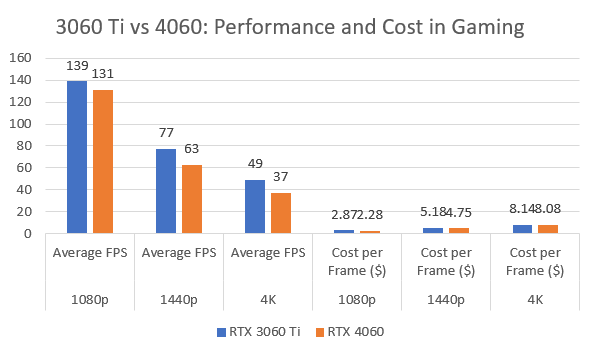
At 1080p, the RTX 4060 and 3060 Ti deliver similar performance, both exceeding 130 FPS. The 3060 Ti pulls ahead at higher resolutions, especially 4K, where it offers around 32% better performance.
The RTX 4060 is more efficient in terms of cost per frame, reflecting improved power usage. At 4K, however, the cost per frame for both cards is nearly the same.
4060 vs 3060 Ti Benchmark in AI Tasks
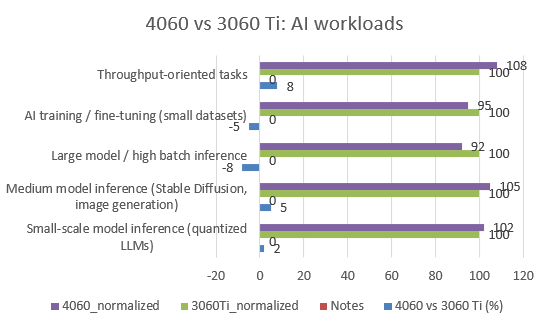
Due to VRAM and computational limitations, these GPUs are not specifically designed for training or inference of large language models like GPT-4 or LLaMA. However, they are still suitable for smaller-scale applications such as lightweight language models and text-to-speech synthesis.
For lightweight AI workloads such as small-scale model inference (quantized LLMs) and general throughput-oriented tasks, the RTX 4060 is often the more efficient option. 4060 is well-suited for local assistants, embedding generation, and other tasks that don’t demand large memory bandwidth or capacity.
In contrast, the RTX 3060 Ti shows clear advantages in more demanding scenarios like Stable Diffusion image generation, high-batch inference, and fine-tuning tasks. For users aiming to run less than 7B models or do frequent training/fine-tuning, the 3060 Ti remains the stronger choice.
4060 vs 3060 Ti Benchmark in Rendering
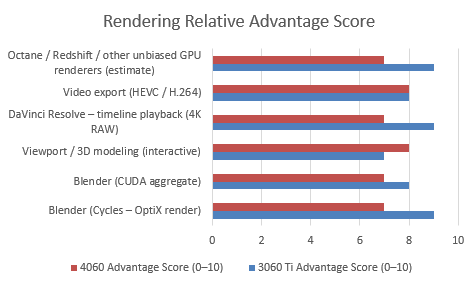
3060 Ti scores higher for large scenes, high-resolution rendering, and tasks that demand more VRAM and memory bandwidth. Examples include Blender (Cycles – OptiX render), Blender (CUDA aggregate), DaVinci Resolve – timeline playback (4K RAW), and Octane / Redshift / other unbiased GPU renderers.
4060 scores higher for lightweight or interactive tasks, offering better power efficiency and faster hardware-accelerated encoding for short to medium projects. An example is Viewport / 3D modeling (interactive).
RTX 4060 vs 3060 Ti: Price & Value
| Platform | RTX 4060 (USD) | RTX 3060 Ti (USD) | Price Difference: 3060 Ti vs 4060 (%) |
|---|---|---|---|
| Official MSRP | $299 | $399 | +33% |
| Amazon | $299–$329 | $389–$429 | +30–42% |
| Third-Party Resellers (eBay etc.) | $290–$340 | $380–$450 | +31–32% |
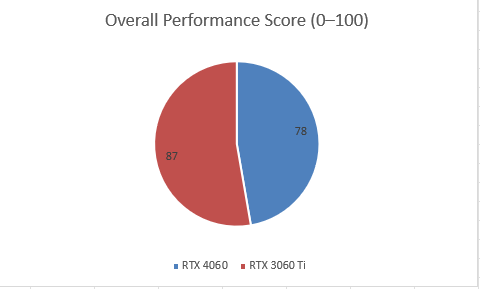
The price gap between the 3060 Ti and 4060 can be as high as 30%, yet the 3060 Ti's overall score is only 11% higher. This suggests that the new 40-series card offers better value for money.
4060 & 3060 Ti Server Hosting
Although the 4060 and 3060 Ti GPUs are relatively affordable, server hosting remains an excellent option for customers with short-term needs. Database Mart’s 4060 dedicated server comes with 64 GB of RAM and 8 CPU cores, while the 3060 Ti hosting variant offers 128 GB of RAM and 24 cores, better suited for rendering and small-scale AI workloads.
Conclusion
The RTX 3060 Ti excels in memory bandwidth, memory bus width, number of rendering units, texture and pixel processing capabilities, and overall value, as reflected in user reviews. It is better suited for high-resolution gaming, 3D rendering, and mid-sized AI workloads. On the other hand, the RTX 4060 stands out for its energy efficiency, higher clock speeds, advanced 5 nm process, and support for the latest OpenCL versions, making it ideal for 1080p/1440p gaming, lightweight AI tasks, and scenarios where power consumption matters.
3060 ti vs 4060, rtx 3060 ti vs rtx 4060, rtx 4060 vs 3060 ti, 4060 vs 3060, rtx 4060 vs 3060