


RTX 3080 Ti vs RTX 5060 Ti (8GB & 16GB): Performance, VRAM, and Server Comparison
Choosing the right GPU server isn’t just about raw performance—it’s about balancing compute power, VRAM capacity, and workload demands. In this comparison, we break down how the RTX 3080 Ti stacks up against the RTX 5060 Ti 8GB and 16GB across gaming, 3D rendering, and AI workloads, helping you identify which server delivers the best value and scalability for your use case.
Summary Light of 3080 ti & 5060 ti
Key Features
The RTX 3080 Ti delivers powerful raw compute performance with a wide memory bus and high bandwidth, making it well suited for high-resolution gaming and GPU-intensive workloads. In comparison, the RTX 5060 Ti adopts a newer architecture with improved efficiency, updated Ray Tracing and Tensor cores, and support for modern AI-accelerated features such as DLSS and AV1 encoding, targeting balanced performance with lower power consumption.
Industries
Both GPUs are suitable for gaming, 3D rendering, video editing, AI inference, and visualization workloads. The RTX 3080 Ti is more commonly chosen for heavy rendering, 4K gaming, and compute-focused tasks, while the RTX 5060 Ti is ideal for mainstream gaming, creative production, and cost-efficient AI and multimedia workloads.
Popular Software
Compatible with Blender, Maya, Cinema 4D, Unreal Engine, Premiere Pro, After Effects, DaVinci Resolve, PyTorch, TensorFlow, Stable Diffusion, OBS Studio, and modern AAA games such as Cyberpunk 2077.
RTX 3080 ti vs RTX 5060 ti – Background Comparison
The biggest difference among the RTX 3080 Ti, RTX 5060 Ti 8GB, and RTX 5060 Ti 16GB lies in architecture, memory configuration, and power design.
The RTX 3080 Ti features a wider memory bus and higher raw compute capacity, while the RTX 5060 Ti is offered in both 8GB and 16GB variants, focusing on newer architecture and improved efficiency across the two models.
| Brand | Series | Model | Release Year | Official Positioning / Description | Market Price (USD) |
|---|---|---|---|---|---|
| NVIDIA | GeForce RTX 30 Series | RTX 3080 Ti | 2021 (June) | High-end flagship GPU focused on raw compute performance and high memory bandwidth (12GB GDDR6X, 10240 CUDA cores) | ~$1199 |
| NVIDIA | GeForce RTX 50 Series | RTX 5060 Ti 8GB | 2025 (April) | Mid-range RTX 50 series GPU designed for balanced performance and efficiency (8GB GDDR7, 4608 CUDA cores) | ~$379 |
| NVIDIA | GeForce RTX 50 Series | RTX 5060 Ti 16GB | 2025 (April) | Mid-range RTX 50 series GPU with larger memory capacity for heavier workloads (16GB GDDR7, 4608 CUDA cores) | ~$429 |
NVIDIA 3080 Ti vs 5060 Ti – Specifications Comparison
Core 3080 Ti vs 5060 Ti Specs
| Parameter | RTX 3080 Ti | RTX 5060 Ti 8GB | RTX 5060 Ti 16GB | Difference / Advantage |
|---|---|---|---|---|
| Architecture | Ampere | Blackwell | Blackwell | Different architectures |
| CUDA Cores | 10,240 | ~4,608 | ~4,608 | 3080 Ti has significantly more cores |
| Memory Type | GDDR6X | GDDR7 | GDDR7 | Different memory generations |
| Memory Capacity | 12 GB | 8 GB | 16 GB | 16GB Ti offers the largest VRAM |
| Memory Bus | 384-bit | 128-bit | 128-bit | 3080 Ti has much wider bus |
| Memory Bandwidth | ~912 GB/s | ~448 GB/s | ~672 GB/s | 3080 Ti delivers highest bandwidth |
| Core Frequency (Boost) | ~1.67 GHz (varies by AIB) | ~2.6 GHz (varies by AIB) | ~2.6 GHz (varies by AIB) | 5060 Ti has higher clocks |
| TDP (Power) | ~350 W | ~160 W | ~165 W | 3080 Ti draws much more power |
| Interface / Bus | PCIe Gen4 | PCIe Gen4 | PCIe Gen4 | Same interface |
| FP32 Performance | ~34 TFLOPS | ~23 TFLOPS | ~23 TFLOPS | 3080 Ti has higher raw compute |
| Ray Tracing / Tensor | 2nd-gen RT, 3rd-gen Tensor | 4th-gen RT, 5th-gen Tensor | 4th-gen RT, 5th-gen Tensor | 5060 Ti has newer AI features |
| PCIe Version | Gen4 | Gen4 | Gen4 | Same version |
Advanced Features Comparison
| Feature / Capability | RTX 3080 Ti | RTX 5060 Ti 8GB | RTX 5060 Ti 16GB | Difference / Advantage |
|---|---|---|---|---|
| Ray Tracing Cores | 2nd Gen RT Cores | 3rd Gen RT Cores | 3rd Gen RT Cores | 5060 Ti has newer RT cores |
| Tensor Cores | 3rd Gen Tensor Cores | 4th Gen Tensor Cores | 4th Gen Tensor Cores | 5060 Ti has newer Tensor cores |
| DLSS Support | DLSS 3 (Frame Generation) | DLSS 4 (Frame Generation) | DLSS 4 (Frame Generation) | 5060 Ti supports newer DLSS version |
| AI Acceleration | Yes (CUDA / Tensor) | Yes (Transformer Engine support) | Yes (Transformer Engine support) | 5060 Ti more specialized for modern AI workloads |
| AV1 Encoding / Decoding | Dual NVENC, AV1 Encode + Decode | Dual NVENC, AV1 Encode + Decode | Dual NVENC, AV1 Encode + Decode | Same feature set |
| Display Outputs | HDMI 2.1, DisplayPort 1.4a | HDMI 2.1a, DisplayPort 2.1 | HDMI 2.1a, DisplayPort 2.1 | 5060 Ti supports newer DP 2.1 |
| Max Supported Resolution | Up to 8K / 60Hz | Up to 8K / 60Hz | Up to 8K / 60Hz | Same |
| PCIe Support | PCIe Gen4 ×16 | PCIe Gen4 ×16 | PCIe Gen4 ×16 | Same |
| VRAM Advantage | 12GB GDDR6X | Limited 8GB (may bottleneck in 4K) | Expanded 16GB (better for high-res / AI) | 16GB 5060 Ti best for large datasets / AI |
| Target Use Case | 4K / high-settings gaming, rendering & compute-heavy workloads | 1440p high-settings gaming | 1440p / 4K, creator & AI workloads | 3080 Ti for raw performance, 5060 Ti for modern efficiency & AI |
Key Differences: 3080 Ti vs 5060 Ti
Architecture & AI / Ray Tracing
– RTX 3080 Ti uses Ampere, delivering raw compute performance with 2nd‑gen RT cores and 3rd‑gen Tensor cores. RTX 5060 Ti 8GB and 16GB use the newer Blackwell architecture, featuring 4th‑gen RT cores, 5th‑gen Tensor cores, and DLSS 4, providing better efficiency for AI workloads and modern games.
CUDA Cores
– With 10,240 cores, the 3080 Ti significantly outperforms both 5060 Ti models (~4,608 cores), giving higher FPS in games and faster throughput in rendering or compute-heavy tasks.
Memory Capacity & Bandwidth
– 3080 Ti has 12 GB GDDR6X with ~912 GB/s bandwidth, ideal for 4K gaming, rendering, and AI models. The 5060 Ti 8GB is enough for 1080p–1440p gaming, but may bottleneck in 4K or large AI projects. The 16GB 5060 Ti doubles VRAM and offers 672 GB/s bandwidth, making it more suitable for high-resolution textures, AI datasets, and complex creative workloads.
FP32 Performance
– The 3080 Ti delivers ~34 TFLOPS, far above the ~23 TFLOPS of both 5060 Ti variants, giving it a clear advantage in raw compute and rendering speed.
Power Efficiency
– 3080 Ti consumes ~350 W, reflecting its high performance, while 5060 Ti models draw ~160–165 W, offering a more energy-efficient solution for AI training and creative applications.
🔍 Choosing between RTX 3080 Ti and RTX 5060 Ti?
If your workload demands maximum performance for 4K gaming, rendering, or AI training, the 3080 Ti is the better choice. If you prefer energy efficiency, modern AI/RT features, or larger VRAM for creative/AI workloads, consider the 5060 Ti 8GB or 16GB.
👉 Share your workload, and we’ll provide a tailored GPU server recommendation with a free monthly cost estimate.
RTX 3080 Ti vs 5060 Ti Benchmark: Performance Across Different Scenarios
RTX 3080 Ti vs 5060 Ti Gaming Performance
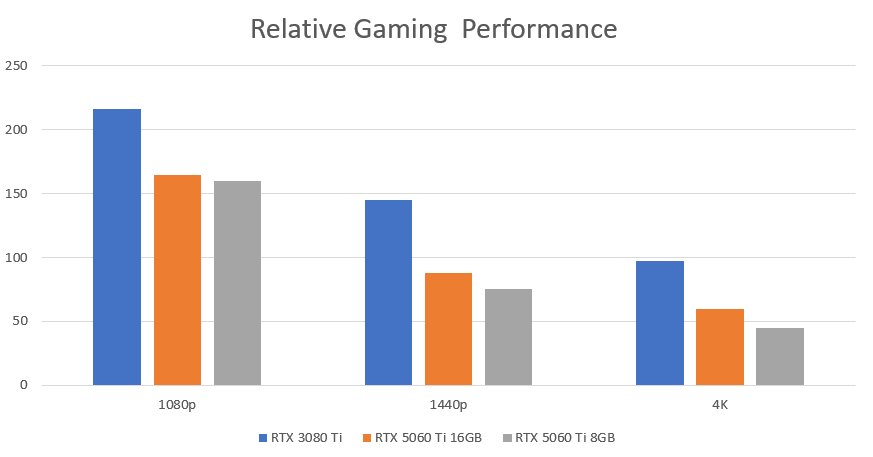
Based on benchmark data across multiple games and resolutions, RTX 3080 Ti, RTX 5060 Ti 8GB, and RTX 5060 Ti 16GB show clear, quantifiable performance differences that scale with resolution.
1080p
At 1080p, all three GPUs perform very closely. Average FPS differences between the RTX 3080 Ti, RTX 5060 Ti 8GB, and RTX 5060 Ti 16GB are generally within 5–10%, indicating that performance is mainly compute-bound and VRAM capacity has little impact at this resolution.
1440p
At 1440p, performance gaps become more visible. The RTX 3080 Ti maintains a clear advantage in average FPS, while the RTX 5060 Ti 16GB delivers approximately 15–20% higher performance than the 5060 Ti 8GB. The 8GB model begins to show mild VRAM limitations in high-quality and large-scene workloads.
4K
At 4K resolution, VRAM capacity plays a critical role. The RTX 5060 Ti 16GB achieves 40–60% higher average FPS compared to the 5060 Ti 8GB in memory-intensive titles, where the 8GB version suffers from significant bottlenecks. The RTX 3080 Ti remains the strongest overall performer at 4K, but the 16GB 5060 Ti offers substantially better stability than its 8GB counterpart.
3D Rendering
5060 Ti (8GB) vs 5060 Ti (16GB):
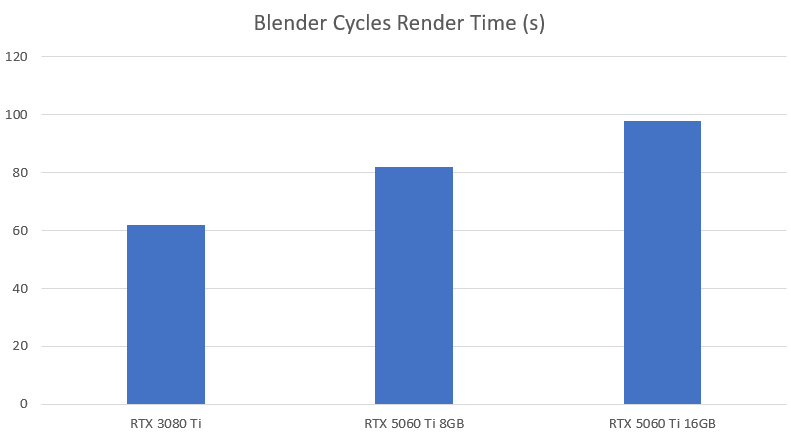
In 3D rendering workloads, the performance difference between the two VRAM variants of the RTX 5060 Ti is relatively moderate when scenes fit within 8GB of memory. In small-to-medium scenes, render time differences are typically around 5–12%. The 16GB model shows a clearer advantage in complex scenes with high-resolution textures or large assets, where the additional VRAM helps avoid memory overflow and maintains more stable render times.
RTX 3080 Ti vs 5060 Ti (8GB):
The RTX 3080 Ti delivers approximately 30–40% faster rendering performance than the RTX 5060 Ti 8GB in most 3D rendering tasks, benefiting from higher raw compute power and wider memory bandwidth. While the 5060 Ti 16GB can reduce slowdowns in memory-heavy scenes, the RTX 3080 Ti remains the strongest option for compute-intensive rendering workloads.
AI Image Generation
5060 Ti (8GB) vs 5060 Ti (16GB):
In AI training and image generation workloads, performance differences between the RTX 5060 Ti 8GB and 16GB are generally small for small models and moderate batch sizes, with throughput varying by about 8–15%. The 16GB version becomes significantly more effective when handling larger models or higher batch sizes, as the increased VRAM reduces data swapping and improves training stability.
RTX 3080 Ti vs 5060 Ti (8GB):
The RTX 3080 Ti achieves roughly 25–35% higher AI training throughput than the RTX 5060 Ti 8GB in compute-bound workloads, thanks to stronger FP32 performance and higher memory bandwidth. Although the 5060 Ti 16GB can close part of the gap in memory-limited scenarios, the RTX 3080 Ti continues to lead in sustained AI training and high-throughput inference tasks.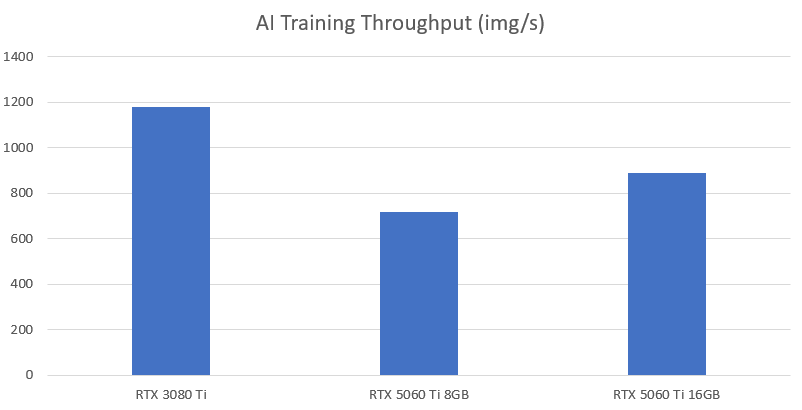
Price & Value: RTX 3080 Ti vs 5060 Ti (8GB/16GB)
| Platform | RTX 3080 Ti (USD) | RTX 5060 Ti 8GB (USD) | RTX 5060 Ti 16GB (USD) | Price Difference: 5060 Ti 8GB vs 3080 Ti (%) | Price Difference: 5060 Ti 16GB vs 5060 Ti 8GB (%) |
|---|---|---|---|---|---|
| Official MSRP | $1,199 | $379 | $429 | +216% | +13% |
| Amazon | $1,149–$1,299 | $369–$399 | $429–$459 | +211–226% | +8–24% |
| Third-Party Resellers (eBay etc.) | $1,100–$1,499 | $325–$400 | $450–$480 | +238–275% | +13–38% |
Databasemart GPU Alternatives to RTX 3080 Ti & 5060 Ti
Databasemart does not currently offer NVIDIA RTX 3080 Ti or RTX 5060 Ti servers. However, the following GPU server options provide comparable performance tiers and are suitable alternatives for common AI, rendering, and compute workloads.
| Model | Best Use Case | GPU | CPU | Memory | Storage | Architecture | FP32 Performance |
|---|---|---|---|---|---|---|---|
| Basic GPU Dedicated Server | Stable AI inference, light training | RTX 5060 8GB GDDR7 |
24-Core Platinum 8160 | 64GB | 120GB SSD + 960GB SSD | Blackwell 2.0 | 23.22 TFLOPS |
| Basic GPU VPS | Testing, development, flexible workloads | RTX 5060 8GB GDDR7 |
16 Cores | 30GB | 240GB SSD | Blackwell 2.0 | 23.22 TFLOPS |
| Advanced GPU Dedicated Server | Rendering, mature AI workloads | RTX 3060 Ti 8GB GDDR6 |
Dual 12-Core E5-2697 v2 | 128GB | 240GB SSD + 2TB SSD | Ampere | 16.2 TFLOPS |
Selection Tip:
Choose RTX 5060-based servers if you prioritize newer architecture and energy efficiency.
Choose the RTX 3060 Ti Dedicated Server if you prefer a mature ecosystem and higher core counts.
Why buy when you can host? RTX 3080 Ti and 5060 Ti servers aren’t currently available, but you can get similar high-performance GPUs on our servers with full CPU, RAM, disk, and resources included.
👉 View GPU server recommendations
3080 Ti vs 5060 Ti 8G vs 5060 Ti 16G– Pros & Cons
| Model | Pros | Cons |
|---|---|---|
| RTX 3080 Ti | ✅ Extremely high raw performance, ideal for 4K gaming, rendering, and compute-heavy workloads ✅ Large 12GB GDDR6X memory and 384-bit bus for maximum bandwidth ✅ High FP32 throughput (~34 TFLOPS) |
❌ Very high power consumption (~350 W) ❌ Older Ampere architecture, lacks latest Blackwell AI/RT features ❌ Significantly more expensive than 5060 Ti options |
| RTX 5060 Ti 8GB | ✅ Balanced price-to-performance, efficient for 1080p–1440p gaming ✅ Blackwell architecture with 4th-gen RT and 5th-gen Tensor cores ✅ Energy-efficient, lower TDP (~160 W) |
❌ Only 8GB VRAM, may bottleneck in 4K or large AI/creative workloads ❌ Lower raw performance than 3080 Ti ❌ Performance gain mostly limited to mid-level tasks |
| RTX 5060 Ti 16GB | ✅ Doubled VRAM, better for 4K gaming, AI training, rendering, and large projects ✅ Same efficient Blackwell architecture with DLSS 4 ✅ Suitable for creators and AI workloads |
❌ Higher price compared to 8GB version ❌ Raw FPS / compute still lower than 3080 Ti ❌ Performance gains mainly in memory-intensive tasks |
High-Performance GPU Server Hosting
Looking for RTX 3080 Ti or 5060 Ti servers? While these specific GPUs aren’t available, Database Mart GPU servers
offer a wide range of high-performance options, giving you remote access to powerful GPUs without the cost of buying or maintaining hardware. Our servers feature 99.9% uptime, multi-core CPUs, and high-speed SSD storage, ensuring smooth performance for gaming, AI, rendering, and creative workloads.
Compared to local workstations, GPU hosting saves on electricity, cooling, and maintenance, while offering scalable resources and remote access—perfect for freelancers, studios, or AI developers.
Not sure which GPU server fits your workload?
👉 Browse our full GPU server lineup and choose the option that best suits your needs.
Conclusion
In the end, each GPU option targets a different need. The RTX 3080 Ti offers top-tier performance for 4K gaming, heavy rendering, and compute-heavy workloads, while the 5060 Ti 8GB balances performance for 1440p gaming or light creative tasks. For heavier tasks like AI model training, 3D rendering, or projects that require more VRAM, the 16GB 5060 Ti provides extra headroom.
While we don’t provide RTX 3080 Ti or 5060 Ti servers directly, Database Mart offer a wide range of high-performance GPU options, letting you scale resources remotely without the cost of buying hardware. Your choice should depend on whether you prioritize raw performance, balanced efficiency, or long-term capability.
5060 ti vs 3080 ti, 3080 ti vs 5060 ti, 5060 ti price, 5060 ti specs, 3080 ti benchmark, 3080 ti price