


RTX 5060 vs 5060 Ti: Is the 16GB Upgrade Worth It?
As part of NVIDIA’s 50-series GPUs announced in 2025, the RTX 5060 and 5060 Ti (8GB/16GB) have attracted significant attention. Touted by NVIDIA as “game changers,” they are designed primarily for gamers and creators, while also supporting small- to mid-scale AI model training and inference. But which one is the right choice for your needs? This article offers a concise guide to help you decide.
Summary Light of 5060 & 5060 Ti
- Key Features: The RTX 5060 / 5060 Ti feature upgraded CUDA cores, Ray Tracing (RT) cores, and Tensor cores, supporting DLSS 4 and AV1 hardware encoding/decoding, delivering high performance and energy efficiency for mid-to-high-end gaming, creative work, and AI inference.
- Industries: Suitable for gaming, 3D modeling and animation, video editing, multimedia production, AI model training, and entry-level engineering simulations and visualization.
- Popular Software: Compatible with Blender, Maya, Cinema 4D, Premiere Pro, After Effects, DaVinci Resolve, PyTorch, TensorFlow, Stable Diffusion, OBS Studio, and mainstream AAA games like Cyberpunk 2077.
RTX 5060 vs 5060 Ti – Background Comparison
The biggest difference between the RTX 5060 and 5060 Ti lies in memory and CUDA cores. While the RTX 5060 comes with 8GB of VRAM, the 5060 Ti is available in both 8GB and 16GB variants. Across the three models, pricing differs by nearly one-third.
| Brand | Series | Model | Release Year | Official Positioning / Description | Market Price (USD) |
|---|---|---|---|---|---|
| NVIDIA | GeForce RTX 50 Series | RTX 5060 | 2025 (May) | Mainstream / entry-level RTX 50 series (8GB GDDR7, 3840 CUDA cores) | ~$299 |
| NVIDIA | GeForce RTX 50 Series | RTX 5060 Ti 8GB | 2025 (April) | Mid-range / performance upgrade (8GB GDDR7, 4608 CUDA cores) | ~$379 |
| NVIDIA | GeForce RTX 50 Series | RTX 5060 Ti 16GB | 2025 (April) | Mid-range / larger memory version (16GB GDDR7, 4608 CUDA cores) | ~$429 |
NVIDIA 5060 vs 5060 Ti – Specifications Comparison
Core 5060 vs 5060 Ti Specs
| Parameter | RTX 5060 | RTX 5060 Ti 8GB | RTX 5060 Ti 16GB | Difference / Advantage |
|---|---|---|---|---|
| Architecture | Blackwell | Blackwell | Blackwell | Same architecture across all models |
| CUDA Cores | ~3,840 | ~4,608 | ~4,608 | Ti models have ~20% more cores |
| Memory Type | GDDR7 | GDDR7 | GDDR7 | Same memory type |
| Memory Capacity | 8 GB | 8 GB | 16 GB | 16GB Ti offers double VRAM |
| Memory Bus | 128-bit | 128-bit | 128-bit | Same bus width |
| Memory Bandwidth | ~448 GB/s | ~448 GB/s | ~672 GB/s | 16GB of 5060 Ti has higher effective bandwidth |
| Core Frequency (Boost) | ~2.5 GHz (varies by AIB) | ~2.6 GHz (varies by AIB) | ~2.6 GHz (varies by AIB) | Ti slightly higher |
| TDP (Power) | ~150W | ~160W | ~165W | Ti models slightly higher power draw |
| Interface / Bus | PCIe Gen4 | PCIe Gen4 | PCIe Gen4 | Same interface |
| FP32 Performance | ~19 TFLOPS | ~23 TFLOPS | ~23 TFLOPS | 5060 Ti models ~20% faster |
| Ray Tracing / Tensor | 4rd-gen RT, 5th-gen Tensor Cores | 4rd-gen RT, 5th-gen Tensor Cores | 4rd-gen RT, 5th-gen Tensor Cores | Same features |
| PCIe Version | Gen4 | Gen4 | Gen4 | Same version |
Advanced Features Comparison
| Feature / Capability | RTX 5060 | RTX 5060 Ti 8GB | RTX 5060 Ti 16GB | Difference / Advantage |
|---|---|---|---|---|
| Ray Tracing Cores | 3rd Gen RT Cores | 3rd Gen RT Cores | 3rd Gen RT Cores | Same features |
| Tensor Cores | 4th Gen Tensor Cores | 4th Gen Tensor Cores | 4th Gen Tensor Cores | Same features |
| DLSS Support | DLSS 4 (Frame Generation) | DLSS 4 (Frame Generation) | DLSS 4 (Frame Generation) | All support equally |
| AI Acceleration | Yes (Transformer Engine support) | Yes (Transformer Engine support) | Yes (Transformer Engine support) | Same features |
| AV1 Encoding / Decoding | Dual NVENC, AV1 Encode + Decode | Dual NVENC, AV1 Encode + Decode | Dual NVENC, AV1 Encode + Decode | Same features |
| Display Outputs | HDMI 2.1a, DisplayPort 2.1 | HDMI 2.1a, DisplayPort 2.1 | HDMI 2.1a, DisplayPort 2.1 | Same |
| Max Supported Resolution | Up to 8K / 60Hz | Up to 8K / 60Hz | Up to 8K / 60Hz | Same |
| PCIe Support | PCIe Gen4 ×16 | PCIe Gen4 ×16 | PCIe Gen4 ×16 | Same |
| VRAM Advantage | Standard 8GB GDDR7 | Limited 8GB (may bottleneck in 4K) | Expanded 16GB (better for high-res / AI) | 16GB clearly superior for heavy workloads |
| Target Use Case | 1080p / entry-level 1440p gaming | 1440p high-settings gaming | 1440p / 4K, creator & AI workloads | Each card fits a different tier |
Key Differences: 5060 vs 5060 Ti
CUDA Cores
– The 5060 Ti has 20% more CUDA cores than RTX 5060, giving it stronger rasterization and parallel compute power. This means smoother FPS at 1440p/4K and faster AI or rendering tasks compared to the base 5060.
Memory Capacity (VRAM)
– 8GB (5060 / 5060 Ti 8GB) is fine for 1080p and most 1440p games, but can bottleneck in 4K or AI workloads. The 16GB version of 5060 Ti with double VRAM handles large models, textures, and projects much more smoothly.
Memory Bandwidth
– 448 GB/s on the 8GB 5060 Ti cards is mid-range, while 672 GB/s on the 16GB 5060 Ti card allows faster data flow. This reduces stutter in high-res gaming and improves AI/rendering stability.
FP32 Performance –
With ~23 TFLOPS, the 5060 Ti outperforms the ~19 TFLOPS 5060, delivering higher FPS in games (especially with ray tracing/DLSS) and better throughput for compute-heavy workloads.
🔍Choosing between RTX 5060 and RTX 5060 Ti?
If you’re looking for GPU hosting, tell us your workload (AI training / inference / rendering / game simulation),
👉 and we’ll provide a tailored GPU server recommendation with a free monthly cost estimate.
RTX 5060 vs 5060 Ti Benchmark: Performance Across Different Scenarios
RTX 5060 vs 5060 Ti Gaming Performance
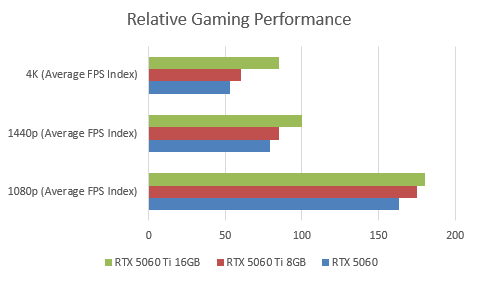
Based on our 5060 benchmark tests across multiple games, the RTX 5060, 5060 Ti 8GB, and 5060 Ti 16GB show significant performance differences at various resolutions.
1080p: All three cards run smoothly, with minimal perceptible differences—performance varies by only about 2–10%. VRAM has little impact at this resolution.
1440p: The 5060 Ti 8GB performs slightly better than the base 5060, while the 16GB version provides greater stability in large scenes and at high settings. On average, the 8GB Ti is about 18% slower than the 16GB Ti.
4K: The 5060 Ti 16GB shows the most significant advantage. The doubled VRAM eliminates key bottlenecks, delivering over 60% higher average performance compared to the 5060.
3D Rendering/AI Image Generation
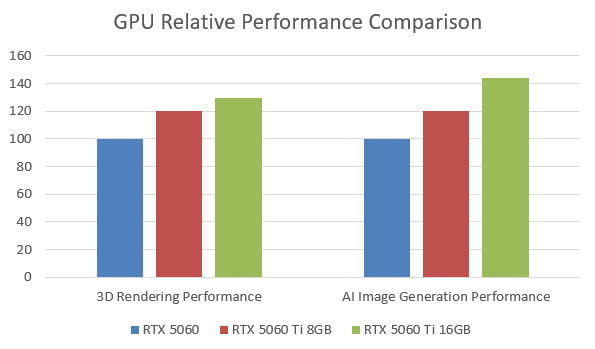
5060 Ti (8G) vs 5060 Ti (16G): In 3D rendering or small-to-medium AI image generation tasks, the difference between the two VRAM versions of the 5060 Ti is less pronounced than in gaming, with performance varying by only 5–14%.
5060 vs 5060 Ti (8G): The 5060 Ti 8GB is approximately 20–25% faster than the base 5060 in AI and 3D rendering, primarily due to the increased number of CUDA cores and higher FP32 performance. The 16GB version only shows a clear advantage in large scenes, high-resolution workloads, or very large models, as the additional VRAM helps reduce data transfer between GPU memory and system memory.
🔍 Need RTX 5060 or 5060 Ti power without buying the card?
👉 DatabaseMart offers dedicated RTX 5060 GPU servers, ideal for AI training, inference, and rendering. Enjoy high stability, dedicated resources, and unmetered bandwidth — explore detailed specs and real-world AI workload performance benchmarks.
Price & Value: RTX 5060 vs 5060 Ti (8GB/16GB)
| Platform | RTX 5060 (USD) | RTX 5060 Ti 8GB (USD) | RTX 5060 Ti 16GB (USD) | Price Difference: 5060 Ti 8GB vs 5060 (%) | Price Difference: 5060 Ti 16GB vs 5060 Ti 8GB (%) |
|---|---|---|---|---|---|
| Official MSRP | $299 | $379 | $429 | +27% | +13% |
| Amazon | $299–$329 | $369–$399 | $429–$459 | +23–30% | +8–24% |
| Third-Party Resellers (eBay etc.) | $280–$442 | $325–$400 | $450–$480 | +16–27% | +13–38% |
Why buy when you can host? Get the same GPU at 25% of the cost, with full CPU, RAM, disk, and resources included.
👉 View RTX 5060 GPU server options
5060 vs 5060 Ti 8G vs 5060 Ti 16G– Pros & Cons
| Model | Pros | Cons |
|---|---|---|
| RTX 5060 (8GB) | ✅ 5060 has the lowest price, very accessible entry-level card ✅ Good power efficiency for 1080p gaming ✅ Widely available in the market |
❌ Lowest CUDA cores and memory ❌ Struggles with higher resolutions and ray tracing ❌ Not suitable for heavy AI/3D workloads |
| RTX 5060 Ti 8GB | ✅ Balanced price-to-performance, clear upgrade over 5060 ✅ Great for high-FPS mid-level 1440p gaming and light 3D rendering ✅ Suitable for entry-level creators |
❌ Around 27% more expensive than 5060 ❌ 8GB VRAM may become limiting in future AI/ heavy 3D tasks ❌ Higher resale/second-hand market price |
| RTX 5060 Ti 16GB | ✅ Doubled VRAM, ideal for 4K gaming, AI training and 3D rendering ✅ Better future-proofing for demanding workloads ✅ More headroom for multitasking and creators |
❌ 40%+ higher cost compared to 5060 ❌ Performance gains mainly visible in memory-intensive tasks ❌ Higher launch premium on most platforms |
5060 Server Hosting
“5060 hosting” means servers or cloud instances with RTX 5060 GPUs, allowing remote access without the cost of buying or maintaining hardware. Database Mart’s 5060 servers, with 99.9% uptime, 24 CPU cores, and over 1TB of SSD storage, provide stable performance for streaming, live broadcasting, light 3D rendering, AI, and other multimedia workloads.
Compared to local workstations, server hosting saves on electricity, cooling, and maintenance, while offering easy scalability and remote access—perfect for freelancers, small studios, or AI developers.
Still unsure which GPU server to choose?
👉 Get expert recommendations from DatabaseMart.
Conclusion
In the end, the RTX 5060 series offers solid options across different budgets and workloads. The base 5060 stands out as the best value for pure 1080p gaming, while the 5060 Ti 8GB strikes a balance for those who want smoother performance in 1440p titles or light creative work. For users aiming to tackle mid-sized AI models, heavier 3D rendering, or simply seeking stronger future-proofing, the 16GB 5060 Ti is the clear choice. Your decision ultimately depends on whether you prioritize upfront savings, balanced performance, or long-term capability.
5060 ti vs 5060, 5060 vs 5060 ti, 5060 benchmark, 5060 price, 5060 specs, 5060 ti specs, 5060 ti 8gb vs 5060 ti 16gb