


RX 7600 vs RTX 3060: Which GPU Wins in Gaming, AI, Rendering?
Here you can check out how AMD RX 7600 stacks up against Nvidia RTX 3060 in benchmarks, 8GB/12GB performance tests, and price points. We analyze 7600 vs 3060 12GB/8GB in real-world to help you choose the right GPU for your setup.
Summary of RX 7600 vs RTX 3060 (8GB/12GB)
- Key Features: The RX 7600 offers excellent 1080p gaming performance and high value for mid-range users; the RTX 3060 8GB provides solid performance for mid-range gaming, 3D rendering, and light AI tasks; the RTX 3060 12GB features higher VRAM, optimized CUDA/OptiX support, and strong performance for 3D rendering, AI inference, and training.
- Industries: Suitable for gaming, content creation, 3D modeling and animation, video editing, light AI/ML research, and visualization.
- Popular Software: Compatible with Blender, Adobe Creative Suite, Cinema 4D, Premiere Pro, After Effects, DaVinci Resolve, PyTorch, TensorFlow, Stable Diffusion, and mainstream AAA games at Full HD or 4K.
RX 7600 vs RTX 3060 – Background Comparison
| Brand / GPU | Release Year | Official Performance Description (Excerpt) | MSRP / Price |
|---|---|---|---|
| AMD Radeon RX 7600 (8GB) | 2023 | “The AMD Radeon RX 7600 delivers high-performance 1080p gaming with the efficient RDNA 3 architecture.” | $269 |
| NVIDIA GeForce RTX 3060 (8GB) | 2021 | “Designed for mainstream gamers, the RTX 3060 8GB brings ray tracing and DLSS to 1080p and 1440p experiences.” | ~$329 (varies by partner) |
| NVIDIA GeForce RTX 3060 (12GB) | 2021 | “Faster than the RTX 2060 SUPER by an average of 40%, enabling smooth gameplay and creative applications.” | $329 |
NVIDIA RX 7600 vs RTX 3060 – Specifications Comparison
7600 vs 3060 Core Specs
| Parameter | AMD Radeon RX 7600 | NVIDIA GeForce RTX 3060 (8GB) | NVIDIA GeForce RTX 3060 (12GB) | Difference / Advantage |
|---|---|---|---|---|
| Architecture | RDNA 3 | Ampere | Ampere | RX 7600 uses newer RDNA 3 architecture |
| CUDA / Stream Cores | 2048 | 3584 | 3584 | RTX 3060 has more cores (~75% more) |
| Memory Type | GDDR6 | GDDR6 | GDDR6 | Same memory type |
| Memory Capacity (VRAM) | 8 GB | 8 GB | 12 GB | 3060 12GB has more VRAM |
| Memory Bus | 128-bit | 128-bit | 192-bit | 3060 12GB has wider bus |
| Memory Bandwidth | ~288 GB/s | ~240 GB/s | ~360 GB/s | 3060 12GB has highest bandwidth |
| Core Frequency (Boost) | ~2.655 GHz | ~1.78 GHz | ~1.78 GHz | RX 7600 has higher boost clock |
| TDP (Power) | 165W | 170W | 170W | RX 7600 slightly more efficient |
| Interface / Bus | PCIe 4.0 | PCIe 4.0 | PCIe 4.0 | Same interface |
| FP32 Performance | ~10.1 TFLOPS | ~12.3 TFLOPS | ~12.7 TFLOPS | 3060 12GB leads slightly |
| Ray Tracing / Tensor | 2nd-gen RT, 3rd-gen Tensor | 2nd-gen RT, 3rd-gen Tensor | 2nd-gen RT, 3rd-gen Tensor | Similar capabilities |
7600 vs 3060 Advanced Features
| Parameter | AMD Radeon RX 7600 | NVIDIA GeForce RTX 3060 (8GB) | NVIDIA GeForce RTX 3060 (12GB) | Difference / Advantage |
|---|---|---|---|---|
| L2 / Infinity Cache | 32 MB | 3 MB | 3 MB | RX 7600 has much larger cache |
| Texture Units | 128 | 112 | 112 | RX 7600 has more texture units |
| **ROP Units ** | 64 | 48 | 48 | RX 7600 has more render output units |
| FP16 / Half-Precision | ~20.2 TFLOPS | ~24.6 TFLOPS | ~25.4 TFLOPS | RTX 3060 better for compute |
| Upscaling Technology | FSR | DLSS | DLSS | 3060 supports DLSS, better for AI upscaling |
| Recommended PSU | 450W | 550W | 550W | RX 7600 has lower PSU requirement |
| Card Length / Dimensions | 204mm x 115mm | ~242mm x 112mm | ~242mm x 112mm | RX 7600 more compact |
| Display Outputs | 1x HDMI 2.1a, 3x DP 2.1 | 1x HDMI 2.1, 3x DP 1.4a | 1x HDMI 2.1, 3x DP 1.4a | RX 7600 supports newer DP 2.1 |
| VR / Multi-Monitor Support | Yes | Yes | Yes | Both support VR & multi-monitor |
| Driver / Software Features | Radeon Software, FSR | GeForce Experience, DLSS, Reflex | GeForce Experience, DLSS, Reflex | Ecosystem differs |
Key Differences
Architecture & Core Count
The RX 7600 is built on the newer RDNA 3 architecture, while the RTX 3060 uses NVIDIA’s earlier Ampere architecture. Although the 3060 has significantly more cores (~75% more), the RX 7600 gains efficiency from its newer design.
Memory & Bandwidth
The RTX 3060 12GB clearly leads with more VRAM (12GB vs 8GB), a wider 192-bit bus, and much higher memory bandwidth (~360 GB/s) than RT 7600. This benefits high-resolution gaming and memory-heavy workloads. The RX 7600 and RTX 3060 8GB are closer in this category.
Cache & Clock Speeds
The RX 7600 compensates for its narrower bus with a much larger L2/Infinity Cache (32MB vs 3MB) and a far higher boost clock (~2.66 GHz vs ~1.78 GHz). This reduces latency and boosts performance at 1080p. It also features more Texture Units and ROPs, aiding rendering.
Features & Ecosystem
A key differentiator is upscaling: the RTX 3060 supports DLSS, which generally delivers stronger AI-enhanced performance in supported titles. The RX 7600 relies on AMD FSR, which is widely compatible across hardware and supports the newer DisplayPort 2.1 standard.
Power & Size
The RX 7600 is more efficient (165W vs 170W) and has a much lower PSU requirement (450W vs 550W) than RTX3060. RX 7600's compact design also makes it easier to fit into smaller builds.
RX 7600 vs RTX 3060 Benchmark: Performance Across Different Scenarios
RX 7600 vs RTX 3060 in Gaming
1080p (Full HD)
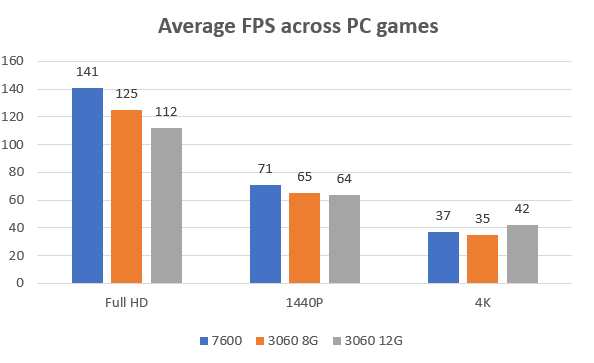
At 1080p, the RX 7600 benchmark shows it leading with 141 FPS, ahead of the RTX 3060 8GB (125 FPS) and the 3060 12GB (112 FPS). This advantage comes mainly from the RX 7600’s higher boost clock and its large 32MB Infinity Cache, which reduce memory latency and allow RDNA 3 to deliver strong raster performance at lower resolutions. Meanwhile, the RTX 3060 models rely more on memory bandwidth and core count—factors that matter less at 1080p—so their advantage does not fully translate at this resolution.
1440p
At 1440p, the RX 7600 still holds a small lead (71 FPS), slightly outperforming the RTX 3060 8GB (65 FPS) and 3060 12GB (64 FPS). However, the gap narrows because the RX 7600’s 128-bit memory bus begins to limit throughput as resolution increases. The RTX 3060 cards start to benefit more from their wider 192-bit bus and higher overall bandwidth, reducing the 7600’s architectural efficiency advantage at this mid-resolution workload.
4K
At 4K, the RTX 3060 12GB pulls ahead with 42 FPS, surpassing both the RX 7600 (37 FPS) and RTX 3060 8GB (35 FPS). This shift happens because 4K is heavily dependent on memory bandwidth and VRAM capacity. The 12GB 3060’s 192-bit bus and significantly higher bandwidth provide the throughput needed for high-resolution textures and large frame buffers. The RX 7600’s narrower bus and smaller VRAM become bottlenecks at 4K, causing its earlier performance advantage to reverse.
Below is an example of benchmark values from a single game.
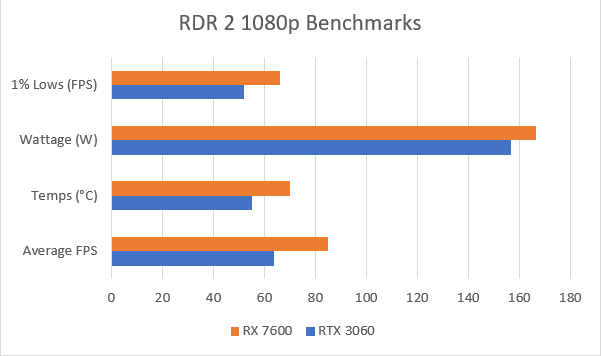
The RX 7600 outperforms the RTX 3060 in Red Dead Redemption 2 at 1080p, delivering 28.1% higher average FPS and smoother 1% lows. It does run hotter and draws slightly more power, while the RTX 3060 remains cooler and more efficient but trails in raw performance.
Summary
- RX 7600 benchmark shows it is the best choice for high-FPS 1080p gaming.
- RTX 3060 12GB is the strongest option for 4K and memory-demanding games.
- RTX 3060 8GB performs close to the RX 7600 at lower resolutions, but falls behind the 12GB model in 4K due to memory limitations.
RX 7600 vs RTX 3060 in 3D Rendering
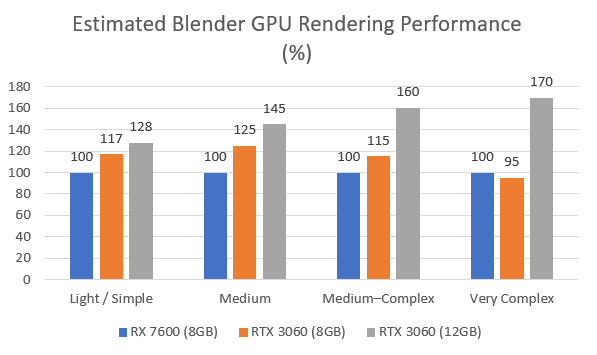
- RX 7600 (8GB) serves as the baseline. It performs close to the RTX 3060 in light scenes, but its 8 GB VRAM and narrower memory bus become bottlenecks as scene complexity increases.
- RTX 3060 (8GB) is slightly better than the RX 7600 in light and medium scenes, but performance may drop in complex scenes due to limited VRAM.
- RTX 3060 (12GB) performs best across all scenarios, with 40%-70% more advantages in medium–complex and very complex scenes, mainly due to larger VRAM, higher memory bandwidth, and CUDA/OptiX rendering optimization.
RX 7600 vs RTX 3060 for AI Tasks
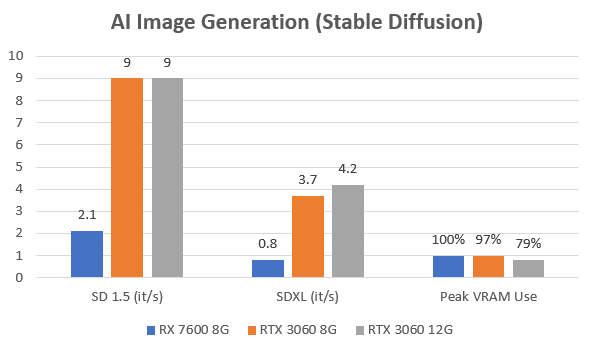
Under our test conditions (512×512, Euler a, 20 steps, single image), the performance gap between these GPUs becomes very clear. The RX 7600 suffers a heavy DirectML penalty, delivering only about 20–25% of the speed of comparable NVIDIA cards. The RTX 3060 8GB, while generally faster, frequently runs into VRAM limits with SDXL and slows down by roughly 30% due to memory swapping. On Linux, the RX 7600 can achieve 4–5 it/s through ROCm, but the setup remains unstable and prone to crashes, making it unreliable for consistent AI workloads.
The RTX 3060 12GB, with its unique large VRAM advantage and full CUDA support, remains the king of price-to-performance for entry-level AI workstations.
RT 7600 vs RTX 3060 Price & Value
| Platform / Source | RX 7600 8GB | RTX 3060 8GB | RTX 3060 12GB |
|---|---|---|---|
| Official MSRP | $269 | $329 | $329 |
| Amazon (new card) | $316 | $298 | $542 |
| eBay (used) | $250–$280 | $323 | $257–$279 |
From the table, it can be seen that although the official MSRP of the RTX 3060 (8GB) is about 20% higher than the RX 7600, the 3060 price on third-party platforms is actually lower than the RX 7600 ($250-$316). This may be attributed to the RX 7600’s excellent performance in 1080p gaming and its relatively low official price.
The new 12GB of RTX 3060 price remains relatively expensive, as it offers the strongest overall performance and is still a good choice for those with a sufficient budget.
RT 7600 vs RTX 3060 8G vs 3060 12G– Pros & Cons
| GPU Model | Strengths (Pros) | Weaknesses (Cons) |
|---|---|---|
| RX 7600 8GB | √ Good 1080p gaming performance | × Only 8GB VRAM limits heavy workloads |
| √ Strong theoretical FP32 compute power | × Weaker AI/ML support and fewer optimized libraries | |
| √ Lower retail price | × Less mature software ecosystem for AI/deep learning | |
| RTX 3060 8GB | √ Better CUDA/OptiX support than AMD | × 8GB VRAM often limited for SDXL / large models |
| √ Solid performance for mid‑range workloads | × Memory swapping can slow down AI tasks (~30%) | |
| √ Strong Blender/GPU rendering performance | × Narrow memory bus reduces bandwidth | |
| RTX 3060 12GB | √ Best overall balance for gaming + rendering | × Higher new card price |
| √ 12GB VRAM supports larger models/scenes | × Not as fast as higher‑end RTX GPUs (e.g., RTX 40/50) | |
| √ Excellent CUDA/OptiX + deep learning support | × Still limited for very large AI models |
RX 7600 & RTX 3060 Hosting
The AMD Ryzen 5 7600 and NVIDIA RTX 3060 are mid-range GPUs, and their cost can be significant. For short-term rendering, continuous inference training, or live-stream workloads, GPU hosting remains the most cost-effective solution. Database Mart offers 8GB RTX 3060 Ti and 16GB A4000 servers, making them ideal alternatives to the RX 7600 and RTX 3060.
Conclusion
For gamers who only need full HD, the AMD RX 7600 offers exceptional value and is an excellent choice. However, for 4K gaming, 3D rendering, or light LLM inference and training/fine-tuning tasks, GPU VRAM becomes a decisive factor, and the 12GB RTX 3060 clearly outperforms. While neither the 7600 nor the 3060 are the newest cards, both are more than capable of meeting most users’ basic needs.
RX 7600 vs RTX 3060, 7600 vs 3060, 3060 price, 3060 benchmark, 7600 vs 3060 12GB, 7600 benchmark