


AMD RX 7800 XT vs NVIDIA RTX 4060: Performance, Value, and Gaming Focus in 2025?
The AMD RX 7800 XT and NVIDIA RTX 4060 are designed for different types of gamers. The RX 7800 XT offers stronger raw performance and is better suited for 1440p and 4K gaming. The RTX 4060 focuses on power efficiency and features like DLSS 3 and ray tracing, making it a good choice for mainstream and budget users. In 2025, the decision comes down to higher performance versus better efficiency and AI features..
Summary Light of 7800 XT & 4060
- Key Features: RX 7800 XT offers high raw performance, wide memory bus, and excellent 1440p/4K gaming capabilities. RTX 4060 focuses on power efficiency, DLSS 3, and advanced ray tracing for modern gaming.
- Industries: Gaming, game development, streaming, content creation, eSports.
- Popular Software: DirectX 12 games, Vulkan titles, Unreal Engine, Blender, Adobe Premiere, Unity, DLSS-supported games.
RX 7800 XT vs RTX 4060 – Background Comparison
The AMD RX 7800 XT focuses on strong raw performance and high memory bandwidth, making it ideal for 1440p and 4K gaming and content creation. The NVIDIA RTX 4060 emphasizes power efficiency and modern features like DLSS 3 and ray tracing, targeting mainstream and budget-conscious gamers.
| Brand | Series | Model | Release Year | Official Positioning / Description | Market Price (USD) |
|---|---|---|---|---|---|
| AMD | RX 7000 Series | RX 7800 XT | 2025 | High-performance gaming GPU / wide memory bus and strong rasterization for 1440p and 4K gaming, content creation | ~$499–$549 |
| NVIDIA | RTX 40 Series | RTX 4060 | 2025 | Mainstream GPU / power-efficient with DLSS 3 and advanced ray tracing, suitable for mainstream and budget gamers | ~$299–$349 |
AMD RX 7800 XT vs NVIDIA RTX 4060 – Specifications Comparison
Core Specs Comparison
| Parameter | RX 7800 XT | RTX 4060 | Difference / Advantage |
|---|---|---|---|
| Architecture | RDNA 3 | Ada Lovelace | Different architectures; RX 7800 XT focuses on raster performance, RTX 4060 on efficiency and AI features |
| CUDA / Stream Cores | 3,840 Stream Cores | 3,072 CUDA Cores | RX 7800 XT has more cores for raw raster performance |
| Ray Tracing Cores | 60 | 48 | RTX 4060 specialized for ray tracing |
| Memory Type | GDDR6 | GDDR6 | Both use GDDR6 memory |
| Memory Capacity | 16 GB | 8 GB | RX 7800 XT better for high-resolution gaming and texture-heavy workloads |
| Memory Bus | 256-bit | 128-bit | RX 7800 XT wider memory bus for higher throughput |
| Memory Bandwidth | 512 GB/s | 224 GB/s | RX 7800 XT roughly 2× higher bandwidth |
| FP32 Performance | ~24 TFLOPS | ~17 TFLOPS | RX 7800 XT stronger for raster and general compute |
| TDP (Power) | 300W | 115W | RTX 4060 much more power-efficient |
| Interface / Bus | PCIe Gen4 ×16 | PCIe Gen4 ×16 | Same PCIe interface |
| Target Workloads | High-resolution gaming, content creation, 3D modeling | Mainstream gaming, ray tracing, DLSS, streaming | RX 7800 XT for high performance; RTX 4060 for efficiency and AI-assisted features |
Advanced Features Comparison
| Feature / Capability | RX 7800 XT | RTX 4060 | Difference / Advantage |
|---|---|---|---|
| AI Acceleration | Basic AI for games / FSR 3 | DLSS 3, AI-powered upscaling | RTX 4060 better for AI-driven gaming features |
| Ray Tracing / Rendering | Hardware ray tracing supported | Advanced ray tracing with DLSS 3 | RTX 4060 stronger for real-time ray tracing in modern titles |
| Multi-GPU Support | Limited / CrossFire | NVLink not supported | Both limited for multi-GPU consumer setups |
| VRAM Advantage | 16GB GDDR6 | 8GB GDDR6 | RX 7800 XT better for texture-heavy and high-res gaming |
| Target Industries | Gaming, content creation, 3D modeling | Gaming, streaming, casual content creation | RX 7800 XT for performance-demanding users; RTX 4060 for mainstream and budget gamers |
| Popular Software | Unreal Engine, Blender, Adobe Premiere, DirectX 12 / Vulkan games | DLSS-supported games, Unity, Blender, Adobe Creative Suite | RX 7800 XT better for high-res creative workloads; RTX 4060 optimized for AI-assisted gaming |
The AMD RX 7800 XT focuses on raw gaming performance, high memory bandwidth, and strong rasterization for 1440p and 4K gaming as well as content creation. The NVIDIA RTX 4060 emphasizes power efficiency, DLSS 3, and advanced ray tracing for mainstream and budget-conscious gamers. In 2025, the choice comes down to high-resolution and high-performance gaming (RX 7800 XT) versus efficiency, AI-assisted features, and ray tracing support (RTX 4060).
RT 7800 XT vs RTX 4060 Benchmark: Performance Across Different Scenarios
Game Performance
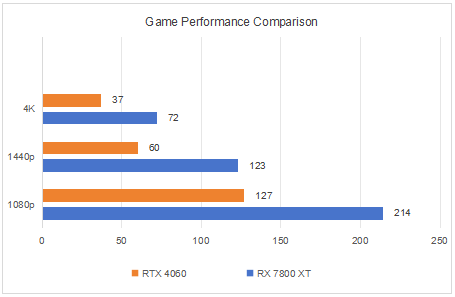
When comparing RX 7800 XT vs RTX 4060 performance, the RX 7800 XT clearly leads across all major gaming resolutions. At 1080p, the RX 7800 XT achieves 214 fps, significantly higher than the RTX 4060’s 127 fps. Moving to 1440p, the gap widens, with 123 fps for the RX 7800 XT versus 60 fps for the RTX 4060, almost double the frame rate. Even at 4K, the RX 7800 XT maintains 72 fps, while the RTX 4060 drops to 37 fps, showing that the RX 7800 XT is much better for high-resolution gaming. Overall, in terms of gaming performance, the RX 7800 XT delivers smoother, more consistent frame rates, making it the superior choice for gamers who demand high FPS and excellent performance at 1440p and 4K resolutions.
3D Rendering Performance
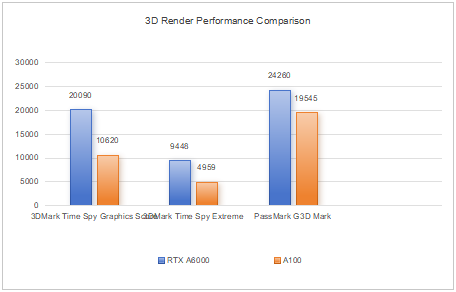
When comparing the RX 7800 XT and the RTX 4060, the performance gap is quite clear. In 3DMark Time Spy Graphics, the RX 7800 XT scores 20,090, nearly double the RTX 4060’s 10,620. The trend continues in 3DMark Time Spy Extreme, where the RX 7800 XT achieves 9,448 compared to 4,959 for the RTX 4060. Even in PassMark G3D Mark, the RX 7800 XT leads with 24,260 versus the RTX 4060’s 19,545.
Overall, the RX 7800 XT demonstrates significantly higher graphics performance, making it a stronger choice for gamers and content creators seeking top-tier performance.
Price & Value: RX 7800 XT vs RTX 4060
| Platform | RX 7800 XT (USD) | RTX 4060 (USD) | Price Difference: RTX 4060 vs RX 7800 XT (%) |
|---|---|---|---|
| Official MSRP | $449 | $319 | –29% |
| Amazon / Enterprise Resellers | $450–$480 | $310–$330 | –27% to –31% |
| Secondary / Gray Market | $430–$470 | $300–$320 | –30% |
The RX 7800 XT costs roughly 27–31% more than the RTX 4060, but it delivers stronger raw rasterization and higher rendering performance in games and creative workloads.
For gaming at 1440p/4K, content creation (Blender, DaVinci Resolve, Premiere Pro), and tasks that benefit from higher VRAM and memory bandwidth, the RX 7800 XT offers better price-to-performance value, while the RTX 4060 is more budget-friendly and efficient for lower-resolution gaming and light creative workloads.
AMD RX 7800 XT vs NVIDIA RTX 4060 – Pros & Cons
| Model | Pros | Cons |
|---|---|---|
| RX 7800 XT | ✅ Strong raw gaming performance and high FPS in most modern titles | ❌ Higher power consumption (~263 W TDP) |
| ✅ 16 GB VRAM and wide memory bandwidth, suitable for 1440p/4K gaming and future-proofing | ❌ Lacks NVIDIA DLSS, Tensor cores, and CUDA acceleration | |
| ✅ Better rasterization performance and price-to-performance for high-end gaming | ❌ Ray tracing performance weaker than RTX 4060 | |
| RTX 4060 | ✅ Lower power consumption (~115 W TDP), good efficiency and thermals | ❌ Weaker raw gaming performance compared to RX 7800 XT |
| ✅ Supports DLSS 3 and mature ray tracing technology | ❌ Smaller 8 GB VRAM may limit high-res textures and future-proofing | |
| ✅ Budget-friendly, strong NVIDIA software ecosystem (CUDA, AI acceleration, creative apps) | ❌ Narrower memory bus and lower memory bandwidth |
4060 Hosting
The 4060 Server provides cloud or dedicated instances powered by RTX 4060 GPUs, offering remote access to high-performance graphics without the need to purchase physical hardware. Database Mart’s RTX4060 server features dual Intel Xeon CPUs, 64GB RAM, fast SSD storage, and 99.9% uptime, making it ideal for gaming servers, AI inference, 3D rendering, HD video editing, and other GPU-intensive workloads. Compared to local workstations, GPU server hosting reduces costs on electricity, cooling, and maintenance, while delivering scalable performance accessible from anywhere. Freelancers, content creators, small studios, and developers can enjoy stable GPU computing without a large upfront investment.
Although we don’t offer the RX 7800 XT, our RTXA4000 server (16GB GDDR6) serves as a powerful alternative, providing strong performance for gaming, professional workloads, and modern applications.
Conclusion
Overall, the RX 7800 XT vs RTX 4060 comparison highlights strong options for different use cases and budgets. The RX 7800 XT excels in raw gaming performance, high-resolution rendering, and creative workloads, offering substantial VRAM and memory bandwidth, making it ideal for 1440p/4K gaming, video editing, and 3D rendering tasks. The RTX 4060, on the other hand, provides efficient performance with lower power consumption, advanced features like DLSS 3 and real-time ray tracing, and solid performance for mainstream gaming and professional applications, making it a cost-effective choice for users seeking stable GPU performance without heavy upfront investment.
AMD RX 7800 XT vs NVIDIA RTX 4060, RX 7800 XT vs RTX 4060, AMD 7800 XT vs NVIDIA 4060, RX 7800 XT vs RTX 4060 performance, RX 7800 XT gaming benchmarks, NVIDIA 4060 price, RTX 4060 specs