


AMD vs NVIDIA: RX 7800 XT vs RTX 4070 Performance Showdown in 2025
The RX 7800 XT vs RTX 4070 showdown represents one of the most heated battles in the AMD vs NVIDIA rivalry. Both GPUs target the sweet spot of high-end 1440p gaming, offering a perfect blend of performance, efficiency, and price. Whether you’re chasing higher FPS, smoother ray tracing, or superior value for money, this Radeon RX 7800 XT vs RTX 4070 comparison will reveal which card truly dominates in 2025 — and which one deserves a place in your next gaming build.
Summary of RX 7800 XT vs RTX 4070
The RTX 4070 and RX 7800 XT are two of the most notable GPUs in the mid-to-high-end market, representing the ongoing AMD vs NVIDIA competition.
Both target high-end 1440p and 4K gaming, content creation, and AI workloads, but they excel in different areas. The RTX 4070 focuses on AI acceleration, ray tracing, and energy efficiency, powered by its Ada Lovelace architecture and features like DLSS 3. It offers smoother performance in AI tasks and next-gen visuals, making it ideal for creators and gamers who prioritize efficiency and advanced features.
Industry Applications
Both the RTX 4070 and RX 7800 XT excel in:
Gaming and real-time ray tracing
Both GPUs provide smooth 1440p and 4K gameplay. The RTX 4070 leads in ray tracing performance and AI-assisted features like DLSS 3, while the 7800 XT vs 4070 tests show AMD excels in raw rasterization and high-resolution textures.Content creation, rendering, and AI acceleration
Applications such as Adobe Creative Suite, Blender, DaVinci Resolve, TensorFlow, and PyTorch run efficiently on both GPUs. However, the RTX 4070’s AI cores and RTX 4070 specs make it slightly faster for AI image generation and model training, whereas the AMD 7800 XT shines in traditional 3D rendering and large scene handling.Professional streaming, multi-monitor setups, or high-refresh-rate workflows
Both cards can drive multiple displays and high-refresh-rate monitors for smooth streaming and productivity. The 7800 XT’s larger VRAM (16GB GDDR6) gives it an edge in memory-intensive creative tasks, while NVIDIA’s efficiency favors AI-driven workflows.
In the RX 7800 XT vs RTX 4070 comparison, the RTX 4070 excels at AI-accelerated tasks and ray tracing, while the Radeon RX 7800 XT shines in raw performance and memory capacity, making it ideal for traditional gaming and creative workloads.
Background Comparison: RTX 4070 vs RX 7800 XT
| Feature | NVIDIA RTX 4070 | AMD RX 7800 XT |
|---|---|---|
| Release Date | April 13, 2023 | September 6, 2023 |
| Launch Price | $599 | $499 |
| Architecture | Ada Lovelace | RDNA 3 |
| VRAM | 12GB GDDR6X | 16GB GDDR6 |
| Key Technologies | DLSS 3, Ray Tracing, AI Acceleration | Large VRAM, Strong Rasterization Performance |
| Target Use | High-FPS Gaming, AI-Enhanced Workflows | High-Resolution Gaming, Memory-Intensive Creative Workflows |
From the table, it is clear that the RTX 4070 prioritizes AI-enhanced performance, ray tracing, and energy efficiency, making it ideal for AI workflows and next-gen graphics. On the other hand, the RX 7800 XT emphasizes raw rasterization power and larger VRAM, which is advantageous for high-resolution gaming and memory-intensive creative tasks. Therefore, the radeon rx 7800 xt vs rtx 4070 comparison highlights NVIDIA’s strength in AI and ray tracing, while 7800 XT vs 4070 underscores AMD’s advantage in traditional performance and VRAM capacity.
RTX 4070 vs RX 7800 XT – Detailed Specifications Comparison
| Specification | NVIDIA RTX 4070 | AMD Radeon RX 7800 XT |
|---|---|---|
| GPU Model | GeForce RTX 4070 | Radeon RX 7800 XT |
| Architecture | Ada Lovelace | RDNA 3 |
| CUDA Cores / Stream Processors | 5,888 CUDA Cores | 4,352 Stream Processors (AMD equivalent) |
| Memory Type | GDDR6X | GDDR6 |
| Memory Capacity | 12GB | 16GB |
| Memory Bandwidth | 504.2 GB/s | 624.1 GB/s |
| Core Frequency (Base/Boost) | 1920 MHz / 2475 MHz | 1295 MHz / 2430 MHz (game/boost) |
| TDP | 200W | 263W |
| Interface | PCIe 4.0 x16 | PCIe 4.0 x16 |
| FP32 Performance | 22 TFLOPS | 19.5 TFLOPS (approx.) |
| Tensor Cores / AI Units | 4th Gen Tensor Cores | AMD AI Accelerators |
| PCIe Lanes | 16 | 16 |
Spec Analysis:
Memory and Bandwidth:
The RX 7800 XT has larger VRAM (16GB vs 12GB) and higher bandwidth (624.1 GB/s vs 504.2 GB/s), giving it an advantage for high-resolution gaming, large textures, and memory-intensive workloads.Core Frequencies and TDP:
The RTX 4070 offers higher base and boost frequencies relative to its TDP (1920/2475 MHz at 200W) compared to the RX 7800 XT (1295/2430 MHz at 263W), highlighting NVIDIA’s energy-efficient performance.Architecture and AI:
NVIDIA’s Ada Lovelace architecture with Tensor cores and DLSS 3 provides superior AI acceleration and ray tracing, while AMD’s RDNA 3 architecture focuses on raw rasterization power and large VRAM.
Overall, the RTX 4070 excels in AI-driven workflows and ray tracing, while the RX 7800 XT shines in traditional raster performance and memory-heavy creative or gaming tasks, making the 7800 XT vs RTX 4070 comparison particularly relevant for gamers and professionals.
7800 XT vs 4070 Benchmark: Performance Across Different Scenarios
Gaming Performance Comparison
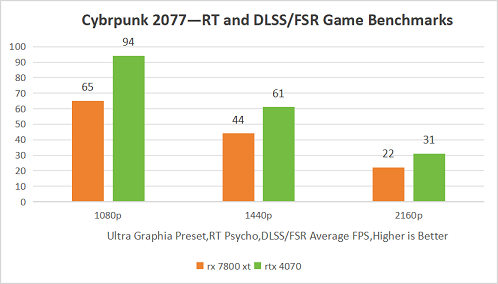
RT and DLSS/FSR Game Benchmarks
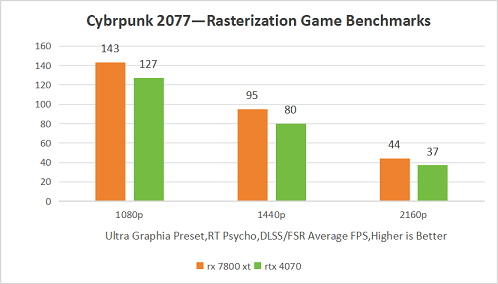
RTX 4070 vs RX 7800 XT – Rasterization Game Benchmarks
Based on the results, enabling ray tracing favors the RTX 4070 over the RX 7800 XT. While the RX 7800 XT can still maintain decent frame rates with ray tracing, it requires lowering graphics settings to achieve higher performance.
Regarding upscaling technologies, NVIDIA GPUs support both DLSS and FSR 2.0, whereas AMD 7800 XT only supports FSR. Overall, DLSS delivers superior image quality compared to AMD’s upscaling solutions. In purely rasterized games, the Radeon RX 7800 XT often outperforms the RTX 4070, especially in titles optimized or sponsored by AMD, where performance gains can be significant.
Average FPS and per-frame costs for popular games at different resolutions:
| Resolution | RX 7800 XT FPS | RTX 4070 FPS | RX 7800 XT Cost/Frame | RTX 4070 Cost/Frame |
|---|---|---|---|---|
| 1080p | 198 | 214 | $3.03 (-29.7%) | $2.33 (+29.7%) |
| 1440p | 104 | 123 | $5.76 (-42%) | $4.06 (+42%) |
| 4K | 63 | 72 | $9.51 (-37.2%) | $6.93 (+37.2%) |
In summary, RX 7800 XT vs RTX 4070 shows that the 7800 XT has a cost and performance advantage in rasterized gaming, while RTX 4070 leads when ray tracing is enabled. This highlights the ongoing AMD vs NVIDIA debate, with 7800 XT offering strong value in pure rasterization, and RTX 4070 specs excelling in advanced features.
3D Rendering & AI Image Generation Benchmarks
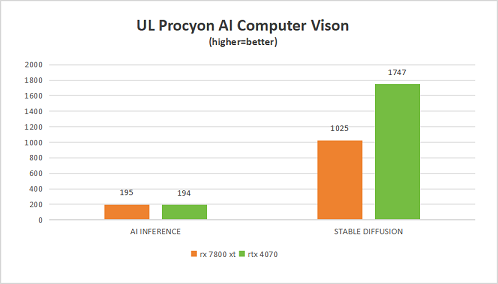
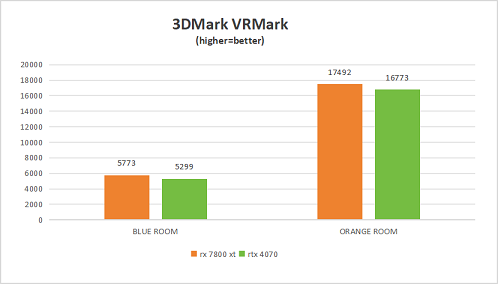
In content creation and AI workloads, RTX 4070 and RX 7800 XT show distinct strengths. Both GPUs demonstrate comparable inference performance in DirectML tests, but for AI image generation, RTX 4070 leveraging TensorRT achieves roughly 70% higher performance than RX 7800 XT in Stable Diffusion XL. This highlights the advantage of RTX 4070 specs in AI-driven tasks, making it the preferred choice for creators relying on neural networks and AI acceleration.
Conversely, in virtual reality applications, RX 7800 XT outperforms RTX 4070 across both light (Orange Room) and heavy (Blue Room) workloads in VRMark tests. Its high raw compute power and memory bandwidth provide a smoother VR experience, demonstrating that 7800 XT is particularly suited for VR-intensive tasks and rasterized workloads.
Summary:
- RTX 4070 excels in AI inference and image generation due to Tensor cores and NVIDIA acceleration.
- RX 7800 XT leads in VR and high-bandwidth rasterized workloads.
- These results emphasize the trade-offs in RX 7800 XT vs RTX 4070 and illustrate the ongoing AMD vs NVIDIA performance differences across gaming, rendering, and AI workloads.
Nvidia RTX 4070 vs AMD RX 7800 XT: Price&Vale
| Category | RX 7800 XT | RTX 4070 |
|---|---|---|
| Launch Price | $499 (Sep 2023) (amd.com) | $599 (Apr 2023) (nvidia.com) |
| Current Market Price | $450–$700 (amazon.com) | $500–$800 (amazon.com) |
| Second-Hand Price | $420–$600 (ebay.com) | $425–$600 (ebay.com) |
From a value perspective, the RX 7800 XT is clearly better suited for budget-conscious users. However, for those seeking AI acceleration and ray tracing performance, the RTX 4070 performs stronger. After the release of the RX 7800 XT, some RTX 4070 models dropped to around $549, roughly matching RX 7800 XT prices. This shows that NVIDIA is actively managing pricing in the mid-range market to remain competitive.
RX 7800 xt vs RTX 4070: Pros & Cons Comparison
| Model | Pros | Cons |
|---|---|---|
| RX 7800 XT | ✅ 16GB VRAM provides excellent headroom for high-resolution gaming and VRAM-intensive content creation. ✅ Excellent rasterization performance in most games. ✅ More affordable launch price and better value for budget-conscious users. ✅ Strong performance-per-dollar in the mid-range market. |
❌ Ray tracing performance is moderate — enabling it may require lowering graphics settings. ❌ Lacks Tensor cores — no AI acceleration comparable to NVIDIA. ❌ Supply is limited due to high demand and AIC partner customizations. |
| RTX 4070 | ✅ DLSS 3 and Tensor cores provide strong AI acceleration and deep learning performance. ✅ Excellent ray tracing performance in supported games. ✅ Competitive mid-range pricing after RX 7800 XT launch (~$549 for some models). ✅ Suitable for creators and gamers seeking AI-enhanced features. |
❌ Only 12GB VRAM — may limit high-resolution or VRAM-heavy workloads. ❌ Rasterization performance slightly lower than RX 7800 XT. ❌ Higher MSRP compared to RX 7800 XT launch price. |
Conclusion
In the RX 7800 XT vs RTX 4070 showdown, there’s no absolute winner—only the GPU that fits your needs, making the consumer the real winner in this crowded mid-range category. If value and VRAM matter most, the RX 7800 XT is the obvious choice, offering 16GB GDDR6 VRAM, superior rasterization, and DisplayPort 2.1 support. On the other hand, the slightly pricier RTX 4070 excels in ray tracing, productivity tasks, and energy efficiency.
Ultimately, it comes down to what you prioritize: value and VRAM, or AI and ray tracing performance. Whichever you choose, both cards deliver outstanding performance in their strengths, unlocking the full potential of gaming and content creation. If you prefer NVIDIA, the 4070 is a solid pick; if you lean toward AMD, the 7800 XT remains a strong contender at this price point.
rx 7800 xt vs rtx 4070, rtx 4070 vs rx 7800 xt, radeon rx 7800 xt vs rtx 4070, 7800 xt vs 4070, AMD vs NVIDIA, 7800xt, rtx 4070 specs, amd 7800 xt