


RX 9060 XT vs RTX 5060 Comparison — Which Mid-Range GPU Offers Better Value?
Get a clear, in-depth look at how the RX 9060 XT and RTX 5060 stack up in real-world gaming, performance, features, and pricing. This side-by-side breakdown highlights key strengths, value differences, and what each GPU offers for mid-range gamers in 2025.
RX 9060 XT vs RTX 5060 – Background Comparison
| GPU | Brand | Series | Release Year | Official Positioning | Current Market Price (Approx.) |
|---|---|---|---|---|---|
| RX 9060 XT (8 GB) | AMD | Radeon RX 9000 Series | 2025 | Mid-range mainstream gaming & cost-efficient solution. | ~$299 USD |
| RX 9060 XT (16 GB) | AMD | Radeon RX 9000 Series | 2025 | Mid-range card with expanded VRAM for heavier workloads and future-proofing. | ~$349 USD |
| RTX 5060 | NVIDIA | GeForce RTX 50 Series | 2025 | Mid-range GPU with modern ray tracing, AI and creator/ecosystem support. | ~$299 USD |
Both GPUs sit in the mid-range segment at similar price points. The RX 9060 XT focuses on strong value for mainstream gamers, while the RTX 5060 emphasizes ray tracing, AI features, and creator-focused performance.
RX 9060 XT vs RTX 5060 Specification Comparison
Core Specs: 9060 vs 5060
| Specification | RX 9060 XT | RTX 5060 | Difference / Advantage |
|---|---|---|---|
| Architecture | AMD RDNA 4 (Navi 44) | NVIDIA Blackwell | RTX stronger in ray tracing & AI; RX strong in raster performance. |
| CUDA / Stream Processors | 2,048 stream processors (32 CUs) | 3,840 CUDA cores | RTX better for parallel compute, AI, and creator workloads. |
| Memory Type | GDDR6 | GDDR7 | RTX has slightly faster memory tech; RX has mature GDDR6. |
| Memory Capacity (vRAM) | 8 GB / 16 GB | 8 GB | RX offers higher-capacity option for heavy textures/creators. |
| Memory Bus | 128‑bit | 128‑bit | Same bus width |
| Memory Bandwidth | ~320 GB/s | ~448 GB/s | RTX 5060 ~ 40% higher memory bandwidth |
| Core Frequency (Boost) | ~3,130 MHz | ~2,500 MHz | RX higher boost for raster; RTX optimized for efficiency & AI cores. |
| TDP (Power) | ~150–160 W | ~145 W | RTX slightly more power-efficient. |
| Interface / Bus | PCIe 5.0 x16 | PCIe 5.0 (some sources x8) | RX may utilize full x16 bandwidth; RTX depends on card design. |
| FP32 Performance | ~25.6 TFLOPS | ~19 TFLOPS | RX 9060 XT ~ 35% higher FP32 compute |
| Ray Tracing / Tensor Cores | 32 RT + 64 AI accelerators | 30 RT + 120 Tensor cores (5th Gen) | RTX 5060 ~ 87% more AI/Tensor cores |
| PCIe Version | PCIe 5.0 | PCIe 5.0 | Same version |
The RX 9060 XT offers ~ 35% higher FP32 compute (~25.6 TFLOPS vs ~19 TFLOPS) and optional 16 GB VRAM, while the RTX 5060 has ~ 87% more AI/Tensor cores (120 vs 64) and ~ 40% higher memory bandwidth (~ 448 GB/s vs ~ 320 GB/s). RX excels in raster performance and VRAM, RTX in ray tracing, AI, and memory throughput.
Advanced Features & Performance Comparison
| Feature Category | RX 9060 XT | RTX 5060 | Difference / Advantage |
|---|---|---|---|
| Neural Rendering / AI | 2nd‑gen AI accelerators | 5th‑gen Tensor cores | RTX has ~87% more AI cores, better for AI workloads |
| Upscaling / Frame Generation | FSR 4 ML‑enhanced upscaling | DLSS 4 Multi‑Frame Generation | RTX offers stronger upscaling & frame generation |
| Ray Tracing | Enhanced RT support (RDNA 4) | Latest-gen RT cores | RTX has stronger ray tracing hardware |
| Display & Connectivity | DisplayPort 2.1a, HDMI 2.1b | PCIe 5.0, modern outputs | RTX slightly better ecosystem support |
| Creator / Workflow Ecosystem | Good for gaming & general creative | Broad support: Studio, AI, streaming | RTX better for creators & AI-heavy workflows |
In the RX 9060 XT vs RTX 5060 comparison, the RX 9060 XT focuses on 2nd‑gen AI accelerators and FSR 4 upscaling, while the RTX 5060 offers 5th‑gen Tensor cores, DLSS 4, and stronger ray tracing. RTX provides ~87% more AI/Tensor cores (120 vs 64), excelling in AI, neural rendering, and creator workflows. Both support modern display outputs, but RTX’s broader ecosystem makes it better suited for creators and streaming tasks.
RX 9060 XT vs RTX 5060 Performance Across Different Scenarios
1080p Gaming Performance
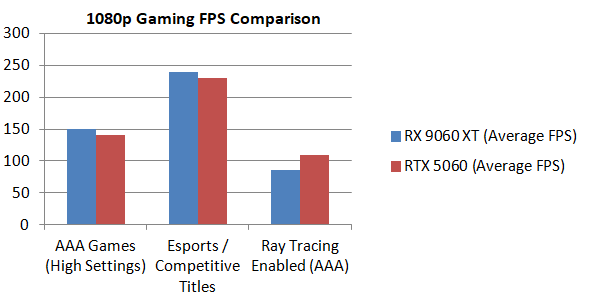
At 1080p, the RX 9060 XT slightly outperforms the RTX 5060 in standard AAA games ( ~ 150 vs 140 FPS, ~ 7% higher) and esports titles (~ 240 vs 230 FPS, ~ 4% higher). However, when ray tracing is enabled, the RTX 5060 leads significantly (~ 110 vs 85 FPS, ~ 29% higher). Overall, higher FPS indicates smoother gameplay, with RX favoring raw raster performance and RTX excelling in ray-traced visuals.
Content Creation & Rendering Performance
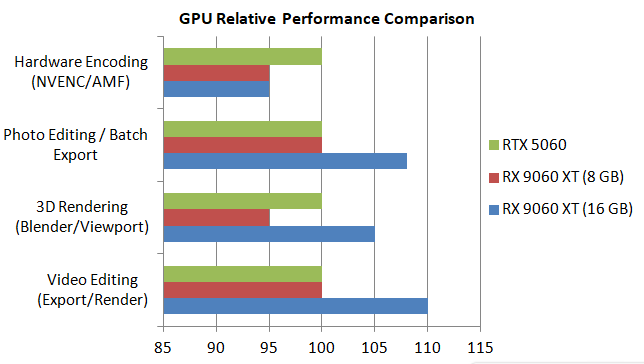
In content creation and rendering workloads, the RX 9060 XT delivers a clear performance advantage. The 16GB model offers roughly a 10% improvement in video editing render times and an 8% uplift in photo processing performance compared to the RTX 5060. 3D rendering is also slightly faster, with about a 5% gain.
However, the RTX 5060 still leads in hardware encoding, providing around 5% better performance thanks to NVIDIA’s more mature NVENC engine.
Price & Value: RX 9060 XT vs RTX 5060
| Platform | RX 9060 XT 8GB (USD) | RX 9060 XT 16GB (USD) | RTX 5060 (USD) | Price Difference: 9060 XT 8GB vs 5060 (%) | Price Difference: 9060 XT 16GB vs 5060 (%) |
|---|---|---|---|---|---|
| Official MSRP | $299 | $349 | $299 | +0% | +17% |
| Amazon | $299 – $330 | $349 – $389 | $299 – $320 | +0% – 10% | +10% – 28% |
| Third-Party Resellers (eBay etc.) | $290 – $360 | $340 – $400 | $280 – $330 | +3% – 24% | +3% – 36% |
The RX 9060 XT price sits close to the RTX 5060 price across most platforms, with small variations between the 8GB and 16GB versions. This keeps all three GPUs firmly positioned in the same mid-range segment, each offering a different mix of performance, VRAM capacity, and features. With pricing remaining relatively tight, users can focus on choosing the option that best matches their gaming resolution, workflow needs, and preferred ecosystem.
RX 9060 XT vs RTX 5060 – Pros & Cons
| GPU | Pros | Cons |
|---|---|---|
| RX 9060 XT 16GB | + Higher VRAM for 4K and large projects + Strong performance in video editing and 3D rendering + Competitive price-to-performance |
– Hardware encoding slower than RTX 5060 – Slightly higher MSRP |
| RX 9060 XT 8GB | + Matches RTX 5060 in most 1080p/1440p tasks + Good mid-range price |
– Limited VRAM for heavy 4K workloads – Slower encoding |
| RTX 5060 | + Excellent NVENC hardware encoding for streaming + Stable performance across creative apps and games + Mature driver support |
– Less VRAM for 4K or large projects – Slightly lower rasterized performance in content creation |
RTX 5060 Server Hosting
For users who want reliable GPU performance without the hassle of maintaining their own hardware, Database Mart’s RTX 5060 server hosting offers a simple and flexible solution. Powered by the rtx 5060 8gb, these servers deliver stable 1080p–1440p performance, DLSS-enhanced efficiency, and smooth acceleration for gaming, streaming, and everyday GPU-driven tasks. With affordable plans and on-demand access, this hosting option makes it easy to tap into the RTX 5060’s capabilities from anywhere—providing a practical, cost-effective alternative to building and managing a system yourself.
Conclusion
The RX 9060 XT and RTX 5060 are both strong choices for the best budget GPU for gaming. The RX 9060 XT excels in 4K rendering and content creation, while the RTX 5060 leads in hardware encoding and streaming. This AMD vs NVIDIA comparison highlights that your choice depends on whether you prioritize high-resolution workloads or encoding and streaming performance, with both offering solid price-to-performance value.
rx 9060 xt vs rtx 5060, 9060 vs 5060, rtx 5060 price, rx 9060 xt price, rtx 5060 specs, RX 9060 XT specs, rtx 5060 8gb, best budget gpu for gaming, amd vs nvidia comparison