


RX 9060 XT vs RTX 5060 Ti — AMD’s Power vs NVIDIA’s Efficiency?
Discover how AMD’s RX 9060 XT vs RTX 5060 Ti comparison stacks up in real-world performance, AI acceleration, and creative workloads. From gaming benchmarks to power efficiency and rendering tasks, this RX 9060 XT vs RTX 5060 Ti breakdown helps reveal which mid-range GPU truly delivers the edge for gamers, creators, and AI enthusiasts.
Summary Light of RX 9060 XT and RTX 5060 Ti
- Key Features: The RX 9060 XT and RTX 5060 Ti bring major upgrades in performance and efficiency to the mid-range GPU market. The RX 9060 XT, built on AMD’s RDNA 4 architecture, offers higher clock speeds, great power efficiency, and full support for DisplayPort 2.1 and AV1 encoding. Meanwhile, NVIDIA’s RTX 5060 Ti, powered by the Blackwell architecture, introduces DLSS 4, enhanced ray tracing, and AI acceleration for next-gen workloads.
- Industries: Both GPUs are ideal for 1080p and 1440p gaming, 3D modeling, video editing, and AI inference. They cater to gamers, content creators, and professionals who need reliable mid-range performance for creative and technical tasks.
- Popular Software: Compatible with major creative and AI tools such as Blender, Premiere Pro, DaVinci Resolve, TensorFlow, and Stable Diffusion, as well as popular games like Cyberpunk 2077 and Fortnite.
RX 9060 XT and RTX 5060 Ti – Background Comparison
| Model | Brand | Series / Architecture | Release Year | Official Positioning | Approx. Price |
|---|---|---|---|---|---|
| RX 9060 XT | AMD | Radeon RX 9000 Series / RDNA 4 | 2025 | Mainstream / mid-range GPU for 1080p–1440p gaming and creative workloads | ~$299–$349 |
| RTX 5060 Ti | NVIDIA | GeForce RTX 50 Series / Blackwell | 2025 | Mid-range upgrade with DLSS 4, AI acceleration, and advanced ray tracing | ~$379–$429 |
Both GPUs target the mid-range GPU card for gaming market with a focus on 1080p–1440p and creative workloads.
The RX 9060 XT stands out for its strong performance-per-dollar and power efficiency, while the RTX 5060 Ti offers next-gen advantages like DLSS 4, improved ray tracing, and AI acceleration.
In short, AMD delivers value; NVIDIA delivers features.
AMD RX 9060 XT & NVIDIA RTX 5060 Ti – Specification Comparison
Core Specs Comparison between RX 9060 XT and RTX 5060 Ti
| Specification | RX 9060 XT (AMD) | RTX 5060 Ti (NVIDIA) | Difference / Advantage |
|---|---|---|---|
| Architecture | RDNA 4 (Navi 44) | Blackwell (GB206) | RTX 5060 Ti features newer AI & RT tech; AMD focuses on efficiency |
| CUDA / Stream Cores | 2,048 Stream Processors / 32 CUs | 4,608 CUDA Cores | RTX 5060 Ti has ~2.2× more cores → ~25–30% higher compute power |
| Memory Type | GDDR6 | GDDR7 | RTX 5060 Ti’s GDDR7 offers ~40% higher bandwidth |
| Memory Capacity (vRAM) | 8 GB / 16 GB | 8 GB / 16 GB | Similar vRAM options — no clear advantage |
| Memory Bus | 128-bit | 128-bit | Same memory bus width |
| Memory Bandwidth | ~320 GB/s | ~448 GB/s | RTX 5060 Ti ~40% faster bandwidth |
| Core Frequency (Boost) | ~3,130 MHz | ~2,570 MHz | RX 9060 XT ~15–20% higher boost clock → faster gaming response |
| TDP (Power) | ~160 W | ~180 W | RX 9060 XT ~10–12% more power-efficient |
| Interface / Bus | PCIe 5.0 | PCIe 5.0 | Same interface |
| FP32 Performance | ~17 TFLOPs | ~23 TFLOPs | RTX 5060 Ti ~30% higher raw compute throughput |
| Ray Tracing / Tensor Cores | 32 RT / 16 AI | 36 RT / 144 Tensor | RTX 5060 Ti offers far superior RT & AI performance |
| PCIe Version | 5.0 | 5.0 | Same generation support |
Where Each GPU Excels: RX 9060 XT and RTX 5060 Ti
The RX 9060 XT delivers about 10–15% higher clock speeds and 10% lower power consumption, making it ideal for 1440p gaming and creators who value efficiency.
Meanwhile, the RTX 5060 Ti specs provide up to 30% higher compute power and 40% faster memory bandwidth, along with superior AI and ray tracing performance powered by its Blackwell architecture.
In short, AMD leads in efficiency and value, while NVIDIA dominates in AI, speed, and next-gen graphics performance.
RX 9060 XT vs RTX 5060 Ti Benchmark: Performance Across Different Scenarios
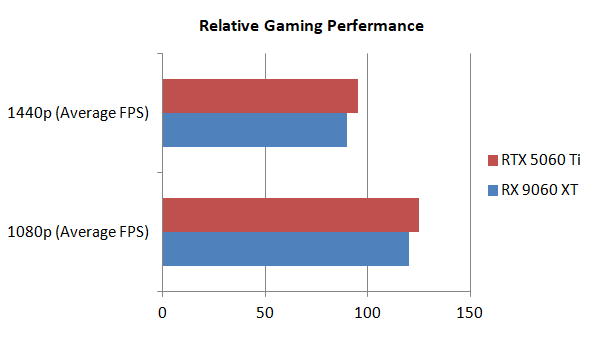
Gaming Performance
RX 9060 XT and RTX 5060 Ti deliver smooth 1080p and 1440p gaming performance. RX 9060 XT benefits from slightly lower power consumption, while RTX 5060 Ti has higher core frequency and better memory bandwidth, allowing it to pull slightly ahead in FPS at both resolutions. Both GPUs are excellent choices for mid-range gamers.
Ray Tracing & AI Upscaling
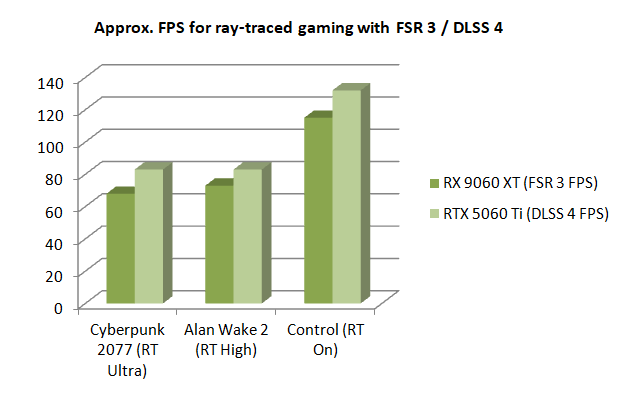
RTX 5060 Ti outperforms RX 9060 XT in ray tracing and AI upscaling. RX 9060 XT benefits from slightly lower power consumption, while RTX 5060 Ti’s advanced Ray Tracing cores and higher memory bandwidth allow it to deliver higher FPS at both 1080p and 1440p. Both GPUs support AI-driven upscaling, but NVIDIA’s GPU provides a smoother visual experience in ray-traced games.
AI / Content Creation Performance
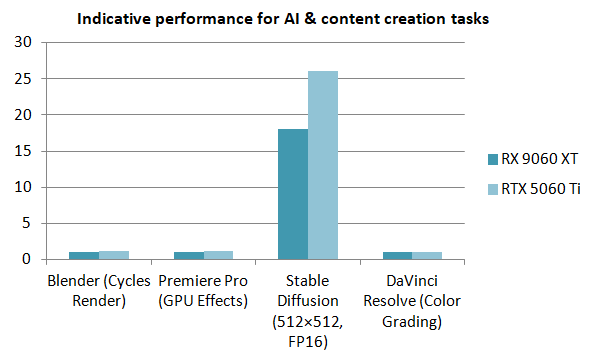
RTX 5060 Ti consistently outperforms RX 9060 XT in content creation and AI workloads. RX 9060 XT provides solid performance for Blender rendering, Premiere Pro GPU effects, Stable Diffusion, and DaVinci Resolve, while RTX 5060 Ti’s higher core frequency and Tensor Cores accelerate these tasks, delivering up to 44% faster AI inference in Stable Diffusion and noticeably improved GPU-accelerated editing performance. Both GPUs are suitable for mid-range creators, but NVIDIA offers a clear advantage for AI-focused workflows.
Price & Value: RX 9060 XT vs RTX 5060 Ti
| Platform | RX 9060 XT (USD) | RTX 5060 Ti (USD) | Price Difference (USD) | Price Difference (%) |
|---|---|---|---|---|
| Official MSRP | $299 | $379 | +$80 | +27% |
| Amazon | $280 – $340 | $370 – $430 | +$90 – $90 | +26% – +32% |
| Third-Party Resellers (eBay etc.) | $270 – $350 | $360 – $450 | +$90 – $100 | +26% – +29% |
The RTX 5060 Ti price roughly 25–30% more than the RX 9060 XT but delivers slightly higher FPS, better memory bandwidth, and AI acceleration. For budget-conscious gamers and creators, the RX 9060 XT offers excellent mid-range performance at a lower cost, while the RTX 5060 Ti is ideal for those seeking a bit more power and advanced features.
RX 9060 XT vs RTX 5060 Ti – Pros & Cons
| GPU Model | Pros | Cons |
|---|---|---|
| RX 9060 XT | - More budget-friendly - Lower power consumption - Solid 1080p / 1440p gaming performance - Good for mid-range content creation |
- Slightly lower FPS than RTX 5060 Ti - Lacks advanced AI acceleration - Ray tracing performance is weaker |
| RTX 5060 Ti | - Higher FPS at 1080p and 1440p - Better memory bandwidth and core frequency - Strong AI acceleration and ray tracing - Great for AI / content creation workloads |
- Higher price (~25–30% more than RX 9060 XT) - Slightly higher power consumption |
RX 9060 XT is a great choice for budget-conscious gamers and creators who want solid performance with lower power usage. RTX 5060 Ti offers enhanced FPS, AI capabilities, and ray tracing performance, making it ideal for those willing to pay more for extra features and smoother visuals.
RTX 5060 Server Hosting
For users needing mid-range GPU performance without owning physical hardware, Database Mart’s RTX 5060 server hosting provides an excellent balance of performance and value. With dedicated RTX 5060 GPUs, you can run mid-range gaming servers, AI inference tasks, or creative applications like Blender and Premiere Pro smoothly without investing in physical hardware.
This option complements our GPU comparisons: while RX 9060 XT and RTX 5060 Ti focus on personal PC performance, the RTX 5060 servers let users access GPU power remotely, making it ideal for testing, small-scale AI projects, or collaborative creative work.
Conclusion
In summary, the RX 9060 XT showcases AMD’s power and efficiency, offering solid 1080p/1440p gaming performance, lower power consumption, and great value for budget-conscious gamers and creators. The RTX 5060 Ti demonstrates NVIDIA’s efficiency and advanced features, delivering higher FPS, improved memory bandwidth, AI acceleration, and superior ray tracing for users who want extra performance.
Recommendation: Choose RX 9060 XT for cost-effective efficiency and solid mid-range performance, or RTX 5060 Ti for enhanced FPS, AI capabilities, and advanced gaming and content creation features. Both GPUs are strong mid-range options; your choice depends on whether you prioritize value or performance.
RX 9060 XT vs RTX 5060 Ti, AMD RX 9060 XT, NVIDIA RTX 5060 Ti, mid-range GPUs comparison, best GPUs for gaming 1080p, best GPUs for 1440p gaming, gaming performance comparison, rx 9060 xt price, ray tracing performance