


RX 9070 XT vs RTX 5070: The Ultimate GPU Battle
RX 9070 XT vs RTX 5070 shows the RX 9070 XT excels in 4K gaming and efficient power use, while the 5070 leads in AI acceleration and ray tracing. Considering RX 9070 XT price and RTX 5070 price, gamers and creators can decide whether they prioritize raw AI/3D power or balanced gaming and creative efficiency.
RX 9070 XT vs RTX 5070 – Background Comparison
| Brand | Series | Model | Release Year | Official Positioning | Market Price (USD) |
|---|---|---|---|---|---|
| AMD | Radeon | RX 9070 XT | 2025 | The AMD Radeon™ RX 9070 XT is designed for high-end 4K gaming and efficient creative workloads. Powered by AMD RDNA™ 4 architecture, it delivers smooth performance, energy efficiency, and advanced features such as FidelityFX™ Super Resolution. Ideal for gamers and content creators seeking a balance between power and cost-effectiveness. | Starting at $599 |
| NVIDIA | GeForce | RTX 5070 | 2025 | The NVIDIA® GeForce RTX™ 5070 targets AI-accelerated workloads, ray tracing, and professional creative tasks. With higher CUDA cores, Tensor cores, and GDDR7 memory, it offers superior throughput for AI rendering, 3D modeling, and next-gen gaming at high resolutions. Perfect for users prioritizing raw performance and AI capabilities. | Starting at $549 |
NVIDIA RTX 5070 vs RX 9070 XT – Specifications Comparison
The RTX 5070 and RX 9070 XT are high-end GPUs targeting gamers, content creators, and AI enthusiasts, each with its own strengths. The RTX 5070 leverages NVIDIA’s Blackwell 2.0 architecture, offering higher CUDA cores, faster GDDR7 memory, and advanced ray tracing and AI acceleration, making it ideal for 4K gaming, AI workloads, and high-performance rendering.
On the other hand, the RX 9070 XT utilizes AMD’s RDNA 4.0 architecture, providing larger memory capacity, wider memory bus, and high peak frequencies. This design favors memory-intensive applications, smooth gaming at high resolutions, and efficient power usage.
In short, the RTX 5070 excels in raw compute power and next-gen AI/ray tracing features, while the RX 9070 XT shines in memory-heavy tasks and efficient high-resolution gaming, offering users a choice based on performance priorities and workload needs.
Core Specs Comparison between RTX 5070 vs RX 9070 XT
| Parameter | RTX 5070 | RX 9070 XT | Difference / Advantage |
|---|---|---|---|
| Architecture | Blackwell 2.0 | RDNA 4.0 | RTX 5070 has newer Blackwell 2.0 architecture optimized for AI and ray tracing; RX 9070 XT uses RDNA 4.0 focusing on gaming efficiency. |
| CUDA Cores | 6,144 | 4,096 | RTX 5070 has significantly more parallel compute cores for higher processing power. |
| Memory Type | GDDR7 | GDDR6 | RTX 5070’s GDDR7 offers faster data rates, benefiting 4K/8K and AI workloads. |
| Memory Capacity | 12 GB | 16 GB | RX 9070 XT has larger VRAM, advantageous for memory-intensive tasks. |
| Memory Bus | 192-bit | 256 bit | RX 9070 XT has a wider memory bus, improving memory throughput for large datasets. |
| Memory Bandwidth | 672 GB/sec | 644.6 GB/s | RTX 5070 has slightly higher bandwidth, favoring peak performance workloads. |
| Core Frequency (Boost) | 2.51 | Up to 2970 MHz | RX 9070 XT has higher peak frequency; RTX 5070 optimized for efficiency and sustained workloads. |
| TDP (Power) | 250 W | 304 W | RTX 5070 consumes less power relative to its performance. |
| Interface / Bus | PCIe 5.0 x16 | PCIe 5.0 x16 | Both support the same PCIe interface. |
| FP32 Performance | 30.87 TFLOPS | 48.66 TFLOPS | RX 9070 XT has higher FP32 throughput, favoring raw compute performance. |
| Ray Tracing / Tensor | 4th Generation 94 TFLOPS | 3rd Gen | RTX 5070 has more advanced ray tracing and AI cores for next-gen graphics and ML tasks. |
| PCIe Version | 5.0 | 5.0 | Both use PCIe 5.0. |
Key Differences: RTX 5070 vs RX 9070 XT
Compute & AI Performance: The RTX 5070 offers 6,144 CUDA cores and advanced tensor cores, giving it a clear edge in AI workloads and parallel compute tasks, while the RX 9070 XT has 4,096 cores optimized for traditional graphics and memory-intensive operations.
Memory & Bandwidth: RX 9070 XT provides 16 GB GDDR6 on a 256-bit bus, slightly larger than RTX 5070’s 12 GB GDDR7 with 192-bit,favoring high-resolution asset handling, though the 5070’s GDDR7 is faster for extreme 4K/8K workloads.
FP32 & Rendering: RTX 5070 delivers higher FP32 throughput and better ray tracing performance, making it superior for rendering and AI acceleration.
Power & Efficiency: RX 9070 XT consumes more power (304 W vs 250 W) but achieves higher peak clock frequencies, offering better performance-per-clock in some gaming scenarios.
Use Case Focus: RTX 5070 targets users demanding next-gen AI, ray tracing, and 4K/8K rendering performance, whereas RX 9070 XT favors high-resolution gaming, memory-heavy workloads, and efficient rasterization performance.
Advanced Features & Performance Comparison
| Feature / Parameter | RTX 5070 | RX 9070 XT | Key Difference / Advantage |
|---|---|---|---|
| Market Segment | Desktop | Desktop | Both target high-end desktop users |
| Cost-effectiveness Evaluation | 74.07 | 63.00 | RTX 5070 has ~18% better value for money |
| Power Efficiency | 21.11 | 16.17 | RTX 5070 is more power-efficient |
| Boost Clock | 2,512 MHz | 2,970 MHz | RX 9070 XT higher boost favors small-batch rendering tasks |
| Tensor / RT Cores | 192 / 48 | 128 / 64 | RTX 5070 stronger for AI and ray tracing workloads |
| Synthetic Benchmark Score | 65.45 | 60.96 | RTX 5070 ~7.4% higher in synthetic tests |
| Average FPS (Full HD / 1440p / 4K) | 218 / 124 / 77 | 214 / 126 / 80 | RTX 5070 slightly faster in Full HD, RX 9070 XT slightly faster in 1440p & 4K |
| Cost per Frame ($, 1080p / 1440p / 4K) | 2.52 / 4.43 / 7.13 | 2.80 / 4.75 / 7.49 | RTX 5070 offers lower cost per frame across all resolutions |
| Popular Game Wins (Total Tested) | 40 / 63% | 12 / 19% | RTX 5070 performs better in the majority of popular games |
| Notable Game Outliers | Fortnite, Forza Horizon 5 | Witcher 3, Hogwarts Legacy | RX 9070 XT can outperform RTX 5070 in specific high-res or heavily optimized titles |
Note: While the RTX 5070 excels in cost-effectiveness, power efficiency, and AI/ray tracing workloads, the RX 9070 XT shines in 1440p–4K gaming and creative small-batch rendering, making each GPU appealing to different types of high-end users.
RTX 5070 vs RX 9070 XT Performance Across Different Scenarios
Artificial Intelligence Tests
With AI workloads becoming increasingly important for creative professionals and researchers, GPU performance in machine learning tasks is a key differentiator. GeekBench 6 ML provides a standardized test to measure throughput across single precision, half precision, and quantized precision operations.
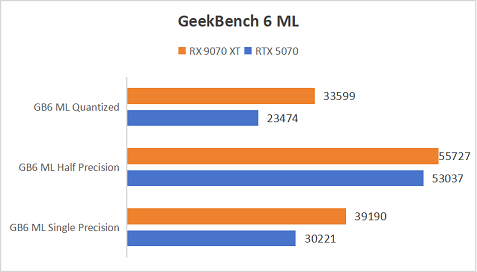
The RX 9070 XT leads in all AI tests, with especially strong gains in quantized (+43%) and single precision (+30%) workloads. Half-precision performance is closer, but RX 9070 XT still maintains an edge. Overall, for AI tasks, RX 9070 XT offers superior throughput, making it the better choice for professionals and enthusiasts.
Gaming Performance
To evaluate real-world gaming performance, we tested the average FPS of most popular games, with Counter-Strike 2 (CS2) highlighted as one of the most popular competitive titles.
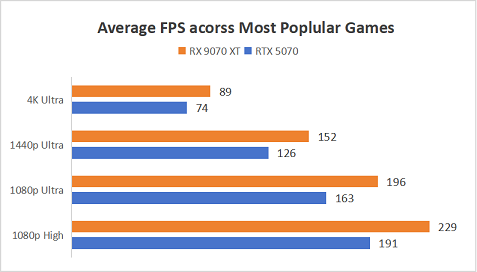
Looking at average FPS across most popular games, the RX 9070 XT shows a more pronounced advantage, outperforming the RTX 5070 by roughly 20% at most resolutions. At 1080p High, it hits 229 FPS versus 191 FPS on the RTX 5070, and the lead remains consistent at 1080p Ultra (196 vs. 163 FPS), 1440p Ultra (152 vs. 126 FPS), and 4K Ultra (89 vs. 74 FPS).
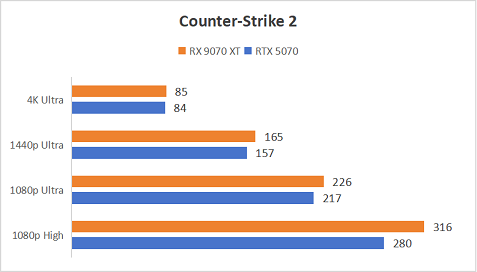
In Counter-Strike 2 (CS2) testing, the RX 9070 XT achieved 316 FPS at 1080p High, compared to the RTX 5070’s 280 FPS—a 12.9% advantage. Even at more demanding settings, RX 9070 XT maintains a slight edge, delivering 226 FPS at 1080p Ultra (+4.1%) and 165 FPS at 1440p Ultra (+5.1%).
These results highlight the RX 9070 XT’s superior performance in both mid-range and high-end gaming scenarios. Whether you’re aiming for smooth competitive play or immersive 4K experiences, the RX 9070 XT delivers consistently higher FPS with minimal drops, making it the preferred choice for gamers seeking reliable performance across all resolutions.
Combined Synthetic Benchmark Score
This is our combined benchmark score.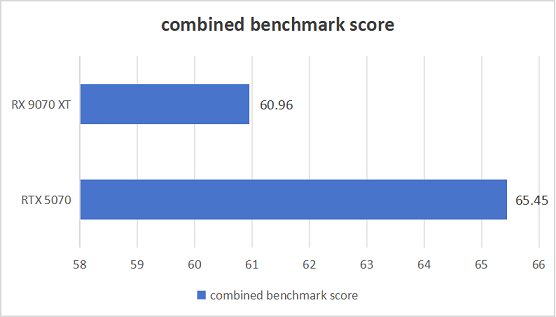
In combined synthetic benchmarks, the RTX 5070 scores 65.45, slightly outperforming the RX 9070 XT at 60.96, giving it a 7.4% advantage.
This indicates that the RTX 5070 has a marginal edge in raw computational and benchmark-oriented performance.
Passmark
This is the most ubiquitous GPU benchmark. It gives the graphics card a thorough evaluation under various types of load, providing four separate benchmarks for Direct3D versions 9, 10, 11 and 12 (the last being done in 4K resolution if possible), and few more tests engaging DirectCompute capabilities.
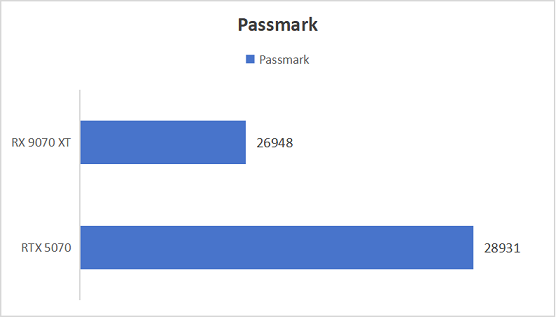
In the PassMark benchmark, the RTX 5070 scores 28,931, outperforming the RX 9070 XT at 26,948 by 7.4%. With a larger sample size (7,451 vs. 6,450), this suggests that the RTX 5070 consistently delivers slightly better performance across a variety of Direct3D versions and DirectCompute workloads.
Price Comparison: RX 9070 XT vs RTX 5070
While the official MSRP shows the RX 9070 XT slightly higher, online marketplaces present a wide range of prices for both GPUs, reflecting availability, demand, and resale market fluctuations. This makes it important for buyers to consider both performance and cost when choosing between the two cards.
Price Comparison
| Platform | RX 9070 XT (USD) | RTX 5070 (USD) | Price Difference (USD) | Price Difference (%) |
|---|---|---|---|---|
| Official MSRP | $599 | $549 | -$50 | -8.3% |
| Amazon | $599–$2,304 | $543–$2,535 | -$56 – +$231 | -9.3% – +10% |
| eBay | $408–$4,000 | $577–$3,594 | +$169 – -$406 | +41.4% – -10.2% |
User Value-for-Money Feedback
From a value-for-money perspective, the RX 9070 XT often delivers better real-world gaming performance at popular resolutions like 1080p and 1440p, even if its synthetic benchmark scores are slightly lower than the RTX 5070. For gamers looking to maximize FPS without paying a premium for NVIDIA-exclusive features, the RX 9070 XT offers excellent performance at a flexible price range.
Meanwhile, the RTX 5070 may appeal more to users who prioritize synthetic benchmarks, compute workloads, or NVIDIA-specific technologies, but it generally comes at a higher cost in both official and resale markets.
This makes the RX 9070 XT a cost-effective choice for budget-conscious gamers without compromising on high-quality gameplay.
RTX 5070 vs RX 9070 XT – Pros & Cons
| Model | Pros | Cons |
|---|---|---|
| RTX 5070 | ✅ Excellent value for money — around 18% better cost-effectiveness than RX 9070 XT ✅ Great performance in 1080p gaming and ray tracing workloads ✅ Lower power draw (250 W) and cooler operation ✅ Supports DLSS 3.5 and Frame Generation for smoother gameplay |
❌ Falls behind RX 9070 XT in 1440p and 4K gaming FPS ❌ Smaller VRAM (12 GB) limits performance in large textures or AI workloads ❌ Slightly weaker in AI throughput and FP32 compute |
| RX 9070 XT | ✅ Strong 1440p and 4K gaming performance — about 20% higher FPS in most modern titles ✅ Larger VRAM (16 GB GDDR6) and wider 256-bit bus for better high-res textures ✅ Competitive in AI inference and FP32 performance ✅ Slightly better performance per watt at high loads |
❌ Slightly higher power consumption (304 W) ❌ Lacks DLSS — FSR 3 is less refined in visual quality ❌ Lower driver optimization for some older or NVIDIA-optimized games |
RTX 5070 & RX 9070 XT GPU Hosting
The RTX 5070 and RX 9070 XT are both highly competitive graphics cards in the current mid-to-high-end market. The former excels in ray tracing, while the latter has an advantage in native 1440p and 4K gaming performance as well as AI capabilities.
However, for gamers or professional creators seeking peak performance, the limitations of a single GPU and potential supply constraints can be a concern. In such cases, high-performance GPU servers offer a more flexible and powerful computing solution, freeing you from the restrictions of local hardware upgrades or inventory availability.
Database Mart offers RTX 5090 GPU servers that can easily handle demanding tasks such as AI training, video rendering, and 3D modeling, allowing you to experience flagship-level GPU performance without the hassle of maintenance and upgrades.
For users seeking a more cost-effective alternative with ample VRAM, DBM also provides A4000 GPU servers provide 16GB memory, making them a great substitute for the RTX 5070 in AI workloads, creative projects, and compute tasks beyond gaming.
Conclusion
Both the RTX 5070 and RX 9070 XT remain highly competitive in 2025, but they excel in different areas:
Choose the RX 9070 XT if your priority is AI performance, high-resolution gaming, and memory-intensive workloads. With superior results across all AI benchmarks, larger VRAM, a wider memory bus, and high FP32 throughput, it delivers smooth 1440p and 4K gameplay and handles demanding creative and AI tasks with ease.
Choose the RTX 5070 if you value ray tracing, AI acceleration, and cost-effective performance. Its Blackwell 2.0 architecture, advanced tensor cores, and DLSS 3.5 support make it ideal for 1080p gaming, synthetic benchmarks, and next-gen rendering while maintaining lower power consumption.
While the RTX 5070 offers excellent efficiency and advanced AI/ray tracing features, the RX 9070 XT shines in real-world gaming and memory-heavy workloads, making each GPU appealing to users depending on their performance needs and priorities.
rx 9070 xt vs rtx 5070, 9070 xt vs 5070, 5070 vs 9070 xt, rx 9070 xt price, radeon rx 9070, rtx 5070 price, rx 9070 xt specs, rtx 5070 specs, 9070 xt performance, gpu test