


GPU Cloud Server vs. GPU Dedicated Server vs. GPU VPS
With the growing demand for AI training, 3D rendering, gaming, and data-intensive applications, GPUs have become one of the most critical computing resources. Today, businesses and developers can access GPU power through different hosting options, including GPU Cloud Servers, GPU Dedicated Servers, and GPU VPS.
Each solution offers unique benefits in terms of performance, cost, scalability, and control. However, choosing the right one depends on your workload and budget. In this article, we’ll break down the differences between these three GPU hosting options and help you decide which fits your needs best.
What is a GPU Cloud Server?
A GPU Cloud Server is a virtualized server that provides on-demand access to powerful GPUs hosted in a data center. Instead of purchasing and maintaining expensive hardware, users can rent GPU resources through a cloud platform and pay only for the time or capacity they need.
The key advantage of GPU cloud servers is flexibility. They allow you to scale resources up or down quickly, making them ideal for projects that require temporary or variable GPU power. Developers can deploy environments within minutes, test different GPU types, and run workloads without long-term commitments.
Typical use cases include:
- AI inference and small-scale training experiments
- Video rendering and transcoding tasks
- Game development and testing
- Short-term projects that don’t require permanent infrastructure
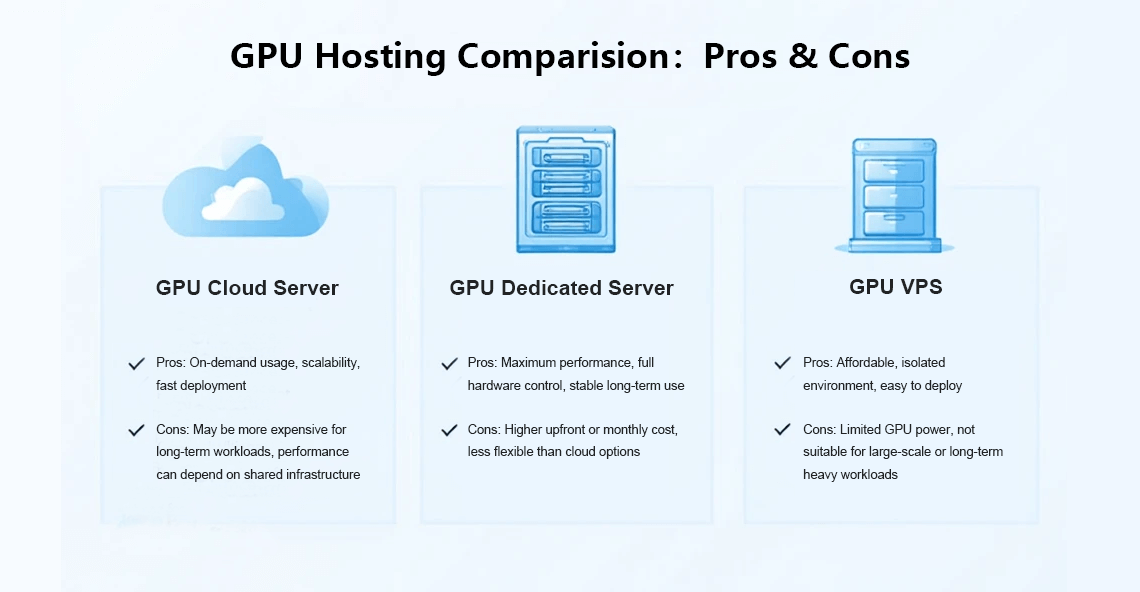
Pros: On-demand usage, scalability, fast deployment
Cons: May be more expensive for long-term workloads, performance can depend on shared infrastructure
What is a GPU Dedicated Server?
A GPU Dedicated Server is a physical machine equipped with one or multiple GPUs that are fully dedicated to a single user. Unlike cloud servers, the hardware is not shared, which means you get consistent performance, full customization, and maximum control over the environment.
This type of server is best suited for high-performance workloads that require stability and large computing power. You can install any operating system, configure custom drivers, and optimize the setup for your specific applications. Since the resources are not virtualized, GPU dedicated servers typically deliver the highest and most predictable performance.
Typical use cases include:
- Large-scale AI and deep learning model training
- High-performance computing (HPC) and scientific research
- 3D rendering farms and virtual production pipelines
- Virtualization platforms or multi-user GPU environments
Pros: Maximum performance, full hardware control, stable long-term use
Cons: Higher upfront or monthly cost, less flexible than cloud options
What is a GPU VPS?
A GPU VPS (Virtual Private Server) is a virtual server instance that includes allocated GPU resources. Unlike a dedicated server, the hardware is shared among multiple users, but each VPS operates in an isolated environment with its own operating system, storage, and GPU portion.
GPU VPS is designed to be a cost-effective solution for individuals or small businesses that need GPU acceleration without investing in a full dedicated machine. While it doesn’t provide the same raw power as a dedicated server, it is more affordable and sufficient for lightweight or medium workloads.
Typical use cases include:
- Running multiple emulator instances (e.g., Android emulators for testing or automation)
- Small-scale AI inference or machine learning projects
- Video encoding, streaming, and graphics processing
- Game hosting and development environments
Pros: Affordable, isolated environment, easy to deploy
Cons: Limited GPU power, not suitable for large-scale or long-term heavy workloads
GPU Cloud Server vs. GPU Dedicated Server vs. GPU VPS
| Feature / Aspect | GPU Cloud Server | GPU Dedicated Server | GPU VPS |
|---|---|---|---|
| Performance | High, but may vary due to shared infrastructure | Maximum, consistent and dedicated hardware | Moderate, limited by virtualized GPU resources |
| Scalability | Very flexible, scale up or down on demand | Fixed hardware, requires upgrade for scaling | Limited, can upgrade within VPS plans |
| Control | Limited (depends on cloud provider’s environment) | Full control over hardware and software | Medium (root access but shared hardware) |
| Cost Model | Pay-as-you-go or subscription | Higher monthly cost, best for long-term | Affordable, budget-friendly |
| Best For | Short-term projects, testing, variable workloads | Long-term heavy workloads, AI training, rendering farms | Individuals or small teams with light-to-medium GPU needs |
| Deployment Speed | Instant or within minutes | Requires provisioning (hours to days) | Fast, usually within minutes |
| Typical Users | Developers, researchers, startups | Enterprises, research labs, rendering studios | Freelancers, small businesses, gamers |
How to Choose?
Choosing between a GPU Cloud Server, GPU Dedicated Server, and GPU VPS depends on your workload, budget, and long-term goals.
If you need flexibility and on-demand resources for short-term projects or testing, a GPU Cloud Server is the best choice. It allows you to scale up or down easily without long-term commitments.
If your applications involve intensive, long-term workloads such as AI model training, scientific simulations, or large rendering tasks, a GPU Dedicated Server offers maximum performance and full control over the hardware.
If you are an individual or small team with lighter GPU needs—such as emulator hosting, small AI inference tasks, or video processing—a GPU VPS provides a cost-effective and easy-to-deploy option.
By evaluating your project requirements and budget, you can select the hosting solution that balances performance, scalability, and cost efficiency for your use case.
GPU cloud server, GPU dedicated server, GPU VPS, GPU hosting comparison, GPU server rental, AI GPU hosting, rendering server, GPU virtualization