


Intel Arc B580 vs RTX 4060 (2025): Is Arc Finally Worth It?
Why is the 12GB Intel Arc B580 cheaper than the 8GB Nvidia RTX 4060? In this article, we break down the Intel Arc B580 vs RTX 4060 from multiple perspectives, including price, specifications, gaming performance, and AI benchmarks, to help you understand the real differences and value behind these two GPUs.
The Intel Arc B580 vs RTX 4060 comparison highlights a growing shift in the mainstream GPU market. With 12GB of VRAM at a lower price, the Arc B580 challenges the Nvidia RTX 4060’s traditional strengths in gaming, AI workloads, and rendering. While NVIDIA maintains an advantage in software maturity and ecosystem support, Intel’s B580 delivers strong raw performance and value, making this matchup especially relevant for users focused on price-to-performance rather than brand alone.
Intel Arc B580 vs RTX 4060 – Background Comparison
| Brand | Series | Model | Release Year | Official Positioning / Description | Market Price (USD) |
|---|---|---|---|---|---|
| Intel | Intel Arc B-Series | Arc B580 | 2024 | Mid-range Battlemage GPU designed for 1080p/1440p gaming; 12GB GDDR6; strong price-to-performance ratio. | ~$249 |
| NVIDIA | GeForce RTX 40 Series | GeForce RTX 4060 | 2023 | Mainstream Ada Lovelace GPU for efficient 1080p gaming; 8GB GDDR6; supports DLSS 3 and mature RT ecosystem. | ~$279–$299 |
Intel Arc B580 vs RTX 4060 – Specifications Comparison
B580 vs 4060 Core Specs
| Parameter | Intel Arc B580 | NVIDIA GeForce RTX 4060 | Difference / Advantage |
|---|---|---|---|
| Architecture | Battlemage (Xe2) | Ada Lovelace | Different architectures |
| Shader / CUDA Cores | ~4,096 Xe2 cores | 3,072 CUDA cores | B580 has more cores, but architectures differ |
| Memory Type | GDDR6 | GDDR6 | Same memory type |
| Memory Capacity | 12 GB | 8 GB | B580 has 50% more VRAM |
| Memory Bus | 192-bit | 128-bit | B580 has wider memory bus |
| Memory Bandwidth | ~432 GB/s (varies by clock) | ~272 GB/s | B580 offers higher bandwidth |
| Core Frequency (Boost) | ~2.4–2.5 GHz (varies by AIB) | ~2.4–2.5 GHz (varies by AIB) | Similar boost clocks |
| TDP (Power) | ~185W | 115W | RTX 4060 is much more power-efficient |
| Interface / Bus | PCIe Gen4 | PCIe Gen4 | Same interface |
| FP32 Performance | ~17–18 TFLOPS (estimated for Xe2) | ~15 TFLOPS | B580 slightly higher theoretical TFLOPs |
| Ray Tracing | 2nd-gen Intel RT | 3rd-gen NVIDIA RT | RTX 4060 has more mature RT |
| AI / Upscaling | XeSS 2.0 | DLSS 3 (Frame Generation) | RTX 4060 has stronger AI ecosystem |
| PCIe Version | Gen4 | Gen4 | Same PCIe version |
B580 vs 4060 Extended Specifications
| Additional Parameter | Intel Arc B580 | NVIDIA GeForce RTX 4060 | Difference / Advantage |
|---|---|---|---|
| Process Node | TSMC 5nm | TSMC 5nm | Same manufacturing process |
| Transistor Count | ~19.6 billion | ~18.9 billion | B580 slightly higher |
| Die Size | Larger (~270 mm²) | Smaller (~160 mm²) | RTX 4060 more efficient design |
| PCIe Lanes | PCIe 4.0 x8 | PCIe 4.0 x8 | Same interface |
| Display Output Support | HDMI 2.1 + DisplayPort 2.1 (varies by AIB) | HDMI 2.1 + DisplayPort 1.4a | B580 may support newer DP 2.1 |
| Video Encoder / Decoder | AV1 Encode/Decode (Intel Xe Media Engine) | AV1 Encode/Decode (NVENC 8th gen) | Both support AV1 encoding |
| Multi-Monitor Support | Up to 4 monitors | Up to 4 monitors | Same |
| Maximum Supported Resolution | Up to 8K (DP 2.1) | Up to 8K (DP 1.4a) | B580 can offer higher DP bandwidth |
| Idle/Low-Power Efficiency | Moderate | Excellent | RTX 4060 much better in idle power |
| Driver Maturity | Improving but still developing | Very mature ecosystem | RTX 4060 advantage |
| Software Features | XeSS, Arc Control | DLSS 3, Reflex, Broadcast | NVIDIA has broader software suite |
Key Difference
The Intel Arc B580 features Intel’s Battlemage (Xe2) architecture with more shader/compute units (~4,096 Xe cores) and 12 GB GDDR6 memory on a 192-bit bus. This provides higher memory capacity and bandwidth, which can benefit workloads that require larger textures or data sets.
The NVIDIA GeForce RTX 4060, based on Ada Lovelace, has 3,072 CUDA cores and 8 GB GDDR6 on a 128-bit bus. While it has lower memory capacity, its DLSS 3 support, mature ray tracing, and efficient architecture deliver smoother performance in ray-traced and AI-accelerated tasks.
In terms of power and efficiency, the B580 draws around 185 W, whereas the RTX 4060 is more efficient at ~115 W, which may impact system power requirements and thermal management.
Summary
Arc B580 offers higher memory and compute resources, making it advantageous for memory-heavy tasks. At first glance, the Intel Arc B580 seems to outperform the RTX 4060 in raw specs. However, it’s worth taking a closer look at how the 4060 performs in AI workloads.
B580 vs 4060 Benchmark: Performance Across Different Scenarios
B580 vs 4060 Gaming Performance
Horizon Forbidden West Test
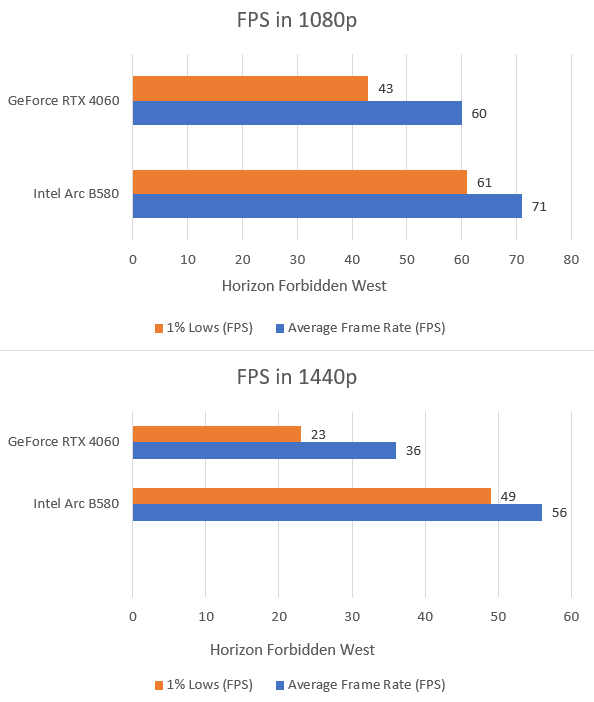
In 1080p testing of Horizon Forbidden West, the Arc B580 excelled with its 12GB VRAM and higher memory bandwidth, delivering an average frame rate 15% higher than the RTX 4060 and outperforming it by 40% in 1% lows. At 1440p, the Arc B580’s frame rate was even 50% higher.
Call of Duty: Black Ops 6 Test
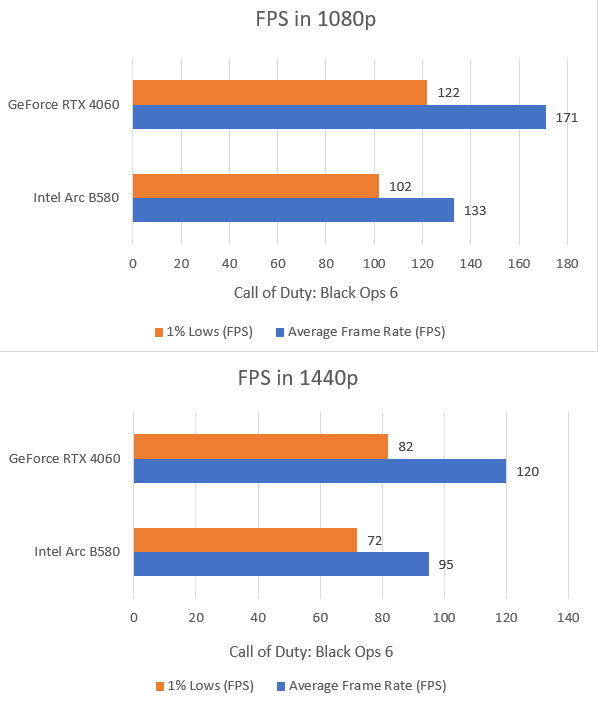
However, in Call of Duty: Black Ops 6, the Intel Arc B580 delivered underwhelming performance, running 20% slower than the RTX 4060 at 1080p and 19% slower at 1440p. This is likely because COD BO6 is a game optimized for the GeForce architecture, benefiting NVIDIA GPUs with better driver support and architectural features, whereas Horizon Forbidden West demands higher texture and memory bandwidth, making the 8GB VRAM of the 4060 a limiting factor.
In summary, Intel Arc shows greater potential in large-scale rendering, AI effects, and high-texture workload scenarios. Meanwhile, the NVIDIA RTX 4060 proves more stable in shooter games, mature DirectX titles, and ray tracing or AI inference tasks, leveraging higher clock speeds and a mature architecture to compensate for its smaller VRAM.
Intel Arc B580 vs RTX 4060 for AI
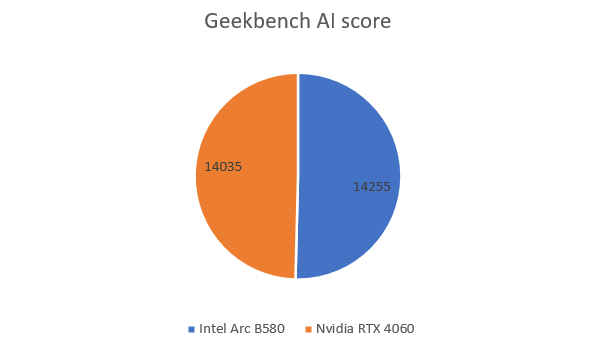
In the Geekbench AI benchmark, the Intel Arc B580 slightly edges out the RTX 4060 by about 1%. This marginal advantage is mainly due to B580’s higher number of Xe cores and larger memory bandwidth, which allow it to handle matrix-heavy AI computations slightly more efficiently. However, the difference is minimal, and both GPUs perform comparably for typical AI workloads, with the RTX 4060 still benefiting from a more mature software and driver ecosystem for AI acceleration.
Intel Arc B580 vs RTX 4060 Price & Value
| Platform / Source | Intel Arc B580 | NVIDIA GeForce RTX 4060 |
|---|---|---|
| Official MSRP | Start from $249 | Start from $299 |
| Typical Retail (new) | ~$300–$410+ (AIB cards) | ~$300–$540+ (AIB cards) |
| eBay / Used | ~$250–$330+ (varies) | ~$290–$380+ (varies) |
The Intel Arc B580 has a lower official MSRP ($249) and usually a smaller markup in the third-party market ($300–$410) compared to the RTX 4060 ($299 MSRP, $300–$540+ market price). The B580 offers more memory (12 GB) and compute units for the price, making it generally better value per dollar, while the RTX 4060 benefits from a mature driver ecosystem, ray tracing, and DLSS support, but at a higher market cost.
B580 vs 4060 (8GB)– Pros & Cons
| GPU Model | Strengths (Pros) | Weaknesses (Cons) |
|---|---|---|
| Intel Arc B580 12GB | √ Higher VRAM (12GB) and memory bandwidth for memory-heavy workloads | × Less mature driver and software ecosystem |
| √ More Xe cores / compute units | × Ray tracing performance weaker than NVIDIA | |
| √ Competitive retail price | × Limited support for CUDA-accelerated AI workloads | |
| NVIDIA RTX 4060 8GB | √ Mature drivers and DLSS 3 support | × Only 8GB VRAM can limit large scenes or AI models |
| √ Efficient architecture, lower power draw | × Narrower memory bus (128-bit) reduces bandwidth | |
| √ Strong gaming and rendering performance | × Higher market price on custom AIB cards |
RTX 4060 Server Hosting
The Intel Arc B580 server and NVIDIA RTX 4060 hosting service perform excellently in gaming, rendering, live streaming, and more, making them ideal choices for personal studios and small businesses. Compared to buying a GPU individually, the hosting service saves on additional hardware setup and maintenance costs, while supporting long‑duration workloads.
Conclusion
The Intel Arc B580 server, with its superior GPU memory and bandwidth, outperforms the RTX 4060 across a wide range of tasks, including gaming, light AI workloads, and 3D rendering. At a lower price point, the B580 rightfully earns the title of best value for money. That said, the RTX 4060 offers strong CUDA and OptiX support, providing better compatibility with AI frameworks, rendering engines, and professional 3D software.
intel arc b580 vs rtx 4060, b580 vs 4060, 4060 price, rtx 4060 price, b580 price, 4060 benchmark, b580 benchmark