


GTX 1070 Ti vs GTX 1660 Ti in 2025 — Are These GPUs Still Worth Using?
In this 2025 comparison, we break down the GTX 1070 Ti vs GTX 1660 Ti, covering performance, benchmarks, gaming results, and real-world value. Find out how these older GPUs handle modern workloads and see which one still offers the best bang for your buck for gaming, productivity, and creative projects.
Summary Light of GeForce GTX 1070 Ti and GTX 1660 Ti
Even in 2025, the GeForce 1070 Ti and 1660 Ti remain practical choices for 1080p gaming, basic content creation, and light compute workloads. While they are no longer top-tier, these GPUs still deliver reliable performance for budget-conscious gamers, creators, and developers.
Key Features: The GTX 1070 Ti offers higher CUDA core counts and memory bandwidth, while the GTX 1660 Ti benefits from Turing efficiency, lower power consumption, and improved encoding support. Both cards provide solid mid-range performance for older games and productivity tasks.
Industries: These GPUs are still useful for gaming, indie game development, 3D modeling basics, video editing, and small-scale AI experimentation. They suit users who need stable performance for educational, hobbyist, or light-production environments.
Popular Software: They continue to run Blender (basic rendering), Adobe Premiere Pro, DaVinci Resolve, Unity, Unreal Engine (entry-level projects), and older CUDA-based AI frameworks. For 1080p workflows and legacy pipelines, both cards deliver dependable results in 2025.
GTX 1070 Ti vs GTX 1660 Ti – Background Comparison
| Model | Brand | Series / Architecture | Release Year | Official Positioning (2025 view) | Approx. Current Price (2025) |
|---|---|---|---|---|---|
| GTX 1070 Ti | NVIDIA | GTX 10‑series / Pascal (GP104) | 2017 | Legacy high‑performance GPU; still capable for 1080p/1440p gaming and older workloads | ~ US$200–250 |
| GTX 1660 Ti | NVIDIA | GTX 16‑series / Turing (TU116) | 2019 | Legacy high‑performance mainstream GPU; efficient for 1080p gaming and creative tasks | ~ US$220–260 |
As of 2025, both the GTX 1070 Ti and GTX 1660 Ti are considered legacy high-performance GPUs. While no longer cutting-edge, they remain capable for 1080p and even 1440p gaming, as well as older creative workloads. Both cards now trade in the range of $200–260 on the secondary or leftover market, offering a cost-effective option for gamers or creators who don’t require the latest GPU features.
1070 Ti vs 1660 Ti – Specification Comparison
Core Specs: GTX 1070 Ti vs GTX 1660 Ti
| Specification | GTX 1070 Ti | GTX 1660 Ti | Difference / Advantage |
|---|---|---|---|
| Architecture | Pascal (GP104) | Turing (TU116) | 1660 Ti is more modern and efficient |
| CUDA Cores | 2432 | 1536 | 1070 Ti has 58% more CUDA cores |
| Memory Type | GDDR5 | GDDR6 | 1660 Ti uses faster GDDR6 |
| Memory Capacity (vRAM) | 8 GB | 6 GB | 1070 Ti has 33% more VRAM |
| Memory Bus | 256‑bit | 192‑bit | 1070 Ti has 33% wider memory bus |
| Memory Bandwidth | 256 GB/s | 288 GB/s | 1660 Ti has ~13% higher bandwidth |
| Core Frequency (Boost) | 1683 MHz | 1770 MHz | 1660 Ti boost clock ~5% higher |
| TDP (Power) | 180 W | 120 W | 1070 Ti consumes ~ 50% more power |
| Interface / Bus | PCIe 3.0 x16 | PCIe 3.0 x16 | No significant difference |
| FP32 Performance | ~8.1 TFLOPS | ~5.4 TFLOPS | 1070 Ti ~ 50% faster in FP32 compute |
| Ray Tracing / Tensor Cores | None | None | Neither supports Ray Tracing / Tensor cores |
| PCIe Version | PCIe 3.0 | PCIe 3.0 | No significant difference |
Key Differences: 1070 Ti vs 1660 Ti
CUDA Cores: The GTX 1070 Ti has 2432 CUDA cores, ~ 58% more than the GTX 1660 Ti, offering higher parallel computing performance.
Memory Capacity: With 8 GB VRAM, the 1070 Ti provides 33% more memory than the 1660 Ti, better for large textures and complex scenes.
Memory Bandwidth: The 1660 Ti has ~288 GB/s memory bandwidth, ~13% higher than the 1070 Ti, thanks to faster GDDR6 memory.
Core Clock / Boost: The 1660 Ti’s boost clock is ~5% higher, giving a slight edge in lighter tasks or games.
FP32 Performance: The 1070 Ti reaches ~ 8.1 TFLOPS, ~ 50% higher than the 1660 Ti, making it stronger in rendering, scientific computing, and GPU-accelerated workloads.
TDP: The 1070 Ti consumes ~ 50% more power, requiring better cooling and a stronger power supply.
More Specs Comparison: 1070 ti vs 1660 ti
| Specification | GTX 1070 Ti | GTX 1660 Ti | Difference / Advantage |
|---|---|---|---|
| Texture Units (TMUs) | 152 | 96 | 1070 Ti has more TMUs, improving texture fillrate and rendering performance |
| ROPs (Render Output Units) | 64 | 48 | Higher ROP count on 1070 Ti enhances final pixel output, better for high-res rendering |
| Max Resolution / Display Outputs | 7680×4320 / 3x DisplayPort, 1x HDMI, 1x DVI | 7680×4320 / 3x DisplayPort, 1x HDMI, 1x DVI | Similar max resolution and outputs, no practical difference |
| Die Size / Transistor Count | 314 mm² / 7.2 B | 284 mm² / 6.6 B | 1070 Ti has larger die and more transistors, allowing higher peak performance at the cost of power |
| Memory Type / Bandwidth (Optional Extra) | GDDR5 / 256 GB/s | GDDR6 / 288 GB/s | Already covered; highlights that 1660 Ti uses newer memory standard |
TMUs & ROPs: GTX 1070 Ti has ~ 58% more TMUs and ~ 33% more ROPs, giving it better texture fillrate and pixel output performance, which helps in high-resolution or GPU-heavy games.
Die Size / Transistors: 1070 Ti has a slightly larger die and more transistors, supporting higher sustained compute at the cost of power and heat.
Display / Resolution: Both cards support up to 8K resolution and have similar output ports, so multi-monitor setups are equally feasible.
1070 Ti vs 1660 Ti Benchmarks: Performance Across Different Scenarios
Gaming Performance — 1080p / 1440p
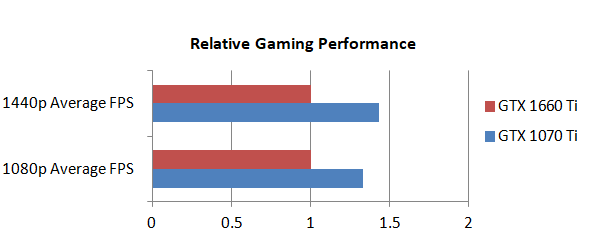
The GTX 1070 Ti outperforms the GTX 1660 Ti across most gaming scenarios.
At 1080p, the 1070 Ti delivers roughly 33% higher average FPS compared to the 1660 Ti, and at 1440p the gap increases to around 43%, maintaining smoother frame rates in AAA titles.
At 4K, where both cards are considered underpowered, the 1070 Ti still holds an advantage of approximately 25–30% in average FPS, thanks to its higher CUDA core count and larger VRAM. The 1660 Ti remains playable for lighter games but cannot match the sustained performance of the 1070 Ti in demanding modern titles.
Content Creation & Productivity Performance
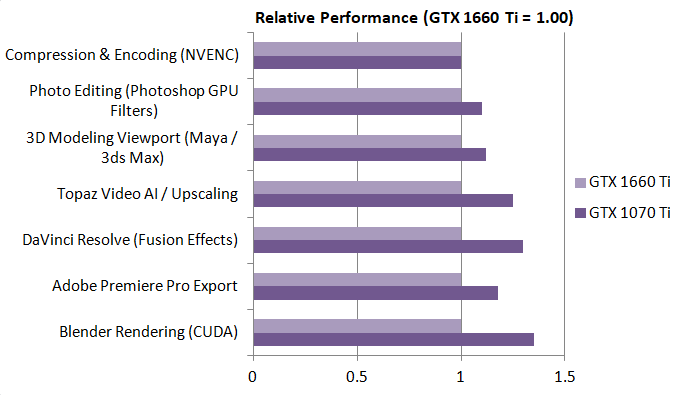
In content creation workloads, the GTX 1070 Ti consistently performs better than the GTX 1660 Ti. The 1070 Ti delivers roughly 30–35% faster performance in rendering-heavy tasks such as Blender and DaVinci Resolve, and about 18–25% better performance in Premiere Pro and AI upscaling workloads. While NVENC encoding performance remains identical on both GPUs, the 1070 Ti still provides smoother operation in 3D modeling and GPU-accelerated photo editing due to its stronger compute capability.
Price & Value: 1070 Ti vs 1660 Ti
| Platform | GTX 1660 Ti (USD) | GTX 1070 Ti (USD) | Price Difference (USD) | Price Difference (%) |
|---|---|---|---|---|
| Original MSRP | $279 | $449 | $170 | 61% |
| Amazon (Used / Renewed) | $110 – $150 | $140 – $200 | $30 – $50 | 20% – 45% |
| Third-Party Resellers (eBay etc.) | $100 – $160 | $130 – $210 | $30 – $60 | 19% – 38% |
In 2025, the GTX 1660 Ti remains the better choice for pure price-per-performance, costing about 20–45% less than the GTX 1070 Ti. However, thanks to its higher memory bandwidth, larger core count, and stronger FP32 compute power, the GTX 1070 Ti still delivers better overall performance per dollar in gaming and content creation. If you want the most budget-friendly option, choose the 1660 Ti; if you want the strongest performance from older GPUs in 2025, the 1070 Ti offers more total value despite its higher price.
1070 Ti vs 1660 Ti – Pros & Cons
| GPU | Pros | Cons |
|---|---|---|
| GTX 1070 Ti | - Higher CUDA core count, memory bandwidth, and FP32 performance - Stronger 1080p/1440p gaming performance - Better for rendering, editing, and creator workloads - Delivers stronger overall performance in 2025 |
- Higher power consumption (165W) - Typically 20–45% more expensive than 1660 Ti - Older Pascal architecture |
| GTX 1660 Ti | - Lower power consumption (120W) with better thermals/noise - Strong price-to-performance for budget users - More efficient Turing architecture - Easier to find at lower second-hand prices |
- 15–25% slower than 1070 Ti overall - No Tensor/RT acceleration features - Weaker performance in creator and compute workloads |
RTX 5070 & RTX 4070 Server Hosting
If you want the performance of GPUs like the GTX 1070 Ti or GTX 1660 Ti for 1080p gaming servers, light 3D rendering, video encoding, or entry-level CUDA tasks—without buying aging hardware—reliable GPU server hosting is the way to go.
Database Mart offers a wide range of GPU server configurations designed for different performance needs and budget levels. Whether you require an affordable entry-level GPU server or a more scalable multi-GPU setup, you can enjoy stable performance, flexible upgrade options, 99.9% uptime, and 24/7 expert support—allowing you to focus on your projects while all hardware management and maintenance are fully handled for you.
Conclusion
In 2025, both the GTX 1070 Ti and GTX 1660 Ti remain solid mid-range GPU options, each with its strengths. The 1070 Ti delivers higher performance for gaming and content creation, while the 1660 Ti offers a more budget-friendly, power-efficient choice for 1080p gaming and light workloads. For entry-level GPU server tasks, both handle video encoding and light 3D rendering well. Choose the 1070 Ti for performance or the 1660 Ti for cost efficiency.
1070 ti vs 1660 ti, GTX 1070 Ti vs GTX 1660 Ti, gtx 1070 ti 8gb, geforce gtx 1070 ti, 1660 Ti benchmarks, 1070 ti price, 1660 ti specs, 1660 ti price, geforce 1070 ti,GTX 1660 Ti performance, GTX 1070 Ti performance