


NVIDIA GTX 1650 vs GTX 1660 — Which Graphics Card Is the Better Choice?
Dive into the ultimate GPU showdown! Explore detailed specs, real-world benchmarks, price comparisons, and user recommendations to find out which GPU gives you the best performance, value, and gaming or development experience. Don’t make a purchase before seeing this full comparison!
GTX 1650 vs GTX 1660 – Background Comparison
| Brand | Series | Model | Release Year | Official Positioning | Market Price (USD) |
|---|---|---|---|---|---|
| NVIDIA | GeForce | GTX 1650 | 2019 | The NVIDIA GeForce GTX 1650 is positioned as an entry-level gaming graphics card designed for 1080p gaming with low power consumption. Built on the Turing architecture, it targets budget-conscious gamers and compact PC builds, offering solid performance for esports titles and everyday computing tasks. | Starting at $149 |
| NVIDIA | GeForce | GTX 1660 | 2019 | The NVIDIA GeForce GTX 1660 is positioned as a mid-range GPU aimed at delivering smooth 1080p and light 1440p gaming. Based on the Turing architecture, it offers significantly better performance than the GTX 1650 and previous-generation GTX 1060 models, making it ideal for gamers seeking a strong balance between performance and affordability without requiring ray-tracing features. | Starting at $219 |
GTX 1650 vs GTX 1660 – Specifications Comparison
The NVIDIA GeForce GTX 1650 and GTX 1660 are both part of NVIDIA’s Turing-based 16-series lineup, targeting gamers who want solid 1080p performance without paying premium GPU prices. Although they were released in the same year and share the same architecture, the two cards are designed for different user groups. The GTX 1650 focuses on efficiency and affordability, making it a popular option for compact or entry-level systems. Meanwhile, the GTX 1660 offers a noticeable jump in performance, thanks to more CUDA cores, higher memory capacity, and increased bandwidth — giving gamers a smoother and more capable experience in modern titles.
| Parameter | GTX 1650 | GTX 1660 | Difference / Advantage |
|---|---|---|---|
| Architecture | Turing | Turing | Both use Turing; GTX 1660 is faster due to more cores and higher clocks. |
| CUDA Cores | 896 | 1,408 | GTX 1660 has +512 CUDA cores, delivering stronger parallel and gaming performance. |
| Memory Type | GDDR5 | GDDR5 | Same memory type; no performance advantage here. |
| Memory Capacity | 4 GB | 6 GB | GTX 1660 benefits from higher VRAM for modern games and multitasking. |
| Memory Bus | 128-bit | 192-bit | GTX 1660's wider bus transfers more data per cycle. |
| Memory Bandwidth | 128.1 GB/s | 192.1 GB/s | GTX 1660 has higher bandwidth, improving texture loading and throughput. |
| Core Frequency (Boost) | 1665 MHz | 1785 MHz | GTX 1660 boosts higher, providing better performance under load. |
| TDP (Power) | 75 W | 120 W | GTX 1650 is more power-efficient; good for compact/low-power builds. |
| Bus Interface | PCIe 3.0 x16 | PCIe 3.0 x16 | Same interface; no difference. |
| FP32 Performance | 2.984 TFLOPS | 5.027 TFLOPS | GTX 1660 has significantly higher compute performance. |
| Ray Tracing / Tensor Cores | – | – | Neither GPU includes these cores; no advantage. |
| PCIe Version | 3.0 | 3.0 | Same PCIe version. |
Key Differences: GTX 1650 vs GTX 1660
Significantly Higher Performance on GTX 1660
With far more CUDA cores and noticeably higher FP32 compute performance, the GTX 1660 delivers a substantial real-world performance boost, especially in modern 1080p games.More VRAM for Modern Titles
The GTX 1660’s 6GB of memory (vs. 4GB on the GTX 1650) provides smoother performance in newer games and reduces stuttering when handling high-resolution textures.Wider Memory Bus & Higher Bandwidth
The GTX 1660’s 192-bit bus and higher bandwidth result in faster texture loading and better overall responsiveness in demanding scenes.Higher Power Requirement but Better Performance
The GTX 1650 is more power-efficient at 75W, but the GTX 1660’s 120W TDP allows it to deliver significantly stronger gaming performance—especially important for users who prioritize frame rates over power savings.
GTX 1650 vs GTX 1660 Performance Across Different Scenarios
Artificial Intelligence Tests
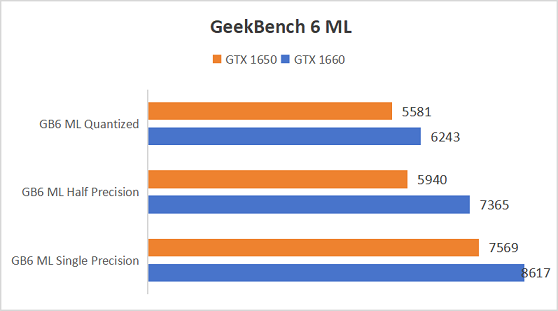
With AI and machine learning becoming increasingly common, GPUs are now evaluated not only for gaming but also for their compute capabilities. The GTX 1650 and GTX 1660, both based on NVIDIA’s Turing architecture, show different levels of performance in AI workloads. Using GB6 ML benchmarks, we compare their performance in single-precision (FP32), half-precision (FP16), and quantized inference tasks to highlight which GPU handles AI applications more efficiently.
Summary:
Based on GB6 ML benchmark results, the GTX 1660 consistently outperforms the GTX 1650 across all tested AI scenarios:
Single Precision (FP32): GTX 1660 scores 8617, compared to GTX 1650’s 7569, showing a clear advantage in compute-intensive tasks.
Half Precision (FP16): GTX 1660 achieves 7365, versus 5940 on the GTX 1650, making it more efficient for mixed-precision workloads.
Quantized Inference: GTX 1660 leads with 6243, compared to GTX 1650’s 5581, enabling faster inference for optimized AI models.
In practice, this means that the GTX 1660 is better suited for small-scale model training, ML experiments, and inference tasks, while the GTX 1650 can still handle entry-level AI workloads but with slower performance and lower throughput.
Gaming Performance
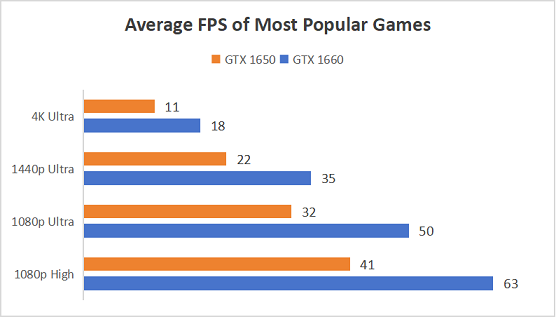
While both the GTX 1650 and GTX 1660 are part of NVIDIA’s Turing lineup, they are primarily entry-level to mid-range cards and are not designed for high-end gaming. Benchmarking at 1080p, 1440p, and 4K across high and ultra settings shows that while neither card can deliver consistently smooth performance in modern demanding titles, the GTX 1660 still offers a noticeable edge over the GTX 1650.
Based on the benchmark results:
1080p High: GTX 1660 achieves 63 FPS versus GTX 1650’s 41 FPS, providing significantly smoother gameplay.
1080p Ultra: GTX 1660 runs at 50 FPS, while GTX 1650 manages 32 FPS, showing the GTX 1660 handles more demanding settings comfortably.
1440p Ultra & 4K Ultra: Both GPUs fall below ideal frame rates (35–18 FPS for 1660, 22–11 FPS for 1650), indicating neither is suitable for modern gaming at these resolutions.
In short, the GTX 1660 performs slightly better than the GTX 1650, but both are best suited for light or older games at 1080p rather than demanding modern titles.
Combined Synthetic Benchmark Score
Synthetic benchmarks provide a standardized way to measure overall GPU performance across a variety of workloads, from gaming to compute tasks. Comparing the GTX 1650 and GTX 1660 using combined synthetic scores allows us to see their general performance differences and understand which card offers a smoother and more capable experience across multiple scenarios.
This is our combined benchmark score.
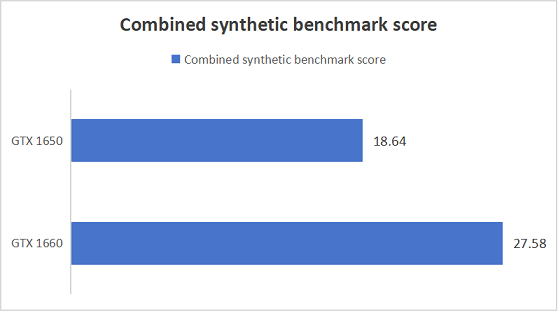
The GTX 1660 achieves a combined synthetic score of 27.58, significantly higher than the GTX 1650’s 18.64. This indicates that the GTX 1660 delivers noticeably better overall performance across both gaming and compute tasks. While neither card competes with high-end GPUs, the GTX 1660 consistently outperforms the GTX 1650, making it the preferable choice for users seeking stronger performance in a budget-friendly graphics card.
Price Comparison: GTX 1650 vs GTX 1660
At present, the price difference between these two GPUs exists, but it’s smaller than anticipated. The RTX 5070 Ti holds a steady MSRP of $750, with various base models available at retailers such as Newegg. On the other hand, the RX 9070 XT hovers around $650, roughly $50 above its official MSRP.
Price Comparison
| Platform | GTX 1650 (USD) | GTX 1660 (USD) | Price Difference (USD) | Price Difference (%) |
|---|---|---|---|---|
| Official MSRP | $149 | $219 | $70 | 47% |
| Amazon | $149–$199 | $154–$249 | $5 – $50 | 3% – 25% |
| Newegg | $269–$340 | $176–$389 | -$93 – $49 | -35% – 14% |
User Value-for-Money Feedback
The GTX 1650 is a lower-priced graphics card, suitable for entry-level gaming and budget-conscious PC builds.
In comparison, the GTX 1660 offers a significant performance boost but comes with a higher upfront cost. However, if you can get a GTX 1660 for around $180–$200, it is considered a very good deal. Given the performance gains it provides, this price is well worth it for most users. Many reviews and sources also indicate that the GTX 1660 offers better value for money than the GTX 1650. For example, some benchmarks show that the GTX 1660 delivers higher performance per dollar, making it a more rewarding investment in real-world usage.
GTX 1650 vs GTX 1660– Pros & Cons
| GPU Model | Pros | Cons |
|---|---|---|
| GTX 1650 | ✅ Lower price, affordable for budget builds ✅ Low power consumption, no external power connector needed ✅ Good for e-sports and less demanding games |
❌ Lower performance, ~40% fewer CUDA cores than 1660 ❌ Less future-proof, 4GB VRAM may struggle with modern games ❌ Fewer texture units than 1660 |
| GTX 1660 | ✅ Significantly higher performance, ~40% better than 1650 ✅ 6GB GDDR5 VRAM, better for modern games ✅ More CUDA cores (1,408 vs 896) |
❌ Higher price than 1650 ❌ Higher power consumption, requires 8-pin connector |
GTX 1650 vs GTX 1660 GPU Hosting
The GTX 1650 and GTX 1660 are entry- to mid-level GPUs, making them ideal for budget-conscious users and light to moderate workloads.
For individuals or small teams who need flexible GPU resources without investing in local hardware, GPU hosting offers a convenient solution. Hosted GTX 1650 and GTX 1660 servers allow users to run entry-level AI experiments, basic compute tasks, and development workloads remotely, removing the limitations of local systems and power constraints.
Database Mart provides both GTX 1650 and GTX 1660 GPU servers, offering a cost-effective way to access GPU performance without purchasing the physical cards. The GTX 1650 is best suited for lightweight tasks and entry-level projects, such as small AI experiments or basic development workloads, while the GTX 1660, with higher performance and more VRAM, is better for moderately larger workloads, multitasking, or more demanding development projects. Choosing the right GPU server depends on your performance needs and budget, ensuring you get the most suitable setup for your tasks.
Conclusion
When comparing entry- to mid-level GPUs, the GTX 1650 and GTX 1660 each cater to different user needs.
For light compute and development workloads, the GTX 1650 is suitable for budget-conscious users running entry-level AI experiments, basic development tasks, or lightweight gaming emulation. Its low power consumption and affordability make it ideal for small builds or limited-power systems. The GTX 1660, with more CUDA cores and 6GB VRAM, handles moderately larger workloads, multitasking, and more demanding development projects, providing a smoother and more versatile experience.
In terms of value, the GTX 1660 offers a noticeable performance boost over the 1650 for a moderate increase in cost, delivering better performance per dollar for users who need more capability. The GTX 1650 remains a practical choice for users prioritizing budget and light usage.
In summary, choose the GTX 1650 for lightweight tasks and cost-effective setups, while the GTX 1660 is the smarter choice for users needing higher performance and more flexibility.
gtx 1650 vs gtx 1660, 1660 vs 1650, gtx1650 price, gtx 1660 price, gtx 1650 specs, gtx 1660 specs, gtx 1650 benchmark, gtx 1660 benchmark, gpu comparisons