


NVIDIA GTX 1650 vs RTX 2060: Which GPU Is Worth Buying in 2025?
GTX 1650 vs RTX 2060 – Background Comparison
| Brand | Series | Model | Release Year | Official Positioning | Market Price (USD) |
|---|---|---|---|---|---|
| NVIDIA | GeForce | GTX 1650 | 2019 | The NVIDIA GeForce GTX 1650 is positioned as an entry-level gaming graphics card designed for 1080p gaming with low power consumption. Built on the Turing architecture, it targets budget-conscious gamers and compact PC builds, offering solid performance for esports titles and everyday computing tasks. | Starting at $149 |
| NVIDIA | GeForce | RTX 2060 | 2019 | NVIDIA officially positions the RTX 2060 as a high‑performance sweet spot GPU for 1080p gaming, with performance between the GTX 1070 and 1070 Ti. It is designed to deliver performance above the GTX 1060, support ray tracing and DLSS, and was initially priced at $349. Its main competitors at launch were AMD’s RX 590/RX 580, and later the 12GB version was primarily positioned against the AMD RX 6600. | Starting at $349 |
NVIDIA GTX 1650 vs RTX 2060 – Specifications Comparison
Core Specs Comparison
| Parameter | GTX 1650 | RTX 2060 | Difference / Advantage |
|---|---|---|---|
| Architecture | Turing (No RT / Tensor) | Turing (1st-gen RT, 2nd-gen Tensor) | RTX 2060 adds dedicated ray tracing & AI cores |
| CUDA Cores | 896 | 1,920 | RTX 2060 has over 2× CUDA cores → much stronger compute power |
| Memory Type | GDDR5 | GDDR6 | RTX 2060 uses faster memory |
| Memory Capacity | 4 GB | 6 GB | RTX 2060 offers more VRAM for modern games |
| Memory Bus | 128-bit | 192-bit | RTX 2060 wider bus → better data throughput |
| Memory Bandwidth | ~128 GB/s | ~336 GB/s | RTX 2060 nearly 3× higher bandwidth |
| Core Frequency (Boost) | ~1.67 GHz | ~1.68 GHz | Similar boost clocks |
| TDP (Power) | 75 W | 160 W | GTX 1650 far more power-efficient |
| Interface / Bus | PCIe 3.0 ×16 | PCIe 3.0 ×16 | Same PCIe generation |
| FP32 Performance | ~3 TFLOPS | ~6.45 TFLOPS | RTX 2060 delivers over 2× FP32 performance |
| PCIe Version | PCIe Gen3 | PCIe Gen3 | No difference |
Key Differences: GTX 1650 vs RTX 2060
Performance Tier
The RTX 2060 sits in a much higher performance class, offering over 2× the compute power of the GTX 1650. This results in noticeably higher frame rates and smoother gameplay in modern and demanding titles.VRAM & Memory Bandwidth (Major User Impact)
With 6 GB GDDR6, a 192-bit bus, and nearly 3× the memory bandwidth, the RTX 2060 handles high-resolution textures and modern game engines far better. The GTX 1650’s 4 GB VRAM can become a bottleneck in newer games, causing stutter or reduced settings.Ray Tracing & DLSS Support
The RTX 2060 supports hardware ray tracing and DLSS, allowing improved visuals or higher FPS in supported games. The GTX 1650 lacks these features entirely, limiting image quality and performance optimization options.Power Efficiency & System Requirements
The GTX 1650’s 75 W TDP makes it ideal for low-power or compact systems with minimal cooling. In contrast, the RTX 2060’s higher power draw requires a stronger PSU and better airflow.
GTX 1650 vs RTX 2060 Performance Across Different Scenarios
Artificial Intelligence Tests
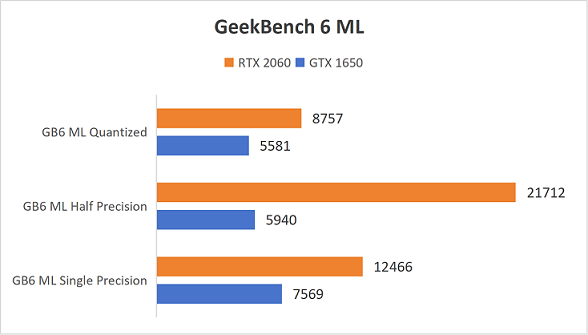
To better understand how the GTX 1650 and RTX 2060 perform in AI-related workloads, we examine their results in Geekbench 6 Machine Learning tests, including Single Precision, Half Precision, and Quantized scenarios. These benchmarks reflect real-world tasks such as AI inference, image and video processing, and other GPU-accelerated intelligent workloads. The results highlight not only raw compute differences, but also the impact of dedicated AI hardware on practical performance.
Summary:
RTX 2060 shows a clear performance advantage in AI workloads
Across all Geekbench 6 ML tests, the RTX 2060 consistently delivers higher scores, indicating much faster AI inference and processing compared to the GTX 1650.Half-precision performance gap is the most significant
The RTX 2060’s massive lead in Half Precision workloads highlights the impact of Tensor cores, which are critical for modern AI tasks and DLSS acceleration.Quantized workloads also favor RTX 2060
While the gap is smaller than in Half Precision, the RTX 2060 still maintains a solid advantage, making it better suited for optimized and lightweight AI models.GTX 1650 is limited in AI-focused scenarios
Without Tensor cores, the GTX 1650 relies solely on CUDA processing, resulting in noticeably lower efficiency in AI and machine learning applications.Real-world implication for users
Users working with AI-enhanced creative tools, DLSS-supported games, or light machine learning tasks will experience significantly better performance and smoother workflows on the RTX 2060.
Gaming Performance
To evaluate real-world gaming performance, we compared the GTX 1650 and RTX 2060 across multiple resolutions and settings. Benchmarks include 1080p (High and Ultra), 1440p Ultra, and 4K Ultra, providing insight into how each GPU handles modern games at different detail levels and resolutions. These results reveal not only frame rate differences but also the practical gaming experience you can expect from each card.
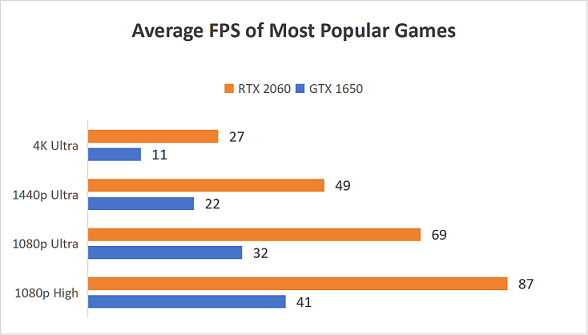
Based on the benchmark results:
RTX 2060 delivers roughly double the frame rates of the GTX 1650 across all tested resolutions.
1080p Ultra and 1440p gaming: RTX 2060 provides smooth gameplay, while GTX 1650 struggles at higher settings.
4K gaming: Both cards are limited, but RTX 2060 still maintains more playable frame rates.
Practical takeaway: RTX 2060 is better suited for high-quality, modern gaming at 1080p and 1440p, whereas GTX 1650 is mainly suitable for 1080p High or esports-focused gaming.
Combined Synthetic Benchmark Score
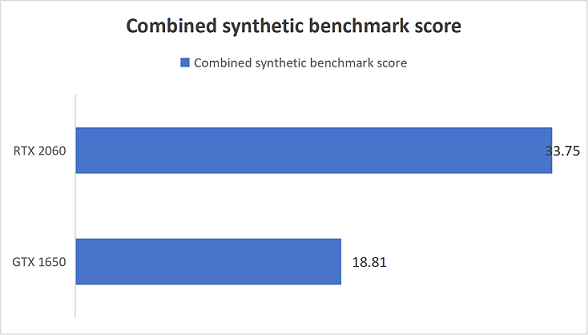
Synthetic benchmarks provide a standardized way to measure overall GPU performance across a variety of workloads, from gaming to compute tasks. Comparing the GTX 1650 and RTX 2060 using combined synthetic scores allows us to see their general performance differences and understand which card offers a smoother and more capable experience across multiple scenarios.
This is our combined benchmark score.
Summary:
RTX 2060 achieves nearly double the combined score of the GTX 1650, highlighting its overall superior performance.
GTX 1650 is significantly weaker, reflecting lower capabilities across compute, gaming, and AI tasks.
Practical takeaway: For users seeking a more powerful, all-around GPU for modern workloads, the RTX 2060 is clearly the better choice.
Price & Value: 1650 vs 2060
| Platform | GTX 1650 (USD) | RTX 2060 (USD) | Price Difference: 2060 vs 1650 (%) |
|---|---|---|---|
| Official MSRP | $149 | $349 | +134% |
| Amazon | $120–$150 | $169–$229 | +41% to +91% |
| Third-Party Resellers (eBay etc.) | $70–$100 | $140–$189 | +90% to +170% |
Value Analysis:
RTX 2060: Despite the higher price, the performance gains justify the cost for users who play modern games, use 1440p displays, or run AI/creative workloads. It offers better future-proofing and a more versatile experience.
GTX 1650: Offers excellent budget value for basic 1080p gaming and esports titles. Its low power draw and lower price make it attractive for entry-level systems, but it lags behind significantly in modern, demanding applications.
Conclusion:
If your goal is long-term performance and versatility, the RTX 2060 provides superior price-to-performance despite the higher upfront cost. For tight budgets or casual 1080p gaming, the GTX 1650 remains a solid choice, but compromises on features, AI support, and higher-resolution gaming are expected.
GTX 1650 vs GTX 2060 – Pros & Cons
| GPU | Pros | Cons |
|---|---|---|
| GTX 1650 | ✅ Very low power consumption (~75W), often no external power required ✅ Cost-effective for basic gaming, esports, and older titles ✅ Compact size fits small PCs or pre-built systems |
❌ Lower raw performance (fewer CUDA cores, lower TFLOPS) ❌ No Ray Tracing or Tensor cores ❌ Slower memory and lower bandwidth |
| RTX 2060 | ✅ Much higher overall performance for modern and demanding games ✅ Supports Ray Tracing & DLSS (RT and Tensor cores) ✅ Faster and larger memory (6GB GDDR6) ✅ Supports DirectX 12 Ultimate |
❌ Higher power draw (~160W), often requires external power connectors ❌ Higher price compared to GTX 1650 |
GTX 1650 vs RTX 2060 GPU Hosting
For users or small teams who need flexible GPU resources without purchasing physical hardware, GPU hosting offers a convenient and cost-effective solution. Hosted GTX 1650 and RTX 2060 servers allow users to run gaming, AI experiments, content creation, and development workloads remotely, eliminating the limitations of local systems, power consumption, and hardware availability.
Database Mart offers both GTX 1650 GPU servers and RTX 2060 GPU servers, allowing users to access the performance they need without the need for physical cards.
GTX 1650 GPU servers are ideal for entry-level gaming, and basic AI experiments, offering low-cost, low-power solutions for lighter workloads.
RTX 2060 GPU servers are better suited for modern 1080p/1440p gaming, advanced AI projects, and creative workloads that require higher performance, faster memory, and support for DLSS and ray tracing.
By opting for hosted GPU servers from Database Mart, users can scale computing power on demand, access high-performance GPUs instantly, and avoid upfront costs or hardware upgrade limitations.
Conclusion
When comparing entry- to mid-level GPUs, the GTX 1650 and RTX 2060 target different user needs.
For gaming, AI, and creative workloads, the GTX 1650 is suitable for budget-conscious users playing 1080p esports, casual titles, or running basic AI experiments. Its low power consumption and affordability make it ideal for small builds or low-power systems. The RTX 2060, with more CUDA cores, Tensor/RT cores, and 6GB GDDR6 memory, handles modern AAA gaming, 1440p gaming, and AI or content creation tasks with significantly better performance and efficiency.
In terms of value, the RTX 2060 delivers a substantial performance boost over the GTX 1650 for a higher price, offering better future-proofing and versatility for users who need higher capability. The GTX 1650 remains a practical choice for those prioritizing budget and energy efficiency.
In summary, choose the GTX 1650 for entry-level gaming and light workloads, while the RTX 2060 is the smarter choice for high-performance gaming, AI tasks, and more demanding applications.
gtx 1650 vs rtx 2060, 1650 vs 2060, 2060 vs 1650, gtx 1650 price, rtx 2060 price, gtx 1650 specs, rtx 2060 specs, rtx 2060 benchmark, gtx 1650 benchmark , nvidia gtx 1650, nvidia rtx 2060