


NVIDIA GTX 1650 vs RTX 3050: Which GPU Is Worth Buying in 2025?
Summary Light of 1650 & 3050
- Key Features: The GTX 1650 and RTX 3050 target the entry-to-mid-range GPU market. The RTX 3050 offers Ampere architecture, higher CUDA core counts, ray tracing, DLSS support, and 8GB GDDR6 VRAM for modern gaming and creative workloads. The GTX 1650 provides reliable 1080p performance with low power consumption, 4GB GDDR5, and solid Turing-based efficiency, making both GPUs suitable for gaming, content creation, and general-purpose GPU computing.
- Industries: Suitable for gaming, esports, video editing, digital content creation, 3D modeling and visualization, multimedia production, CUDA-accelerated development, streaming, and light AI inference or creative workloads.
- Popular Software: Compatible with Blender, Premiere Pro, After Effects, DaVinci Resolve, Unity, Unreal Engine, AutoCAD, SolidWorks, TensorFlow (GPU), PyTorch (GPU), OBS Studio, and mainstream games such as Fortnite, Apex Legends, GTA V, Cyberpunk 2077, and Call of Duty.
GTX 1650 vs RTX 3050 – Background Comparison
| Brand | Series | Model | Release Year | Official Positioning / Description | Market Price (USD) |
|---|---|---|---|---|---|
| NVIDIA | GeForce 16 Series | GTX 1650 | 2019 | Entry-level / efficient 1080p gaming (Turing, 4GB GDDR5, 896 CUDA cores) | ~$100–$150 |
| NVIDIA | GeForce 30 Series | RTX 3050 | 2022 | Mainstream / modern 1080p gaming with ray tracing & DLSS (Ampere, 8GB GDDR6, 2560 CUDA cores) | ~$250–$300 |
The biggest difference between the GTX 1650 and RTX 3050 lies in architecture, performance, and features. While the GTX 1650 focuses on low-power 1080p gaming with solid Turing-based efficiency, the RTX 3050 delivers a significant performance boost, supports ray tracing and DLSS, and comes with higher VRAM and CUDA core counts, making it better suited for modern gaming, content creation, and light AI workloads. Pricing reflects the performance gap, with the RTX 3050 costing more due to its newer generation and enhanced capabilities.
NVIDIA GTX 1650 vs RTX 3050 – Specifications Comparison
Core Specs Comparison
| Parameter | GTX 1650 | RTX 3050 | Difference / Advantage |
|---|---|---|---|
| Architecture | Turing (No RT/Tensor) | Ampere | RTX 3050 uses newer Ampere architecture with RT/Tensor cores; GTX 1650 is older Turing |
| CUDA Cores | 896 | 2,560 | RTX 3050 has ~185% more CUDA cores → stronger compute and gaming performance |
| Memory Type | GDDR5 | GDDR6 | RTX 3050 faster memory |
| Memory Capacity | 4 GB | 8 GB | RTX 3050 doubles VRAM → better for high-res textures and creative workloads |
| Memory Bus | 128-bit | 128-bit | Same bus width |
| Memory Bandwidth | 128 GB/s | 224 GB/s | RTX 3050 higher bandwidth → better data throughput |
| Core Frequency (Boost) | ~1.67 GHz | ~1.78 GHz | RTX 3050 slightly higher boost clock |
| TDP (Power) | 75 W | 130 W | GTX 1650 more power-efficient |
| Interface / Bus | PCIe Gen3 | PCIe Gen4 | RTX 3050 supports PCIe 4.0, future-proofing |
| FP32 Performance | ~3 TFLOPS | ~9 TFLOPS | RTX 3050 ~3× higher → faster rendering, gaming, compute |
| Tensor Cores | None | 80 | RTX 3050 supports AI workloads and DLSS |
| PCIe Version | Gen3 | Gen4 | RTX 3050 supports newer PCIe standard |
Advanced Features Comparison
| Feature / Capability | GTX 1650 | RTX 3050 | Difference / Advantage |
|---|---|---|---|
| Ray Tracing Cores | None | Yes | RTX 3050 supports real-time ray tracing |
| Tensor Cores | None | Yes | RTX 3050 can run AI-accelerated tasks like DLSS |
| DLSS Support | No | Yes | Only RTX 3050 supports DLSS → higher FPS with better visuals |
| AI Acceleration | Limited CUDA-based | Yes (Tensor cores) | RTX 3050 better for AI and GPU-accelerated workloads |
| AV1 Encoding / Decoding | No | Yes | RTX 3050 supports modern video codecs |
| Display Outputs | HDMI 2.0b, DP 1.4 | HDMI 2.1, DP 1.4a | RTX 3050 supports higher refresh rates / resolutions |
| Max Supported Resolution | Up to 4K / 60Hz | Up to 8K / 60Hz | RTX 3050 supports higher resolution outputs |
| PCIe Support | PCIe Gen3 ×16 | PCIe Gen4 ×16 | RTX 3050 uses newer PCIe interface |
| VRAM Advantage | 4 GB (may bottleneck in modern games) | 8 GB (better for high-res textures / modern games) | RTX 3050 clearly superior for memory-intensive tasks |
| Target Use Case | 1080p / esports / casual gaming | 1080p high-settings / 1440p / ray tracing / creative workloads | Each GPU fits different performance tiers |
The RTX 3050 delivers significantly stronger performance with more CUDA cores, faster memory, higher bandwidth, and double the VRAM, making it well-suited for modern 1080p/1440p gaming, ray tracing, DLSS, content creation, and light AI workloads.
In contrast, the GTX 1650 is more power-efficient (75 W), cooler, and cheaper, ideal for budget 1080p gaming and esports, but lacks modern features like ray tracing, DLSS, Tensor cores, and AV1 support.
Overall, RTX 3050 is the better choice for future-proofing and high-performance tasks, while GTX 1650 remains a solid entry-level option.
GTX 1650 vs RTX 3050 Benchmark: Performance Across Different Scenarios
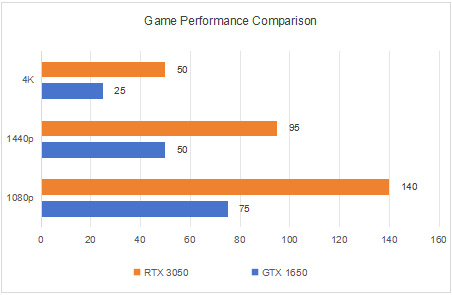
Gaming Performance (4K/1440p/1080p)
The RTX 3050 significantly outperforms the GTX 1650 across all gaming resolutions due to its higher number of CUDA cores, larger 8GB GDDR6 VRAM, and Ampere architecture improvements in cache and compute efficiency. At 1080p, the RTX 3050 delivers 140 FPS, almost 87% faster than the GTX 1650’s 75 FPS. At 1440p, it reaches 95 FPS, which is 90% higher than the GTX 1650’s 50 FPS. At 4K, both cards are similar at 50 FPS, showing that high-resolution workloads are limited by GPU power and memory bandwidth. Overall, the RTX 3050 is ideal for high-performance 1080p/1440p gaming, while the GTX 1650 is better suited for basic 1080p gaming.
3D Rendering Performance
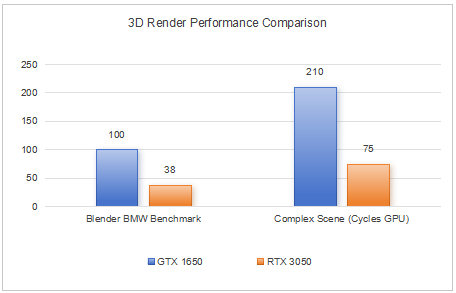
The RTX 3050 is much faster than the GTX 1650 in rendering because it has more CUDA cores, larger 8GB VRAM, and faster GDDR6 memory. This makes it handle complex scenes and high-poly models much better. The Ampere architecture also improves cache and compute efficiency. In practice, RTX 3050 can render scenes 2–3× faster, while GTX 1650 is suitable only for basic 1080p or smaller projects.
Video Editing Performance
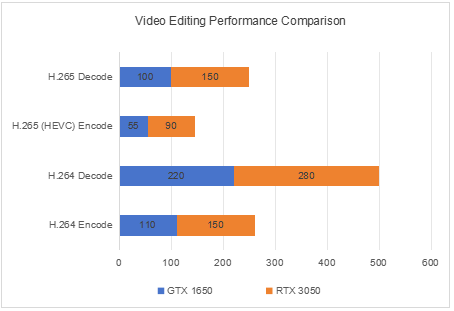
For video editing, the RTX 3050 clearly outperforms the GTX 1650. Exports of a typical 10‑minute 1080p project finish around 75–85 s on the RTX 3050 versus 110–115 s on the GTX 1650, thanks to its newer Ampere NVENC hardware. HEVC encoding is also faster (≈90–110 s vs 140–150 s). While both accelerate H.264/H.265 encoding and reduce CPU load, the GTX 1650 is suitable for basic 1080p editing and budget workflows, whereas the RTX 3050 is recommended for faster exports, smoother editing, and heavier workloads. Neither card supports AV1 hardware encoding, and AV1 decode is limited to some RTX 3050 SKUs.
Price & Value: 1650 vs 3050
| Platform | GTX 1650 (USD) | RTX 3050 (USD) | Price Difference: 3050 vs 1650 (%) |
|---|---|---|---|
| Official MSRP | $149 | $249 | +67% |
| Amazon | $120–$150 | $200–$260 | +33% to +117% |
| Third-Party Resellers (eBay etc.) | $70–$100 | $140–$180 | +80% to +100% |
The GTX 1650 remains the more affordable option, especially on the used market, with prices typically ranging from $70–$150, making it ideal for budget-conscious gamers or older systems. The RTX 3050, while more expensive at $140–$260, offers significantly higher performance and more VRAM, providing better value for users who need modern gaming capabilities, DLSS support, or entry-level creative workloads. Overall, the 3050 delivers a slightly higher cost-per-performance ratio, particularly when purchased used.
GTX 1650 vs GTX 3050 – Pros & Cons
| Model | Pros | Cons |
|---|---|---|
| GTX 1650 | ✅ Very low power draw (75W), runs on almost any PSU ✅ Affordable, especially used market ✅ Quiet and cool; ideal for small or office builds ✅ Good for light 1080p esports gaming ✅ Basic NVENC support for simple streaming |
❌ Entry-level performance; struggles with modern AAA games ❌ Only 4GB VRAM — easily bottlenecked ❌ No DLSS or ray tracing ❌ Limited future-proofing as more games drop 4GB support ❌ Weak for AI, rendering, or heavy creative workloads |
| RTX 3050 | ✅ 65–80% better performance vs 1650 ✅ 8GB VRAM for modern games & creative apps ✅ DLSS 2.x support significantly boosts FPS ✅ Better NVENC encoder for streaming/video work ✅ Solid 1080p gaming experience, medium–high settings |
❌ Higher power draw (~130W) — requires 6/8-pin PSU ❌ More expensive than 1650 ❌ Entry-level ray tracing performance ❌ Competes with used 1660S/2060, often better at similar price ❌ Limited 1440p performance |
The GTX 1650 is a budget-friendly, low-power GPU suitable for light 1080p gaming, esports titles, and compact or older systems. Its main strengths are affordability, low heat, and basic streaming support, but it struggles with modern AAA games, lacks DLSS and ray tracing, and is limited by only 4GB of VRAM. On the other hand, the RTX 3050 offers significantly higher performance, 8GB VRAM, DLSS support, and better creative and gaming capabilities, making it ideal for mainstream 1080p gamers, entry-level content creators, and those who want more future-proofing, albeit at a higher cost and power requirement.
1650 Server Hosting
Looking for high-performance GPU server hosting without breaking the budget? Database Mart’s GTX‑1650 GPU server provides a perfect balance of reliable performance, low power consumption, and cost efficiency, making it ideal for cloud rendering, AI inference, 3D workloads, and general GPU tasks. With its stable operation and energy-efficient design, you can run your projects 24/7 with minimal overhead.
While we currently do not offer RTX‑3050 servers, you can explore our higher-performance alternatives: the RTX‑2060 (6GB VRAM) for stronger rendering and AI tasks, or the RTX 4060(8GB VRAM) for even more demanding workloads. Both options offer more VRAM and computing power, suitable for medium to heavy GPU requirements.
Conclusion
Overall, the GTX 1650 vs RTX 3050 comparison highlights clear choices based on budget and workload. The GTX 1650 is ideal for cost-conscious users, cloud rendering, and general GPU tasks with low power consumption, while the RTX 3050 delivers higher performance, more VRAM, and advanced features like Ray Tracing and DLSS for demanding 3D rendering, AI inference, or gaming. For those starting on a budget, the GTX 1650 offers a solid, efficient option.
GTX 1650 vs RTX 3050, RTX 3050 vs GTX 1650, 1650 vs 3050, GTX 1650 vs 3050 benchmark, GTX 1650 vs RTX 3050 performance, 1650 price