


GTX 1650 Super vs RTX 2060: More Than Just an Entry-Level vs Mid-Range GPU
Explore the key differences between the GTX 1650 Super and RTX 2060 beyond their entry-level and mid-range labels. This guide covers detailed specs, benchmark results, and real-world gaming performance to help you understand their true value and performance trade-offs.
Summary Light of GTX 1650 Super & RTX 2060
Key Features: The GTX 1650 Super features NVIDIA’s Turing architecture without ray tracing, 4GB GDDR6 memory, and low power consumption, delivering solid 1080p gaming performance. The RTX 2060, on the other hand, offers Turing architecture with ray tracing and DLSS support, 6GB GDDR6 memory, and higher CUDA cores, suitable for mid-range gaming and AI workloads.
Industries: The GTX 1650 Super is commonly used for entry-level gaming, eSports, casual content creation, and home PC setups. The RTX 2060 targets mid-range gaming, AAA game streaming, 3D rendering, AI/ML experimentation, and video editing.
Popular Software: Popular applications for the GTX 1650 Super include Fortnite, League of Legends, Minecraft, and OBS Studio for streaming. The RTX 2060 supports software such as Cyberpunk 2077, Blender, Adobe Premiere Pro, DaVinci Resolve, and AI frameworks like TensorFlow and PyTorch.
GTX 1650 Super vs RTX 2060 – Background Comparison
| Model | Brand | Series | Architecture | Release Year | Official Positioning | Current Market Price (Approx.) |
|---|---|---|---|---|---|---|
| GTX 1650 Super | NVIDIA | GeForce GTX 16 Series | Turing | 2019 | Entry-level / Mainstream GPU; focused on affordability and solid 1080p gaming performance; suitable for budget gamers and esports | $159–$180 USD |
| RTX 2060 | NVIDIA | GeForce RTX 20 Series | Turing | 2019 | Mid-range GPU; entry point to NVIDIA’s RTX features (ray tracing & DLSS); aimed at gamers who want higher performance, AAA titles, and future-ready graphics | $300–$350 USD |
1650 Super vs 2060 Specification Comparison
Core Specs: 1650 super vs 2060
| Specification | GTX 1650 Super | RTX 2060 | Difference / Advantage |
|---|---|---|---|
| Architecture | NVIDIA Turing (no RT/Tensor cores) | NVIDIA Turing (with RT & Tensor cores) | RTX 2060 has dedicated ray tracing & Tensor cores for modern effects & DLSS support |
| CUDA Cores | 1,280 | 1,920 | RTX 2060 has significantly more CUDA cores, offering higher compute and raster performance |
| Memory Type | GDDR6 | GDDR6 | Same memory type; both use modern GDDR6 |
| Memory Capacity (vRAM) | 4 GB | 6 GB | RTX 2060 provides more VRAM for high‑texture gaming and future titles |
| Memory Bus | 128‑bit | 192‑bit | RTX 2060 wider memory bus, enabling better memory throughput |
| Memory Bandwidth | ~192 GB/s | ~336 GB/s | RTX 2060 ~75% higher bandwidth for faster data transfer |
| Core Frequency (Boost) | ~1,725 MHz | ~1,680 MHz | Similar boost clocks; slightly higher on 1650 Super but overall performance dominated by core count and bandwidth |
| TDP (Power) | ~100 W | ~160 W | GTX 1650 Super is much more power‑efficient, lower heat and PSU requirement |
| Interface / Bus | PCIe 3.0 x16 | PCIe 3.0 x16 | Same PCIe interface; no difference |
| FP32 Performance | ~4.4 TFLOPS | ~6.45 TFLOPS | RTX 2060 offers significantly higher FP32 compute performance |
| Ray Tracing / Tensor Cores | No RT / No Tensor | Yes RT / Yes Tensor | RTX 2060 supports real‑time ray tracing and DLSS via dedicated cores |
| PCIe Version | PCIe Gen3 | PCIe Gen3 | Both support PCIe 3.0; no difference |
The RTX 2060 has 50% more CUDA cores, 50% more VRAM, a 50% wider memory bus, and ~ 75% higher memory bandwidth, resulting in smoother gameplay and better handling of high-resolution textures. It also delivers ~ 46% higher FP32 performance and supports ray tracing and DLSS, enabling more realistic graphics. The GTX 1650 Super is ~ 38% more power-efficient, making it ideal for compact or budget-friendly systems.
Advanced Features
| Specification | GTX 1650 Super | RTX 2060 | Difference / Advantage |
|---|---|---|---|
| Base Clock | 1,530 MHz | 1,365 MHz | GTX 1650 Super slightly higher base clock, but overall performance dominated by CUDA cores and memory |
| ROPs (Render Output Units) | 32 | 48 | RTX 2060 has more ROPs, improving high-resolution rendering efficiency |
| Texture Units (TMUs) | 80 | 120 | RTX 2060 processes textures faster, benefiting high-detail gaming |
| L2 Cache | 2 MB | 3 MB | RTX 2060 larger cache improves data access and compute efficiency |
| Max Resolution | 7680×4320 | 7680×4320 | Same max resolution, but RTX 2060 maintains better performance at high settings |
| Cooling / Form Factor | Single-fan / Dual-slot | Dual-fan / Dual-slot | RTX 2060 has stronger cooling for sustained high-load gaming |
The RTX 2060 has 1.5× more ROPs, 1.5× more TMUs, and ~ 1.5× larger L2 cache, delivering smoother gameplay, faster texture processing, and better performance at high resolutions. The GTX 1650 Super is ~ 1.6× more power-efficient and easier to fit in compact systems due to its simpler cooling and smaller form factor.
GTX 1650 super vs RTX 2060 Benchmark: Performance Across Different Scenarios
1650 Super vs RTX 2060 Gaming Performance
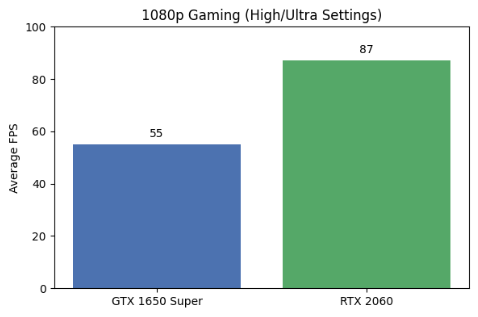
1080p Gaming (High/Ultra Settings)
At 1080p high/ultra settings, the RTX 2060 delivers about 58% higher average FPS compared to the GTX 1650 Super, providing smoother gameplay and higher frame rates in demanding titles.
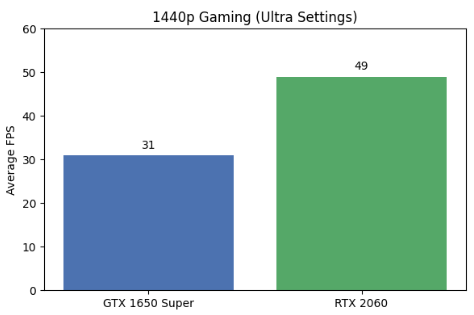
1440p Gaming (Ultra Settings)
At 1440p ultra settings, the RTX 2060 maintains roughly 58% higher performance than the GTX 1650 Super, ensuring more consistent frame rates for high-resolution gaming.
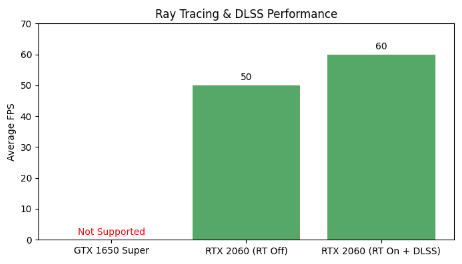
Ray Tracing & DLSS Performance
In ray tracing scenarios, the RTX 2060 outperforms the GTX 1650 Super by supporting RT and DLSS, achieving a ~ 20% FPS uplift when DLSS is enabled. The GTX 1650 Super cannot run ray tracing, making RTX 2060 the clear choice for enhanced visuals.
Price & Value: Nvidia GTX 1650 Super vs RTX 2060
| Platform | GTX 1650 Super (USD) | RTX 2060 (USD) | Price Difference (USD) | Price Difference (%) |
|---|---|---|---|---|
| Official MSRP | $159 | $349 | +$190 | +120% |
| Amazon | $150 – $200 | $300 – $380 | +$100 – $230 | +90% – 110% |
| Third-Party Resellers (eBay etc.) | $140 – $210 | $280 – $360 | +$70 – $220 | +80% – 115% |
The GTX 1650 Super remains a budget-focused GPU, typically priced below $200 in the current market, making it attractive for entry-level 1080p gaming and cost-sensitive users.
By comparison, the RTX 2060 price is generally 80%–120% more expensive, but the higher price delivers substantially stronger gaming performance, larger VRAM, and access to ray tracing and DLSS, resulting in a noticeably higher overall value for mainstream and performance-oriented gamers.
GTX 1650 Super vs RTX 2060 – Pros & Cons
| GPU | Pros | Cons |
|---|---|---|
| GTX 1650 Super | • Lower purchase cost, budget-friendly • Lower power consumption and heat output • Suitable for 1080p esports and older AAA titles • Works well with entry-level CPUs and smaller PSUs |
• No ray tracing or Tensor cores • Limited VRAM capacity (4GB) • Weaker performance in modern AAA games • Less future-proof for upcoming titles |
| RTX 2060 | • Significantly stronger gaming performance • Supports ray tracing and DLSS • Larger VRAM (6GB) helps in modern games • Better suited for high-refresh-rate 1080p and entry-level 1440p |
• Much higher price compared to GTX 1650 Super • Higher power consumption • Requires a stronger PSU and better cooling • Less cost-efficient for very casual or esports-only users |
RTX 2060 Server Hosting
“RTX 2060 hosting” refers to renting cloud servers powered by NVIDIA RTX 2060 GPUs, allowing users to run GPU-accelerated workloads without purchasing or maintaining physical hardware. Database Mart provides reliable RTX 2060 server hosting with high uptime, multi-core CPUs, and fast NVMe storage—suitable for 1080p game servers, video editing, 3D modeling, AI inference, and general GPU-intensive applications.
Compared to running workloads on a local PC, RTX 2060 hosting helps reduce upfront hardware costs, electricity usage, and long-term maintenance. It also offers remote access, flexible scalability, and consistent performance, making it a practical option for developers, creators, and businesses that need GPU power on demand.
Conclusion
The GTX 1650 Super and RTX 2060 serve different performance levels and use cases within NVIDIA’s lineup. The 1650 Super emphasizes efficiency and affordability for entry-level gaming, while the RTX 2060 offers significantly stronger performance and modern features like ray tracing and DLSS. Rather than choosing a clear winner, the better option depends on budget, target resolution, and workload requirements, making each GPU a practical choice within its intended segment.
GTX 1650 Super vs RTX 2060, 1650 super vs 2060, NVIDIA GTX 1650 Super vs RTX 2060,GTX 1650 Super specs, RTX 2060 specs, RTX 2060 benchmark, RTX 2060 price, RTX 2060 gaming performance