


GTX 1660 vs GTX 1070: Which GPU Is the Better Choice?
The NVIDIA GTX 1660 and GTX 1070 are two popular choices in the mid-range GPU market. The Pascal-based GTX 1070 was once a high-end favorite, while the newer Turing-based GTX 1660 focuses on delivering strong value for mainstream users. Although both offer solid performance, they differ in pricing, power efficiency, VRAM, and overall suitability for different workloads. This article breaks down their specs, benchmarks, gaming performance, and ideal use cases to help you decide which GPU fits your needs in 2025.
Summary Light of 1660 & 1070
- Key Features: The GTX 1660 and GTX 1070 deliver strong 1080p to entry-level 1440p performance, with the 1070 offering higher CUDA core counts, greater memory bandwidth, and 8GB VRAM for more demanding workloads. The GTX 1660 performance provides excellent power efficiency and improved Turing-based architecture enhancements (without RT/Tensor cores), making both GPUs reliable choices for gaming, creative tasks, and general-purpose GPU computing.
- Industries: Suitable for gaming, video editing, digital content creation, 3D modeling and visualization, multimedia production, CUDA-accelerated development, and light AI inference or engineering workloads.
- Popular Software: Compatible with Blender, Premiere Pro, After Effects, DaVinci Resolve, Unity, Unreal Engine, AutoCAD, SolidWorks, TensorFlow (GPU), PyTorch (GPU), OBS Studio, and mainstream games such as Fortnite, Apex Legends, and GTA V.
GTX 1660 vs GTX 1070 – Background Comparison
| Brand | Series | Model | Release Year | Official Positioning / Description | Market Price (USD) |
|---|---|---|---|---|---|
| NVIDIA | GeForce 16 Series | GTX 1660 | 2019 | Mainstream / efficient 1080p performance (6GB GDDR5, 1408 CUDA cores) | ~$120–$160 |
| NVIDIA | GeForce 10 Series | GTX 1070 | 2016 | Upper-mid-range / higher performance GPU (8GB GDDR5, 1920 CUDA cores) | ~$150–$220 |
The biggest difference between the 1660 vs 1070 lies in overall performance capacity, CUDA cores, and memory configuration. While the GTX 1660 features 6GB of GDDR5 and focuses on power-efficient 1080p gaming, often featuring a competitive 1660 price, the GTX 1070 provides a stronger GPU with 8GB of GDDR5 and significantly higher core counts, making it better suited for higher-end gaming, rendering, and GPU-accelerated workloads. Pricing on the used market varies widely, but the GTX 1070 generally costs more due to its superior performance tier.
NVIDIA GTX 1660 vs GTX 1070 – Specifications Comparison
Core Specs Comparison
| Parameter | GTX 1660 | GTX 1070 | Difference / Advantage |
|---|---|---|---|
| Architecture | Turing (No RT/Tensor) | Pascal | Different generations; 1660 is newer & more efficient |
| CUDA Cores | 1,408 | 1,920 | 1070 has ~36% more CUDA cores |
| Memory Type | GDDR5 | GDDR5 | Same memory type |
| Memory Capacity | 6 GB | 8 GB | 1070 offers more VRAM for heavy workloads |
| Memory Bus | 192-bit | 256-bit | 1070 has wider bandwidth |
| Memory Bandwidth | 192 GB/s | 256 GB/s | 1070 higher bandwidth |
| Core Frequency (Boost) | ~1.78 GHz (varies by AIB) | ~1.68 GHz (varies by AIB) | 1660 slightly higher core clock |
| TDP (Power) | 120W | 150W | 1660 more power-efficient |
| Interface / Bus | PCIe Gen3 | PCIe Gen3 | Same interface |
| FP32 Performance | ~5 TFLOPS | ~6.5 TFLOPS | 1070 ~30% faster |
| Ray Tracing / Tensor | None | None | Neither supports hardware RT/Tensor |
| PCIe Version | Gen3 | Gen3 | Same version |
Advanced Features Comparison
| Feature / Capability | GTX 1660 | GTX 1070 | Difference / Advantage |
|---|---|---|---|
| Ray Tracing Cores | None | None | No RT hardware on both |
| Tensor Cores | None | None | No Tensor hardware on both |
| DLSS Support | No (DLSS requires RTX) | No | Neither supports DLSS |
| AI Acceleration | Limited CUDA-based | Limited CUDA-based | Similar; depends on CUDA cores and VRAM |
| AV1 Encoding / Decoding | No | No | Neither supports AV1 |
| Display Outputs | HDMI 2.0b, DP 1.4 | HDMI 2.0b, DP 1.4 | Same |
| Max Supported Resolution | Up to 8K / 60Hz | Up to 8K / 60Hz | Same |
| PCIe Support | PCIe Gen3 ×16 | PCIe Gen3 ×16 | Same |
| VRAM Advantage | 6GB (may bottleneck in some games) | 8GB (better for high-res / large textures) | 1070 clearly superior |
| Target Use Case | 1080p / mid-range gaming | 1080p high-settings / entry-level 1440p | Each GPU fits a different performance tier |
The GTX 1070 delivers noticeably stronger performance with more CUDA cores, higher memory bandwidth, a wider 256-bit bus, and 8GB VRAM, making it better suited for high-settings 1080p gaming, entry-level 1440p, and heavier creative workloads. In contrast, the GTX 1660 offers newer and more power-efficient Turing architecture, slightly higher boost clocks, and lower 120W TDP, making it a more efficient option for mainstream 1080p use. Both lack RT/Tensor cores and DLSS support, but the 1070’s overall raw compute power (~30% higher FP32) and extra VRAM give it a clear advantage in demanding games, rendering tasks, and memory-intensive applications, while the 1660 remains a cheaper, cooler, and energy-efficient choice.
GTX 1660 vs 1070 Benchmark: Performance Across Different Scenarios
Gaming Performance (4K/1440p/1080p)
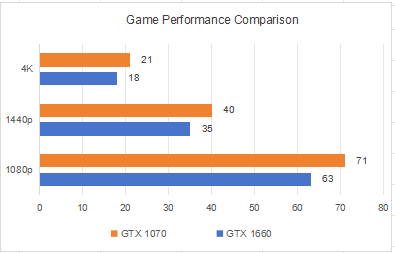
When comparing mid-range GPUs for gaming, real-world frame rates across different resolutions highlight their true capabilities. Based on benchmark tests, we evaluate how the GTX 1660 and GTX 1070 perform in modern games, from 1080p High to 4K Ultra settings, showing the differences in FPS, stability, and handling of high-resolution textures.
3D Rendering Performance
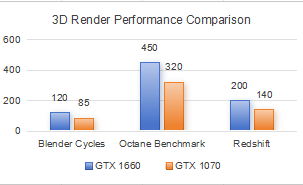
The GTX 1070 significantly outperforms the GTX 1660 in GPU rendering tasks such as Blender Cycles, Octane, and Redshift, achieving roughly 40–45% faster render times. This performance gap is mainly due to the 1070’s higher CUDA core count, larger memory capacity, and wider memory bandwidth, which allow it to handle complex scenes and high-resolution textures more efficiently. While both cards have similar clock speeds, the 1070’s increased cache and parallel processing capability reduce bottlenecks in demanding GPU workloads, making it particularly advantageous for professional 3D rendering and high-resolution projects, whereas the 1660 is more suitable for lighter or less complex tasks.
Price & Value: 1660 vs 1070
| Platform | GTX 1660 (USD) | GTX 1070 (USD) | Price Difference: GTX 1070 vs 1660 (%) |
|---|---|---|---|
| Official MSRP | $219 | $379 | +73% |
| Amazon | $220–$249 | $359–$399 | +63–80% |
| Third-Party Resellers (eBay etc.) | $200–$280 | $340–$420 | +70–100% |
GTX 1660 vs GTX 1070 – Pros & Cons
| Model | Pros | Cons |
|---|---|---|
| GTX 1660 | ✅ Lower price / power draw, better price-to-performance ratio ✅ Newer Turing architecture with efficiency gains ✅ Good for mainstream 1080p gaming and budget-conscious builds |
❌ Lower raw performance vs 1070 ❌ Less VRAM / bandwidth — may limit high-res, heavy 3D, future games ❌ Less headroom for heavy rendering / 4K / demanding workloads |
| GTX 1070 | ✅ Higher performance / FPS overall ✅ More VRAM / wider memory bus — better for heavy games/3D/rendering ✅ Better headroom for demanding workloads and future games |
❌ More power hungry / hotter / requires better PSU / cooling ❌ Older architecture / less optimal efficiency ❌ May be harder to find new GPUs — often only used/refurbished units |
1660 Server Hosting
1660 Server provides cloud servers or dedicated instances powered by GTX 1660 GPUs, giving remote access to high-performance graphics without buying physical hardware. Database Mart’s 1660 server
feature dual Intel Xeon CPUs, 64GB RAM, fast SSD storage, and 99.9% uptime, ideal for streaming, gaming, HD video editing, Android emulators, and other graphics-intensive workloads.
Compared to local workstations, GPU server hosting saves on electricity, cooling, and maintenance, while offering scalable performance and anywhere accessibility. Freelancers, content creators, small studios, and developers benefit from stable GPU computing without upfront investment. While we don’t offer the GTX 1070, the RTX 4060 is an excellent alternative, offering 8GB of VRAM and higher performance.
Conclusion
Overall, the 1660 vs 1070 comparison shows strong options for different budgets and workloads. The GTX 1660 is excellent for 1080p gaming and cost-conscious users, while the GTX 1070 offers higher frame rates, better performance at 1440p, and more headroom for 3D rendering or GPU-intensive tasks. For those exploring entry-level AI tasks or light creative work, the 1660 remains a solid, budget-friendly choice.
GTX 1660 vs GTX 1070, GTX 1660 vs 1070, 1660 vs 1070, 1660 price, GTX 1660 specs, 1660 Server, GTX 1660 performance, GTX 1660 benchmark