


GTX 1660 SUPER vs RTX 2060 : Which GPU Offers the Best Performance and Value?
Compare the GTX 1660 SUPER and RTX 2060 to see which GPU gives you the best balance of performance, features, and value for gaming, content creation, and GPU-powered tasks.
GTX 1660 SUPER vs RTX 2060 – Background Comparison
| Brand | Series | Model | Release Year | Official Positioning | Market Price (USD) |
|---|---|---|---|---|---|
| NVIDIA | GeForce | GTX 1660 SUPER | 2019 | Built on NVIDIA’s Turing architecture with fast GDDR6 memory, the GTX 1660 SUPER delivers up to 20% better performance than the GTX 1660 and up to 1.5× the performance of the GTX 1060 6GB, making it a strong value choice for popular games. | $229 |
| NVIDIA | GeForce | GTX 2060 | 2019 | The GeForce RTX 2060 is powered by the NVIDIA Turing architecture, bringing incredible performance and the power of real-time ray tracing and AI to the latest games and to every gamer. | $349 |
NVIDIA GTX 1660 SUPER vs RTX 2060– Specifications Comparison
The main difference between the RTX 2060 and the GTX 1660 SUPER lies in performance and feature support. The RTX 2060 offers higher overall performance thanks to more CUDA cores and stronger FP32 compute power, delivering around 25–30% better gaming and productivity performance. It also supports real-time ray tracing and DLSS through dedicated Tensor and RT cores, enabling more advanced visuals and higher frame rates. In contrast, the GTX 1660 SUPER focuses on efficiency and value, lacks ray tracing and AI acceleration, and is best suited for mainstream 1080p gaming.
Core Specs Comparison between GTX 1660 SUPER vs RTX 2060
| Specification | RTX 2060 | GTX 1660 SUPER | RTX 2060 Improvement / Gain |
|---|---|---|---|
| GPU Model | GeForce RTX 2060 | GeForce GTX 1660 SUPER | — |
| Architecture | Turing (RTX) | Turing (GTX) | RTX adds ray tracing & AI |
| CUDA Cores | 1920 | 1408 | +36% |
| Memory Type | GDDR6 | GDDR6 | Same |
| Memory Capacity | 6 GB | 6 GB | Same |
| Memory Bandwidth | 336 GB/s | 336 GB/s | Same |
| Core Frequency (Base / Boost) | ~1365 / 1680 MHz | ~1530 / 1785 MHz | Lower clocks but more cores |
| TDP (Power Draw) | 160 W | 125 W | +28% power |
| Interface | PCIe 3.0 x16 | PCIe 3.0 x16 | Same |
| FP32 Performance | ~6.5 TFLOPS | ~5.0 TFLOPS | +30% |
| Tensor Cores | Yes (240) | No | RTX-only feature |
| PCIe Interface | PCIe 3.0 x16 | PCIe 3.0 x16 | Same |
The RTX 2060 clearly outperforms the GTX 1660 SUPER in advanced use cases. It supports ray tracing and DLSS for enhanced visuals, and offers better VR performance. For content creators, it accelerates rendering and AI-based workloads, and its newer NVENC encoder provides superior streaming quality. The GTX 1660 SUPER, while efficient and capable for mainstream 1080p gaming, lacks these advanced features, making the RTX 2060 a more future-proof and versatile option for gamers and creators seeking higher performance and additional capabilities.
Advanced Feature Comparison between GTX 1660 SUPER vs RTX 2060
| Advanced Performance Metric | RTX 2060 | GTX 1660 SUPER | RTX 2060 Improvement / Gain |
|---|---|---|---|
| Ray Tracing Support | Yes (Playable with DLSS) | No | Exclusive feature |
| DLSS Support | DLSS 1.x / 2.x | Not supported | Higher FPS & image quality |
| VR Performance | VR-Ready (Smooth) | Entry-level VR | Better VR stability |
| Content Creation (Blender / Adobe) | Faster render & effects | Moderate performance | ~30% faster |
| AI-Accelerated Workloads | Supported | Not supported | Major advantage |
| Streaming (NVENC Quality) | Newer NVENC (better quality) | Older NVENC | Higher stream quality |
| Future Game Longevity | Better long-term support | Limited by features | Higher |
| Overall Use Case | High-end 1080p / Entry 1440p | Mainstream 1080p | Clear tier upgrade |
GTX 1660 SUPER vs RTX 2060 Performance Across Different Scenarios
Artificial Intelligence Testing
The GeForce GTX 1660 SUPER and RTX 2060 are popular choices for mainstream gaming and AI workloads. Geekbench ML provides a standardized benchmark to evaluate machine learning performance, including single-precision, half-precision, and quantized tasks. Comparing these two GPUs highlights the differences in efficiency, throughput, and suitability for AI inference and GPU-accelerated computing.
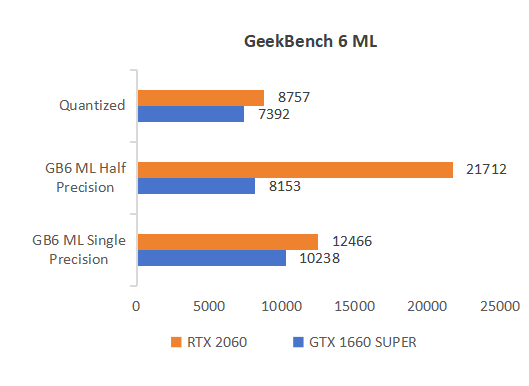
The Geekbench ML results show that the RTX 2060 outperforms the GTX 1660 SUPER by roughly 20–166% depending on the precision type, with particularly large gains in half-precision tasks. This demonstrates that the RTX 2060 delivers significantly higher efficiency and performance for machine learning workloads, making it a better choice for AI applications beyond basic gaming.
Gaming Performance
The GeForce GTX 1660 SUPER and RTX 2060 are both mainstream graphics cards, designed for 1080p and 1440p gaming as well as moderate GPU workloads. Their performance varies across different resolutions, with the RTX 2060 generally delivering higher frame rates and smoother gameplay compared to the GTX 1660 SUPER. Below is a bar chart comparing their performance across 1080p, 1440p, and 4K settings:
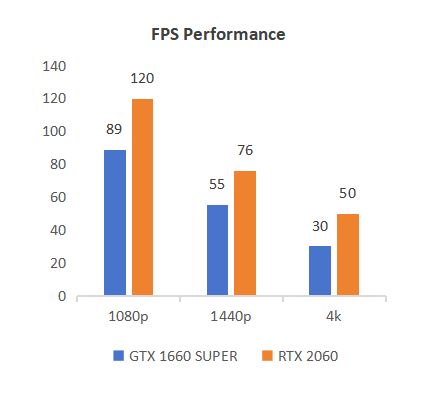
At 1080p, the RTX 2060 delivers roughly 35% higher FPS compared to the GTX 1660 SUPER, providing smoother and more responsive gameplay.
At 1440p, the RTX 2060 maintains a lead of about 38%, allowing higher settings with playable frame rates, while the GTX 1660 SUPER typically needs medium settings.
At 4K, the RTX 2060 outperforms the GTX 1660 SUPER by approximately 67%, though both cards are still limited by low frame rates at this resolution.
3D Rendering
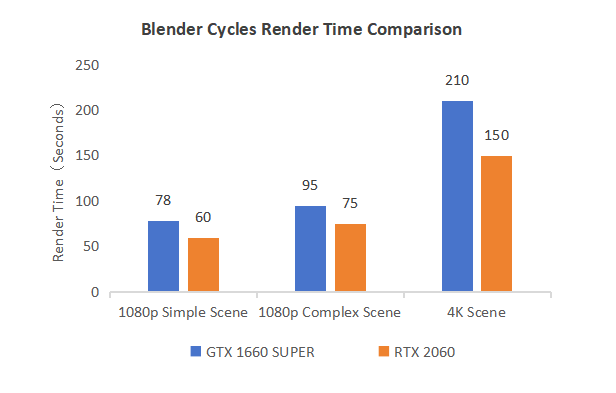
In Blender Cycles rendering tests, the RTX 2060 outperforms the GTX 1660 SUPER across all scenarios: in 1080p simple scenes, it renders approximately 23% faster, in 1080p complex scenes about 27% faster, and in 4K scenes around 29% faster. This performance gap is mainly due to the RTX 2060 having more CUDA cores (1920 vs. 1408), higher memory bandwidth, and support for OptiX ray-tracing acceleration, which significantly reduces computation time and improves overall rendering efficiency in complex and high-resolution scenes. In comparison, the GTX 1660 SUPER remains capable for moderately complex or lower-resolution tasks but lags noticeably in complex effects and 4K rendering workloads.
Price & Value: GTX 1660 SUPER vs RTX 2060
The GTX 1660 SUPER and RTX 2060 occupy the mid-range segment, with the RTX 2060 generally costing $120–$239 more than the 1660 SUPER, representing a 19%–44% price increase depending on retailer or marketplace. While the RTX 2060 offers features like ray tracing, DLSS, and higher overall performance, the 1660 SUPER delivers strong gaming and GPU-accelerated performance at a lower cost. For users seeking better price-to-performance without advanced RTX features, the GTX 1660 SUPER is often the more cost-efficient choice, whereas the RTX 2060 is ideal for those prioritizing future-proofing and higher-end graphics workloads.
Price Comparison
| Platform / Retailer | GTX 1660 SUPER (USD) | RTX 2060 (USD) | Price Difference (USD) | Price Difference (%) |
|---|---|---|---|---|
| Official MSRP | ~$229 | ~$349 | –$120 | –34% |
| Retail (Amazon / Newegg) | ~$150–$380 | ~$270–$619 | –$120–$239 | –44%––19% |
| Secondary / Marketplace | ~$70–$180 | ~$80–$306 | –$10–$236 | –5%––73% |
User Value-for-Money Feedback
User value‑for‑money feedback generally shows that the GTX 1660 SUPER delivers very strong performance per dollar in traditional gaming and GPU tasks compared with the RTX 2060, because it costs significantly less while still handling most 1080p/1440p workloads well. The RTX 2060, although more expensive, adds ray tracing and DLSS support and higher raw performance, so it’s considered better value only if those features or higher settings matter to the user.
GTX 1660 SUPER vs RTX 2060 – Pros & Cons
| Model | Pros | Cons |
|---|---|---|
| GTX 1660 SUPER | ✅ Strong mid-range performance for 1080p–1440p gaming and GPU tasks ✅ Excellent price-to-performance ratio ✅ Low power consumption and efficient cooling ✅ Handles most modern games at high settings without RTX features |
❌ Lacks ray tracing and DLSS support ❌ Less future-proof than RTX 2060 ❌ Limited for 4K gaming or highly demanding GPU workloads |
| RTX 2060 | ✅ Higher raw performance than GTX 1660 SUPER ✅ Supports ray tracing and DLSS for enhanced graphics ✅ Better future-proofing for upcoming games and workloads ✅ Strong for 1440p gaming and creative tasks |
❌ Higher cost compared to GTX 1660 SUPER ❌ Slightly higher power consumption ❌ Not always a proportional performance increase for traditional rasterized gaming compared to 1660 SUPER |
GTX 1660 SUPER vs RTX 2060 Hosting
The GTX 1660 SUPER and RTX 2060 cater to mid-range and upper mid-range performance needs, making them suitable for 1080p–1440p gaming, 3D rendering, video editing, and GPU-accelerated workloads.
For individuals or teams needing GPU resources without investing in local hardware, GPU hosting provides a flexible and cost-effective solution. Database Mart offers GTX 1660 GPU servers and GTX 2060 GPU servers , Providing affordable access to powerful GPUs, the GTX 1660 offers strong cost-efficient performance for standard workloads, including 1080p gaming, 3D rendering, and GPU-accelerated tasks. In comparison, the RTX 2060 delivers higher raw performance along with ray tracing and DLSS support, making it ideal for more demanding projects, enhanced visuals, and future-proofing GPU-intensive workflows.
Conclusion
GTX 1660 SUPER: Mid-range GPU, good for 1080p–1440p gaming, 3D rendering, video editing, and moderate GPU tasks. Cost-efficient and energy-friendly. Limited VRAM may restrict large AI models.
RTX 2060: Upper mid-range GPU with higher performance, supports ray tracing and DLSS, suitable for demanding gaming and creative workloads. Also limited by VRAM for large AI models.
Summary: Both GTX 1660 SUPER and RTX 2060 provide solid performance for gaming and GPU tasks, but both have limitations for AI workloads, typically suitable only for small to medium models due to memory constraints.
1660 super vs 2060, 1660 super vs rtx 2060, 2060 vs 1660 super, 1660 super vs 2060 price, GTX 1660 super vs RTX 2060, 2060 vs 1660 super benchmark, gtx 1660 super vs rtx 2060 power consumption