


GTX 1660 Super vs RTX 2060 Super: Do These GPUs Still Make Sense Today?
This in-depth comparison goes beyond specs to explore how GTX 1660 Super and RTX 2060 Super handle real-world tasks—from gaming and content creation to development and AI—helping you choose the GPU that best fits your needs and budget.
Summary Light of GTX 1660 Super & RTX 2060 Super
Even though GTX 1660 Super and RTX 2060 Super are now considered older GPUs, they remain practical GPUs for gaming, content creation, and development. They are no longer the latest cards but still offer solid performance for users on a budget or with moderate needs.
Key Features: The GTX 1660 Super delivers 1080p gaming with 1408 CUDA cores and GDDR6 memory, without ray tracing or Tensor cores. The RTX 2060 Super adds 2176 CUDA cores, RT and Tensor cores, and supports ray tracing and DLSS for higher-resolution gaming and more demanding workloads.
Industries: GTX 1660 Super is ideal for eSports, casual gaming, indie development, and entry-level content creation. RTX 2060 Super fits AAA gaming, professional content creation, software development, and light AI experimentation, offering more versatility for mixed workloads.
Popular Software: GTX 1660 Super runs Fortnite, CS:GO, Minecraft, Photoshop, and basic Blender projects smoothly. RTX 2060 Super handles Cyberpunk 2077, Valorant, Premiere Pro, DaVinci Resolve, Blender, and Unreal Engine, supporting more demanding creative and development tasks.
1660 Super vs 2060 Super – Background Comparison
| Model | Brand | Series / Architecture | Release Year | Official Positioning (2025 view) | Approx. Current Price (2025) |
|---|---|---|---|---|---|
| GTX 1660 Super | NVIDIA | GTX 16-series / Turing (TU116) | 2019 | Budget / Mainstream 1080p gaming, entry-level content creation | ~ US$120–150 |
| RTX 2060 Super | NVIDIA | RTX 20-series / Turing (TU106) | 2019 | Mid-range gaming and creative workloads, supports ray tracing and lightweight AI tasks | ~ US$180–220 |
GTX 1660 Super vs RTX 2060 Super – Specification Comparison
Core Specs: 1660 Super vs 2060 Super
| Specification | GTX 1660 Super | RTX 2060 Super | Difference / Advantage |
|---|---|---|---|
| Architecture | Turing (TU116) | Turing (TU106) | RTX 2060 Super adds RT & Tensor cores, giving hardware ray tracing and AI capabilities |
| CUDA Cores | 1408 | 2176 | +55% more CUDA cores → higher parallel compute and raster performance |
| Memory Type | GDDR6 | GDDR6 | Same memory type |
| Memory Capacity (vRAM) | 6 GB | 8 GB | +33% more VRAM → better for high-res textures and heavier workloads |
| Memory Bus | 192-bit | 256-bit | +33% wider memory bus → higher throughput |
| Memory Bandwidth | 336 GB/s | 448 GB/s | +33% higher bandwidth → faster data transfer |
| Core Frequency (Boost) | ~1785 MHz | ~1650 MHz | GTX 1660 Super has ~8% higher boost clock, but fewer cores |
| TDP (Power) | 125 W | 175 W | RTX 2060 Super consumes +40% more power for higher performance |
| Interface / Bus | PCIe 3.0 x16 | PCIe 3.0 x16 | Same interface |
| FP32 Performance | ~5.03 TFLOPS | ~7.18 TFLOPS | +43% higher FP32 compute → stronger raw performance |
| Ray Tracing / Tensor Cores | No | Yes | RTX 2060 Super supports ray tracing and Tensor cores; GTX 1660 Super does not |
| PCIe Version | PCIe 3.0 | PCIe 3.0 | Same PCIe generation; backward compatible |
Key Differences: 1660 Super vs 2060 Super
CUDA Cores: RTX 2060 Super has 55% more cores, delivering faster compute and rendering performance.
Memory: The 2060 Super 8GB features 33% more VRAM, a 33% wider bus and 33% higher bandwidth allow smoother handling of high-res textures and heavier workloads.
FP32 Performance: 43% higher on RTX 2060 Super → stronger for creative tasks and light AI workloads.
Ray Tracing & AI: RTX 2060 Super has RT and Tensor cores; GTX 1660 Super does not.
Power & Clock: GTX 1660 Super has slightly higher boost clock and lower TDP, making it more power-efficient and budget-friendly for 1080p gaming.
More Specs: 2060 Super vs 1660 Super
| Specification | GTX 1660 Super | RTX 2060 Super | Difference / Advantage |
|---|---|---|---|
| Ray Tracing Support | No | Yes (hardware) | RTX 2060 Super supports real-time ray tracing; GTX 1660 Super cannot |
| Tensor / AI Acceleration | No | Yes (Tensor cores) | RTX 2060 Super can accelerate AI workloads like DLSS or deep learning inference |
| Video Encode / Decode | NVENC / NVDEC (Turing Gen 7) | NVENC / NVDEC (Turing Gen 7, RTX enhancements) | RTX 2060 Super has slightly better hardware encoding efficiency for 4K streaming and content creation |
| VR / Mixed Reality Support | Basic VR-ready | Enhanced VR-ready | RTX 2060 Super better handles high-fidelity VR applications |
| Software Ecosystem / Driver Support | NVIDIA Studio Drivers | NVIDIA Studio + RTX-enhanced apps | RTX 2060 Super can leverage DLSS-enabled and RTX-enhanced creative and gaming apps |
The RTX 2060 Super stands out with hardware ray tracing, Tensor cores, enhanced video encoding, and better VR support, making it more versatile for modern gaming, creative work, and light AI tasks. The GTX 1660 Super remains a budget-friendly 1080p option, but lacks these advanced features.
GTX 1660 Super vs RTX 2060 Super Benchmarks: Performance Across Different Scenarios
Gaming Performance — 1080p / 1440p
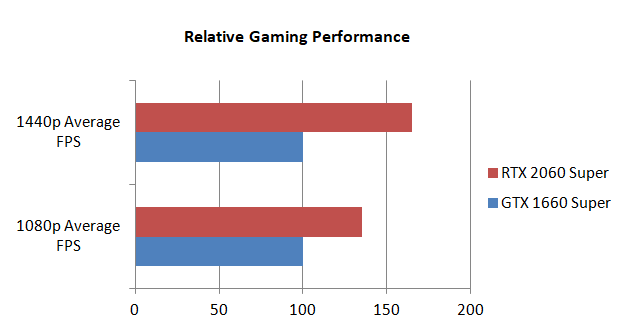
Based on real-world gtx 1660 super benchmarks, the RTX 2060 Super shows a consistent lead in rtx 2060 super gaming, with the performance gap becoming more noticeable as graphical demands and resolution increase.
In 1080p high settings, the RTX 2060 Super delivers about 35% higher FPS compared to the GTX 1660 Super.
At 1440p high settings, the performance gap widens, with the RTX 2060 Super achieving approximately 65% higher FPS. This demonstrates that while the GTX 1660 Super remains capable for 1080p gaming, the RTX 2060 Super provides a significant boost for higher-resolution and more demanding gaming workloads.
Content Creation & Productivity Performance
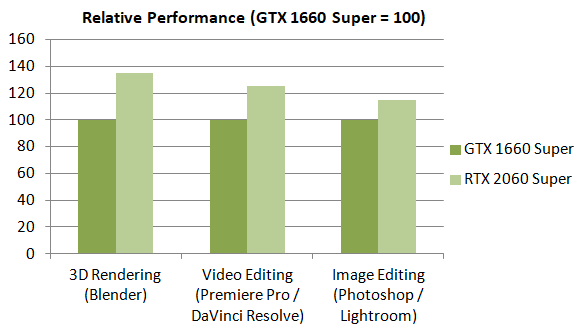
Across common creative tasks, the RTX 2060 Super Performance outperforms the GTX 1660 Super consistently. In 3D rendering, it delivers about 35% faster performance, making complex scenes render quicker. For video editing, performance is ~ 25% higher, providing smoother playback and faster export times. In image editing, RTX 2060 Super shows ~ 15% improvement, especially when using GPU-accelerated filters. The GTX 1660 Super remains capable for entry-level projects, but the RTX 2060 Super clearly provides a noticeable boost for creators working with heavier workloads.
AI & Machine Learning Performance
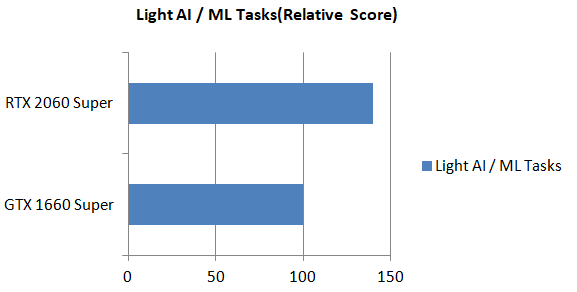
For light AI and machine learning workloads, the RTX 2060 Super delivers about 40% higher performance compared to the GTX 1660 Super. The GTX 1660 Super can handle basic tasks, but the RTX 2060 Super’s Tensor cores provide a clear advantage for modern AI-accelerated applications.
Price & Value: GTX 1660 Super vs RTX 2060 super
| Platform | GTX 1660 Super (USD) | RTX 2060 Super (USD) | Price Difference (USD) | Price Difference (%) |
|---|---|---|---|---|
| Original MSRP | $229 | $399 | $170 | 74% |
| Amazon (Used / Renewed) | $110 – $150 | $160 – $220 | $40 – $70 | 30% – 45% |
| Third-Party Resellers (eBay etc.) | $100 – $160 | $150 – $240 | $50 – $80 | 35% – 55% |
In 2025, the GTX 1660 Super is typically 30 – 55% cheaper, making it a strong budget choice. However, the higher rtx 2060 super price is justified by better gaming performance, higher memory bandwidth, and support for ray tracing and AI features, offering greater long-term value for demanding workloads.
GTX 1660 Super vs RTX 2060 Super – Pros & Cons
| GPU | Pros | Cons |
|---|---|---|
| RTX 2060 Super | - Higher CUDA cores for faster rendering and gaming - Supports hardware ray tracing and Tensor cores for AI tasks - Better performance in content creation and AI workloads - Enhanced VR and modern software support |
- Higher power consumption (175 W) - Slightly lower boost clock compared to 1660 Super - More expensive |
| GTX 1660 Super | - Lower power consumption (125 W) - Slightly higher boost clock for some gaming scenarios - Budget-friendly, good for 1080p gaming - Solid performance in entry-level creative workloads |
- Lacks RT and Tensor cores (no hardware ray tracing / AI acceleration) - Less VRAM (6 GB) and narrower memory bus - Lower performance in modern content creation and AI tasks |
GTX 1660 Super & RTX 2060 Super Server Hosting
If you want the performance of GPUs like the GTX 1660 Super or RTX 2060 Super for 1080p gaming servers, content creation, video encoding, light AI workloads, or CUDA-based applications—without investing in older physical hardware—GPU server hosting is a practical and cost-effective solution.
Database Mart offers a wide range of GPU server configurations designed for different performance needs and budget levels. Whether you require an affordable entry-level GPU server or a more scalable multi-GPU setup, you can enjoy stable performance, flexible upgrade options, 99.9% uptime, and 24/7 expert support—allowing you to focus on your projects while all hardware management and maintenance are fully handled for you.
Conclusion
In 2025, both the GTX 1660 Super and RTX 2060 Super still make sense for specific use cases. The GTX 1660 Super is a strong budget option for 1080p gaming and basic creative workloads, while the RTX 2060 Super offers better performance, modern feature support, and greater long-term value. Choosing between them ultimately depends on whether you prioritize lower cost or higher overall capability.
GTX 1660 Super vs RTX 2060 Super, 1660 super vs 2060 super, 2060 super vs 1660 super, gtx 1660 super specs, 2060 super 8gb, RTX 2060 Super gaming, GTX 1660 Super benchmarks, RTX 2060 Super price, RTX 2060 Super performance, budget GPU server for gaming, GPU server with GTX 1660 Super