


NVIDIA H100 vs H800 Comparison: Which GPU Should You Choose?
NVIDIA H100 vs NVIDIA H800 – Background Comparison
| Brand | Series | Model | Release Year | Official Positioning | Market Price (USD) |
|---|---|---|---|---|---|
| NVIDIA | Hopper GPU | NVIDIA H100 | 2022 | High-performance data center GPU for AI training, inference, and HPC workloads; full Hopper architecture | ~$30,000 |
| NVIDIA | Hopper GPU | NVIDIA H800 | 2023 | Region-compliant variant of H100 optimized for AI workloads with regulatory restrictions; slightly limited features | ~$41,221 |
NVIDIA H100 vs NVIDIA H800– Specifications Comparison
Primary details
GPU architecture, market segment, value for money and other general parameters compared.
| Specification | NVIDIA H100 | NVIDIA H800 |
|---|---|---|
| Architecture | Hopper | Hopper |
| GPU code name | GH100 | GH100 |
| Market segment | Workstation | Workstation |
| Release date | 22 March 2022 | 21 March 2023 |
Detailed specifications
General parameters such as number of shaders, GPU core base clock and boost clock speeds, manufacturing process, texturing and calculation speed. Note that power consumption of some graphics cards can well exceed their nominal TDP, especially when overclocked.
| Specification | NVIDIA H100 | NVIDIA H800 |
|---|---|---|
| Pipelines / CUDA cores | 8448 | 16896 |
| Core clock speed | 1065 MHz | 1095 MHz |
| Boost clock speed | 1780 MHz | 1755 MHz |
| Number of transistors | 80,000 million | 80,000 million |
| Manufacturing process technology | 4 nm | 4 nm |
| Power consumption (TDP) | 700 Watt | 700 Watt |
| Texture fill rate | 939.8 | 926.6 |
| Floating-point processing power | 30.07 TFLOPS | 59.3 TFLOPS |
| ROPs | 24 | 24 |
| TMUs | 528 | 528 |
| Tensor Cores | 528 | 528 |
| L1 Cache | 24.8 MB | 33 MB |
| L2 Cache | 50 MB | 50 MB |
Form factor & compatibility
Information on compatibility with other computer components. Useful when choosing a future computer configuration or upgrading an existing one. For desktop graphics cards it's interface and bus (motherboard compatibility), additional power connectors (power supply compatibility).
| Specification | NVIDIA H100 | NVIDIA H800 |
|---|---|---|
| Interface | PCIe 5.0 x16 | PCIe 5.0 x16 |
| Width | no data | SXM Module |
| Supplementary power connectors | 8-pin EPS | 8-pin EPS |
VRAM capacity and type
Parameters of VRAM installed: its type, size, bus, clock and resulting bandwidth. Integrated GPUs have no dedicated video RAM and use a shared part of system RAM.
| Specification | NVIDIA H100 | NVIDIA H800 |
|---|---|---|
| Memory type | HBM3 | HBM3 |
| Maximum RAM amount | 80 GB | 80 GB |
| Memory bus width | 5120 Bit | 5120 Bit |
| Memory clock speed | 1500 MHz | 1313 MHz |
| Memory bandwidth | 1,920 GB/s | 1,681 GB/s |
| Resizable BAR | + | + |
NVIDIA H100 vs NVIDIA H800 Performance Across Different Scenarios
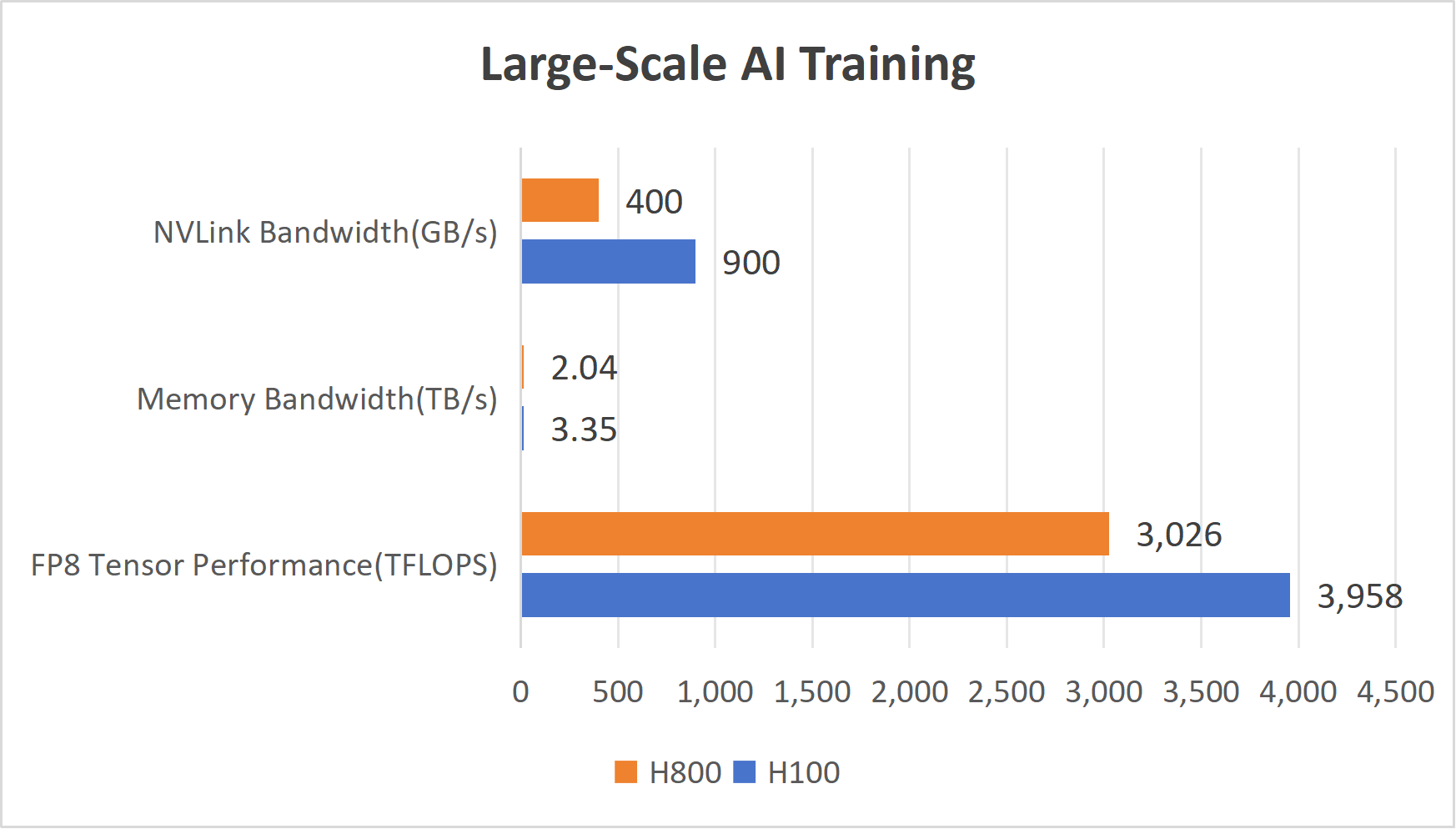
Large-Scale AI Training (LLMs, Foundation Models)
- H100 excels in large-scale distributed training thanks to higher NVLink bandwidth and faster memory access.
- H800 can handle training workloads but becomes less efficient as model size and GPU count increase.
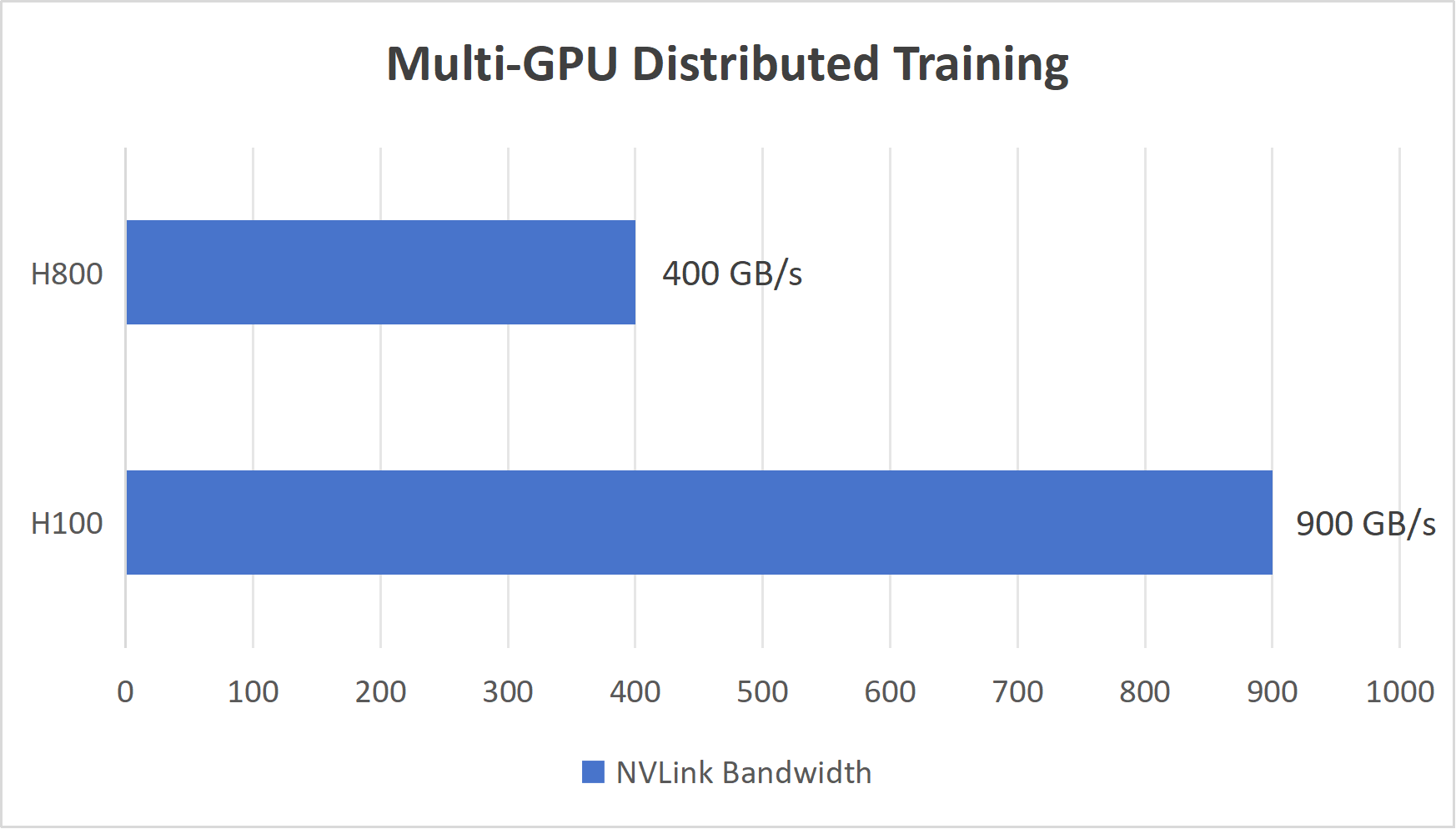
Multi-GPU Distributed Training
- H100 benefits greatly from higher NVLink bandwidth, reducing communication overhead.
- H800’s reduced interconnect bandwidth slows down multi-GPU synchronization.
Price & Value: NVIDIA H100 vs NVIDIA H800
Price Comparison
| Platform | NVIDIA H100 | NVIDIA H800 | Price Difference (USD) | Price Difference (%) |
|---|---|---|---|---|
| Official MSRP / Official Manufacturer Pricing | ~$25,000–$30,000 | ~$33,800 | ~$3,800–$8,800 | ~15–35% higher for H800 |
| eBay (Used / Resale) | ~$28,000–$35,000 | ~$33,000–$50,000+ | ~$5,000–$15,000+ | ~18–40%+ higher on average |
| Amazon (New / Current Listings) | ~$28,000–$32,000 | ~$30,000–$40,000 | ~$2,000–$10,000 | ~7–30% higher for H800 |
User Value-for-Money Feedback
H100 – Premium Performance, Premium Price
Many users highlight that the H100 delivers exceptional performance in large‑scale AI training and multi‑GPU clusters, and that this performance justifies the cost if raw compute and scalability are mission‑critical.
Users with large budgets or performance‑driven SLAs rate H100’s value score very high.
H800 – Better Value for Inference & Mid‑Scale Training
Across user reviews and community discussions, H800 often gets positive remarks on cost efficiency, especially where ultra‑high performance is not essential.
Especially positive in setups where large‑scale distributed training is rare.
NVIDIA H100 vs NVIDIA H800 – Pros & Cons
| GPU | Pros | Cons |
|---|---|---|
| NVIDIA H100 | - Top-tier AI training performance (high FP8/FP16 TFLOPS) - High memory bandwidth and NVLink, ideal for multi -GPU distributed training- Supports high -precision computing (FP64), suitable for HPC - Strong ecosystem and long-term support |
- High cost - High power consumption - Single-GPU inference cost-efficiency is average |
| NVIDIA H800 | - Lower cost, better price-performance ratio - Single-GPU inference performance close to H100 - Compliance and regional deployment optimized - Higher energy efficiency |
- Bandwidth and NVLink limitations reduce multi-GPU training efficiency - FP64 performance significantly reduced, not ideal for high-precision HPC - Large-scale model training efficiency lower than H100 |
NVIDIA H100 vs NVIDIA H800 GPU Hosting
NVIDIA H100 and H800 each have distinct advantages in GPU hosting scenarios. The H100 delivers top-tier computational performance and excellent multi-GPU scalability, making it ideal for large-scale AI training, distributed multi-node workloads, and high-precision HPC tasks. The H800, on the other hand, offers better cost efficiency and energy performance, making it suitable for medium-scale training and inference deployments. Choosing the right GPU hosting solution depends on your workload size, performance requirements, and budget.
Database Mart offers flexible server plans with support for both H100 and H800 GPUs. Their hosting solutions cater to a wide range of needs—from small to medium AI projects to large distributed training—ensuring high-performance computing for AI training, LLM inference, and cost-conscious deployments alike.
Conclusion
The NVIDIA H100 and H800 are both based on the Hopper architecture but serve different needs: The H100 excels in large-scale AI training, multi-GPU distributed workloads, and high-precision HPC tasks thanks to its higher memory bandwidth, NVLink interconnect, and FP64 performance. The H800, on the other hand, offers better cost-efficiency and strong performance for single-GPU inference and medium-scale training, delivering near-H100 capabilities while reducing investment. Choosing the right GPU based on workload size, performance requirements, and budget ensures optimal compute efficiency and return on investment.
h100 vs h800, nvidia h100 vs h800, h100 vs h800 specs, h100 vs h800 performance, nvidia h100, nvidia h800, h100 gpu, nvidia h100 specs