


Nvidia H100 vs RTX 5090: Which GPU is Worth Buying?
While NVIDIA H100 and RTX 5090 both offer extreme GPU performance, the key differences are in AI acceleration, memory bandwidth, power efficiency, and pricing. The H100 suits professionals running large-scale AI training, whereas the RTX 5090 is ideal for gamers and creators seeking cutting-edge graphics and real-time rendering.
Summary Light of H100 & 5090
- Key Features: DH100 excels in AI acceleration and memory bandwidth, while RTX 5090 focuses on gaming, ray tracing, and DLSS 3 support.
- Industries: H100 is ideal for AI research and data centers, whereas RTX 5090 suits gaming, content creation, and 3D rendering.
- Popular Software: H100 runs TensorFlow, PyTorch, and large-scale AI workloads, while RTX 5090 powers Unreal Engine, Blender, and Adobe Creative Suite.
H100 vs RTX 5090 – Background Comparison
The NVIDIA H100 is designed for extreme AI acceleration and high-performance computing, with massive memory bandwidth and HBM3 support, making it ideal for large-scale AI training, scientific computing, and data center workloads. The NVIDIA RTX 5090 emphasizes cutting-edge graphics performance, efficient power consumption, DLSS 3, and advanced ray tracing, targeting gamers, content creators, and professionals needing high-end rendering and real-time applications.
| Brand | Series | Model | Release Year | Official Positioning / Description | Market Price (USD) |
|---|---|---|---|---|---|
| NVIDIA | H100 | H100 | 2022–2023 | Data center GPU / extreme AI acceleration, high memory bandwidth, HBM3, optimized for large-scale AI and HPC workloads | ~$25,000+ |
| NVIDIA | RTX 50 Series | RTX 5090 | 2025 | Enthusiast GPU / high-end gaming and content creation with DLSS 3, efficient power consumption, advanced ray tracing | ~$2,000–$2,500 |
H100 vs RTX 5090 – Specifications Comparison
Core Specs Comparison
| Parameter | NVIDIA H100 | RTX 5090 | Difference / Advantage |
|---|---|---|---|
| Architecture | Hopper | Ada Lovelace | H100 optimized for AI/HPC; RTX 5090 focused on gaming and content creation |
| CUDA / Stream Cores | 16,384 CUDA Cores | 16,384 CUDA / 128 Ray Tracing Cores | H100 has tensor cores for AI acceleration; RTX 5090 focuses on graphics/AI gaming |
| Tensor / AI Cores | 512 Tensor Cores | 512 AI cores | H100 specialized for AI training and HPC; RTX 5090 for AI-assisted gaming |
| Memory Type | HBM3 | GDDR7 | H100 high-bandwidth memory for HPC; RTX 5090 high-speed graphics memory |
| Memory Capacity | 80 GB / 96 GB | 24–32 GB | H100 much larger memory for large-scale AI and datasets |
| Memory Bus | 5120-bit | 384-bit | H100 extremely wide bus for massive throughput |
| Memory Bandwidth | 3,000+ GB/s | 1,000 GB/s | H100 ~3× higher bandwidth, ideal for AI/HPC |
| FP32 Performance | ~60 TFLOPS | ~90 TFLOPS | RTX 5090 better for raw rasterization; H100 optimized for mixed-precision AI |
| TDP (Power) | 700W | 350–450W | RTX 5090 much more power-efficient for gaming |
| Interface / Bus | PCIe Gen5 / NVLink | PCIe Gen5 ×16 | H100 supports NVLink for multi-GPU HPC; RTX 5090 standard PCIe for consumer GPUs |
| Target Workloads | AI training, HPC, scientific computing | High-end gaming, 3D rendering, content creation | H100 for professional AI/HPC; RTX 5090 for gaming and creative workloads |
Advanced Features Comparison
| Feature / Capability | NVIDIA H100 | RTX 5090 | Difference / Advantage |
|---|---|---|---|
| AI Acceleration | Extensive tensor cores and FP8/FP16 support | DLSS 3, AI-powered upscaling | H100 excels at large-scale AI training; RTX 5090 optimized for AI-assisted gaming and content creation |
| Ray Tracing / Rendering | Basic support (not gaming-focused) | Advanced ray tracing and DLSS 3 | RTX 5090 better for real-time ray tracing and graphics workloads |
| Multi-GPU Support | NVLink / Multi-GPU clusters | NVLink not supported | H100 suitable for large AI clusters; RTX 5090 limited to single GPU setups |
| VRAM Advantage | 80–96 GB HBM3 | 24–32 GB GDDR7 | H100 supports massive datasets; RTX 5090 optimized for high-res textures |
| Target Industries | AI research, HPC, data centers | Gaming, content creation, 3D rendering | H100 for professionals and researchers; RTX 5090 for gamers and creators |
| Popular Software | TensorFlow, PyTorch, Hugging Face Transformers, CUDA HPC workloads | Unreal Engine, Blender, Adobe Creative Suite, DLSS-enabled games | H100 for AI and scientific workloads; RTX 5090 for creative and gaming tasks |
The NVIDIA H100 is built for large-scale AI training, HPC, and scientific computing with massive memory bandwidth, tensor cores, and multi-GPU NVLink support. The NVIDIA RTX 5090 emphasizes high-end gaming, creative workloads, DLSS 3, and advanced ray tracing with better energy efficiency. In 2025, the choice comes down to professional AI/HPC performance (H100) versus consumer-focused graphics and next-generation gaming features (RTX 5090).
H100 vs RTX 5090 Benchmark: Performance Across Different Scenarios
Game Performance
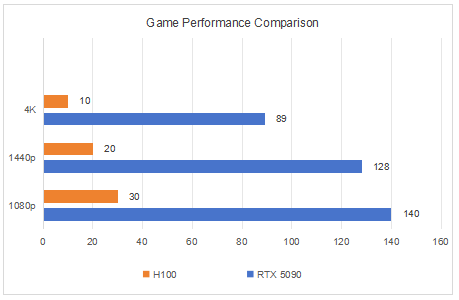
The RTX 5090 delivers excellent gaming performance across all tested resolutions, achieving approximately 140 FPS at 1080p, 128 FPS at 1440p, and 89 FPS at 4K, making it highly suitable for high-resolution gaming and demanding AAA titles. In contrast, the NVIDIA H100, being a data center GPU optimized for AI and HPC workloads rather than gaming, achieves significantly lower frame rates—about **30 FPS **at 1080p, 20 FPS at 1440p, and 10 FPS at 4K. This highlights that while the RTX 5090 excels in gaming scenarios, the H100 is not designed for gaming and performs poorly in these consumer graphics tasks.
AI Performance
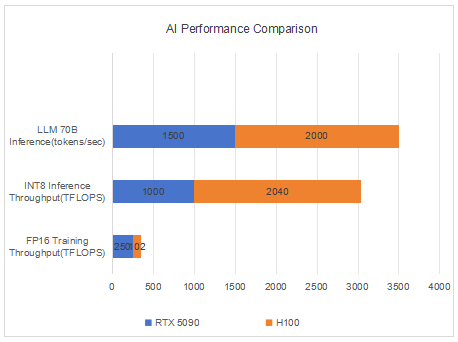
The RTX 5090 and H100 show distinct performance profiles in AI workloads. For FP16 training, the RTX 5090 achieves** 250 TFLOPS**, significantly higher than the H100’s 102 TFLOPS, making it stronger for large-scale training tasks. However, in inference, the H100 excels: its INT8 throughput is 2040 TFLOPS, roughly double the RTX 5090’s 1000 TFLOPS, and for LLM 70B inference, H100 reaches 2000 tokens/sec, compared to RTX 5090’s 1500 tokens/sec.
Overall, RTX 5090 is better suited for training, while H100 is optimized for inference and large language model processing.
Price & Value: NVIDIA H100 vs RTX 5090
| Platform | NVIDIA H100 (USD) | RTX 5090 (USD) | Price Difference (%) |
|---|---|---|---|
| Official / Enterprise Pricing | $25,000–$35,000 | ~$1,999–$2,499 | –90% to –93% |
| Cloud / System Integrators | $30,000–$40,000 | ~$2,200–$2,800 | –91% to –94% |
| Secondary / Gray Market | $22,000–$32,000 | ~$1,800–$2,300 | –89% to –93% |
The NVIDIA H100 is an enterprise-grade data center GPU designed for large-scale AI training, high-throughput inference, and HPC workloads, offering features such as HBM memory, NVLink, ECC, and optimized tensor performance. However, this level of capability comes at an extremely high cost, making it suitable mainly for enterprises, research institutions, and cloud providers.
In contrast, the RTX 5090 delivers exceptional consumer-level AI inference, rendering, and gaming performance at a fraction of the price. While it lacks data-center features like massive HBM memory and multi-GPU NVLink scalability, it provides far superior price-to-performance value for individual developers, startups, and creators.
NVIDIA H100 vs RTX 5090 – Pros & Cons
| Model | Pros | Cons |
|---|---|---|
| H100 | ✅ Industry-leading AI training and inference performance, optimized for large-scale LLMs and HPC workloads | ❌ Extremely expensive, priced for enterprises and data centers |
| ✅ Massive HBM memory with very high bandwidth, ideal for large models and datasets | ❌ Not designed for gaming or consumer graphics workloads | |
| ✅ Supports NVLink, ECC, and enterprise-grade reliability and scalability | ❌ Very high power consumption and cooling requirements | |
| RTX 5090 | ✅ Outstanding consumer-level AI inference, rendering, and gaming performance | ❌ Lacks enterprise features such as HBM memory and full NVLink scalability |
| ✅ Significantly lower cost with excellent price-to-performance ratio | ❌ Less suitable for large-scale AI training compared to H100 | |
| ✅ Ideal for high-end gaming, real-time rendering, and creator workloads | ❌ Limited in multi-GPU data-center deployments |
H100 & RTX 5090 Hosting
The NVIDIA H100 Server provides cloud or dedicated GPU instances powered by NVIDIA H100 GPUs, enabling extreme AI and HPC performance without the cost of owning enterprise hardware. Database Mart’s H100 server offers enterprise-grade CPUs, high-bandwidth HBM memory, fast NVMe storage, and 99.9% uptime, making it ideal for large-scale AI training, LLM workloads, and scientific computing.
The RTX 5090 Server delivers high-performance cloud or dedicated GPU instances powered by NVIDIA RTX 5090 GPUs, giving users affordable access to next-generation AI and graphics acceleration. Database Mart’s RTX5090 server hosting features powerful CPUs, ample RAM, fast NVMe SSD storage, and 99.9% uptime, making it well-suited for AI inference, 3D rendering, video processing, and other GPU-intensive workloads.
Conclusion
Overall, the H100 is designed for enterprise users, offering extreme performance for large-scale AI training, HPC, and scientific computing, but comes at a high cost. The RTX 5090 provides excellent price-to-performance for AI inference, 3D rendering, video processing, and gaming, making it ideal for developers, creators, and smaller teams. For long-term scalability and multi-GPU workloads, H100 is the best choice, while RTX 5090 is perfect for flexible deployment, cost efficiency, and rapid upgrades.
h100 vs 5090, 5090 vs h100, nvidia h100 vs rtx 5090, nvidia h100 vs 5090, h100 specs, 5090 price, rtx5090 specs, 5090 performance