


RTX 4080 vs RTX 3090: Which GPU Is Worth Buying?
Since the launch of the GeForce RTX 4080, many enthusiasts are asking: is the RTX 3090 still worth buying for AI workloads, 4K/8K gaming, and professional rendering? In this article, we’ll compare the RTX 3090 and RTX 4080, highlighting their differences in 3090 performance, 4080 price, and efficiency improvements. We’ll cover key aspects including AI training, 4K / 8K Gaming, 3D rendering,and Video Editing, showing how the 4080 compare to the 3090 in terms of power consumption, VRAM, and modern features, while also considering cost-effective options for those who value the 3090 price on the second-hand market.
RTX 4080 vs RTX 3090 – Background Comparison
| Brand | Series | Model | Release Year | Official Positioning | Market Price (USD) |
|---|---|---|---|---|---|
| NVIDIA | GeForce | RTX 4080 | 2022 | Power your PC with the NVIDIA® GeForce RTX 4080. Accelerated ray tracing and AI-powered graphics bring your games and creative projects to life. It's powered by the ultra-efficient NVIDIA Ada Lovelace | $1,199 |
| NVIDIA | GeForce | RTX 3090 | 2020 | The GeForce RTX™ 3090 are powered by Ampere—NVIDIA’s 2nd gen RTX architecture. It feature dedicated 2nd gen RT Cores and 3rd gen Tensor Cores, streaming multiprocessors, and a staggering 24 GB of G6X memory to deliver high-quality performance for gamers and creators. | $1,499 |
NVIDIA RTX 4080 vs RTX 3090 – Specifications Comparison
Since its launch, the GeForce RTX 4080 has proven a significant upgrade over the RTX 3090. While the 3090 offers 24 GB GDDR6X VRAM for large-scale AI and 3D workloads, the 4080’s Ada Lovelace architecture delivers higher core efficiency, faster memory, and better bandwidth utilization. This results in improved performance across gaming, AI inference, and rendering, with roughly 30% better power efficiency.
Despite having less VRAM than the 3090, the 4080 features DLSS 3.0, enhanced ray tracing, and more responsive performance, making it a more future-proof choice for high-end users. In short, the 4080 excels in efficiency and next-gen capabilities, while the 3090 remains attractive for raw VRAM needs and cost-conscious buyers.
Core Specs Comparison between RTX 4080 vs RTX 3090
| Parameter | RTX 3090 | RTX 4080 | Difference / Advantage |
|---|---|---|---|
| Architecture | Ampere | Ada Lovelace | Different architecture, 4080 is newer |
| CUDA Cores | 10,496 | 9,728 | -768 cores, 4080 more efficient per watt |
| Memory Type | GDDR6X | GDDR6X | Same |
| Memory Capacity | 24 GB | 16 GB | -8 GB, 4080 has less VRAM |
| Memory Bus | 384-bit | 256-bit | -128-bit, narrower bus but higher memory speed |
| Memory Bandwidth | ~936.2 GB/s | ~716.8 GB/s | -219.4 GB/s, lower bandwidth |
| Core Frequency (Boost) | ~1.7 GHz | ~2.5 GHz | +0.8 GHz, higher boost for better per-watt performance |
| TDP (Power) | 350W | 320W | -30W, more power-efficient |
| Interface / Bus | PCIe Gen 4.0 | PCIe Gen 4.0 | Same |
| FP32 Performance | ~35.6 TFLOPS | ~49.7 TFLOPS | +14.1 TFLOPS, ~40% higher performance |
| Ray Tracing / Tensor | 2nd-gen RT, 3rd-gen Tensor Cores | 3rd-gen RT, 4th-gen Tensor Cores | Newer cores, supports DLSS 3.0 |
| PCIe Version | Gen 4.0 | Gen 4.0 | Same |
Key Differences: RTX 3090 vs RTX 4080
Architecture
– RTX 4080 uses the AD103 chip (5nm, TSMC), while RTX 3090 uses GA102 (8nm, Samsung). The newer architecture improves efficiency, performance per watt, and supports modern GPU features.
Core Frequency (Boost)
– RTX 4080 has a ~58% higher base clock and a ~47.8% higher boost clock compared to the 3090, enabling faster rendering, higher frame rates, and better per-watt performance.
Memory Capacity & Memory Bus & Memory Bandwidth
– RTX 3090 offers 24 GB VRAM with a 384-bit bus and 936.2 GB/s memory bandwidth, whereas RTX 4080 has 16 GB VRAM with a 256-bit bus and 716.8 GB/s memory bandwidth. The 3090 is better for very large datasets and high-resolution projects, while the 4080 is sufficient for most 4K gaming and AI workloads.
Ray Tracing / Tensor & DLSS Support
– RTX 4080 features 3rd-gen RT cores, 4th-gen Tensor cores, and DLSS 3.0, compared to 3090’s 2nd-gen RT, 3rd-gen Tensor cores, and DLSS 2.0. Both support G-Sync, but 4080 delivers improved frame generation, better visual quality, and AI-driven features.
Advanced Features & Performance Comparison
| Parameter | RTX 3090 | RTX 4080 | Difference / Advantage / Notes |
|---|---|---|---|
| L2 Cache | Larger capacity | Optimized architecture | Better bandwidth utilization |
| DLSS Support | DLSS 2.0 | DLSS 3 | +45% higher frame generation performance |
| Cooling Design | Dual-axial flow-through | Vapor chamber, larger fans, 20% more airflow | −8°C lower average load temperature |
| Thermal Performance | ~69.4°C | ~65.6°C | −3.8°C cooler under full load |
| AI & Ray Tracing | Good | Excellent | +30–50% uplift in AI & RT workloads |
The RTX 4080 outperforms the RTX 3090 in power efficiency, thermal management, and AI/ray tracing performance. Consuming 320W vs 350W and running cooler at ~65.6°C vs 69.4°C, the 4080 reduces system strain, lowers electricity costs, and ensures quieter operation.
With DLSS 3.0 and improved AI/RT capabilities, it delivers smoother and more reliable performance during gaming, rendering, or creative workloads. While the 3090 retains an advantage with its larger 24GB memory, the 4080 offers a more balanced and efficient choice for most users.
RTX 4080 vs RTX 3090 Performance Across Different Scenarios
AI / Deep Learning Performance Comparison
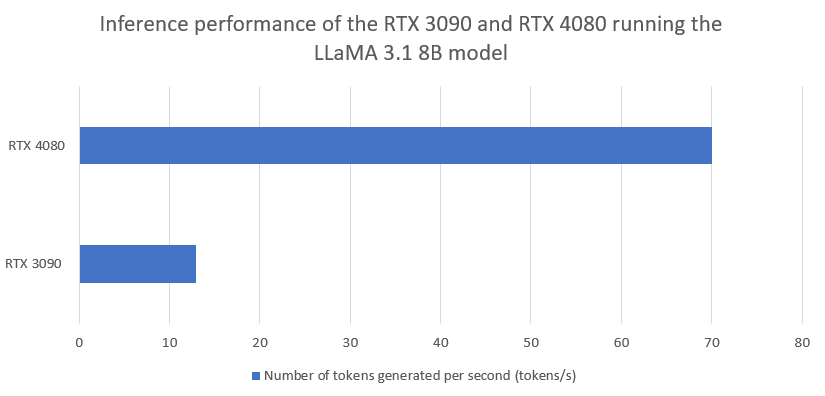
The RTX 4080 significantly outperforms the RTX 3090 in AI inference workloads.
In benchmarks using the LLaMA 3.1 8B model, the RTX 4080 generates ~70 tokens/s, compared to ~12.88 tokens/s on the RTX 3090.
Thanks to the Ada Lovelace architecture and 4th-gen Tensor Cores, the RTX 4080 delivers faster computation, lower latency, and higher efficiency for large language models and AI tasks.
4K / 8K Gaming Performance
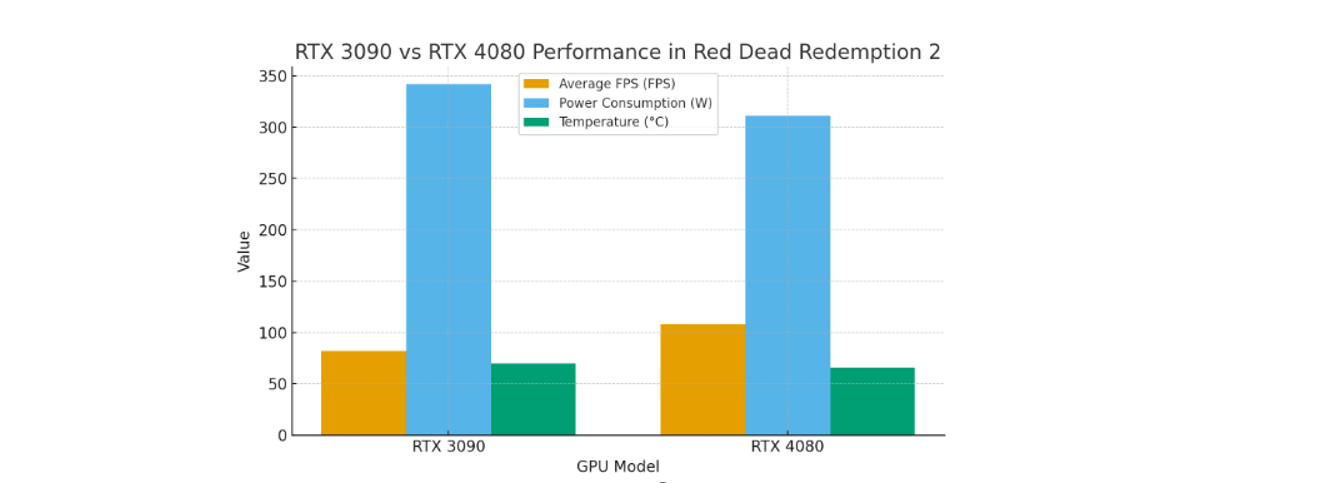
In gaming, the RTX 4080 outperforms the RTX 3090 thanks to higher frame consistency, improved efficiency, and better thermal management.
In Red Dead Redemption 2 benchmarks at 4K, the RTX 4080 achieves an average of ~108 FPS, compared to ~82 FPS on the RTX 3090, delivering roughly 32% higher frame rates.
The RTX 4080 also consumes ~311W, about 9% less power, and runs cooler at ~66°C (vs ~70°C for the 3090), providing a more stable and efficient gaming experience.
These improvements translate to smoother visuals, reduced stutter, and better overall performance, particularly in graphically demanding, ray-traced environments.
3D Rendering / Content Creation
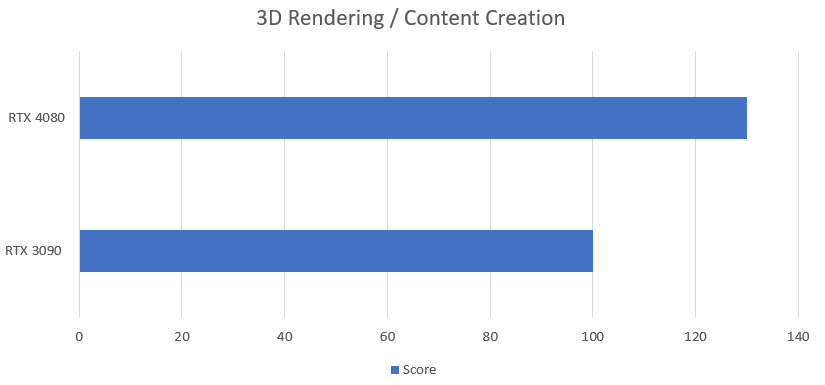
For rendering applications like Blender, Octane, or Unreal Engine, the RTX 4080 shows up to 35% faster render times than the RTX 3090.
The increased L2 cache and improved RT Core throughput allow more efficient ray tracing and scene handling.
Artists benefit from quicker previews and higher productivity without significant thermal throttling.
Video Editing / Production
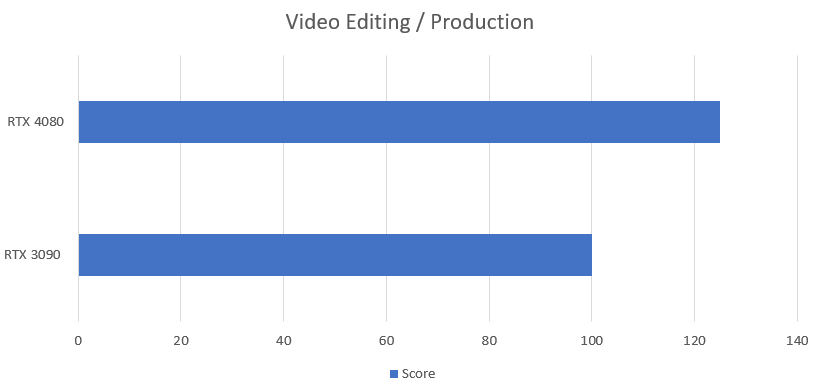
In professional video editing workflows (e.g., Adobe Premiere Pro, DaVinci Resolve), the RTX 4080 excels with optimized AV1 encoding and faster GPU acceleration.
This translates to 25–40% faster export times and smoother playback for 4K/8K video timelines, all while consuming less power and generating less heat than the RTX 3090.
Editors gain both performance and efficiency improvements, enhancing long-session stability.
Price & Value: RTX 4080 vs RTX 3090
The GeForce RTX 4080 may cost about 20–25% more than the RTX 3090 at launch, but it draws slightly less power while offering significant improvements in performance per watt, DLSS 3.0 support, and ray tracing capabilities, making the higher spend worthwhile for gamers and creators seeking top-tier efficiency and future-proof performance. On the flip side, in the second-hand market, the price gap narrows to roughly 19–53%, keeping the RTX 3090 a viable, budget-friendly option for those who want strong 4K performance or large VRAM for creative workloads without overspending.
Price Comparison
| Platform | RTX 3090 (USD) | RTX 4080 (USD) | Price Difference (USD) | Price Difference (%) |
|---|---|---|---|---|
| Official MSRP | $1,499 | $1,199 | +$300 | +25% |
| Amazon | $1,499–$1,699 | $1,199–$1,399 | +$300 | +21–25% |
| eBay | $799–$1,495 | $649–$980 | +$150–$515 | +19–53% |
User Value-for-Money Feedback
On UserBenchmark, the RTX 4080 achieves an average score of 77.97, showing clear improvements in 4K gaming and creative workloads compared to the RTX 3090, which scores 60.24. Users report that the 4080 delivers higher framerates, better efficiency, and improved support for ray tracing and DLSS 3.0, making it a strong choice for gamers and content creators seeking both performance and energy efficiency.
On Technical.City, the RTX 4080 consistently scores about 29% higher than the RTX 3090, confirming the performance gains across synthetic and real-world benchmarks. Meanwhile, the 3090 remains relevant for tasks that require very high VRAM, such as 3D rendering or AI workloads, and can be a more budget-friendly option on the second-hand market.
These feedback trends highlight that while the RTX 4080 offers superior performance per watt and more modern features, the RTX 3090 still holds value for users prioritizing VRAM capacity or cost efficiency.
RTX 4080 vs RTX 3090 – Pros & Cons
| GPU | Pros | Cons |
|---|---|---|
| RTX 4080 | - Excellent 4K gaming performance with DLSS 3.0 and improved ray tracing - Higher performance per watt, lower TGP (320W) for efficiency - Supports modern features and future-proof architecture - Compact 2-slot design for easier installation |
- Official MSRP still high (~$1,199), may be pricey for some - 16GB VRAM may limit very high VRAM workloads compared to 3090 - Limited availability on some markets - Slightly lower raw VRAM capacity for large datasets or heavy 3D scenes |
| RTX 3090 | - 24GB GDDR6X VRAM, ideal for VRAM-intensive tasks like 3D rendering and AI workloads - Strong 4K gaming performance and ray tracing support - Mature drivers, stable and widely compatible - Widely available on second-hand market at discounted prices |
- High power draw (350W), generates more heat and noise under load - Lower performance per watt compared to 4080 - Older architecture, fewer modern features like DLSS 3.0 - Large 3-slot design, may require larger chassis and PSU upgrade |
RTX 4080 & RTX 3090 Hosting
If you want to leverage the high GPU performance of the RTX 3090 or RTX 4080 for AI workloads, 3D rendering, video editing, or 4K/8K gaming and streaming, but don’t want to bear the high cost of hardware, manage maintenance, or handle technical issues yourself, choosing the right GPU server hosting is the ideal solution.
Database Mart offers a variety of dedicated GPU servers designed to meet different workload needs. Whether you are looking for single-GPU or multi-GPU configurations, you can enjoy the power of high-end GPUs with scalable performance, 99.9% uptime, and 24/7 professional technical support, so you can focus on your projects without worrying about hardware management.
Conclusion
Both GPUs remain impressive in 2025 — but they serve different audiences:
Choose the RTX 3090 if your work depends on large memory buffers, such as training LLMs, multi-GPU setups, or 8K video projects.
Choose the RTX 4080 if you value performance, efficiency, and next-generation gaming features like DLSS 3 and better ray tracing.
While the RTX 3090 was once the “King of GPUs,” the RTX 4080 has now claimed the crown for most efficient and versatile performance across AI, gaming, and creative workloads.
3090 vs 4080, rtx 3090, rtx 4080, 3090 performance, 4080 price, 3090price, 3090 compare, 4080 compare,