


RTX 3090 vs 4070 Ti: Which GPU Wins?
Compare NVIDIA’s RTX 3090 and RTX 4070 Ti in gaming, AI tasks, and overall performance. Explore benchmarks, pros & cons, and real-world value to see which GPU delivers the best performance and efficiency for your setup.
RTX 3090 vs 4070 Ti – Background Comparison
| Model | Brand | Series | Architecture | Release Year | Official Positioning | Current Market Price (Approx.) |
|---|---|---|---|---|---|---|
| RTX 3090 | NVIDIA | GeForce RTX 30 Series | Ampere | 2020 | Enthusiast-class GPU for 4K gaming and content creation | $1,000–$1,200 |
| RTX 4070 ti | NVIDIA | GeForce RTX 4070 Family | Ada Lovelace | 2023 | NVIDIA's RTX 4070 Ti is positioned as a high-end, enthusiast-class GPU for excellent 1440p gaming and capable 4K gaming with DLSS | $700-$800 |
RTX 3090 vs RTX 4070 Ti Specification Comparison
Core Specs: 3090 vs 4070 ti
| Specification | RTX 3090 | RTX 4070 Ti | Difference / Advantage |
|---|---|---|---|
| Architecture | Ampere | Ada Lovelace | RTX 4070 Ti uses the newer Ada Lovelace architecture, offering better efficiency and AI/RT performance |
| CUDA Cores | 10,496 | 7,680 | RTX 3090 has significantly more CUDA cores, making it stronger in highly parallel compute workloads |
| Memory Type | GDDR6X | GDDR6X | Both GPUs use the same high-speed GDDR6X memory |
| Memory Capacity (vRAM) | 24 GB | 12 GB | RTX 3090 provides double the VRAM, better suited for large models, 8K video, and heavy textures |
| Memory Bus | 384-bit | 192-bit | RTX 3090 features a wider memory bus, enabling higher data throughput under heavy load |
| Memory Bandwidth | 936 GB/s | 504.2 GB/s | RTX 3090 delivers much higher memory bandwidth, advantageous for high-resolution and data-intensive tasks |
| Core Frequency (Boost) | 1.70 GHz | 2.61 GHz | RTX 4070 Ti has a much higher boost clock, improving single-core and real-time performance |
| TDP (Power) | 350 W | 285 W | RTX 4070 Ti is more power-efficient and easier to cool |
| Interface / Bus | PCI Express 4.0 ×16 | PCI Express 4.0 ×16 | Both use the same PCIe 4.0 ×16 interface |
| FP32 Performance | ~35.6 TFLOPS | ~40.09 TFLOPS | RTX 4070 Ti offers slightly higher theoretical FP32 compute performance |
| Ray Tracing / Tensor Cores | 2nd Gen RT / 3rd Gen Tensor | 3rd Gen RT / 4th Gen Tensor | RTX 4070 Ti supports newer RT and Tensor cores and enables DLSS 3 |
| PCIe Version | PCIe 4.0 | PCIe 4.0 | No difference in PCIe generation |
Summary
Gaming Experience
With higher boost clocks reaching 2.61 GHz, the RTX 4070 Ti delivers more responsive gameplay and smoother frame pacing in modern titles, especially those supporting newer AI-based rendering features. In contrast, when games involve extremely large texture packs or ultra-high resolutions, the RTX 3090’s ability to handle larger data loads at once (enabled by its 24 GB vs 12 GB capacity) helps reduce stuttering and asset pop-in.AI & Machine Learning Workloads
Tasks that require loading and processing large models benefit from the RTX 3090’s ability to keep more data resident at once (24 GB capacity combined with 936 GB/s throughput), resulting in fewer interruptions during long-running jobs. The RTX 4070 Ti, with slightly higher theoretical compute performance (~40.09 vs ~35.6 TFLOPS), is more efficient for smaller models and faster iteration cycles.Video Editing & Post-Production
In complex timelines such as multi-layer 8K editing, the RTX 3090 maintains smoother playback thanks to its ability to move large volumes of data quickly (936 GB/s vs 504.2 GB/s). The RTX 4070 Ti performs exceptionally well in 4K and mainstream workflows, offering quicker responsiveness while consuming less power (285 W vs 350 W).Real-Time Interaction & Responsiveness
Applications that rely on rapid feedback—such as real-time previews or parameter tuning—often feel more immediate on the RTX 4070 Ti due to its much higher operating frequency (2.61 GHz vs 1.70 GHz). The RTX 3090 prioritizes consistency over long durations rather than short, bursty interactions.Power, Thermals & System Fit
With a lower power draw (285 W vs 350 W), the RTX 4070 Ti is easier to cool and better suited for typical desktop systems and extended daily use. The RTX 3090 requires stronger cooling and power delivery but rewards that investment with higher stability under extreme workloads.
RTX 3090 vs RTX 4070 Ti: Performance Across Different Scenarios
Gaming Performance
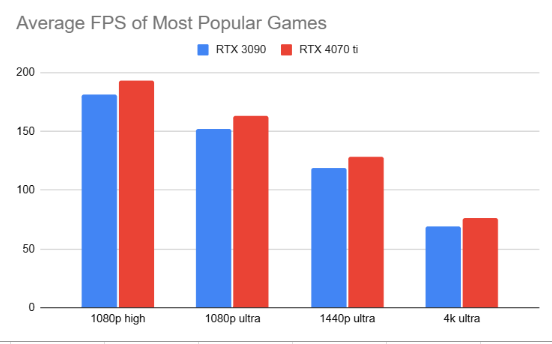
The table below compares the average FPS in popular games between the RTX 3090 and RTX 4070 Ti across common resolutions and quality presets, highlighting real-world gaming performance differences from 1080p to 4K.
✅️Summary
Across all tested settings, the RTX 4070 Ti consistently achieves higher average frame rates than the RTX 3090. The advantage is modest at 1080p, where both GPUs already deliver very high FPS, but becomes more noticeable at higher resolutions and ultra settings. At 1440p Ultra and 4K Ultra, the RTX 4070 Ti maintains better frame-rate headroom, resulting in smoother gameplay and improved consistency in demanding modern titles.
Artificial Intelligence Tests
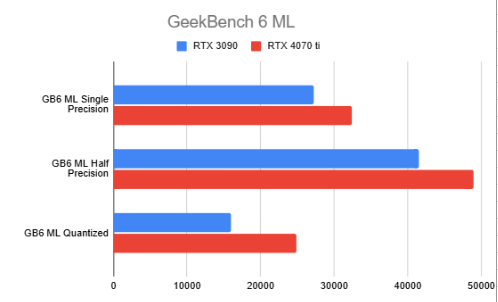
The table below presents Geekbench 6 Machine Learning results for the RTX 3090 and RTX 4070 Ti across single-precision, half-precision, and quantized workloads, reflecting AI inference performance under different numerical formats.
✅️Summary
In single-precision workloads, the RTX 4070 Ti achieves higher performance (32,405 vs 27,237), offering faster inference for standard FP32-based AI models.
In half-precision workloads, the RTX 4070 Ti extends its lead (48,989 vs 41,500), improving throughput for mixed-precision and performance-optimized AI tasks.
In quantized workloads, the performance gap becomes significantly larger (24,894 vs 15,927), highlighting the RTX 4070 Ti’s stronger efficiency in modern, optimized AI inference scenarios.
Overall, the results show that the RTX 4070 Ti is better suited for contemporary AI workloads that emphasize efficiency and lower-precision computation, while the RTX 3090 remains capable but comparatively slower across all tested ML formats.
Combined synthetic benchmark score
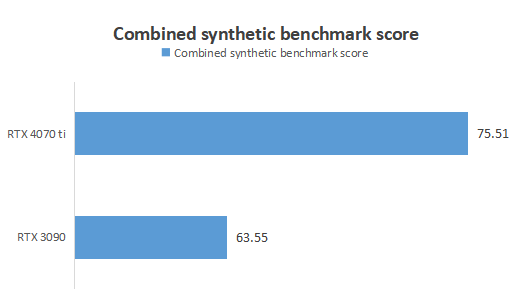
The table below shows the combined synthetic benchmark scores for the RTX 3090 and RTX 4070 Ti, providing a high-level comparison of overall GPU performance across a variety of simulated workloads.
✅️Summary
The RTX 4070 Ti achieves a higher combined score (75.51 vs 63.55), indicating stronger overall performance in synthetic tests.
The score difference suggests improved efficiency and better performance balance across compute, graphics, and modern workloads.
While the RTX 3090 remains competitive, the higher combined result reflects the RTX 4070 Ti’s advantage in newer benchmark scenarios designed to reflect current-generation applications.
Price & Value: RTX 3090 vs 4070 Ti
| Platform | RTX 3090 (USD) | RTX 4070 Ti (USD) | Price Difference (USD) | Price Difference (%) |
|---|---|---|---|---|
| Official MSRP | $1,499 | $1,599 | +$100 | +6.7% |
| Amazon | $1,000 – $1,700 | $625 – $849 | –$375 ~ –$851 | –37.5% ~ –50.1% |
| Third-Party Resellers (eBay etc.) | $700 – $1,500 | $600 – $800 | –$100 ~ –$700 | –14.3% ~ –46.7% |
Recommendation
If your priority is overall value for money — balancing modern performance across gaming, AI workloads, and synthetic metrics with current market pricing — the RTX 4070 Ti generally represents the stronger choice. It typically offers better performance per dollar given its competitive benchmarks and lower street prices.
However, if you specifically need maximum capacity for large datasets, ultra-high-resolution media work, or professional workflows where every bit of throughput and memory headroom matters, and you are willing to pay a premium for that headroom, the RTX 3090 can still make sense — but at significantly higher cost in the used/market channel.
In most consumer and prosumer cases today, the RTX 4070 Ti offers better value for money overall.
RTX 3090 vs RTX 4070 Ti – Pros & Cons
| RTX 3090 | RTX 4070 Ti | |
|---|---|---|
| Pros | ✅ Handles very large datasets smoothly without frequent task interruption ✅ Higher data throughput benefits heavy rendering and long compute jobs ✅ Better suited for professional and memory-intensive applications |
✅ Higher average FPS in modern games across 1080p–4K based on benchmarks ✅ Stronger AI performance in Geekbench 6 ML tests, especially optimized workloads ✅ Better efficiency with lower power consumption and quieter operation ✅ Supports newer AI and rendering technologies (e.g. DLSS 3) ✅ Significantly better value for money at current retail prices |
| Cons | ❌ Higher power consumption and heat output ❌ Harder to cool, requires stronger PSU and case airflow ❌ Weaker support for newer AI and rendering features compared to newer architectures ❌ Generally worse performance per dollar at current market prices |
❌ Less tolerant of extremely large projects and datasets ❌ Not ideal for heavy 8K or large-scale professional workloads ❌ Lower long-term headroom for future memory-heavy applications |
RTX 3090 vs RTX 4070 Ti Server Hosting
When choosing a GPU for server hosting, the key factors are workload type, stability, efficiency, and long-term scalability.
RTX 3090 vs RTX 4070 Ti
RTX 3090 is more tolerant of larger working sets in hosted environments. With higher data capacity and throughput (24 GB and 936 GB/s from previous data), it performs more consistently in tasks such as larger AI inference jobs, complex rendering tasks, and high-resolution media processing. However, it comes with higher power consumption (350 W), which can increase hosting costs.
RTX 4070 Ti benefits from a newer architecture and higher operating frequency, delivering better efficiency and higher performance in modern gaming, AI inference, and synthetic benchmarks, while consuming less power (285 W). It is well suited for cost-efficient hosting where workloads are moderate in size but require good responsiveness and modern feature support.
Recommended Upgrade for Server Hosting
If you need higher performance for enterprise or advanced AI workloads, a more capable GPU can make a significant difference in hosted server environments.
Recommended GPU
For users who need maximum performance, higher scalability, and future-proof hosting, DatabaseMart’s RTX 4090 GPU servers are a stronger choice. With significantly higher compute power and the same 24 GB memory capacity as the RTX 3090, RTX 4090 servers are well suited for advanced AI workloads, demanding rendering tasks, and enterprise-level GPU hosting where performance per server matters most.
Conclusion
The RTX 4070 Ti offers better overall value today, with higher FPS in gaming, stronger AI efficiency, lower power draw, and modern feature support, making it ideal for most gamers and prosumers.
The RTX 3090 excels in handling larger datasets and memory-heavy tasks, but consumes more power and costs more.
rtx 3090 vs 4070 ti, 4070 ti vs 3090, rtx 3090 specs, rtx 4070 ti specs, rtx 3090 performance, rtx 4070 ti performance, rtx 3090 price, rtx 4070 ti price, gpu comparison