


Nvidia RTX 5090 vs 4090: Full Comparison (Specs, Performance, Price in 2025)
Since the launch of the GeForce RTX 5090 in 2025, many enthusiasts are asking: is the RTX 4090 still the most popular consumer graphics card for AI, gaming, and rendering? In this article, we’ll compare the two flagships across Ada Lovelace and Blackwell architectures, highlighting their differences in performance, features, and price-to-performance across multiple scenarios including AI training, 4K/8K gaming, 3D rendering, and video editing.
RTX 5090 vs RTX 4090 – Background Comparison
| Brand | Series | Model | Release Year | Official Positioning | Market Price (USD) |
|---|---|---|---|---|---|
| NVIDIA | GeForce | RTX 5090 | 2025 | GeForce RTX 5090 is NVIDIA’s most powerful GeForce GPU to date, based on the Blackwell architecture, with 32GB high-speed GDDR7 memory, designed for gaming and creative workloads, offering unprecedented AI performance. | $1,999 |
| NVIDIA | GeForce | RTX 4090 | 2022 | GeForce RTX 4090 is NVIDIA’s flagship GPU, based on Ada Lovelace architecture, with 24GB GDDR6X memory, delivering top-tier gaming and creative performance with DLSS 3 and real-time ray tracing support. | $1,599 |
NVIDIA RTX 5090 vs RTX 4090 – Specifications Comparison
Positioned as the successor to the RTX 4090, the GeForce RTX 5090 is hailed by NVIDIA as the most powerful GeForce GPU ever released. Compared to the 4090, it delivers substantial improvements across multiple fronts: faster AI training and rendering performance powered by more CUDA cores and higher tensor compute, expanded memory capacity with 78% wider bandwidth for larger datasets and high-resolution textures, and enhanced RT cores that bring more realistic real-time ray tracing to gaming and 3D workflows.
Equipped with GDDR7 memory, the RTX 5090 offers significantly higher bandwidth and throughput than the 4090’s GDDR6X, enabling smoother handling of large AI models, ultra-high-resolution assets, and demanding workloads with greater efficiency.
Core Specs Comparison between 5090 and 4090
| Parameter | NVIDIA RTX 5090 | NVIDIA RTX 4090 | 5090 Improvement / Gain |
|---|---|---|---|
| Architecture | Blackwell | Ada Lovelace | Newer generation |
| CUDA Cores | 21,760 | 16,384 | +33% |
| Memory Type | GDDR7 | GDDR6X | Newer, faster |
| Memory Capacity | 32 GB | 24 GB | +33% |
| Memory Bandwidth | ~1,792 GB/s | 1,008 GB/s | +78% |
| Core Frequency (Base / Boost) | 2.01 / 2.41 GHz | 2.23 / 2.52 GHz | Slightly lower (−~10%) |
| TDP (Total Graphics Power) | 575 W | 450 W | +28% (higher power draw) |
| Interface / Bus | PCIe Gen5 x16 | PCIe Gen4 x16 | One generation newer |
| FP32 Performance | 318 TFLOPS | ~83 TFLOPS | ~3.8× higher |
| Tensor Cores | 5th-gen | 4th-gen | Newer generation |
| PCIe Version | Gen5 | Gen4 | One generation newer |
The RTX 5090 is built on NVIDIA’s Blackwell architecture, while the RTX 4090 uses Ada Lovelace. This new generation delivers improved
energy efficiency and smarter workload management, allowing the GPU to maintain high performance under heavy AI or rendering tasks.
Blackwell also unlocks next-gen features like DLSS 4 and enhanced multi-frame generation, which aren’t fully supported on the 4090. Overall, the architectural leap ensures smoother performance, better responsiveness, and stronger future-proofing for demanding applications.
Advanced Features & Performance Comparison
| Feature | RTX 5090 | RTX 4090 | 5090 Improvement / Gain |
|---|---|---|---|
| Tensor Performance | ~1676 TFLOPS / 3352 TOPS | ~661 TFLOPS / 1321 TOPS | ~2.5× higher |
| RT Cores | 170 (4th Gen) | 128 (3rd Gen) | +33% more cores, newer generation |
| L2 Cache | ~98 MB | ~73 MB | +34% |
| DLSS Support | DLSS 4 / Multi-Frame Gen | DLSS 3 / Frame Gen | Newer generation |
| Cooling & Design | Slimmer FE, liquid metal TIM, dual fans | Bulkier triple-slot, triple-fan | Improved efficiency, smaller form factor |
5090 vs 4090 Performance Across Different Scenarios
AI Training
One of the biggest advantages of Nvidia GPUs lies in their outstanding performance in artificial intelligence.
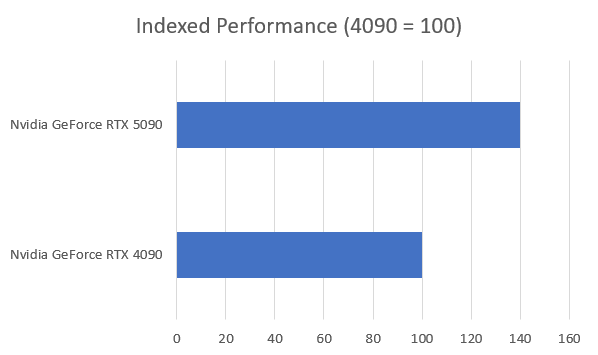
Based on multiple AI benchmark tests, overall results show that the RTX 5090 delivers about 40% higher performance than the RTX 4090 when running typical AI tasks such as inference, image processing, and text generation.
3D Rendering
In terms of 3D rendering, both the RTX 4090 and RTX 5090 deliver strong performance.
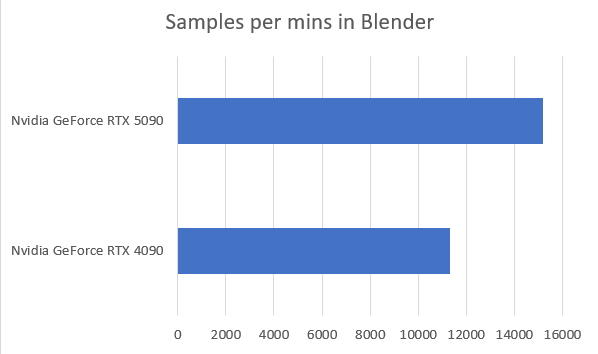
However, in classic rendering software like Blender, the RTX 5090 still outperforms the 4090 by about 35%, being significantly faster in tasks such as ray tracing and path tracing.
Gaming
The advantages of the RTX 5090 and RTX 4090 are most apparent in 4K/8K gaming.
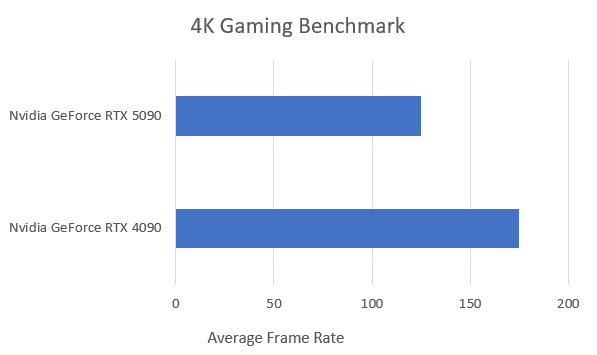
The RTX 5090 achieves an average frame rate of 175 FPS, while the RTX 4090 averages 125 FPS. For example, in A Plague Tale: Requiem, the performance gap increases to 42%.
However, at 1440p and 1080p resolutions, the difference is less noticeable, as the RTX 4090 already meets the needs of most gamers.
Video Editing
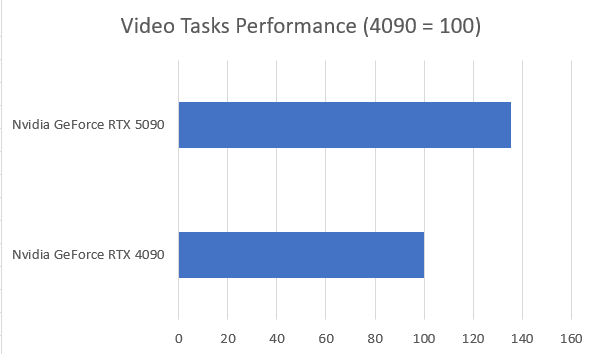
In video editing and decoding tasks, the RTX 5090 brings significant improvements than 4090.
It is equipped with three encoders and two decoders, compared to the RTX 4090 which has only two encoders and one decoder. This allows the 5090 to support H.264 10-bit 4:2:2 decoding.
Overall, in video editing and decoding benchmarks, the RTX 5090 scores 11,412, outperforming the RTX 4090 at 9,244, achieving approximately 35.15% higher performance.
Price & Value: 5090 vs 4090
The GeForce RTX 5090 may cost about 25% more than the 4090 at launch and draw 15–30% more power, but its leaps in VRAM bandwidth and ray tracing make the extra spend worth it for high-end users. On the flip side, in the second-hand market, the price gap can drop to around 60%, keeping the 4090 a smart, budget-friendly choice for those who want strong performance without breaking the bank.
Price Comparison
| Platform | RTX 5090 (USD) | RTX 4090 (USD) | Price Difference (USD) | Price Difference (%) |
|---|---|---|---|---|
| Official MSRP | $1,999 | $1,599 | +$400 | +25% |
| Amazon | $2,249 | $1,879–$2,765 | +$370–$1,166 | +20–62% |
| eBay | $2,249–$2,539 | $1,400–$1,925 | +$849–$1,139 | +44–59% |
User Value-for-Money Feedback
On UserBenchmark, the RTX 5090 scores only 63 according to most users, while the 4090 still achieves 93. On Technical.City, the 5090 scores just 3% higher than the 4090. These figures highlight the limited cost-performance advantage of the 5090.
RTX 5090 vs RTX 4090 – Pros & Cons
| GPU | Pros | Cons |
|---|---|---|
| RTX 5090 | - Excellent AI performance, ideal for running local models - Strong VR and 4K gaming with ray tracing - Multi-frame generation smooths low FPS games - 32GB VRAM prevents memory issues in games and 3D workflows - Faster 4K video decoding - Compact 2-slot design |
- High price (~$2,000) - Hotter and louder under heavy load - Some older games may have issues - Requires 575W PSU and PCIe 5.0 upgrade - Limited availability |
| RTX 4090 | - Great value near MSRP - Lower power draw (450W), cooler and quieter - Mature drivers, stable and compatible - Strong rasterization and legacy game support |
- Weaker AI and video editing performance - 24GB VRAM may limit future workloads - No multi-frame generation tech - Bulky 3-slot design |
RTX 5090 & RTX 4090 Hosting
If you want to leverage the massive GPU power of RTX 4090 or 5090 for AI workloads, rendering, or 4K/8K streaming and gaming, but don’t want to bear the high cost of hardware, lack maintenance knowledge, or need reliable technical support, then choosing the right GPU server hosting is the best solution.
Database Mart offers dedicated 4090 and 5090 servers, from single GPU to multi-GPU configurations, designed to scale with your business needs. Enjoy high cost-effectiveness, 99.9% uptime, and 24/7 professional technical support, so you can focus on your projects without worrying about hardware management.
Conclusion
The RTX 5090 offers better performance and value compared to the 4090, but for most users, the RTX 4090 is already sufficient for typical tasks.
As a new card, the 5090 is still expensive, making used 4090s a more cost-effective choice.
5090 vs 4090, rtx 4090 vs 5090, rtx 4090 vs rtx 5090, 5090 vs 4090 for ai, nvidia 5090 vs 4090, 5090 vs 4090 specs, rtx 5090 vs rtx 4090 performance, rtx 5090 vs 4090 price