


RTX 5090 vs RTX 5090D: Which GPU Should You Buy?
The battle between RTX 5090 vs RTX 5090D has quickly become a key topic for enthusiasts and professionals looking for next-generation GPU performance. Although both cards are built on NVIDIA’s latest architecture, they target different markets and come with important differences in specifications, performance limits, and availability. In this guide, we break down RTX 5090 vs RTX 5090D across gaming, AI workloads, power efficiency, and overall value to help you decide which GPU is the right choice for your needs.
RTX 5090 vs RTX 5090D – Background Comparison
| Brand | Series | Model | Release Year | Official Positioning | Market Price (USD) |
|---|---|---|---|---|---|
| NVIDIA | GeForce | RTX 5090 | 2025 | GeForce RTX 5090 is NVIDIA’s most powerful GeForce GPU to date, based on the Blackwell architecture, with 32GB high-speed GDDR7 memory, designed for gaming and creative workloads, offering unprecedented AI performance. | $1,999 |
| NVIDIA | GeForce | RTX 5090D | 2025 | GeForce RTX 5090D is essentially a "downgraded" RTX 5090, with some specs like VRAM bus width adjusted, but keeping core performance close to the original flagship, positioning it as a unique, powerful, yet regulated card. | $2,299 |
NVIDIA RTX 5090 vs RTX 5090D – Specifications Comparison
Before diving into performance benchmarks, it’s important to understand the core specifications behind NVIDIA RTX 5090 vs RTX 5090D. While both GPUs share the same architectural foundation, differences in core configuration, memory setup, power limits, and regional positioning can have a meaningful impact on real-world performance. This section breaks down the key specifications side by side to highlight where the RTX 5090 and RTX 5090D truly differ.
Core Specs Comparison between 5090 and 5090D
The following core specs comparison between RTX 5090 and RTX 5090D highlights the fundamental hardware differences that define how each GPU performs in real-world scenarios. While both models are based on the same GB202 architecture and share similar memory bandwidth, variations in compute units, clock speeds, power limits, and accelerator configurations can influence gaming performance, AI throughput, and overall efficiency. Reviewing these specifications side by side provides a clear foundation for understanding where the RTX 5090 and RTX 5090D diverge.
| Parameter | NVIDIA RTX 5090 | NVIDIA RTX 5090D |
|---|---|---|
| Architecture | GB202 | GB202 |
| CUDA Cores | 21,760 | 21,760 |
| Memory Type | GDDR7 | GDDR7 |
| Memory Capacity | 32 GB | 32GB |
| Memory Bandwidth | ~1,792 GB/s | ~1,792GB/s |
| Core Frequency (Base / Boost) | 2.01 / 2.41 GHz | 2017 / 2407 GHz |
| TDP (Total Graphics Power) | 575 W | 575 W |
| Interface / Bus | PCIe Gen5 x16 | PCIe Gen5 x16 |
| FP32 Performance | 318 TFLOPS | 104.8 TFLOPS |
| Tensor Cores | 5th-gen | 5th-gen |
| PCIe Version | Gen5 | Gen5 |
Overall, the core specs comparison shows that RTX 5090 and RTX 5090D share nearly identical hardware foundations, including the GB202 architecture, CUDA core count, memory configuration, bandwidth, PCIe Gen5 interface, and Tensor Core generation. The key distinction lies in compute capability, where the RTX 5090D delivers significantly lower FP32 performance despite similar clock speeds and power limits. This indicates that the RTX 5090D is intentionally configured with compute and AI throughput restrictions, rather than physical hardware reductions. As a result, while both GPUs can offer comparable gaming and graphics performance, the standard RTX 5090 remains the stronger choice for AI workloads, high-throughput computing, and unrestricted professional use, whereas the RTX 5090D is positioned as a region-compliant alternative with limited compute performance.
Nvidia GeForce RTX 5090D V2 Specifications
| Graphics Card | GeForce RTX 5090 | GeForce RTX 5090D | GeForce RTX 5090D V2 |
|---|---|---|---|
| Process Technology | TSMC 4N | TSMC 4N | TSMC 4N |
| Transistors (Billion) | 92.2 | 92.2 | 92.2 |
| Die size (mm²) | 750 | 750 | 750 |
| SMs | 170 | 170 | 170 |
| VRAM (GB) | 32 | 32 | 24 |
| VRAM Bus Width | 512 | 512 | 384 |
| AI Performance (AI TOPS) | 3,352 | 2,375 | 2,375 |
| Bandwidth (GB/s) | 1,792 | 1,792 | 1,344 |
| Launch Date | January 2025 | January 2025 | August 2025 |
| Launch Price | $1,999 | $2,299 | $2,299 |
5090 vs 5090D Performance Across Different Scenarios
Performance can vary significantly between the RTX 5090 and RTX 5090D depending on the workload and usage scenario. While both cards share similar hardware foundations, configuration differences—especially in compute throughput and FP32 capability—can lead to divergent results in gaming, creative applications, and AI-centric tasks. In this section, we explore how each GPU performs across a range of real-world scenarios, helping you understand where the strengths and limitations of the RTX 5090 and RTX 5090D truly lie.
Gaming Performance
Architecture Overview: RTX 5090 vs RTX 5090D
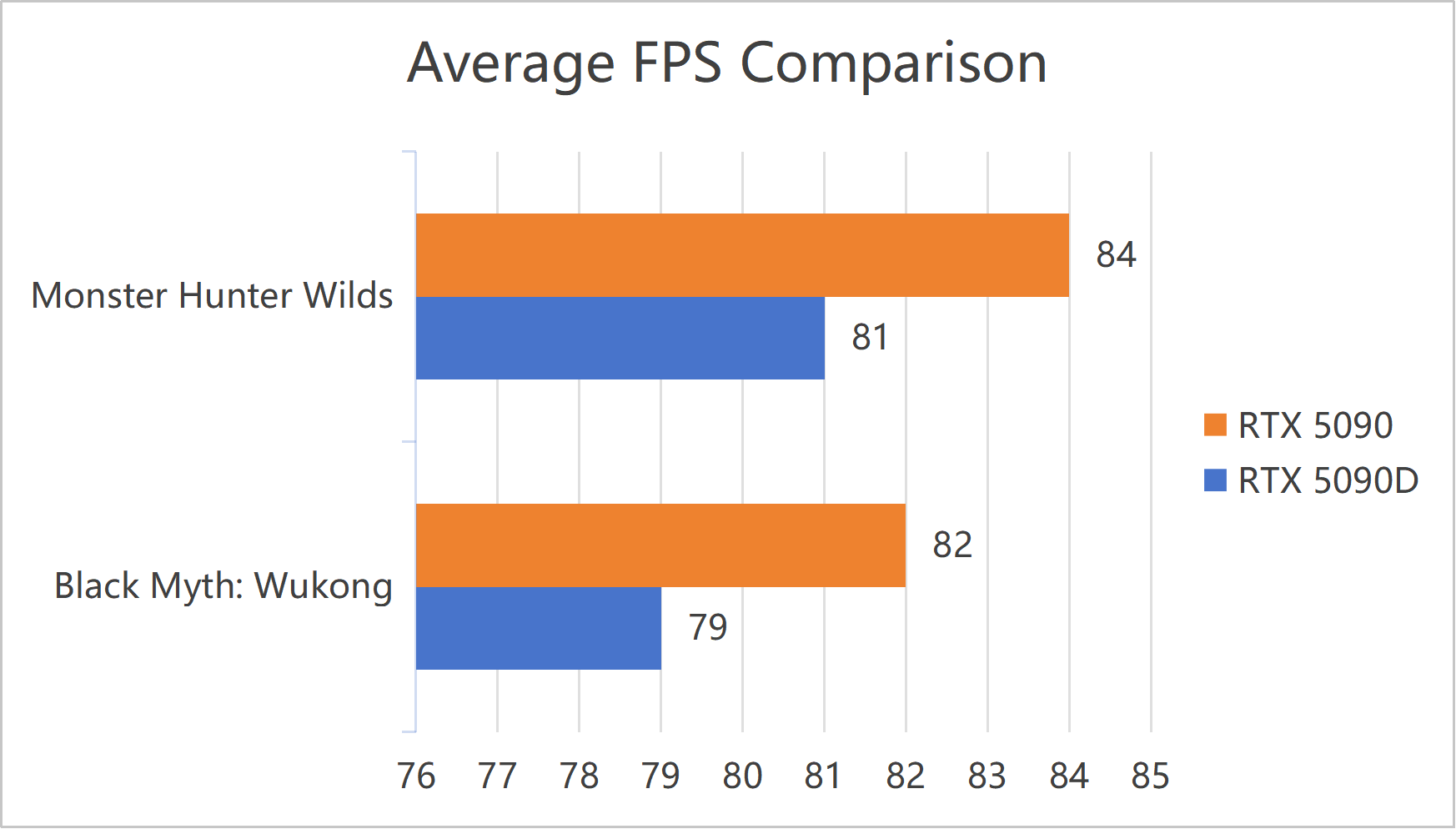
From a gaming perspective, both GPUs are fundamentally similar:
- Same Blackwell GB202 architecture
- Same generation RT cores and Tensor cores
- Similar memory capacity and bus width
- Support for DLSS 4, Frame Generation, and Ray Tracing
The key difference is that RTX 5090D has limited AI compute capability, which mainly impacts AI workloads rather than rasterized or ray-traced gaming.
For games, this means the performance gap is smaller than many users expect.
AI Performance
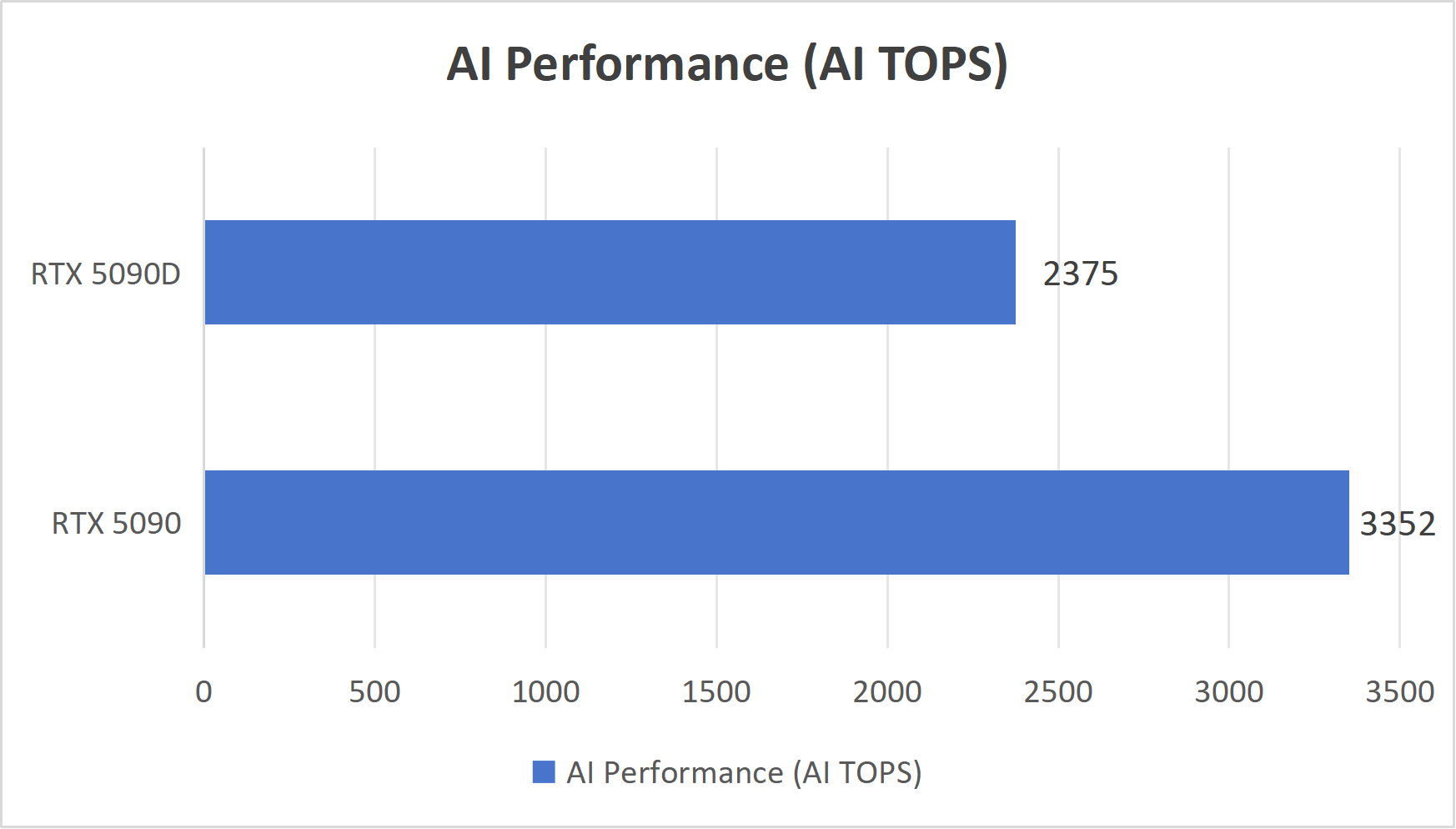
While RTX 5090 and RTX 5090D deliver nearly identical gaming performance, the real difference between these two GPUs appears in AI workloads. The RTX 5090D is a region-specific model designed to comply with export regulations, and as a result, its AI compute capability is intentionally limited. This makes AI performance the most important factor when comparing RTX 5090 vs RTX 5090D.
This article breaks down the AI performance gap, using theoretical metrics and real-world implications for AI inference and training.
AI Architecture Differences Explained
Both GPUs are built on NVIDIA’s Blackwell architecture and feature the same generation of Tensor Cores. However, NVIDIA limits the maximum AI throughput on the RTX 5090D through firmware and driver constraints.
Key takeaway:
- Hardware layout is similar
- AI compute ceiling is restricted on RTX 5090D
- The limitation affects AI workloads, not gaming
Price & Value: 5090 vs 5090D
When comparing the RTX 5090 and RTX 5090D, price and overall value play a crucial role alongside raw performance. While both GPUs target the high-end market, their real-world pricing differs significantly due to regional availability, market demand, and limited supply of the 5090D. This section breaks down official MSRP versus actual marketplace prices across major platforms, helping readers understand how much extra they may pay for the 5090D and whether that premium translates into meaningful value for gaming, AI workloads, or professional use.
Price Comparison
| Platform | RTX 5090 (USD) | RTX 5090D (USD) | Price Difference (USD) | Price Difference (%) |
|---|---|---|---|---|
| Official MSRP | $1,999 | $2,299 | $300 | +15% |
| Amazon | $2,249 | $2,950 | $701 | ~31%–51% |
| eBay | $2,249–$2,539 | ~$4,041 – $6,149+ | ~$1,500 – $3,600+ | ~60% – 140% |
Notes:
- RTX 5090 prices on Amazon vary widely depending on model and retailer, often above MSRP due to markups.
- RTX 5090D listings are much rarer and often appear as premium/scalped units, especially on secondary markets. Typical D-series cards (including V2 variants) fall higher in price than standard 5090s.
- On eBay, there are high-end RTX 5090D cards listed above $6,000 and mid-range listed around ~$4,000+.
If you want, I can calculate average prices from these ranges for a clearer direct comparison.
RTX 5090 vs RTX 5090D – Pros & Cons
| GPU | Pros | Cons |
|---|---|---|
| RTX 5090 | • Highest overall performance in the 50-series lineup with strong gaming and productivity gains over previous generation cards. • Full AI performance with more Tensor TOPS for workloads that use AI acceleration. • Excellent 4K and high-resolution performance with DLSS 4 and Multi Frame Generation support. |
• Premium price with diminishing returns for average gamers compared to lower-priced GPUs. • Very high power consumption and thermal requirements. • Overkill for gamers who don’t utilize AI or extreme resolutions frequently. |
| RTX 5090D | • Positioned to offer slightly better efficiency in some workloads through firmware/clock tuning (potential for slightly higher benchmark scores in select tests). • Can be cheaper than fully marked-up 5090s on secondary markets at times. (varies by listing) |
• Reduced AI performance (fewer AI TOPS) that impacts deep learning and AI workloads. • Some variants (like V2) also have reduced VRAM capacity and bandwidth, hurting heavy workloads. • Availability and pricing are unpredictable—often sold at a steep premium due to scarcity. |
RTX 5090 & RTX 5090D Hosting
If you’re looking for top-tier GPU hosting to accelerate AI training, deep learning inference, 3D rendering, or high-definition streaming, powerful RTX 5090 & RTX 5090D Hosting is the perfect choice. With Database Mart professional GPU server solutions, you can flexibly choose single or multi-GPU configurations, enjoy high computational power, stable performance, and instant deployment—without the need to purchase hardware or handle maintenance.
Opting for RTX 5090 and RTX 5090D hosting services gives you cost-effective, enterprise-grade reliability and 24/7 technical support, allowing you to focus on project development and deployment without worrying about hardware management or upgrades.
Conclusion
For maximum performance and flexibility, especially for AI training, model inference, and professional content creation, go with the standard RTX 5090. The RTX 5090D is still capable and useful in many scenarios, but it generally sits a notch below the standard 5090 in raw and AI‑oriented throughput.
5090 vs 5090d, 5090d vs 5090, rtx 5090 price, rtx 5090 benchmark, rtx 5090 performance, rtx 5090 specs, nvidia rtx 5090, rtx 5090 gpu