


RTX A6000 vs RTX 5090: Which Should You Choose?
Discover the key differences between the RTX A6000 and RTX 5090, from enterprise-grade stability and massive VRAM to consumer-focused speed and peak performance. This guide helps you decide which GPU is best for AI workloads, gaming, or scientific computing, so you can choose the right balance of power, reliability, and value for your needs.
NVIDIA RTX A6000 vs RTX 5090 – Background Comparison
| Brand | Series | Model | Release Year | Official Positioning / Description | Market Price (USD) |
|---|---|---|---|---|---|
| NVIDIA | RTX Professional (Ampere) | RTX A6000 | 2020 | Enterprise-grade professional GPU designed for workstations, AI training, scientific computing, digital twins, and large-scale 3D rendering. | ~$4,500 – $8,000 |
| NVIDIA | GeForce RTX 50 Series (Blackwell 2.0 ) | RTX 5090 | 2025 | The RTX 5090 is the most powerful GeForce GPU ever made, bringing game-changing capabilities to gamers and creators. Tackle the most advanced models and most challenging creative workloads with unprecedented AI horsepower. Game with full ray tracing and the lowest latency. | ~$1,999 (MSRP) / ~$2,401 – $4,998 retail |
RTX A6000 vs RTX 5090 – Specifications Comparison
| Parameter | RTX A6000 | RTX 5090 | Difference / Advantage |
|---|---|---|---|
| Architecture | Ampere | Blackwell 2.0 | RTX 5090 uses a newer architecture with improved efficiency and features |
| CUDA Cores | 10,752 | 21,760 | RTX 5090 has significantly more CUDA cores, enabling stronger parallel compute |
| Memory Type | GDDR6 (ECC) | GDDR7(ECC) | RTX 5090 delivers higher memory speed |
| Memory Capacity | 48 GB | 32 GB | RTX A6000 provides much larger VRAM, ideal for large models and datasets |
| Memory Bus | 384-bit | 512-bit | RTX 5090 features a wider memory bus for higher throughput |
| Memory Bandwidth | ~768 GB/s | ~1.79 TB/s | RTX 5090 delivers substantially higher bandwidth |
| Core Frequency (Boost) | ~1.8 GHz | ~2.4 GHz | RTX 5090 runs at much higher clock speeds |
| TDP (Power) | 300W | 575W | RTX A6000 is more power-efficient |
| Interface / Bus | PCIe Gen4 x16 | PCIe Gen5 x16 | RTX 5090 supports newer PCIe technology |
| FP32 Performance | ~38.7 TFLOPS | ~104.8 TFLOPS | RTX 5090 provides over 2× FP32 compute performance |
| Tensor Cores | 336 × 3rd-gen | 680 × 5th-gen | RTX 5090 has more and newer Tensor Cores for AI workloads |
| Ray Tracing Cores | 2nd-gen RT Cores | 4th-gen RT Cores | RTX 5090 offers much stronger ray tracing performance |
| PCIe Version | Gen4 | Gen5 | RTX 5090 benefits from higher theoretical I/O bandwidth |
Core Differences Between RTX A6000 and RTX 5090
Workload fit: capacity-driven vs throughput-driven
RTX A6000 is better suited to workloads that must reside fully in GPU memory to run reliably, while RTX 5090 excels when tasks can be streamed, partitioned, or parallelized to maximize throughput.
Performance behavior: sustained execution vs peak acceleration
RTX A6000 delivers more predictable performance over long, continuous runs, whereas RTX 5090 is optimized for extremely high peak output over shorter or well-structured execution windows.
Optimization overhead: minimal vs deliberate
With RTX A6000, users spend less time managing memory constraints or restructuring workloads. RTX 5090 often rewards careful optimization and tuning, but requires more deliberate workload design.
Scaling strategy: depth on a single GPU vs breadth across GPUs
RTX A6000 favors scaling by handling larger workloads per GPU, while RTX 5090 favors scaling through multi-GPU parallelism and aggressive task distribution.
Reliability profile: predictability vs performance-first design
RTX A6000 prioritizes operational stability and result consistency during long-running jobs. RTX 5090 prioritizes maximum performance, with greater sensitivity to system conditions and configuration.
Infrastructure dependency: flexible deployment vs high-spec environments
RTX A6000 integrates more easily into standard workstation or data-center setups, while RTX 5090 reaches its full potential only in environments built to sustain very high power and thermal demands.
RTX A6000 vs RTX 5090 Benchmark: Performance Across Different Scenarios
A6000 vs 5090 Gaming Performance
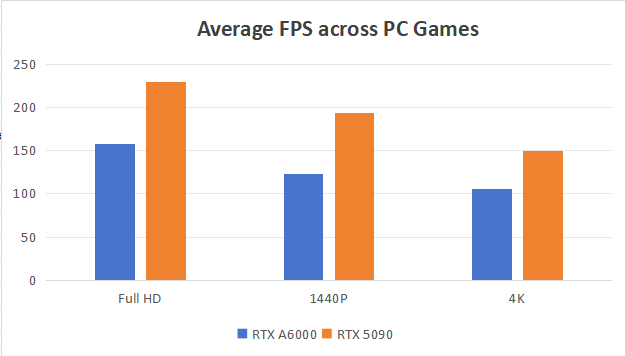
The RTX 5090 delivers significantly higher gaming performance compared to the RTX A6000, achieving approximately 40–50% higher frame rates across Full HD, 1440p, and 4K resolutions. For example, at Full HD, the A6000 runs around 158 FPS while the 5090 reaches 229 FPS—a difference of roughly 45%. Despite this gap, the A6000 is still capable of running most modern games smoothly and is reliable for long gaming sessions. The main difference lies in positioning and cost: as an enterprise-class GPU, the A6000 prioritizes large VRAM capacity, ECC memory, and sustained stability rather than gaming efficiency, making it considerably more expensive per frame than the RTX 5090.
A6000 vs 5090 for AI Tasks
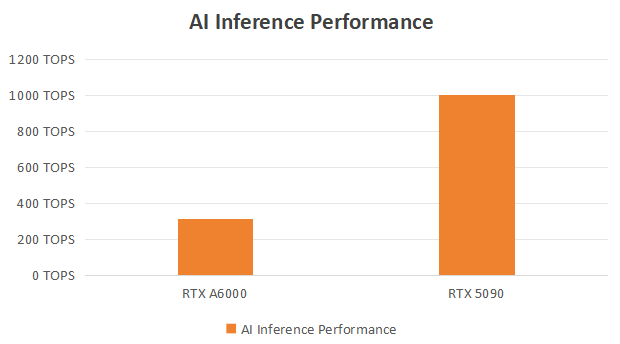
The RTX 5090 delivers dramatically higher AI inference performance compared to the RTX A6000, achieving over three times the integer TOPS—1000 TOPS versus 310 TOPS. This means the 5090 can handle large-scale model inference, batch processing, and real-time AI workloads much faster, significantly reducing latency and increasing throughput for demanding applications. The A6000, while slower in raw AI inference, still provides reliable performance and excels in tasks that require large VRAM or long-running computations, making it suitable for enterprise AI deployments where stability and memory capacity are more important than peak throughput.
Combined Synthetic Benchmark Score
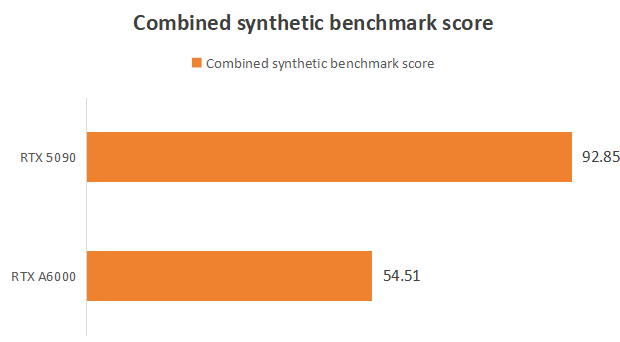
The RTX 5090 achieves a combined synthetic benchmark score of 92.85, significantly higher than the RTX A6000’s 54.51, representing roughly a 70% performance advantage. This indicates that the 5090 delivers faster overall performance across tasks including graphics rendering, AI inference, and high-load real-time computations. The A6000, while scoring lower, still provides reliable performance thanks to its large VRAM and stability, making it well-suited for professional workstations, long-running computations, and large-model processing. In summary, the RTX 5090 is ideal for workloads that prioritize peak performance and high throughput, whereas the A6000 is better suited for enterprise applications that emphasize stability and capacity.
RTX A6000 vs RTX 5090 Price & Value
| Platform | RTX A6000 (USD) | RTX 5090 (USD) | Price Difference (USD) | Price Difference (%) |
|---|---|---|---|---|
| Official MSRP | $4,650 | $1,999 | +$2,651 | +132.6% |
| Amazon | $2,599 – $6,045 | $1,879–$2,765 | +$720 – $3,280 | +26 – 119% |
| eBay | $4,500–$5,200 | $2,401 – $4,998 | +$1,502 – $2,799 | +30 – 116% |
In terms of value, the RTX 5090 clearly offers much more cost-effective performance compared to the RTX A6000. While the A6000 commands a price premium of over $2,500–$3,200 depending on the platform—representing roughly +130–+120% more per card—the 5090 delivers higher gaming frame rates, dramatically better AI inference throughput, and superior overall benchmark performance. This means that for most users seeking raw performance per dollar, the 5090 provides significantly higher return on investment, while the A6000’s value lies primarily in enterprise-focused tasks that require large VRAM, ECC stability, and sustained reliability rather than maximum frame rate or throughput.
RTX A6000 vs RTX 5090 Pros & Cons
| Model | Pros | Cons |
|---|---|---|
| RTX A6000 | ✅ Massive 48 GB VRAM, ideal for huge models, textures, and datasets ✅ Enterprise-grade reliability and stability for long-running workloads ✅ Excellent for professional 3D rendering, AI training, and large-scale simulations |
❌ Older Ampere architecture ❌ Lower CUDA, RT, and Tensor cores compared to 5090 ❌ Slower in gaming, real-time 3D rendering, and AI inference ❌ Very high cost per performance ❌ Less power-efficient than 5090 |
| RTX 5090 | ✅ Next-gen architecture with higher clock speeds and more CUDA/RT/Tensor cores, delivering superior performance ✅ Optimized for gaming, AI inference, and real-time rendering ✅ High memory bandwidth with fast GDDR7, suitable for large scene data ✅ Strong single-card performance for both gaming and AI |
❌ 32 GB VRAM may limit ultra-large datasets or extremely high-res textures ❌ Very high power consumption (TDP 575 W) ❌ May require careful cooling and high-spec system for sustained workloads ❌ Single-card VRAM can limit extremely large AI models |
RTX A6000 vs RTX 5090 Server Hosting
Looking for a high-performance GPU server for AI, 3D rendering, or scientific computing? Database Mart offers dedicated RTX A6000 and RTX 5090 servers, combining enterprise-grade reliability with cutting-edge performance—without the cost of buying hardware outright.
Choose the RTX A6000 server
for massive 48 GB VRAM workloads, long-running simulations, or large-scale AI model training.Opt for the RTX 5090 server
for ultra-fast gaming, real-time 3D rendering, and AI inference tasks, benefiting from higher throughput and peak performance.
All servers come with 99.9% uptime and free 24/7 enterprise-level technical support, ensuring your workloads run smoothly and reliably around the clock.
Conclusion
When it comes to choosing between the RTX A6000 and RTX 5090, the decision ultimately depends on your workload and priorities. The RTX A6000 excels in enterprise and professional applications, offering massive 48 GB VRAM, ECC memory, and stable long-running performance, making it ideal for large-scale AI training, professional 3D rendering, and simulations that demand reliability. On the other hand, the RTX 5090 delivers higher frame rates, faster AI inference, and superior overall throughput, making it the better choice for gaming, real-time rendering, or tasks that require peak performance per dollar.
Both GPUs are excellent in their respective niches, so consider your performance needs, budget, and workload characteristics when deciding. For users prioritizing raw speed and value, the 5090 is unmatched, while the A6000 shines in scenarios that demand stability, memory capacity, and enterprise-grade reliability.
RTX A6000 vs RTX 5090, A6000 vs 5090, rtx a6000 price, rtx 5090 price, a6000 specs, rtx 5090 specs, nvidia a6000, a6000 gpu, nvidia 5090, 5090 gpu