


RTX A6000 vs RTX 4090: Enterprise vs Consumer GPU – Which Should You Choose?
The RTX 4090 delivers exceptional performance at an attractive price, making it a popular choice for many users.
However, for AI training, enterprise deployment, and long-running professional workloads, the RTX A6000 still offers advantages that consumer GPUs like the 4090 cannot match.
In this comparison, we break down benchmarks, pricing, stability, and real-world use cases to help you decide when the A6000 is the smarter choice — and when it isn’t.
Summary Light of RTX A6000 vs RTX 4090
Key Features: The RTX A6000 offers massive 48GB VRAM and optimized Tensor cores for large-scale AI workloads, while the RTX 4090 delivers cutting-edge CUDA cores, Ray Tracing (RT) cores, and Tensor cores for ultra-fast rendering and AI inference. Both support AV1 encoding/decoding and high-performance compute tasks.
Industries: Ideal for AI research, 3D rendering, scientific computing, visual effects, and enterprise-level simulations. The 4090 is also great for gaming, creative work, and small-to-medium AI projects.
Popular Software: Compatible with Blender, Maya, Cinema 4D, Premiere Pro, After Effects, DaVinci Resolve, PyTorch, TensorFlow, Stable Diffusion, and mainstream AAA games.
NVIDIA RTX A6000 vs RTX 4090 – Background Comparison
| Brand | Series | Model | Release Year | Official Positioning / Description | Market Price (USD) |
|---|---|---|---|---|---|
| NVIDIA | RTX Professional (Ampere) | RTX A6000 | 2020 | Enterprise-grade professional GPU designed for workstations, AI training, scientific computing, digital twins, and large-scale 3D rendering. | ~$4,500 – $8,000 |
| NVIDIA | GeForce RTX 40 Series (Ada Lovelace) | RTX 4090 | 2022 | Consumer flagship GPU focused on extreme gaming, AI inference, and content creation. Delivers very high raw compute and tensor performance but lacks ECC memory and enterprise driver certification. | ~$1,599 (MSRP) / ~$3,000 – $4,500 retail |
RTX A6000 vs RTX 4090 – Specifications Comparison
Nvidia A6000 vs 4090 Core Specs
| Parameter | RTX A6000 | RTX 4090 | Difference / Advantage |
|---|---|---|---|
| Architecture | Ampere | Ada Lovelace | 4090 is 1 generation newer |
| CUDA Cores | 10,752 | 16,384 | 4090 has ~52% more cores |
| Memory Type | GDDR6 (ECC) | GDDR6X (non-ECC) | A6000 supports ECC memory |
| Memory Capacity | 48 GB | 24 GB | A6000 offers 2× VRAM |
| Memory Bus | 384-bit | 384-bit | Same bus width |
| Memory Bandwidth | ~768 GB/s | ~1,008 GB/s | 4090 has ~31% higher bandwidth |
| Core Frequency (Boost) | ~1.8 GHz | ~2.52 GHz | 4090 has much higher clocks |
| TDP (Power) | 300W | 450W | A6000 is more power efficient |
| Interface / Bus | PCIe Gen4 x16 | PCIe Gen4 x16 | Same interface |
| FP32 Performance | ~38.7 TFLOPS | ~82.6 TFLOPS | 4090 delivers >2× FP32 compute |
| Tensor Cores | 336 × 3rd-gen Tensor Cores | 512 × 4th-gen Tensor Cores | 4090 has more & newer Tensor cores |
| Ray Tracing Cores | 2nd-gen RT Cores | 3rd-gen RT Cores | 4090 has stronger RT performance |
| PCIe Version | Gen4 | Gen4 | Same version |
Nvidia A6000 vs 4090 Advanced Features
| Advanced Feature | RTX A6000 | RTX 4090 | Difference / Customer Impact |
|---|---|---|---|
| Target Market | Enterprise / Workstation / Server | Consumer / Prosumer | A6000 is enterprise-first |
| ECC Memory Support | Yes (Hardware ECC) | No | A6000 ensures data integrity |
| VRAM Capacity per GPU | 48 GB | 24 GB | A6000 handles larger models & datasets |
| Multi-GPU Scaling | NVLink supported | No NVLink | A6000 enables true multi-GPU training |
| NVLink Bandwidth | Up to 112.5 GB/s (bi-directional) | N/A | Critical for model parallelism |
| Virtualization (vGPU) | Supported (NVIDIA vGPU) | Not supported | A6000 ideal for GPU virtualization / RDP |
| Driver Type | Enterprise / ISV-certified | Game Ready / Studio | A6000 offers long-term stability |
| Long-duration Workloads | Designed for 24/7 operation | Not officially rated | A6000 safer for continuous training |
| AI Training Stability | Very high (ECC + pro drivers) | High but consumer-grade | A6000 preferred in production AI |
| AI Inference Performance | Strong | Excellent | 4090 better performance per dollar |
| LLM Fine-tuning (7B–30B) | Excellent | Good (VRAM-limited) | A6000 fits larger checkpoints |
| Large Model Support (40B+) | Yes (single / multi-GPU) | Limited | A6000 scales beyond single GPU |
| Power Efficiency (Perf/Watt) | Better for sustained workloads | High peak, lower sustained | A6000 more efficient over time |
| Thermal Design | Blower-style, server-friendly | Open-air (most models) | A6000 fits rack-mounted servers |
| Data Center Deployment | Fully supported | Not officially supported | A6000 suitable for colocation & DCs |
| Compliance / Enterprise Use | SOC / enterprise environments | Not compliance-focused | A6000 aligns with enterprise audits |
| Cost Efficiency | Higher upfront cost | Lower upfront cost | 4090 wins on short-term budget |
Core Differences Between RTX A6000 and RTX 4090
Target Market & Use Case
RTX A6000 is designed for enterprise, workstations, and server environments, with ECC memory, NVLink, and certified drivers. It excels at large-scale AI training, multi-GPU workloads, and professional 3D rendering.
RTX 4090 targets enthusiasts and creators, delivering peak gaming, AI inference, and content creation performance at a lower cost, but without ECC or enterprise-grade certification.
Compute & Memory
The RTX 4090 offers higher raw FP32 performance (~82.6 TFLOPS vs ~38.7 TFLOPS) and faster clock speeds, making it ideal for single-card workloads.
The RTX A6000 has 48GB ECC memory, double the VRAM of the 4090, and supports NVLink for multi-GPU scaling, which is crucial for very large models or datasets.
Stability & Enterprise Features
A6000 supports long-duration, 24/7 workloads, hardware ECC, virtualization, and professional ISV-certified drivers, making it more reliable for production AI, simulations, and data centers.
4090 offers peak performance but is not certified for enterprise deployment or virtualization, and lacks ECC memory.
Power, Thermal & Deployment Considerations
A6000 is optimized for efficiency and server-friendly deployment (blower-style cooler, lower TDP relative to performance per sustained workload).
4090 achieves higher peak performance at higher power draw and open-air thermal designs, suitable for desktops but less ideal for rack-mounted servers.
RTX A6000 vs RTX 4090 Benchmark: Performance Across Different Scenarios
A6000 vs 4090 Gaming Performance
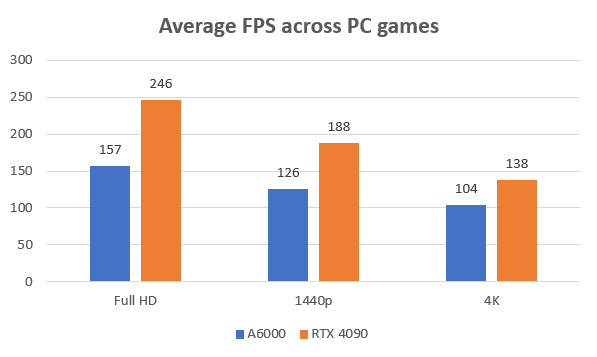
The RTX 4090 is widely known for its outstanding gaming performance and can run almost any modern game smoothly. Compared with the RTX 4090 benchmark, the RTX A6000 delivers around 30–50% lower average frame rates, with the gap reaching up to 58% at Full HD (1080p). However, this does not mean the A6000 performs poorly in games. In practice, it can still handle most PC games smoothly and is perfectly capable of long-term or AFK gaming workloads. The main difference lies in value: as an enterprise-class GPU, the RTX A6000 is not optimized for gaming price-to-performance, costing around 300% more per frame than the RTX 4090.
A6000 vs 4090 for AI Tasks
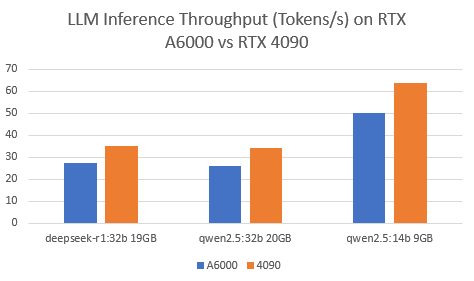
The chart shows LLM inference throughput measured in tokens per second (tokens/s) on RTX A6000 and RTX 4090.
The GB values indicate the actual GPU memory usage during inference, not the raw model size.
Since all models fit within 24GB VRAM, RTX 4090 consistently delivers ~30% higher inference speed than A6000 thanks to its newer architecture and higher compute throughput. RTX A6000’s advantage becomes relevant mainly for larger models or workloads exceeding 24GB VRAM.
The RTX A6000 delivers more stable and reliable performance for large-scale model inference (such as more than 30B), memory-intensive training, and NVLink multi-GPU workloads (4090 does not support NVLink), thanks to its 48GB VRAM, which allows larger models to be loaded entirely on a single GPU.
For more detailed performance data of different models, check the RTX A6000 benchmarks and RTX 4090 benchmarks on AI tasks.
A6000 vs 4090 for 3D Rendering
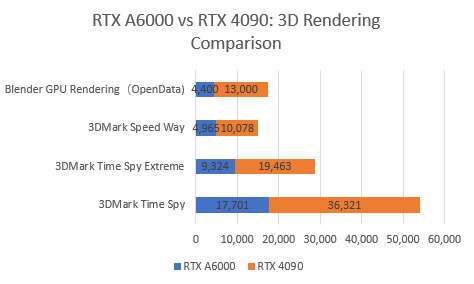
This chart compares the performance of NVIDIA RTX A6000 and RTX 4090 across popular benchmarks and rendering tasks. The 4090 consistently outperforms the A6000, with up to 3× faster Blender rendering and more than double scores in 3DMark tests, making it the stronger choice for GPU-intensive workloads.
The RTX 4090 delivers higher rendering throughput thanks to its newer Ada architecture, more cores, and faster memory, excelling in OptiX, CUDA, and real-time GI workloads. The A6000, with its massive 48GB VRAM, handles larger textures and models, making it ideal for enterprise workstations and render farms.
RTX A6000 vs RTX 4090 Price & Value
| Platform | RTX A6000 (USD) | RTX 4090 (USD) | Price Difference (USD) | Price Difference (%) |
|---|---|---|---|---|
| Official MSRP | $4,650 | $1,599 | +$3,051 | +191% |
| Amazon | $4,799–$5,199 | $1,879–$2,765 | +$3,020–$2,434 | +161–176% |
| eBay | $4,500–$5,200 | $1,400–$1,925 | +$3,100–$3,275 | +161–234% |
In terms of purchase price, the RTX A6000 is 150%–200% more expensive than the RTX 4090 across both NVIDIA’s official store and third-party platforms, with a difference of up to $3,000. The A6000 performs worse than the 4090 in gaming and standard rendering tasks, making the 4090 a more cost-effective choice for most users. However, with its massive 48GB of VRAM, the A6000 remains an excellent option for enterprise-level workloads and large-scale AI models.
RTX A6000 vs RTX 4090 Pros & Cons
| Model | Pros | Cons |
|---|---|---|
| RTX A6000 | ✅ Massive 48GB VRAM, supports huge textures/models/datasets ✅ Enterprise-grade reliability and stability ✅ Excellent for multi-GPU setups and large-scale AI training ✅ Low failure rate under 24/7 workloads ✅ ECC memory for data integrity |
❌ Ampere architecture, older than 4090 ❌ Lower CUDA, RT, and Tensor cores compared to 4090 ❌ Slower in OptiX, CUDA, real-time GI, and gaming workloads ❌ Very high cost ❌ Lower power efficiency |
| RTX 4090 | ✅ Ada architecture with higher clock and more CUDA/RT/Texture cores, delivering faster rendering ✅ Optimized for OptiX, CUDA, and real-time GI ✅ High memory bandwidth with GDDR6X, good for large scene data ✅ Strong single-card AI and rendering performance ✅ Consumer-grade card with widespread availability |
❌ 24GB VRAM may limit ultra-large models/textures ❌ Consumer card, less tested for 24/7 enterprise use ❌ Very high power consumption ❌ Less ECC/data integrity protection ❌ Price still high for a consumer card |
RTX A6000 vs RTX 4090 Server Hosting
Looking for a high-performance GPU server for AI, 3D rendering, or scientific computing? Database Mart’s dedicated RTX A6000 and RTX 4090 servers deliver top-tier performance and reliability at a fraction of the cost of buying hardware. Choose the A6000 for massive 48GB VRAM workloads, or the 4090 for lightning-fast rendering and AI tasks. Enjoy 99.9% uptime and free 24/7 enterprise-level technical support with every server.
Conclusion
Overall, the RTX A6000 and RTX 4090 cater to different user needs. While the A6000 is significantly more expensive—up to 200% higher than the 4090—it offers 48GB of VRAM, ECC memory support, NVLink multi-GPU scalability, and enterprise-grade stability, making it ideal for large-scale AI models, high-resolution rendering, and scientific computing in professional environments. The RTX 4090, by contrast, delivers superior performance in gaming, standard rendering, and most AI tasks at a much more cost-effective price, making it the better choice for general users and smaller workloads. Ultimately, the decision comes down to whether your priority is extreme VRAM capacity and enterprise-level reliability or overall value and versatility.