


RTX 2060 vs RTX 3060: A Complete Performance Comparison and Buying Guide
The RTX 2060 vs RTX 3060 matchup remains one of the most discussed choices among mid-range GPU buyers. As two generations apart, they show clear differences in RTX 2060 performance and RTX 3060 performance across modern games. This guide highlights key benchmarks, ray tracing, DLSS efficiency, power usage, and overall value at 1080p and 1440p.
We also review current 3060 price and 2060 price trends to help you determine which GPU offers better value. Whether you're upgrading or comparing the real gap between 2060 vs 3060, this concise buying guide will help you make a confident choice.
RTX 2060 vs RTX 3060 – Background Comparison
| Brand | Series | Model | Release Year | Official Positioning | Market Price (USD) |
|---|---|---|---|---|---|
| NVIDIA | GeForce | RTX 2060 | 2019 | As NVIDIA's entry-level GPU for real-time ray tracing and AI-enhanced gaming, bringing next-gen RTX features (like DLSS) to the mainstream at a more accessible price point (launching around $349), targeting high-performance 1080p and capable 1440p gaming with 6GB GDDR6 VRAM. | $140 |
| NVIDIA | GeForce | RTX 3060 | 2021 | The GeForce RTX™ 3060 brings next-generation performance with NVIDIA Ampere architecture, delivering faster ray tracing, DLSS acceleration, and improved gaming performance for 1080p and 1440p gamers seeking an attractive balance of value and efficiency. | $250 |
NVIDIA RTX 2060 vs RTX 3060 – Specifications Comparison
From a hardware specification standpoint, the RTX 2060 and RTX 3060 represent a clear generational gap. The RTX 3060 is built on NVIDIA’s newer Ampere architecture, delivering notable improvements in computing efficiency and feature support compared to the Turing-based RTX 2060. One of the most significant upgrades is the CUDA core count, with the RTX 3060 offering nearly twice as many cores, resulting in much stronger parallel processing performance for both gaming and productivity workloads.
In terms of memory, both GPUs use GDDR6, but the RTX 3060 is equipped with 12GB of VRAM, while the RTX 2060 is limited to 6GB. This doubled memory capacity allows the RTX 3060 to handle 1440p and higher resolutions, high-quality textures, and demanding creative tasks such as video editing and 3D rendering more comfortably, while also providing better long-term usability.
Although both cards share the same memory bus width, the RTX 3060 benefits from higher memory bandwidth thanks to architectural optimizations and higher memory clocks. Combined with only a modest increase in power consumption, the RTX 3060 delivers nearly double the theoretical FP32 performance, highlighting a significant improvement in performance-per-watt.
When it comes to advanced features, the RTX 3060 includes second-generation RT Cores and third-generation Tensor Cores, enabling more efficient ray tracing and smoother DLSS performance with less impact on frame rates. Support for PCIe 4.0 further enhances platform compatibility and future readiness on newer systems.
Core Specs Comparison between RTX 2060 vs RTX 3060
| Specification | RTX 2060 | RTX 3060 |
|---|---|---|
| Architecture | Turing | Ampere |
| CUDA Cores | 1,920 | 3,584 |
| Memory Type | GDDR6 | GDDR6 |
| Memory Capacity | 6 GB | 12 GB |
| Memory Bus | 192-bit | 192-bit |
| Memory Bandwidth | 336 GB/s | 360 GB/s |
| Core Frequency (Boost) | ~1680 MHz | ~1.78 GHz |
| TDP (Power) | 160 W | 170 W |
| Interface / Bus | PCIe 3.0 x16 | PCIe 4.0 x16 |
| FP32 Performance | ~6.451 TFLOPS | ~12.7 TFLOPS |
| Ray Tracing / Tensor | 1st Generation / 2nd Generation | 2nd-gen RT, 3rd-gen Tensor |
| PCIe Version | PCIe 3.0 | PCIe 4.0 |
Key Differences: RTX 2060 vs RTX 3060
Architecture (Turing vs Ampere)
The most significant difference between the RTX 2060 and RTX 3060 lies in their underlying architectures. The RTX 2060 is based on NVIDIA’s Turing architecture, which introduced real-time ray tracing for the first time. In contrast, the RTX 3060 uses the newer Ampere architecture, delivering major improvements in efficiency, compute density, and feature support. Ampere’s upgraded RT and Tensor cores provide noticeably better ray tracing performance and DLSS efficiency, giving the RTX 3060 a clear advantage in modern games and AI-assisted workloads.
CUDA Core Count & Compute Performance
The RTX 2060 features 1,920 CUDA cores, while the RTX 3060 significantly increases this number to 3,584 CUDA cores. This near-doubling of cores translates directly into stronger parallel processing power. Combined with Ampere’s architectural optimizations, the RTX 3060 handles complex shaders, modern game engines, and compute-heavy tasks far more efficiently than the RTX 2060, especially at higher resolutions and quality settings.
Memory Capacity (6GB vs 12GB)
One of the most impactful upgrades is memory capacity. The RTX 2060 comes with 6GB of GDDR6 VRAM, whereas the RTX 3060 doubles that to 12GB. This extra VRAM allows the RTX 3060 to better handle modern games with high-resolution textures, large open worlds, and demanding creative applications. Titles that exceed 6GB of VRAM benefit from smoother frame pacing and fewer stutters on the RTX 3060, particularly at 1440p and above.
Memory Bus & Bandwidth
Both GPUs use a 192-bit memory bus, but the RTX 3060 offers slightly higher memory bandwidth (360 GB/s vs 336 GB/s). While the difference on paper is modest, Ampere’s improved memory compression and data handling enable the RTX 3060 to deliver better real-world performance in bandwidth-sensitive scenarios. This helps maintain smoother gameplay in modern engines despite similar bus widths.
Clock Speeds & Power Efficiency
The RTX 2060 boosts to around 1,680 MHz, while the RTX 3060 reaches approximately 1.78 GHz. More importantly, the RTX 3060 achieves much higher performance with only a small increase in power consumption (170W vs 160W TDP). This results in a noticeable improvement in performance per watt, making the RTX 3060 both faster and more efficient overall.
FP32 Compute Performance
In terms of raw compute power, the RTX 2060 delivers roughly 6.45 TFLOPS, while the RTX 3060 nearly doubles that figure at around 12.7 TFLOPS. This substantial uplift benefits not only gaming but also workloads such as rendering, simulation, and GPU-accelerated productivity tasks.
Ray Tracing & DLSS Generation
The RTX 2060 uses first-generation RT cores and second-generation Tensor cores, whereas the RTX 3060 upgrades to second-generation RT cores and third-generation Tensor cores. These improvements allow the RTX 3060 to run ray tracing effects with less performance loss and deliver more efficient, higher-quality DLSS upscaling. As a result, the RTX 3060 maintains higher frame rates in visually demanding, RT-heavy games.
PCIe Interface & Platform Support
The RTX 2060 supports PCIe 3.0, while the RTX 3060 upgrades to PCIe 4.0. Although the performance difference in most games is minimal today, PCIe 4.0 provides better future compatibility and higher theoretical bandwidth for newer platforms and data-intensive workloads.
RTX 2060 vs RTX 3060 Performance Across Different Scenarios
Gaming Performance
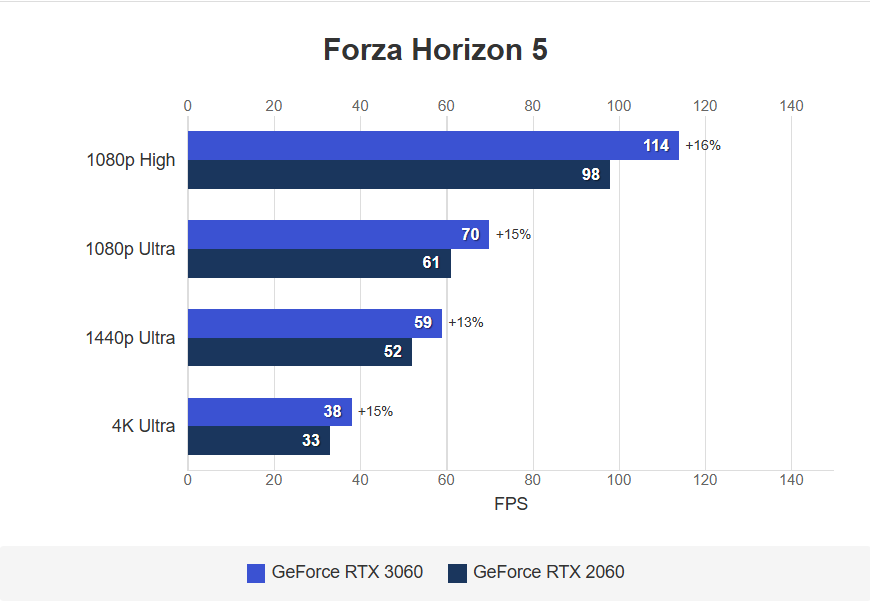
This chart compares the performance of the RTX 3060 and RTX 2060 in Forza Horizon 5 across multiple resolutions and graphics settings. The results show that the RTX 3060 consistently outperforms the RTX 2060, delivering an average performance gain of around 13%–16%. At 1080p, the RTX 3060 achieves higher and more stable frame rates, while at 1440p and 4K Ultra settings, both GPUs see reduced FPS, but the RTX 3060 maintains a clear advantage, offering better overall smoothness and playability.
3DMark Comparison
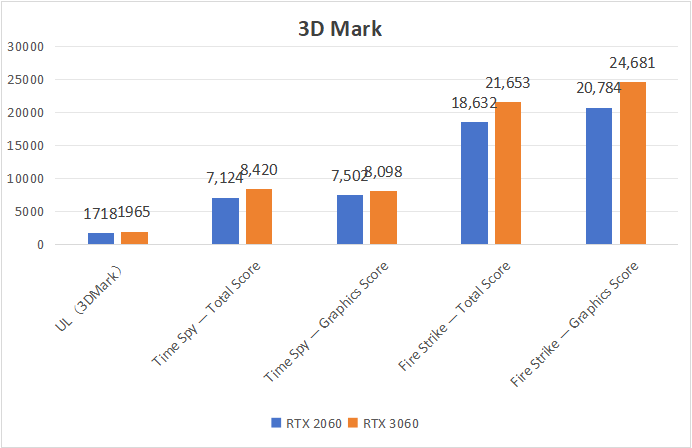
Based on combined 3DMark data (Time Spy, Fire Strike, and official median), the overall performance of the RTX 3060 is approximately 10%–20% higher than the RTX 2060, with a typical improvement of around 15%. The advantage is moderate in DX12 (Time Spy), while the lead is more significant under traditional workloads such as DX11 (Fire Strike). Overall, the RTX 3060 is clearly more powerful, but it represents a steady upgrade rather than a generational leap in performance.resolution textures and more demanding visual effects.
Price & Value: RTX 2060 vs RTX 3060
This table compares the prices of the RTX 2060 and RTX 3060 across different sales platforms, allowing readers to clearly see the differences between official pricing and real-world market prices.
The table lists the reference prices of the RTX 2060 and RTX 3060 on three platforms—Official MSRP, eBay, and Amazon—and uses the Price Difference (USD) and Price Difference (%) columns to clearly show the absolute price gap and relative percentage change of the RTX 3060 compared to the RTX 2060.
From the data, it can be observed that at the official MSRP level, the RTX 3060 is actually priced slightly lower than the RTX 2060, highlighting the stronger pricing competitiveness of the newer-generation product at launch. However, in real-world marketplaces such as eBay and Amazon, the RTX 3060 generally commands a higher price due to its stronger performance and higher demand. This table helps readers evaluate the value proposition of each GPU more rationally based on their preferred purchasing channel.
Price Comparison
| Platform | RTX 2060 | RTX 3060 | Price Difference (USD) | Price Difference (%) |
|---|---|---|---|---|
| Official MSRP | $349 | $329 | -$20 | -5.7% |
| eBay | ~$179 | ~$200 | +$21 | +11.7% |
| Amazon | ~$302 | ~$319 | +$17 | +5.6% |
User Value-for-Money Feedback
The comparison between the RTX 2060 and RTX 3060 reveals key insights into the price-to-performance ratio of each graphics card across different sales platforms.
1.Official MSRP:
The RTX 3060 is priced slightly lower than the RTX 2060 at $329 compared to $349, making it a more attractive option in terms of official pricing. This price difference of $20 (or -5.7%) makes the RTX 3060 a better deal at launch, offering competitive pricing for the newer generation while maintaining solid performance.
2.eBay and Amazon Pricing:
On platforms like eBay and Amazon, the RTX 3060 typically costs more than the RTX 2060, which reflects its superior performance. While the price difference is positive (+11.7% on eBay and +5.6% on Amazon), the performance boost offered by the RTX 3060 justifies the additional cost, making it a worthwhile investment for gamers or users looking for higher performance.
The RTX 2060 is still a good option for those on a budget or looking for a more affordable solution, particularly in the second-hand market (eBay) where it offers significant savings.
Conclusion:
The RTX 3060 generally offers better value for money when considering its performance advantage, though the RTX 2060 can still provide good value, particularly on platforms like eBay. Users should weigh the price differences against the performance needs of their intended use, with the RTX 3060 being more suitable for those who prioritize higher gaming performance and future-proofing.
RTX 2060 vs RTX 3060 – Pros & Cons
| GPU | Pros | Cons |
|---|---|---|
| RTX 2060 | ✅ Lower entry-level price ✅ Slightly lower power draw ✅ Can handle less demanding games and esports titles at 1080p |
❌ Only 8GB VRAM, limiting for modern AAA titles and AI workloads ❌ Turing RT/Tensor cores are less efficient than Ampere ❌ Higher power consumption and weaker efficiency compared to the RTX 3060 ❌ Falls behind the 3060 in modern engines and AI-assisted applications |
| RTX 3060 | ✅ Ampere architecture offers newer-generation RT and Tensor cores, improving ray tracing, DLSS, and AI performance ✅ Larger 12GB VRAM is more suitable for modern gaming and data-heavy tasks ✅ Better power efficiency, quieter and more stable under sustained load ✅ Stronger performance in modern titles, DLSS, and AI-enhanced workloads |
❌ Significantly lower performance in newer games ❌ Struggles at 1440p+ ❌ Lower ray tracing performance ❌ Older Turing architecture, less efficient and lacks Ampere improvements |
RTX 2060 vs RTX 3060 GPU Hosting
When it comes to GPU hosting, both the NVIDIA GeForce RTX 2060 and RTX 3060 are popular mid-range options, but their performance differences become more apparent in server and cloud environments. The RTX 2060 is based on the Turing architecture and comes with 6GB of GDDR6 memory, making it suitable for entry-level GPU hosting tasks such as lightweight AI inference, development testing, and basic GPU-accelerated workloads.
In comparison, the RTX 3060 features the newer Ampere architecture and doubles the VRAM to 12GB, along with a significantly higher CUDA core count. This makes the RTX 3060 far more capable in memory-intensive workloads, including AI model deployment, deep learning inference, and GPU rendering. In long-running GPU server scenarios, the larger memory capacity also helps improve stability and scalability.
For users planning to deploy AI services, run continuous GPU workloads, or handle medium-scale rendering tasks, an RTX 3060 GPU server generally offers better long-term value than an RTX 2060. Providers like Database Mart offer flexible GPU hosting solutions featuring both RTX 2060 and RTX 3060 servers, allowing users to choose the right balance between performance and budget while avoiding the high upfront cost of dedicated hardware.
Conclusion
In summary, the RTX 2060 and RTX 3060 both serve important roles in GPU hosting, but they target different levels of performance and workload demands. The RTX 2060 remains a cost-effective option for entry-level GPU hosting, handling lightweight AI inference, development environments, and basic GPU-accelerated tasks with reasonable efficiency.
The RTX 3060, on the other hand, offers a clear advantage with its newer Ampere architecture, higher CUDA core count, and significantly larger 12GB VRAM. These improvements make it better suited for memory-intensive workloads such as AI model deployment, continuous inference services, and GPU rendering. For users planning long-term GPU usage or expecting workload growth, the RTX 3060 delivers stronger performance and better scalability.
Ultimately, the right choice depends on your budget and application requirements. If affordability and basic GPU functionality are the priority, RTX 2060 GPU hosting is sufficient. However, for higher performance, greater stability, and future-proofing, RTX 3060 GPU servers are the more practical investment. Providers like Database Mart offer flexible GPU server solutions for both GPUs, making it easy to select the configuration that best matches your workload and budget.
2060 vs 3060, 3060 vs 2060, rtx 2060 vs rtx 3060, rtx 3060 vs rtx 2060, 2060 price, 3060 price, 2060 gpu, 3060 gpu