


RTX 2060 vs RTX 3060 Ti: performance comparison – which is the better buy?
A clear and concise comparison of the RTX 2060 vs RTX 3060 Ti, covering gaming performance, DLSS, power efficiency, and overall value to help you decide whether the RTX 3060 Ti or RTX 2060 is the smarter buy.
RTX 2060 vs RTX 3060 Ti – Background Comparison
| Brand | Series | Model | Release Year | Official Positioning | Market Price (USD) |
|---|---|---|---|---|---|
| NVIDIA | GeForce | RTX 2060 | 2019 | NVIDIA positions the RTX 2060 as the entry point to real-time ray tracing and DLSS in the RTX 20 series. It was designed to make RTX features accessible to more mainstream gamers. | Starting at $140 |
| NVIDIA | GeForce | RTX 3060 Ti | 2020 | NVIDIA positions the RTX 3060 Ti as a powerful upper-midrange GPU in the RTX 30 series, delivering performance that rivals previous-generation flagship cards. It is designed to offer excellent 1440p gaming, enhanced ray tracing, and significantly improved DLSS acceleration for mainstream to enthusiast gamers. | Starting at $399 |
NVIDIA RTX 2060 vs RTX 3060 Ti – Specifications Comparison
The NVIDIA RTX 2060 and RTX 3060 Ti represent two distinct generations of NVIDIA’s GPU development—Turing and Ampere. While the RTX 2060 served as the entry point into ray tracing technology for mainstream gamers, the RTX 3060 Ti arrived with substantial architectural improvements, offering significantly higher performance, better efficiency, and more advanced ray tracing capabilities.
For users deciding whether an upgrade is worthwhile, or choosing the right GPU for a new system build, understanding how these two cards compare in architecture, memory configuration, compute performance, and real-world capability is crucial. The following specification table highlights the major hardware differences, followed by a breakdown of the key distinctions.
Core Specs Comparison between RTX 2060 vs RTX 3060 Ti
| Specification | RTX 3060 Ti | RTX 2060 |
|---|---|---|
| Architecture | Ampere | Turing |
| CUDA Cores | 4,864 | 1,920 |
| Memory Type | GDDR6 | GDDR6 |
| Memory Capacity | 8 GB | 6 GB |
| Memory Bus | 256-bit | 192 bit |
| Memory Bandwidth | 448 GB/s | 336.0 GB/s |
| Core Frequency (Boost) | ~1,665 MHz | 1680 MHz |
| TDP (Power) | 200 W | 160 W |
| Interface / Bus | PCIe 4.0 x16 | PCIe 3.0 x16 |
| FP32 Performance | ~16.2 TFLOPS | 6.451 TFLOPS |
| Ray Tracing / Tensor | 2nd-gen RT / 3rd-gen Tensor | 1st Generation / 2nd Generation |
| PCIe Version | PCIe 4.0 | PCIe 3.0 |
Key Differences: RTX 2060 vs RTX 3060 ti
- Major Performance Gap (Most Noticeable in Real Gameplay)
The RTX 3060 Ti delivers 70%–100% higher gaming performance than the RTX 2060, especially at 1440p. This means significantly higher frame rates and smoother gameplay at higher settings.
- Larger VRAM and Higher Bandwidth
With 8GB VRAM and a 256-bit bus, the 3060 Ti handles modern games much better.
In contrast, the 2060’s 6GB VRAM and 192-bit bus can already struggle in some recent titles, affecting texture quality and overall smoothness.
- Better Ray Tracing and DLSS Performance
The 3060 Ti uses 2nd-gen RT Cores and 3rd-gen Tensor Cores, resulting in less frame drop with ray tracing enabled and more stable, sharper DLSS.
The improvement in real gameplay is even more noticeable than the raw specs suggest.
- Ideal for 1440p (and Capable of Light 4K)
The RTX 2060 is mainly a 1080p GPU, while the RTX 3060 Ti can comfortably run games at 1440p, offering higher visual fidelity and an overall better gaming experience.
RTX 2060 vs RTX 3060 Ti Performance Across Different Scenarios
Gaming Performance
Resolution: The performance advantage of the RTX 3060 Ti increases at higher resolutions.
1080p (High): RTX 3060 Ti averages 126 FPS; RTX 2060 averages 97 FPS.
1440p (Ultra): RTX 3060 Ti averages 76 FPS; RTX 2060 averages 57 FPS.
4K (Ultra): RTX 3060 Ti averages 44 FPS; RTX 2060 averages 31 FPS.
General uplift: The RTX 3060 Ti is roughly 30–50% faster than the standard RTX 2060.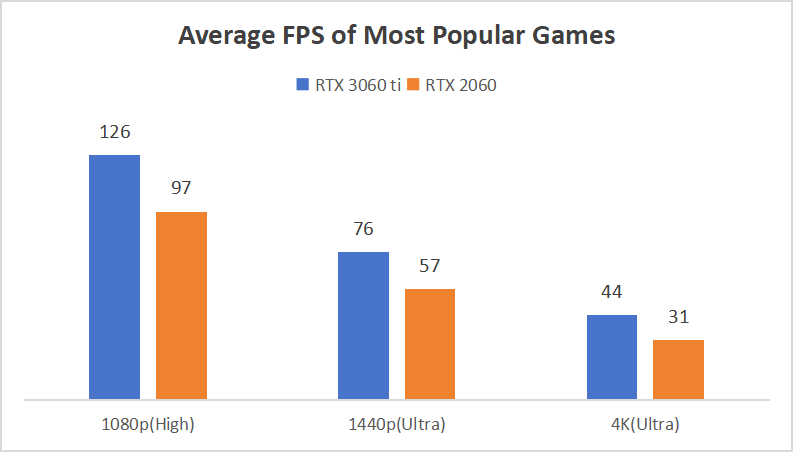
3D Rendering / Content Creation
In the professional 3D industry, GPU rendering performance plays a decisive role in overall workflow efficiency and project delivery speed. With ongoing software optimizations and hardware updates in 2025, the performance gap between different GPUs in major render engines such as V-Ray and Octane has become increasingly evident. As shown in the benchmark chart, the RTX 3060 Ti delivers a significantly higher rendering score than the RTX 2060 across both engines—reaching 695 vs. 236 in V-Ray, and 297 vs. 188 in Octane. These results clearly highlight the generational performance leap and provide valuable guidance for 3D artists, designers, and visualization professionals considering a GPU upgrade.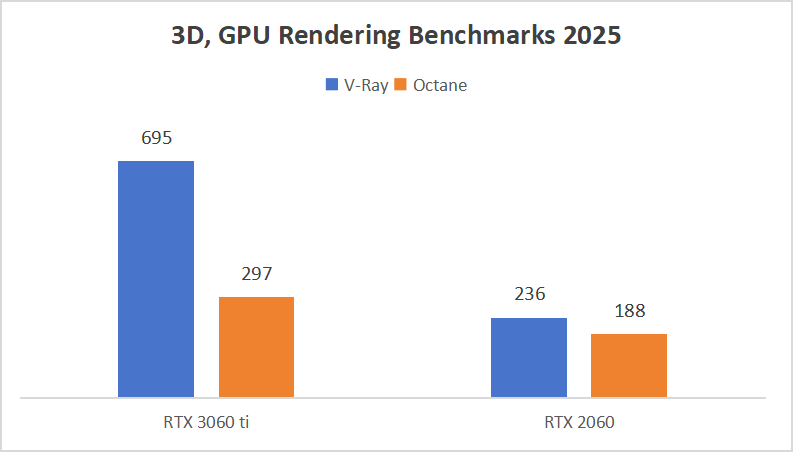
Overall, the benchmark results clearly demonstrate that the RTX 3060 Ti offers a substantial performance advantage over the RTX 2060 in both V-Ray and Octane rendering workloads. With nearly triple the V-Ray score and a strong lead in Octane, the 3060 Ti proves to be a far more capable option for demanding 3D production tasks. For users seeking faster rendering times, smoother workflow efficiency, and better long-term value, the RTX 3060 Ti stands out as the more future-proof and cost-effective choice.
Price & Value: RTX 3060 ti vs RTX 2060
The RTX 3060 Ti vs RTX 2060 comparison reveals a noticeable price gap across major platforms. Based on official MSRP, the RTX 3060 Ti debuted at** $399**, placing it slightly above the RTX 2060’s $349 price point. On eBay, however, the gap becomes inconsistent: the 3060 Ti typically appears around $165–240, while the 2060 ranges more widely from** $179–299**, making the real-world difference dependent on individual listings. Amazon shows an opposite trend, where the 3060 Ti averages around $362, significantly below the $628 often seen for the 2060 during recent market fluctuations.
This 3060 Ti vs 2060 pricing contrast highlights how these two GPUs target different performance tiers while still occupying overlapping market segments in the second-hand space. Although both GPUs are popular options among mid-range buyers, platform-specific pricing and shifting supply conditions introduce substantial variation. For users prioritizing value, the 3060 Ti generally delivers better price-to-performance, while the 2060 only maintains competitiveness when its market price drops into the lower end of its second-hand range.
Price Comparison
The RTX 3060 Ti and RTX 2060 are two popular GPUs from NVIDIA’s previous generations, targeting gamers and creators looking for solid performance at mid-range prices. Comparing their official MSRP and current market prices across platforms like eBay and Amazon reveals interesting differences, showing how supply, demand, and market fluctuations affect affordability. Understanding these price variations can help buyers make informed decisions when upgrading or building a PC.
| Platform / Condition | RTX 3060 Ti | RTX 2060 | Price Difference (USD) | Price Difference (%) |
|---|---|---|---|---|
| Official MSRP | $399 | $349 | $50 | 14.3% |
| eBay | ~$165–240 | ~$179–299 | −$134 – $61 | −74.9% – 34.1% |
| Amazon | ~$362 | ~$628 | −$266 | −42.4% |
User Value-for-Money Feedback
Looking at the data, the RTX 3060 Ti generally offers better value than the RTX 2060 at official MSRP, with a $50 (14%) higher price but significantly stronger performance. However, on secondary markets like eBay and Amazon, prices vary widely. On eBay, the RTX 3060 Ti can be either cheaper or slightly more expensive than the RTX 2060 depending on the listing, while on Amazon, the RTX 3060 Ti is currently much cheaper, offering a price advantage of over $260 (42%). Buyers should consider these variations when deciding between the two GPUs, weighing performance needs against current market prices to find the best deal.
RTX 2060 vs RTX 3060 ti – Pros & Cons
| GPU | Pros | Cons |
|---|---|---|
| RTX 3060 Ti | ✅ Excellent value-for-money for 1080p and 1440p gaming ✅ Lower power consumption, easier to cool ✅ Compact size fits most standard cases ✅ Good performance-per-dollar for mid-range tasks and moderate rendering workloads |
❌ Slightly lower raw FP32 and CUDA performance compared to 3070 ❌ 8GB VRAM may limit very high-resolution gaming or extremely large datasets ❌ Less future-proof for high-end gaming or heavy compute workloads |
| RTX 2060 | ✅ Lower entry-level price ✅ Slightly lower power draw ✅ Can handle less demanding games and esports titles at 1080p |
❌ Significantly lower performance in newer games ❌ Struggles at 1440p+ ❌ Lower ray tracing performance ❌ Older Turing architecture, less efficient and lacks Ampere improvements |
RTX 3060 Ti vs RTX 2060 GPU Hosting
For users or small teams who need flexible GPU resources without investing in physical hardware, GPU hosting provides a convenient and cost-effective solution. Hosted RTX 3060 Ti and RTX 2060 servers allow users to run gaming emulation, AI experiments, content creation, and development workloads remotely, removing the limitations of local systems, power requirements, and hardware availability.
Database Mart offers both RTX 3060 Ti GPU servers and RTX 2060 GPU servers, making it easy for users to access the performance they need without purchasing the physical cards.
RTX 2060 GPU servers are ideal for entry-level tasks and budget-conscious users, handling 1080p gaming, basic AI experiments, and light compute workloads.
RTX 3060 Ti GPU servers are suited for moderate to heavy workloads, including 1440p gaming, more demanding AI projects, and creative tasks requiring higher performance and better ray tracing capabilities.
By choosing hosted GPU servers from Database Mart, users can scale their computing power as needed, access high-performance GPUs instantly, and avoid upfront costs or upgrade limitations.
Conclusion
The RTX 2060 and RTX 3060 Ti are both solid mid-range GPUs, but they serve different needs. The RTX 2060 is best for entry-level tasks, 1080p gaming, and light AI or development workloads, making it ideal for budget-conscious users. The RTX 3060 Ti, with higher performance, more CUDA cores, and better ray tracing capabilities, excels at 1440p gaming, more demanding AI projects, and creative workloads. Choosing between the two depends on your performance requirements and budget, ensuring you get the right GPU for your needs.
3060 Ti vs 2060, 2060 vs 3060 Ti, 3060 Ti price, 2060 price, nvidia geforce rtx 3060 Ti, 2060 gpu, RTX 3060 Ti or RTX 2060, RTX 2060 vs RTX 3060 Ti