


RTX 2060 Super vs 3060: A Complete Comparison of Performance and Value
RTX 2060 Super vs RTX 3060 – Background Comparison
| Brand | Series | Model | Release Year | Official Positioning | Market Price (USD) |
|---|---|---|---|---|---|
| NVIDIA | GeForce | RTX 2060 Super | 2019 | The GeForce RTX™ 2060 Super delivers advanced ray tracing and AI-enhanced graphics powered by NVIDIA Turing. Built for smooth 1080p to 1440p gaming, it offers enhanced performance, real-time ray tracing, and improved power efficiency. | $399 |
| NVIDIA | GeForce | RTX 3060 | 2021 | The GeForce RTX™ 3060 brings next-generation performance with NVIDIA Ampere architecture, delivering faster ray tracing, DLSS acceleration, and improved gaming performance for 1080p and 1440p gamers seeking an attractive balance of value and efficiency. | $329 |
NVIDIA RTX 2060 Super vs RTX 3060 – Specifications Comparison
The RTX 2060 Super vs RTX 3060 comparison reflects a shift in generational positioning. The RTX 2060 Super was released as a higher-tier GPU in the previous generation, offering stronger memory bandwidth and reliable 1440p performance—well suited for classic rendering workflows and older or bandwidth-heavy game engines.
The RTX 3060, meanwhile, represents a new-generation mid-range model built on the Ampere architecture. Its updated Tensor and RT cores deliver noticeably better ray tracing, DLSS acceleration, and greater efficiency in modern titles and AI-enhanced workloads, supported by a larger 12GB VRAM pool.
While the 2060 Super continues to perform well in traditional pipelines, the 3060 benefits from architectural upgrades designed for contemporary gaming and mixed-precision tasks. This means the rtx 2060 super vs rtx 3060 comparison often highlights generational priorities—bandwidth and classic rendering on one side, and AI-driven, modern workloads on the other.
Core Specs Comparison between RTX 2060 Super vs RTX 3060
| Specification | RTX 2060 Super | RTX 3060 |
|---|---|---|
| Architecture | Turing | Ampere |
| CUDA Cores | 2,176 | 3,584 |
| Memory Type | GDDR6 | GDDR6 |
| Memory Capacity | 8 GB | 12 GB |
| Memory Bus | 256-bit | 192-bit |
| Memory Bandwidth | 448 GB/s | 360 GB/s |
| Core Frequency (Boost) | ~1.65 GHz | ~1.78 GHz |
| TDP (Power) | 175 W | 170 W |
| Interface / Bus | PCIe 3.0 x16 | PCIe 4.0 x16 |
| FP32 Performance | ~7.2 TFLOPS | ~12.7 TFLOPS |
| Ray Tracing / Tensor | 1st-gen RT, 1st-gen Tensor | 2nd-gen RT, 3rd-gen Tensor |
| PCIe Version | PCIe 3.0 | PCIe 4.0 |
Key Differences: RTX 2060 Super vs RTX 3060
Architecture (Turing vs Ampere)
The biggest difference comes from the jump from Turing to Ampere. Ampere brings newer-generation Tensor and RT cores, improving ray tracing performance and DLSS efficiency. This makes the RTX 3060 significantly better in modern games and AI-assisted rendering, while the 2060 Super performs more traditionally with less benefit from newer features.
CUDA Core Count & Efficiency
The 3060’s increased CUDA core count doesn’t just mean more cores—it also means better parallel processing efficiency thanks to Ampere’s redesigned SM structure. This results in smoother performance in newer game engines, higher shader throughput, and better handling of complex scenes compared to the 2060 Super’s older architecture.
Memory Capacity (8GB vs 12GB)
The shift from 8GB to 12GB gives the 3060 a major advantage in newer titles with heavy textures, large maps, and AI-based upscaling. Games and applications that exceed 8GB VRAM see fewer stutters and better 1% low performance on the 3060, while the 2060 Super may bottleneck under high-resolution or high-texture workloads.
Memory Bus & Bandwidth Behavior
Although the 2060 Super has higher bandwidth due to its wider bus, Ampere’s improved compression and memory management allow the 3060 to achieve better real-world performance in most modern titles. The 2060 Super benefits older engines, but the 3060 is more optimized for current-generation rendering techniques.
Ray Tracing & DLSS Generation
The 3060 uses newer-generation RT and Tensor cores, allowing much better ray tracing performance and significantly more efficient DLSS upscaling. This gives it a clear edge in visually demanding games, while the 2060 Super struggles more with RT-heavy workloads.
RTX 2060 Super vs RTX 3060 Performance Across Different Scenarios
AI / Deep Learning Performance Comparison
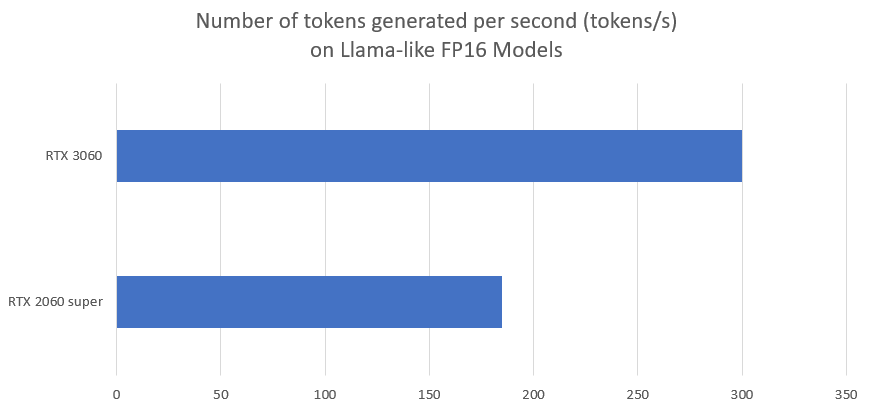
In AI inference, the RTX 3060 is estimated to outperform the RTX 2060 Super by roughly 60–100%, achieving around 200–400 tokens per second versus 120–250 tokens per second. These figures are estimated based on community benchmarks. With larger VRAM and improved CUDA/Tensor cores, the 3060 can handle medium to large models more efficiently, offering smoother generation and higher throughput for sustained workloads.
4K Gaming Performance
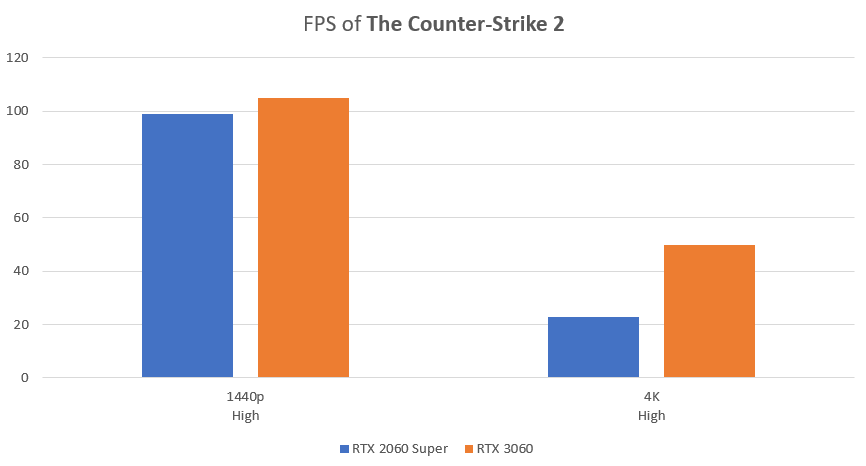
In Counter-Strike 2, a fast-paced competitive shooter featuring dense smoke effects and precise visibility mechanics, GPU performance plays a crucial role in gameplay responsiveness and frame stability. At 1440p High settings, the RTX 2060 Super delivers around 99 FPS, while the RTX 3060 achieves approximately 105 FPS, providing slightly smoother and more consistent performance. Moving up to 4K High, the 2060 Super drops to about 23 FPS, whereas the 3060 maintains a much stronger 50 FPS, highlighting its advantage in handling higher-resolution, graphics-intensive scenarios.
In Fortnite, a fast-paced battle royale game featuring large open maps, dynamic lighting, and intensive particle effects, GPU performance directly impacts frame rates and smooth gameplay. At 1440p Epic settings, the RTX 2060 Super delivers around 98 FPS, while the RTX 3060 reaches approximately 105 FPS, providing slightly smoother performance for competitive play. At 4K Epic, the 2060 Super drops to about 48 FPS, compared to 58 FPS on the 3060, highlighting the 3060’s advantage in handling higher-resolution textures and more demanding visual effects.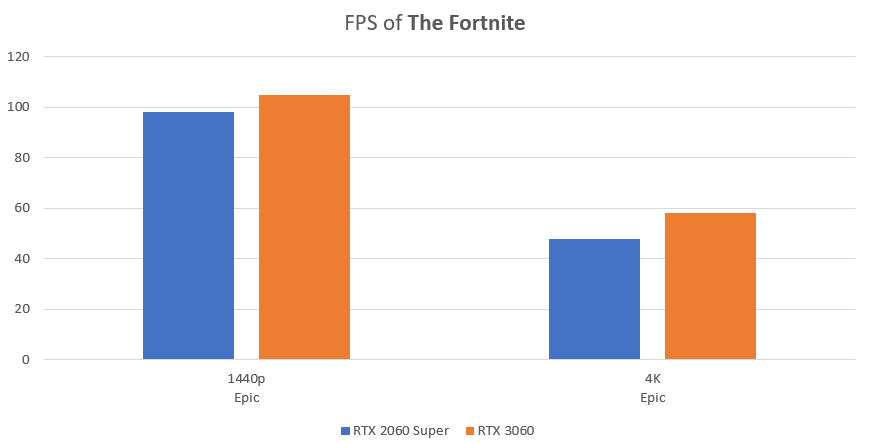
3D Rendering / Content Creation
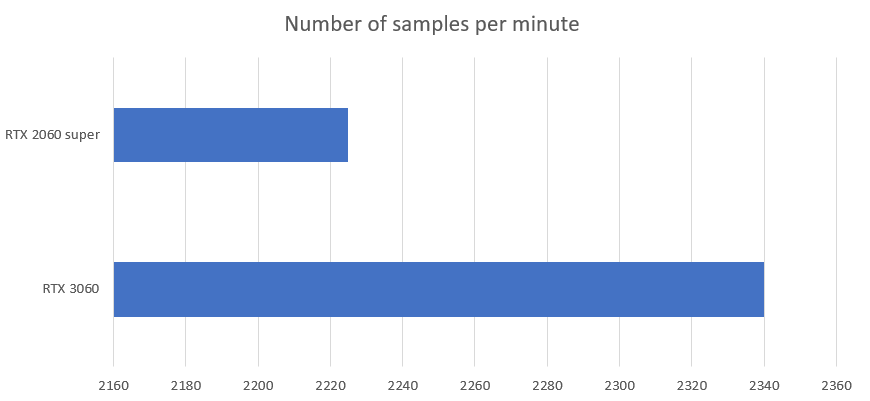
Community benchmarks for Blender Cycles indicate that the RTX 3060 outperforms the RTX 2060 Super, achieving roughly 2,340 vs 2,225 samples per minute. Thanks to its improved architecture and larger VRAM, the 3060 handles complex scenes with high polygon counts and detailed textures more efficiently, providing smoother rendering and slightly faster scene completion for sustained workloads.
Price & Value: RTX 2060 Super vs RTX 3060
Official MSRP — Why the RTX 3060 launched cheaper
The RTX 3060 launched with a lower official MSRP (US $329) than the RTX 2060 Super (US $399) because NVIDIA positioned the 3060 as a new-generation mid-range product while the 2060 Super was a previous-generation upper-mid SKU. Generational improvements in node and yields, plus strategic pricing to capture a broader upgrade market, allowed NVIDIA to set a more aggressive price for the 3060. In short: MSRP reflects product positioning and launch strategy, not a direct one-to-one mapping from raw performance to price.
Second-hand Market — Why used RTX 3060 can trade higher than used 2060 Super
On the secondary market, buyer behavior and demand determine prices more than launch MSRPs. The RTX 3060’s newer Ampere architecture, larger 12GB VRAM, and stronger support for modern features make it more desirable for today’s gamers and creators, which increases demand for used 3060 cards. At the same time, availability patterns affect supply. The result: even though the 3060’s MSRP was lower, higher sustained demand and perceived future-proofing can push its second-hand price above that of many 2060 Super listings.
Price Comparison
| Platform | RTX 2060 Super | RTX 3060 | Price Difference (USD) | Price Difference (%) |
|---|---|---|---|---|
| Official MSRP | $399 | $329 | –$70 | –17.5% |
| eBay | ~$130 | ~$200 | +$70 | +53.8% |
| Amazon | ~$239 | ~$279 | +$40 | +16.7% |
User Value-for-Money Feedback
The RTX 2060 Super vs RTX 3060 comparison receives slightly different but broadly consistent feedback across popular benchmark platforms. On UserBenchmark — where real-world user data is aggregated — the 3060 shows a small lead, with “Effective 3D Gaming GPU Speed” roughly +1% over the 2060 Super.
On Technical.City, the 3060 posts a combined synthetic performance score of 40.71 versus 39.37 for the 2060 Super — about a +3.4% advantage overall.
In practice, this means that while the performance gap is modest, the 3060’s newer architecture, higher VRAM capacity (12 GB vs 8 GB), and Ampere-driven improvements give it a consistent edge in modern workloads and future-oriented titles. For users focused on future-proofing, mixed-precision workloads, or applications that benefit from newer GPU features, the 3060 tends to be a slightly more robust choice.
Conversely, the 2060 Super remains a viable card, and its performance still hovers very close to the 3060 in many real-world scenarios — meaning the difference is often small enough that choice can depend on factors like price, availability, and use case.
RTX 2060 Super vs RTX 3060 – Pros & Cons
| GPU | Pros | Cons |
|---|---|---|
| RTX 2060 Super | ✅ Higher memory bandwidth, beneficial for classic rendering and older game engines ✅ As a previous-generation upper-mid-range card, it still delivers stable 1080p/1440p performance ✅ Strong rasterization in titles optimized for older architectures ✅ Widely available on the used market |
❌ Only 8GB VRAM, limiting for modern AAA titles and AI workloads ❌ Turing RT/Tensor cores are less efficient than Ampere ❌ Higher power consumption and weaker efficiency compared to the RTX 3060 ❌ Falls behind the 3060 in modern engines and AI-assisted applications |
| RTX 3060 | ✅ Ampere architecture offers newer-generation RT and Tensor cores, improving ray tracing, DLSS, and AI performance ✅ Larger 12GB VRAM is more suitable for modern gaming and data-heavy tasks ✅ Better power efficiency, quieter and more stable under sustained load ✅ Stronger performance in modern titles, DLSS, and AI-enhanced workloads |
❌ Lower official MSRP but generally higher used-market prices than the 2060 Super ❌ Fewer CUDA cores can limit gains in older, raster-focused games ❌ Some variants are physically larger, affecting small-case compatibility ❌ Advantages are less noticeable in older engines |
RTX 2060 Super vs RTX 3060 GPU Hosting
When comparing the RTX 2060 Super vs RTX 3060, the difference mainly comes from their generational positioning. The RTX 2060 Super represents the upper-mid tier of its generation, while the RTX 3060 is designed as the newer mid-range option with updated RT/Tensor cores and a more efficient architecture. These design choices affect how each card performs in modern engines, AI-assisted workloads, and ray-traced environments—where the 3060’s improvements offer clear benefits.
Although Database Mart does not currently provide servers equipped with these two specific GPUs, we do offer GPU servers featuring the RTX 2060 and RTX 3060 Ti, covering a broad range of performance tiers and budget levels. Whether you're running AI models, deep learning training, rendering tasks, or general GPU workloads, our scalable configurations deliver consistent performance with 99.9% uptime, flexible deployment options, and 24/7 expert support, allowing you to stay focused on development without worrying about hardware complexity.
Conclusion
Both GPUs remain relevant in 2025, but they serve different priorities:
Choose the RTX 2060 Super if you need stable performance for rasterized games or older engines, and care about memory bandwidth for workloads that benefit from it. Its previous-generation design can still handle many 1080p–1440p titles reliably, especially in scenarios where newer features (e.g. ray tracing, DLSS) are not critical.
Choose the RTX 3060 if you want a GPU better suited for modern workloads — modern game engines, ray tracing, DLSS, and GPU-accelerated tasks. With newer architecture, updated RT/Tensor cores, and larger VRAM, it offers superior performance for contemporary titles, creative workflows, and AI-enhanced applications.
In short, the RTX 2060 Super remains a solid option for traditional rendering and stable performance with legacy workloads, while the RTX 3060 stands out when it comes to modern game performance, ray tracing and future-proof versatility.
2060 super vs 3060, 3060 vs 2060 super, 2060 super price, 3060 price, rtx 3060 price, 3060 gpu, 2060 super gpu, rtx 2060 super vs rtx 3060