


RTX 3060 vs 3050 – Is the RTX 3050 Still Good in 2025?
With the release of the RTX 40 and RTX 50 series, prices for 3000-series GPUs have started to drop, making mid-range cards like the RTX 3050 and RTX 3060 more appealing than ever. These GPUs strike a great balance between performance and price, offering smooth 1080p and even 1440p gaming in 2025.
In this guide, we’ll dive into the RTX 3050 vs RTX 3060 comparison, looking at real-world performance, benchmarks, and value. Whether you’re curious about RTX 3050 benchmark results or the performance gap in 3060 vs 3050, this article will help you decide which card is right for your setup.
Summary of RTX 3050 vs RTX 3060
When the RTX 3050 first launched, it didn’t make a huge impression on many PC gamers, largely because the price was higher than expected for a mid-range card. Today, with prices having dropped, the RTX 3050 still holds its ground and offers solid competition against the RTX 3060. Both cards now represent strong options for 1080p gaming, and even 1440p in the case of the 3060.
Before we dive into detailed benchmarks and comparisons, here’s a clear overview of RTX 3050 vs RTX 3060:
- Shared Strengths: Both support ray tracing, DLSS, and other NVIDIA technologies, bringing advanced graphics features to mid-range builds. They are also power-efficient, making them easy to pair with most systems.
- Value Proposition: Thanks to the release of the RTX 40 and RTX 50 series, 3000-series card prices have dropped, making these GPUs more attractive for gamers looking for good performance without paying a premium.
In short, whether you’re looking at RTX 3050 benchmark numbers or comparing 3060 vs 3050 performance in real-world games, both cards remain compelling options for cost-conscious gamers.
RTX 3050 vs 3060 – Release Background Comparison
| Feature | RTX 3050 | RTX 3060 |
|---|---|---|
| Release Date | January 2021 | February 2021 |
| Launch Price (MSRP) | $249 | $329 |
| TDP / Power Consumption | 130W | 170W |
| VRAM | 8GB GDDR6 | 12GB GDDR6 |
| Positioning | Entry-level mid-range, aimed at budget-conscious gamers | Mainstream mid-range, aimed at gamers seeking higher performance and future-proofing |
From the release background, both the RTX 3050 and RTX 3060 are mid-range 3000-series GPUs that support NVIDIA’s modern features like ray tracing and DLSS, with power consumption and VRAM suitable for most mainstream gaming setups.
Their positioning differs slightly: the RTX 3050 is geared toward budget-conscious gamers, primarily for 1080p gaming, while the RTX 3060 targets the mainstream mid-range segment, offering stronger performance and the ability to handle 1440p games. Comparing 3060 vs 3050 helps highlight which card delivers the best balance of performance and value for today’s gamers.
RTX 3050 vs 3060 Specifications
| Parameter | RTX 3050 (8 GB version) | RTX 3060 (12 GB version) |
|---|---|---|
| Architecture / GPU Model | Ampere (GA106) | Ampere (GA106) |
| CUDA Cores / Shading Units | 2,560 | 3,584 |
| Tensor Cores | 80 | 112 |
| RT Cores | 20 | 28 |
| Memory Type | GDDR6 | GDDR6 |
| Memory Capacity | 8 GB | 12 GB |
| Memory Bus Width | 128‑bit | 192‑bit |
| Memory Bandwidth | 224 GB/s | 360 GB/s |
| Core Clock (Base / Boost) | 1552 MHz / 1777 MHz | 1320 MHz / 1777 MHz |
| TDP / Power Consumption | 130 W | 170 W |
| PCIe Interface | PCIe 4.0 x8 | PCIe 4.0 x16 |
| Theoretical FP32 Performance | ~ 9.1 TFLOPS | ~ 12.74 TFLOPS |
Looking at the specifications of the RTX 3060 and RTX 3050, both cards use the GA106 GPU, yet the performance gap is clear. While the 3050 can handle most games, it falls behind the 3060 in computational power, memory bandwidth, and core count. These differences also explain why each card targets a different type of gamer.
Performance and Core Differences
The RTX 3060 comes with more CUDA cores, Tensor cores, and RT cores, giving it a significant advantage in rendering, ray tracing, and handling complex or high-quality gaming scenarios. The 3050 has fewer cores but is still capable of smooth gameplay at mainstream 1080p settings.Memory and Bandwidth
With 12GB GDDR6 memory, a 192‑bit bus, and 360 GB/s bandwidth, the 3060 handles high-resolution textures and large game assets more efficiently. In comparison, the 3050’s 8GB GDDR6, 128‑bit bus, and 224 GB/s bandwidth are suitable for standard 1080p gaming but may be limiting at 1440p or ultra settings.Power and Positioning
The 3050 has a lower TDP of around 130 W, compared to 3060’s 170 W, making it ideal for budget-conscious or small-form-factor builds. This lower power consumption comes at the cost of reduced performance, making the 3050 better suited for entry-level gamers.
In summary, if you aim for higher resolutions, better visuals, and long-term compatibility with future games, the RTX 3060 is the safer choice. If your focus is 1080p gaming, lower power consumption, and cost efficiency, the RTX 3050 remains a practical option.
RTX 3050 vs RTX 3060: Performance Across Different Scenarios
When comparing RTX 3050 vs RTX 3060, the most important aspect to focus on is their real-world performance gap, especially the results from RTX 3050 benchmark vs RTX 3060 benchmark. To provide a clear and comprehensive understanding of the differences between these two GPUs, this analysis is organized into three key sections: gaming performance, 3DMark synthetic benchmarks, and AI computing capabilities.
Gaming Performanc
The following table shows their performance in Forza Horizon 5 under different settings: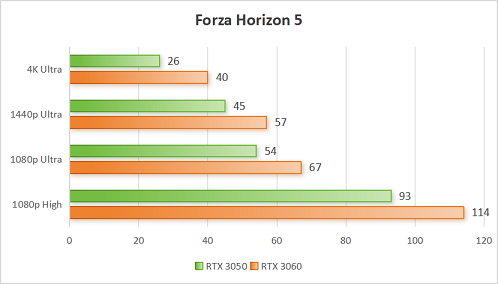
Based on this data, it is clear that the RTX 3060 leads by 20–30% at 1080p and 1440p.At 4K Ultra, the gap expands to 53.8%, indicating that the RTX 3050 struggles significantly at high resolutions.
This already demonstrates that although both GPUs use the GA106 core, the RTX 3060 is built with higher specifications, stronger compute capability, and better memory bandwidth.
To avoid bias toward a single game, we also compare their average FPS across a wider set of workloads: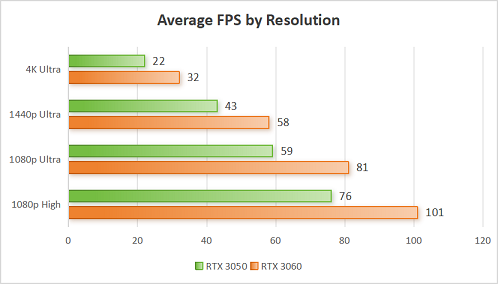
From this broader dataset, the RTX 3060 consistently outperforms the RTX 3050 by 33–46%, an even larger gap than in Forza Horizon 5 alone.
And as resolution increases, this difference becomes more pronounced due to the RTX 3060’s:
- higher CUDA core count
- stronger memory bandwidth
- larger shader throughput
Therefore, we can conclude that the RTX 3050 is more suitable for entry-level 1080p gaming, while the RTX 3060 can comfortably handle 1080p Ultra settings and deliver solid performance at 1440p.
3DMark Synthetic Benchmark Results
To further clarify the real performance gap in RTX 3050 vs RTX 3060, we analyze several key 3DMark benchmarks. These tests focus on GPU compute power, ray tracing capability, and overall graphics throughput, offering another angle beyond the gaming benchmarks shown earlier.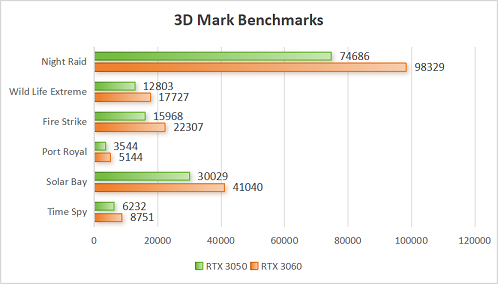
From these synthetic benchmarks, several trends become clear:
1.RTX 3060 is consistently 30–40% faster across core graphics workloads.
- In Time Spy, which evaluates modern DirectX 12 performance, the RTX 3060 leads by 40.4%.
- In Solar Bay, an advanced mobile ray tracing test, the lead is 36.6%.
2.Ray tracing capability shows an even larger gap.
- In Port Royal, the RTX 3060 delivers 45.2% higher performance, highlighting its stronger RT cores compared to the RTX 3050.
3.Traditional rasterized workloads also favor the RTX 3060.
- Fire Strike: +39.7%
- Wild Life Extreme: +38.4%
- Night Raid: +31.7%
These results further confirm what we observed in the gaming benchmarks:
Even though both GPUs share the GA106 architecture, the RTX 3060 benchmark scores place it clearly in a higher performance class.
Artificial Intelligence Tests
Now let’s take a look at the AI benchmarks to further understand how the two GPUs differ in real compute workloads: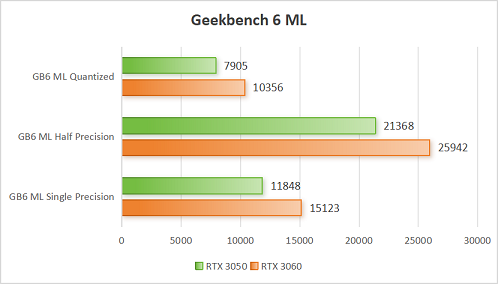
Across all AI benchmarks, the RTX 3060 shows a consistent and decisive lead over the RTX 3050. In Single Precision, Half Precision, and Quantized workloads, the RTX 3060 delivers roughly 25–30% higher performance, confirming that it has noticeably stronger compute capability and better throughput for modern ML tasks.
In practical terms, this means that for anyone comparing rtx 3050 vs rtx 3060 for AI use, the RTX 3060 handles model inference and lightweight training much faster and more efficiently. The RTX 3050 can still manage basic AI workloads, but it clearly falls behind as models grow in size and complexity.
RTX 5070 Ti vs RTX 5080 — User Recommendation & Value Analysis
| GPU Model | MSRP (Official) | Amazon / Official Channel | Third-party / Reseller |
|---|---|---|---|
| RTX 3050 | US $249 | US $190–210 (Amazon) | US $140–160 |
| RTX 3060 | US $329 | US $279–330 (Amazon) | US $200–240 |
Value Summary
Based on the gaming, 3DMark, and AI comparisons above — and taking current prices into account — you should choose according to your needs.
If your budget is tight and you mainly want stable 1080p gaming, esports-level performance, everyday use, or light content creation, the RTX 3050 is a sensible entry-level choice. Its combination of low price, essential features (including RTX support), and relatively low power draw makes it ideal for budget-conscious players who do not demand top-tier visual settings.
If you want a longer service life and stronger performance for gaming, rendering, AI workloads, ray tracing, or higher-resolution play, the RTX 3060 is the safer pick. Although it costs more, the 3060’s performance and versatility usually justify the price.
Geforce RTX 3050 vs 3060 Pros & Cons
| GPU | Pros | Cons |
|---|---|---|
| RTX 3050 | ✅ Low power consumption / easy to pair with smaller PSUs ✅ Budget-friendly, entry-level option ✅ Supports basic RTX / DLSS features ✅ Adequate for 1080p / light gaming |
❌ Lower performance / fewer CUDA, Tensor, RT cores ❌ Limited for high-res / high-quality / demanding games ❌ Less future-proof |
| RTX 3060 | ✅ Strong overall performance / more CUDA, Tensor, RT cores ✅ Handles higher resolution / high-quality settings ✅ Better for 3D rendering, AI, and content creation ✅ Good mid-range value |
❌ Higher power consumption / more heat ❌ More expensive ❌ Overkill for low-res or very light gaming |
Conclusion
After a thorough comparison, it is clear that the performance gap between the RTX 3050 and RTX 3060 ranges from 23% to 35%, with the 3060 showing a more significant advantage at higher resolutions. However, the RTX 3060 is about 32% more expensive than the lower-power RTX 3050, so the final choice largely depends on your specific needs.
Both NVIDIA GPUs are highly regarded mid-range options, enabling gamers to enjoy excellent 1080p gaming experiences. If you are looking for a cost-effective card capable of solid 1080p performance, the RTX 3050 is an excellent entry-level choice. For those who want a more future-proof system capable of handling higher-end games and demanding tasks, the RTX 3060 is undoubtedly the stronger and more versatile option.
3060 ti vs 3070, rtx 3050 vs rtx 3060, rtx 3060 vs 3050, rtx 3050 benchmark, rtx 3060 benchmark, rtx 3060 ti price, 3060 vs 3050, RTX 3050 VS 3060