


RTX 3050 vs 3060 Ti: Which GPU Delivers Better Value and Performance?
The RTX 3050 and RTX 3060 Ti may sit in the same family, but their performance levels are worlds apart. This comparison breaks down gaming FPS, ray tracing, power efficiency, and pricing to reveal why the 3060 Ti remains a top choice for 1080p and 1440p gamers, while the 3050 targets budget-friendly builds. Discover which GPU truly offers the best value for your next upgrade.
RTX 3050 vs RTX 3060 ti – Background Comparison
| Brand | Series | Model | Release Year | Official Positioning | Market Price (USD) |
|---|---|---|---|---|---|
| NVIDIA | GeForce | RTX 3050 | 2022 | The GeForce RTX 3050 is positioned as an entry-level ray-tracing GPU aimed at budget-conscious gamers. Built on the Ampere architecture, it delivers solid 1080p performance, DLSS support, and improved energy efficiency, making it ideal for mainstream gaming and affordable PC builds. | Starting at $249 |
| NVIDIA | GeForce | RTX 3060 ti | 2020 | The GeForce RTX 3060 Ti targets upper-midrange gamers seeking high FPS at 1080p and 1440p. With significantly more CUDA cores and stronger ray tracing and DLSS performance, it offers near-RTX 3070-level output, making it a favorite for gamers and creators who want exceptional performance per dollar. | Starting at $399 |
RTX 3050 8GB vs RTX 3060 ti – Specifications Comparison
This comparison provides a clear technical overview of the NVIDIA RTX 3050 and RTX 3060 Ti, two GPUs built on the same Ampere architecture but positioned at different performance tiers. By examining core specifications such as CUDA cores, memory configuration, FP32 throughput, and power requirements, the table highlights how each card is designed to serve distinct user needs. Overall, the RTX 3060 Ti targets significantly higher performance workloads, while the RTX 3050 offers a more power-efficient entry-level option.
Core Specs Comparison between RTX 3050 8GB vs RTX 3060 ti
| Parameter | RTX 3050 8GB | RTX 3060 TI | Difference / Advantage |
|---|---|---|---|
| Architecture | Ampere | Ampere | Both use the same Ampere architecture, so neither gains an architectural advantage. |
| CUDA Cores | 2,560 | 4,864 | The RTX 3060 Ti has far more CUDA cores, giving it stronger parallel and overall compute performance. |
| Memory Type | GDDR6 | GDDR6 | Both use GDDR6, offering no memory-type advantage. |
| Memory Capacity | 8 GB | 8 GB | Both cards provide the same 8 GB capacity. |
| Memory Bus | 128 bit | 256 bit | The RTX 3060 Ti doubles the bus width, allowing significantly higher data throughput. |
| Memory Bandwidth | 224.0 GB/s | 448.0 GB/s | The RTX 3060 Ti offers much higher bandwidth, improving performance in bandwidth-heavy tasks. |
| Core Frequency (Boost) | 1777 MHz | 1665 MHz | The RTX 3050 has a higher boost clock, but frequency alone doesn’t outweigh the 3060 Ti’s larger core count. |
| TDP (Power) | 130 W | 200 W | The RTX 3050 draws less power and is more energy-efficient overall. |
| Bus Interface | PCIe 4.0 x8 | PCIe 4.0 x16 | The RTX 3060 Ti provides a full x16 interface, offering better potential bandwidth on supporting systems. |
| FP32 Performance | 9.098 TFLOPS | 16.20 TFLOPS | The RTX 3060 Ti delivers much higher FP32 compute performance. |
| Tensor Cores | 3rd Generation | 3rd Generation | Both use the same generation of Tensor cores. |
| PCIe Version | 4.0 | 4.0 | Both GPUs support the same PCIe version. |
Key Differences: RTX 3050 vs RTX 3060 ti
AI & Compute Performance: The RTX 3060 Ti dominates in AI workloads and parallel computing thanks to its 4,864 CUDA cores and 16.20 TFLOPS FP32. It’s ideal for machine learning, video rendering, and simulation tasks. The RTX 3050, while capable, is more suited for entry-level AI projects.
Gaming Performance: For high-resolution gaming, the 3060 Ti’s wider memory bus (256-bit) and higher bandwidth (448 GB/s) deliver smoother frame rates and better texture handling. The 3050’s slightly higher boost clock (1777 MHz) makes it good for lighter, fast-paced games at lower resolutions.
Power & Efficiency: The RTX 3050 consumes less power (130 W vs 200 W), making it a more energy-efficient option for casual gaming or compact builds, while the 3060 Ti trades extra power for raw performance.
Summary: Choose the RTX 3060 Ti if you want top-tier AI and gaming performance. Opt for the RTX 3050 if you value efficiency, moderate gaming, and cost-conscious builds.
Advanced Features & Performance Comparison
| Feature / Parameter | RTX 3060 TI | RTX 3050 | Key Difference / Advantage |
|---|---|---|---|
| Cost-effectiveness Evaluation | 58.59 | 57.28 | RTX 3060 Ti has slightly better cost-effectiveness, offering more performance per dollar spent. |
| Power Efficiency | 18.65 | 17.82 | RTX 3060 Ti is more power-efficient, delivering higher performance for each watt consumed. |
| Synthetic Benchmark Score | 48.54 | 30.14 | RTX 3060 Ti outperforms RTX 3050 by a wide margin in synthetic benchmarks, reflecting stronger overall capabilities. |
| Average FPS (Full HD / 1440p / 4K) | 139/ 77 / 49 | 85−90/ 45−50/ 30−35 | RTX 3060 Ti delivers significantly higher FPS across all resolutions, making it better for high-performance gaming. |
| Cost per Frame ($, 1080p / 1440p / 4K) | 1080p: 2.87 / 1440p: 5.18 / 4K: 8.14 | 1080p: 2.93 / 1440p: 5.53 / 4K: 8.30 | RTX 3060 Ti generally offers lower cost per frame, providing better value for gamers at higher resolutions. |
Note: While both the RTX 3060 Ti and RTX 3050 are capable GPUs for gaming, the 3060 Ti clearly outperforms the 3050 in synthetic benchmarks, average FPS across all resolutions, and power efficiency. This makes it a better choice for gamers seeking high performance and long-term value, especially at 1440p and 4K. The RTX 3050 remains a budget-friendly option for casual gaming or lower-resolution setups.
RTX 3060 ti vs RTX 3050 Performance Across Different Scenarios
Artificial Intelligence Tests
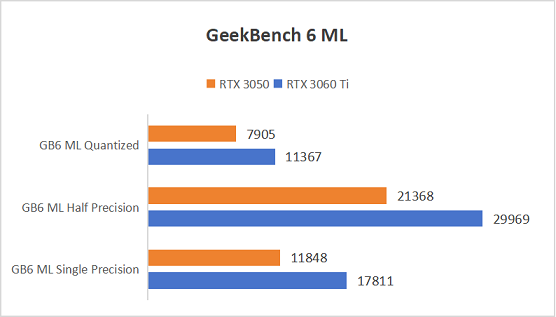
When it comes to AI workloads, GPU performance is crucial for tasks such as deep learning training, machine learning inference, and quantized model processing. Using GeekBench 6 ML benchmarks, we compare the RTX 3060 Ti and RTX 3050 across single precision (FP32), half precision (FP16), and quantized workloads. These metrics reveal how efficiently each card handles AI computations and large-scale neural network operations, helping users determine which GPU better suits their AI development needs.
Summary:
The RTX 3060 Ti consistently outperforms the RTX 3050 across all AI benchmarks. It leads in single precision (17,811 vs 11,848) and half precision (29,969 vs 21,368), making it more suitable for training larger AI models and handling intensive ML tasks. In quantized workloads, the 3060 Ti (11,367 vs 7,905) also shows a clear advantage, indicating faster and more efficient inference performance. Overall, the 3060 Ti is the stronger choice for AI developers and data scientists seeking higher throughput and more robust computational capabilities.
Gaming Performance
When comparing the RTX 3060 Ti and RTX 3050 in gaming performance, frame rates across multiple resolutions provide a clear picture of their capabilities. Higher FPS indicates smoother gameplay, especially at demanding settings like 1440p and 4K Ultra. This comparison highlights which card delivers better performance for gamers seeking high-quality visuals and fluid frame rates.
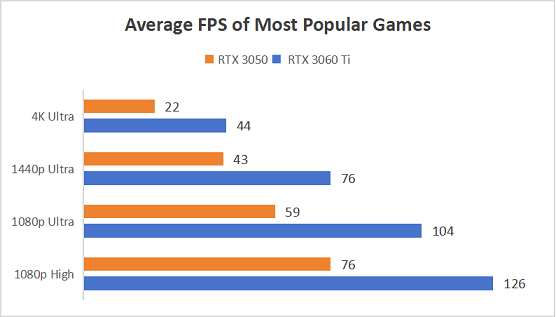
RTX 3060 Ti: Consistently outperforms the RTX 3050, offering 126 FPS at 1080p High, 76 FPS at 1440p Ultra, and 44 FPS at 4K Ultra. Ideal for gamers targeting high settings and smooth gameplay at all resolutions.
RTX 3050: Lower frame rates with 76 FPS at 1080p High, 43 FPS at 1440p Ultra, and 22 FPS at 4K Ultra. Suitable for casual gaming or players willing to compromise on visual settings for performance.
Combined Synthetic Benchmark Score
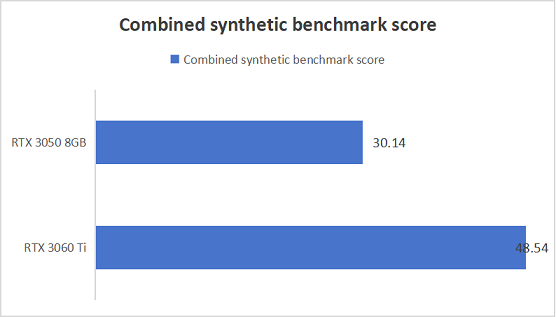
Synthetic benchmarks provide an overall measure of a GPU’s performance across a variety of workloads, including compute, rendering, and general graphics tasks. Comparing the RTX 3060 Ti and RTX 3050 8GB using combined synthetic scores helps evaluate which card delivers stronger all-around performance beyond just gaming.
Summary:
RTX 3060 Ti: Achieves a combined synthetic score of 48.54, outperforming the RTX 3050 by a significant margin. This indicates stronger overall performance in both gaming and productivity tasks.
RTX 3050 8GB: Scores 30.14, showing it is less capable in synthetic workloads. While still suitable for casual gaming and light productivity, it lags behind the 3060 Ti in compute-intensive tasks.
Price Comparison: RTX 3060 ti vs RTX 3050 8GB
The RTX 3060 Ti offers much higher performance across gaming and AI tasks, while the RTX 3050 8GB is more affordable and accessible. Comparing their prices helps users weigh cost against performance.
Price Comparison
| Platform | RTX 3060 TI (USD) | RTX 3050 8GB(USD) | Price Difference (USD) | Price Difference (%) |
|---|---|---|---|---|
| Official MSRP | $399 | $249 | $150 | 60.2% |
| Amazon | $284–$412 | $209–$249 | $75–$163 | 30.1%–65.5% |
| Newegg | $239–$695 | $269–$679 | -$30–$16 | -11.2%–2.4% |
User Value-for-Money Feedback
- RTX 3060 Ti: Superior performance justifies the higher cost for gamers and creators seeking long-term value.
- RTX 3050 8GB: Budget-friendly option, suitable for Full HD gaming and light AI workloads, offering solid value when discounted.
- Overall: Choose 3060 Ti for performance, 3050 for cost efficiency.
RTX 3060 ti vs RTX 3050 – Pros & Cons
| GPU Model | Pros | Cons |
|---|---|---|
| Nvidia GeForce RTX 3060 Ti | ✅ Significantly higher frame rates and overall performance ✅ Excellent for 1440p gaming ✅ Higher TFLOPS, more shading units, and greater memory bandwidth ✅ Better for AI workloads |
❌ Higher price point ❌ Larger card size ❌ Higher power consumption |
| Nvidia GeForce RTX 3050 | ✅ Budget-friendly and lower cost ✅ Great for 1080p gaming and ray tracing at a low price point ✅ Some ITX models available for compact builds |
❌ Significantly lower performance compared to 3060 Ti ❌ Limited overclocking and potential thermal throttling ❌ Can be outperformed by older, less expensive cards |
RTX 3060 ti & RTX 3050 GPU Hosting
The RTX 3060 Ti and RTX 3050 are both popular choices in the mid-range GPU market. The RTX 3060 Ti delivers superior performance for 1440p gaming, AI workloads, and creative applications, while the RTX 3050 offers a budget-friendly option for 1080p gaming and light creative tasks.
For gamers and professionals seeking consistent high performance without being limited by local hardware or stock availability, GPU servers provide an efficient and scalable solution.
DatabaseMart offers RTX 3060 Ti GPU servers capable of handling demanding tasks like AI training, video rendering, and 3D modeling, providing mid-range GPU power with the convenience of remote hosting.
For users on a tighter budget, DBM also provides RTX 2060 GPU servers, which are ideal for 1080p gaming, entry-level AI workloads, and basic creative projects, making them a cost-effective alternative without sacrificing reliability or flexibility.
Conclusion
In conclusion, the RTX 3060 Ti and RTX 3050 cater to different segments of the mid-range GPU market. The RTX 3060 Ti is the clear choice for gamers and creators who demand higher frame rates, stronger AI performance, and robust capabilities for 1440p gaming and content creation. Its higher CUDA cores, memory bandwidth, and overall synthetic benchmark scores make it ideal for resource-intensive workloads, albeit at a higher price and power consumption.
On the other hand, the RTX 3050 8GB remains a solid option for budget-conscious users focused on 1080p gaming and light creative tasks. It delivers respectable performance for its price, consumes less power, and fits well in compact builds, making it perfect for gamers and creators seeking value without breaking the bank.
Ultimately, your choice should hinge on your performance needs and budget. For maximum gaming and AI performance, the 3060 Ti is worth the investment, whereas the 3050 provides a cost-effective, energy-efficient alternative for more casual workloads.
3050 vs 3060 ti, rtx 3050 vs 3060 ti, 3060 ti vs 3050, 3060 ti price, 3060 ti benchmark, rtx 3050 8GB, 3060 ti specs, 3050 price, gpu test