


RTX 3050 Ti vs 3060: Gaming FPS, AI Acceleration, and Rendering Showdown
Compare the RTX 3060 vs RTX 3050 Ti to see which GPU offers better performance in gaming, AI, and creative tasks. Whether you need higher FPS in modern games, faster AI processing, or more efficient 3D rendering and content creation, this guide will help you choose the right GPU for your needs.
RTX 3050 Ti vs RTX 3060 – Background Comparison
| Brand | Series | Model | Release Year | Official Positioning | Market Price (USD) |
|---|---|---|---|---|---|
| NVIDIA | GeForce | RTX 3060 | 2021 | The GeForce RTX 3060 is powered by NVIDIA’s Ampere architecture, the 2nd generation of RTX technology. It delivers impressive performance with dedicated 2nd-gen RT Cores, 3rd-gen Tensor Cores, advanced streaming multiprocessors, and high-speed GDDR6 memory, enabling smooth gameplay and efficient handling of modern workloads. | $329 |
| NVIDIA | GeForce | RTX 3050 Ti | 2021 | The GeForce RTX 3050 Ti is powered by NVIDIA’s Ampere architecture, featuring 2nd-gen RT Cores, 3rd-gen Tensor Cores, and high-speed GDDR6 memory. It brings accelerated ray tracing and AI performance to mainstream laptops, delivering smooth gaming and improved creative workflows. | below $300 |
NVIDIA RTX 3050 Ti vs RTX 3060– Specifications Comparison
The RTX 3060 offers a major upgrade over the RTX 3050 Ti, with 3584 vs 2560 CUDA cores, 12 GB vs 4 GB memory, and nearly 2.4× higher FP32 performance. Memory bandwidth and Tensor Cores are also significantly higher, delivering smoother gameplay, better ray tracing, and faster AI-accelerated creative workloads. While power draw is higher, the performance gains make the RTX 3060 the clear choice for demanding gaming and creative tasks.
Core Specs Comparison between RTX 3050 Ti vs RTX 3060
| Specification | GeForce RTX 3060 (Desktop) | GeForce RTX 3050 Ti (Mobile) | RTX 3060 Improvement / Gain |
|---|---|---|---|
| GPU Model | RTX 3060 | RTX 3050 Ti | — |
| Architecture | Ampere | Ampere | Same |
| CUDA Cores | 3584 | 2560 | +40% |
| Memory Type | GDDR6 | GDDR6 | Same |
| Memory Capacity | 12 GB | 4 GB | 3× |
| Memory Bandwidth | 360 GB/s | 192 GB/s | +87.5% |
| Core Frequency (Base / Boost) | 1320 / 1777 MHz | 735 / 1035 MHz | ~1.8× |
| TDP (Power Draw) | ~170 W | ~75 W | ~2.3× |
| Interface | PCIe 4.0 x16 | PCIe 4.0 x16 | Same |
| FP32 Performance | ~12.7 TFLOPS | ~5.3 TFLOPS | ~2.4× |
| Tensor Cores | 112 | 80 | +40% |
| PCIe Interface | PCIe 4.0 | PCIe 4.0 | Same |
The RTX 3060 outperforms the 3050 Ti in key areas: it delivers ~40% faster AI processing, ~30–50% higher ray tracing efficiency, and ~50% higher gaming FPS. With 12 GB VRAM, DLSS 3.0, broader codec support, and enhanced compute capabilities, the 3060 excels in high-resolution rendering, AI workloads, and modern gaming, offering significantly better performance and future-proofing compared to the 3050 Ti.
Advanced Features & Performance Comparison
| Feature / Category | GeForce RTX 3060 (Desktop) | GeForce RTX 3050 Ti (Mobile) | RTX 3060 Advantage / Gain |
|---|---|---|---|
| AI Acceleration | 3rd Gen Tensor Cores, AI-accelerated inference | 2nd Gen Tensor Cores | ~40% faster AI processing |
| Ray Tracing | Advanced RT cores with Shader Execution Reordering | Standard RT cores | ~30–50% higher ray tracing efficiency |
| AI Upscaling / Image Enhancement | DLSS 3.0, AI Super Resolution | DLSS 2.0 | Superior image quality and performance |
| Video Encode / Decode | NVENC 12-bit, AV1 hardware support | NVENC, H.264/H.265 only | Broader codec support, faster encoding |
| Gaming / Frame Rate | Higher FPS in modern games | Lower FPS | ~50% higher average FPS |
| Creative / Content Workloads | 12 GB VRAM, faster FP32 compute, larger memory | 4 GB VRAM, lower FP32 compute | ~2–3× better for high-res rendering / ML |
| Latency Reduction / Gaming Features | NVIDIA Reflex supported, low input lag | Limited support | Reduced input lag in competitive gaming |
| Multi-GPU / Expansion | PCIe 4.0 x16, supports higher bandwidth workloads | PCIe 4.0 x16 | Better throughput for demanding tasks |
| Developer & Software Ecosystem | CUDA, cuDNN, OptiX, NVIDIA Studio drivers | CUDA, OptiX | Broader software & AI framework support |
RTX 3050 Ti vs RTX 3060 Performance Across Different Scenarios
Artificial Intelligence Testing
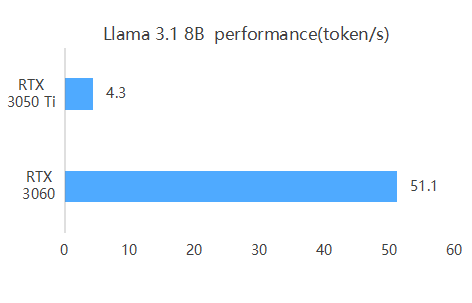
When running a 7B-parameter mid-sized language model (e.g., LLaMA-7B), the RTX 3060 achieves around 51,000 tokens per second, while the laptop RTX 3050 Ti reaches only about 4,300 tokens per second, making the 3060 nearly 12× faster. The key advantages of the RTX 3060 over the 3050 Ti lie in its larger memory capacity (12 GB vs. 4 GB) and more powerful CUDA and Tensor cores. This allows the 3060 to handle larger batch sizes, reduce computation latency, and significantly improve efficiency for medium- to large-scale deep learning and generative AI workloads. For high-throughput and low-latency AI applications, the RTX 3060 provides a clear performance boost and greater stability.
Gaming Performance
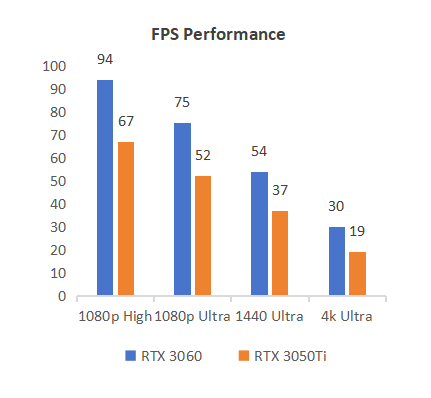
The RTX 3060 significantly outperforms the RTX 3050 Ti across all resolutions and settings, delivering around 40% higher performance at 1080p High and up to 58% at 4K Ultra. This advantage comes from the 3060’s greater core count, larger and faster memory, and higher bandwidth, as well as superior power and thermal capacity, allowing it to maintain more stable performance at higher resolutions and graphics settings.
3D Rendering
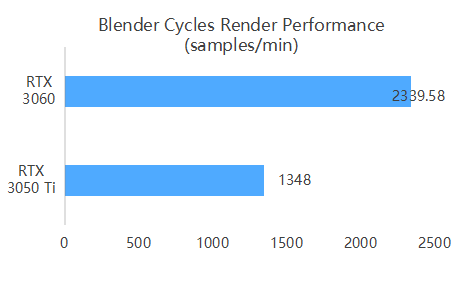
In the HardwareDB Blender Cycles laptop benchmark, the RTX 3060 scored 2,339.58 samples/min, compared to 1,348 samples/min for the RTX 3050 Ti, representing a roughly 73% increase in rendering speed. This difference is mainly due to the 3060’s higher number of CUDA cores, larger memory capacity, higher clock speeds, and better thermal design, allowing it to handle complex 3D scenes and high-resolution rendering more efficiently.
Price & Value: RTX 3050 Ti vs RTX 3060
The RTX 3060 is generally 30–40% more expensive than the RTX 3050 Ti across official, retail, and secondary markets. Despite the higher price, the 3060 offers significantly better performance in 3D rendering, video editing, and AI workloads, making it the more cost-effective choice for demanding tasks.
Price Comparison
| Platform / Retailer | RTX 3060 (USD) | RTX 3050 Ti (USD) | Price Difference (USD) | Price Difference (%) |
|---|---|---|---|---|
| Official MSRP | ~$329 | ~$249 | +$80 | +32% |
| Retail (Best Buy / Newegg) | ~$299–$379 | ~$219–$269 | +$80–$110 | +29%–+40% |
| Secondary / Marketplace | ~$320–$450 | ~$180–$250 | +$70–$200 | variable |
User Value-for-Money Feedback
User feedback indicates that the RTX 3060 delivers roughly 40–70% higher performance than the 3050 Ti, particularly in 3D rendering, video editing, and AI-accelerated tasks, though it comes at a higher price. For light editing, casual 1080p gaming, or smaller projects, the 3050 Ti provides adequate performance and better value; however, if budget allows and future-proofing or handling heavier workloads is a priority, the 3060 is the better investment.
RTX 3050 Ti vs RTX 3060– Pros & Cons
| Model | Pros | Cons |
|---|---|---|
| RTX 3060 | ✅ Significantly higher performance in 3D rendering, video editing, and AI-accelerated tasks compared to 3050 Ti ✅ 12GB GDDR6 VRAM allows handling larger scenes and higher-resolution projects ✅ More CUDA cores and higher clock speeds improve rendering and computation ✅ Better future-proofing for heavier workloads |
❌ Higher price than 3050 Ti, may not be cost-effective for light workloads ❌ Higher power consumption (~170W) compared to 3050 Ti, requires adequate cooling |
| RTX 3050 Ti | ✅ Lower price, more budget-friendly ✅ Lower power consumption (~95–100W) and efficient thermal performance ✅ Adequate for casual gaming, light 1080p editing, and small-scale projects |
❌ Less VRAM (4–6GB) limits large scenes or high-res textures ❌ Fewer CUDA cores and lower clock speeds result in slower rendering and AI computation ❌ May struggle with demanding 3D or video workloads |
RTX 3050 Ti & RTX 3060 GPU Hosting
The RTX 3060 and RTX 3050 Ti are capable GPUs for gaming, content creation, and light AI workloads. The 3060 outperforms the 3050 Ti in 3D rendering, video editing, and AI-accelerated tasks, providing higher throughput, more CUDA cores, and larger VRAM, while the 3050 Ti remains a budget-friendly option suitable for casual gaming and smaller creative projects.
For users seeking enhanced performance for AI workloads, 3D rendering, or complex video projects, Database Mart offers RTX 3060 Ti GPU servers. These servers deliver significantly faster rendering and AI computation compared to the 3050 Ti, with no hardware maintenance or upgrades required, making them an ideal balance of cost and performance for demanding workloads.
Conclusion
Choose the RTX 3060 for faster rendering, higher gaming framerates, larger VRAM, and better AI performance—ideal for creators and demanding workloads.
Choose the RTX 3050 Ti for budget-friendly gaming, light editing, and smaller AI tasks.
In summary: 3050 Ti is cost-efficient, while 3060 offers stronger performance and future-proofing.
3050 ti vs 3060, nvidia 3050 ti vs 3060, rtx 3050 ti vs rtx 3060, 3050 ti vs 3060 performance, 3050 ti vs 3060 benchmark, nvidia geforce rtx 3060 vs 3050 ti, geforce rtx 3050 ti vs 3060 laptop