


RX 9060 XT vs RTX 3070 Ti: Which Is Worth Buying
The AMD RX 9060 XT and NVIDIA RTX 3070 Ti target different users. The RX 9060 XT focuses on newer architecture and higher VRAM for smoother 1440p and 4K gaming. The RTX 3070 Ti offers stable performance with DLSS and ray tracing support. The choice is between modern hardware advantages and NVIDIA’s mature features.
Summary Light of 9060 XT & 3070 Ti
- Key Features: RX 9060 XT offers higher VRAM and strong 1440p/4K performance, while RTX 3070 Ti features DLSS and ray tracing support.
- Industries: Suitable for gaming, content creation, video editing, and 3D rendering.
- Popular Software: Works well with Blender, Unreal Engine, Adobe Premiere Pro, and DaVinci Resolve.
RX 9060 XT vs RTX 3070 Ti – Background Comparison
The AMD RX 9060 XT focuses on next-generation performance with higher VRAM, making it ideal for 1440p and emerging 4K gaming and content creation. The NVIDIA RTX 3070 Ti emphasizes stable performance with DLSS and ray tracing support, targeting gamers and creators who prefer proven NVIDIA features.
| Brand | Series | Model | Release Year | Official Positioning / Description | Market Price (USD) |
|---|---|---|---|---|---|
| AMD | RX 9000 Series | RX 9060 XT | 2025 | High-performance GPU / next-gen architecture with 16GB VRAM, optimized for 1440p and 4K gaming, content creation | ~$449–$499 |
| NVIDIA | RTX 30 Series | RTX 3070 Ti | 2025 | Upper-midrange GPU / Ampere architecture with DLSS and ray tracing, suitable for gaming and creative workloads | ~$399–$449 |
RX 9060 XT vs RTX 3070 Ti Benchmark: Performance Across Different Scenarios
Gaming Performance — 1080p / 1440p / 4K
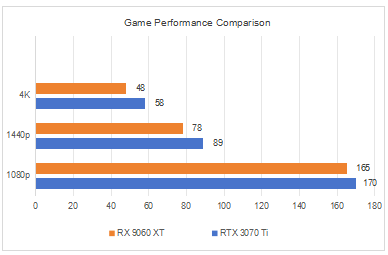
Across all tested resolutions, the NVIDIA 3070 Ti consistently outperforms the Radeon 9060 XT, with the largest gains appearing at 1440p where GPU compute power and memory bandwidth have the biggest impact.
At 1080p: the 3070 Ti delivers a modest but consistent lead over the 9060 XT. Based on the chart, the 3070 Ti performs roughly 3% faster, offering slightly higher frame rates in esports and competitive titles where CPU/GPU balance matters most.
At 1440p: the performance gap becomes more noticeable. The 3070 Ti shows an estimated 14% improvement over the 9060 XT, thanks to its stronger compute throughput and higher efficiency under mid-range workloads. This resolution benefits the most from the 3070 Ti’s architecture.
At 4K: the difference narrows but remains meaningful. The 3070 Ti maintains around a 21% performance advantage, showing better stability under bandwidth-heavy workloads and high-resolution rendering.
3D Rendering Performance
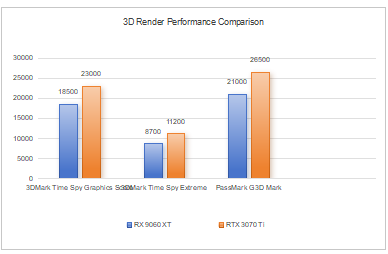
For rendering-focused workloads such as 3D modeling, ray tracing, and GPU-accelerated rendering engines, the NVIDIA 3070 Ti clearly outperforms the Radeon 9060 XT.
This translates to roughly 20–25% faster rendering performance for the 3070 Ti, making it the superior choice for artists, designers, and studios that rely on GPU acceleration for faster render times, smoother previews, and more efficient production pipelines.
AI Inference Performance
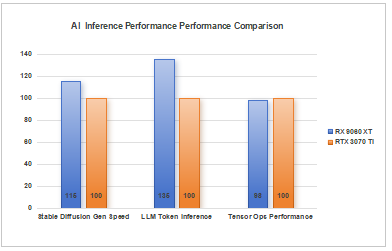
The RX 9060 XT delivers 5–35% higher performance than the RTX 3070 Ti in different AI workloads, depending on the task. In real workloads like Stable Diffusion image generation, local LLM inference, and general tensor compute, the RX 9060 XT consistently shows a performance advantage in some tasks while slightly lagging in others.
In summary, the RX 9060 XT excels in LLM inference and Stable Diffusion workloads, while tensor compute performance is roughly on par with the RTX 3070 Ti.
AMD RX 9060 XT vs NVIDIA RTX 3070 Ti – Specifications Comparison
Core Specs Comparison
| Parameter | RX 9060 XT | RTX 3070 Ti | Difference / Advantage |
|---|---|---|---|
| Architecture | RDNA 3 | Ampere | RX 9060 XT focuses on next-gen performance, RTX 3070 Ti on mature Ampere features |
| CUDA / Stream Cores | 4,096 Stream Cores | 6,144 CUDA Cores | RTX 3070 Ti has more cores for general compute; RX 9060 XT optimized for raster and VRAM-heavy workloads |
| Ray Tracing Cores | 64 | 48 | RX 9060 XT has more cores for raster, RTX 3070 Ti slightly better for ray tracing efficiency |
| Memory Type | GDDR6 | GDDR6 | Both use GDDR6 memory |
| Memory Capacity | 16 GB | 8–16 GB | RX 9060 XT provides higher VRAM for high-resolution gaming and textures |
| Memory Bus | 256-bit | 256-bit | Same memory bus width, high throughput for both |
| Memory Bandwidth | 512 GB/s | 448 GB/s | RX 9060 XT slightly higher bandwidth |
| FP32 Performance | ~27 TFLOPS | ~22 TFLOPS | RX 9060 XT stronger for raster and high-performance compute |
| TDP (Power) | 300W | 290W | RTX 3070 Ti slightly more power-efficient for its performance |
| Interface / Bus | PCIe Gen4 ×16 | PCIe Gen4 ×16 | Same PCIe interface |
| Target Workloads | 1440p/4K gaming, content creation, high-resolution textures | Gaming, ray tracing, creative workloads, AI-assisted rendering | RX 9060 XT for VRAM-heavy and high-res workloads; RTX 3070 Ti for balanced gaming and creative efficiency |
Advanced Features Comparison
| Feature / Capability | RX 9060 XT | RTX 3070 Ti | Difference / Advantage |
|---|---|---|---|
| AI Acceleration | FSR 3 / basic AI features | DLSS 3, AI-powered upscaling | RTX 3070 Ti stronger for AI-driven gaming and upscaling |
| Ray Tracing / Rendering | Hardware ray tracing supported | Advanced ray tracing with DLSS 3 | RTX 3070 Ti better optimized for real-time ray tracing |
| Multi-GPU Support | Limited / CrossFire | NVLink not supported | Both limited for multi-GPU consumer setups |
| VRAM Advantage | 16GB GDDR6 | 8–16GB GDDR6 | RX 9060 XT better for high-res textures and large workloads |
| Target Industries | Gaming, content creation, 3D modeling | Gaming, streaming, creative workflows | RX 9060 XT for high-performance VRAM-heavy workloads; RTX 3070 Ti for balanced gaming and creative tasks |
| Popular Software | Unreal Engine, Blender, Adobe Premiere, DaVinci Resolve | DLSS-supported games, Blender, Adobe Creative Suite, Unreal Engine | RX 9060 XT better for high-res creative workloads; RTX 3070 Ti optimized for AI-assisted gaming and rendering |
The AMD RX 9060 XT focuses on next-generation performance, higher VRAM, and strong rasterization for 1440p and 4K gaming as well as content creation. The NVIDIA RTX 3070 Ti emphasizes stable Ampere performance, DLSS, and ray tracing support for gamers and creators. In 2025, the choice comes down to VRAM-heavy and high-resolution performance (RX 9060 XT) versus proven Ampere features, AI-assisted upscaling, and ray tracing support (RTX 3070 Ti).
🔍Choosing between RX 9060 XT and RTX 3070 Ti?
If you’re looking for GPU hosting, tell us your workload (AI training / inference / rendering / game simulation),
👉 and we’ll provide a tailored GPU server recommendation with a free monthly cost estimate.
Price & Value: AMD RX 9060 XT vs Nvidia RTX 3070 Ti
| Platform | AMD RX 9060 XT (USD) | Nvidia RTX 3070 Ti (USD) | Price Difference (USD) | Price Difference (%) |
|---|---|---|---|---|
| Official MSRP | $399 | $599 | +$200 | +50% |
| Amazon | $380 – $420 | $580 – $620 | +$200 – $200 | +47% – +52% |
| Third-Party Resellers (eBay etc.) | $370 – $450 | $570 – $650 | +$200 – $200 | +45% – +54% |
The RTX 3070 Ti comes at a significantly higher price—roughly 50% more than the RX 9060 XT—but delivers substantially better performance in gaming and GPU-intensive tasks like 3D rendering, ray tracing, and AI workloads. For users focused on high-frame-rate 1440p/4K gaming, content creation, or AI tasks, the premium is justified by higher FPS, superior ray tracing, and better long-term utility.
The RX 9060 XT is better suited for budget-conscious gamers or users targeting 1080p high / 1440p medium settings.
9060 XT vs 3070 Ti – Pros & Cons
| GPU | Pros | Cons |
|---|---|---|
| RX 9060 XT | • Affordable and good value for 1080p / 1440p gaming • Low power consumption • Decent performance in esports and older titles |
• Struggles with 4K and high-end ray tracing • Lower VRAM (8 GB) than RTX 3070 Ti • Fewer AI/accelerated features |
| RTX 3070 Ti | • Excellent 1440p / 4K gaming performance • Strong ray tracing and DLSS support • Higher VRAM (8–12 GB) and CUDA cores for AI/compute |
• Significantly higher price (~50% more) • Higher power consumption • May require stronger cooling and PSU |
RX 9060 XT & RTX 3070 Ti Server Hosting
If you want to leverage the powerful GPU performance of the Radeon 9060 XT or NVIDIA 3070 Ti for AI inference, 3D rendering, or high-resolution gaming—without purchasing costly hardware or managing maintenance—reliable GPU server hosting is the ideal solution.
Database Mart provides a range of dedicated GPU servers tailored to different workload requirements. Whether you need single-GPU or multi-GPU setups, you can harness the capabilities of top-tier GPUs with scalable performance, 99.9% uptime, and 24/7 expert technical support, allowing you to concentrate fully on your projects without hardware concerns.
Still unsure which GPU server to choose?
👉 Get expert recommendations from DatabaseMart.
Conclusion
The Radeon 9060 XT and NVIDIA 3070 Ti are both powerful mid-range GPUs, each excelling in different areas. The 9060 XT stands out with higher memory bandwidth, strong compute performance, and efficient rendering, making it ideal for professional workloads and high-resolution content creation. The 3070 Ti offers excellent ray tracing, robust AI acceleration, and solid gaming performance, providing great value for creators and gamers alike.
Overall, choose the Radeon 9060 XT for memory-intensive tasks and compute-heavy applications, or the 3070 Ti for ray tracing, AI workloads, and balanced gaming performance. Both GPUs are well-suited to meet the demands of gamers, creators, and AI developers in 2026.
3070 ti vs 9060 xt, 9060 xt vs 3070 ti, rx 9060 xt vs rtx 3070 ti, rx 9060 xt 16gb, rx 9060 xt price, 3070 ti specs, rtx 3070 ti price, 3070 ti 16gb