


RTX 3080 vs 4080: Which GPU Delivers Ultimate Gaming and Creative Performance?
Step into the definitive NVIDIA GPU showdown. Compare the RTX 3080 and 4080 for 4K gaming, high-frame-rate esports, and content creation workflows. Explore detailed specs, benchmark results, power efficiency, and pricing to help you choose the perfect GPU for every high-performance task, from epic gaming sessions to professional creative projects.
Summary Light of RTX 3080 & 4080
NVIDIA’s RTX 3080 and 4080 are high-performance graphics cards from their respective generations. While both excel in high-end gaming, they also offer capabilities that make them suitable for content creation and professional workloads.
Key Features: The RTX 3080 and 4080 are high-end NVIDIA graphics cards designed for superior performance. Both offer advanced 4K gaming capabilities, real-time ray tracing, and support for NVIDIA’s latest technologies like DLSS. The 4080 provides higher performance, improved power efficiency, and additional creative enhancements compared to the 3080.
Industries: These GPUs are primarily targeted at the gaming and digital content creation industries. They are ideal for high-frame-rate gaming, video editing, 3D rendering, and other performance-intensive tasks where visual quality and speed are crucial.
Popular Software: The 3080 and 4080 are widely used with popular gaming titles like Cyberpunk 2077, Call of Duty, and Fortnite, as well as creative software such as Adobe Premiere Pro, Blender, and Autodesk Maya. Their performance also benefits applications that utilize GPU acceleration for rendering and simulation.
RTX 3080 vs 4080 – Background Comparison
| Model | Brand | Series / Architecture | Release Year | Official Positioning (2025 view) | Approx. Current Price (2025) |
|---|---|---|---|---|---|
| RTX 3080 | NVIDIA | RTX 30-series / Ampere (GA102) | 2020 | High-end gaming card, designed for 4K gaming, high-frame-rate esports, and mainstream content creation | ~ US$600–700 |
| RTX 4080 | NVIDIA | RTX 40-series / Ada Lovelace (AD103) | 2022 | High-end gaming and creative workloads, improved performance, efficiency, and support for advanced features like DLSS 3 | ~ US$1,300–1,500 |
RTX 3080 vs 4080 – Specification Comparison
Core Specs: 3080 vs 4080
| Parameter | RTX 3080 | RTX 4080 | Difference / Advantage |
|---|---|---|---|
| Architecture | Ampere (GA102) | Ada Lovelace (AD103) | 4080 uses next-gen Ada Lovelace architecture, offering higher efficiency and advanced features |
| CUDA Cores | 8,704 | 9,728 | 4080 has ~12% more cores, improving parallel processing performance |
| Memory Type | GDDR6X | GDDR6X | Same memory type, but 4080 operates at higher frequency for better bandwidth efficiency |
| Memory Capacity (vRAM) | 10 GB | 16 GB | 4080 has 60% more VRAM, ideal for 4K gaming and professional content creation |
| Memory Bus | 320-bit | 256-bit | 3080 has wider bus, but 4080’s faster memory achieves higher effective bandwidth |
| Memory Bandwidth | 760 GB/s | 716 GB/s | Despite narrower bus, 4080 bandwidth efficiency is higher due to faster memory (effective throughput similar) |
| Core Frequency (Boost) | 1.71 GHz | 2.51 GHz | 4080 has ~ 47% higher boost frequency, improving single-core performance |
| TDP (Power) | 320 W | 320 W | Similar power consumption, but 4080 offers higher performance per watt |
| Interface / Bus | PCIe 4.0 x16 | PCIe 4.0 x16 | Same interface and compatibility |
| FP32 Performance | 29.77 TFLOPS | 49.07 TFLOPS | 4080 offers ~ 65% higher FP32 performance |
| Ray Tracing / Tensor Cores | 68 RT / 272 Tensor | 76 RT / 304 Tensor | 4080 has ~12% more RT cores and 12% more Tensor cores, improving ray tracing and AI tasks |
| PCIe Version | PCIe 4.0 | PCIe 4.0 | Same PCIe version |
Based on the 3080 specs, the RTX 3080 remains a capable high-end gaming GPU, but the RTX 4080 specs show clear generational improvements. The RTX 4080 delivers 12% more CUDA cores and 60% more VRAM, making it better suited for 4K gaming and content creation. Boost clock speeds are around 47% higher, while FP32 performance improves by approximately 65%, all while maintaining a similar 320 W TDP for better performance per watt.
More Specs: 4080 vs 3080
| Parameter | RTX 3080 | RTX 4080 | Difference / Advantage |
|---|---|---|---|
| Manufacturing Process | Samsung 8nm | TSMC 4nm | RTX 4080 uses a much smaller node, enabling higher efficiency and performance |
| DLSS Support | DLSS 2 | DLSS 3 (Frame Generation) | RTX 4080 supports DLSS 3, delivering higher frame rates in supported games |
| Video Encoder (NVENC) | 7th Gen NVENC | 8th Gen NVENC with AV1 | RTX 4080 supports AV1 encoding, improving streaming and video quality |
| Display Output | DisplayPort 1.4a, HDMI 2.1 | DisplayPort 1.4a, HDMI 2.1a | RTX 4080 adds HDMI 2.1a for newer high-refresh displays |
| Power Connector | Dual 8-pin (varies by model) | 16-pin (12VHPWR) | RTX 4080 adopts a newer power standard |
While core performance defines the RTX 3080 vs 4080 comparison, these additional specifications highlight key generational upgrades. The RTX 4080 benefits from a smaller 4nm manufacturing process, improved DLSS 3 support for higher frame rates, and AV1 encoding for better streaming and video workflows. HDMI 2.1a and the newer power connector further reflect its focus on modern platforms and long-term compatibility, giving the RTX 4080 an edge beyond raw specs.
RTX 3080 vs 4080 Benchmark: Performance Across Different Scenarios
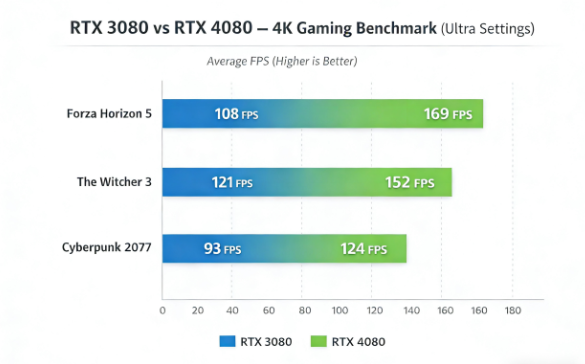
4K FPS Comparison in Specific Games
Based on real-world benchmarks, the RTX 4080 delivers significantly higher native 4K Ultra performance compared to the RTX 3080 across three popular games. It achieves approximately 56% higher FPS in Forza Horizon 5, 26% higher FPS in The Witcher 3, and 33% higher FPS in Cyberpunk 2077, highlighting its clear advantage in 4K gaming with smoother and more consistent frame rates in demanding titles.
Ray Tracing 4K Benchmark
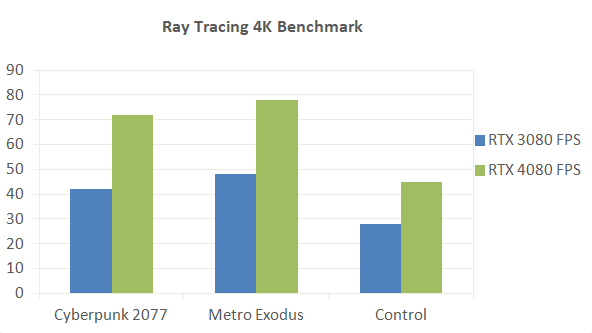
In practical 4K ray tracing tests, the RTX 4080 demonstrates a substantial performance advantage over the RTX 3080. It delivers approximately 61% higher FPS in Cyberpunk 2077, 48% higher FPS in Metro Exodus, and 49% higher FPS in Control, highlighting its superior ability to handle modern ray tracing games at high settings.
Content Creation / Rendering Performance
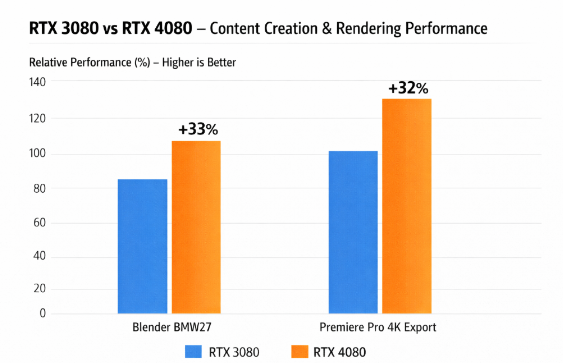
In relative content creation benchmarks, the RTX 4080 significantly outperforms the RTX 3080. In Blender BMW27 rendering, it completes the task approximately 33% faster, while in 4K video export using Premiere Pro, it achieves around 32% faster performance. These results demonstrate the RTX 4080’s clear advantage for creators, enabling faster workflows and more efficient handling of demanding rendering tasks.
Price & Value: RTX 3080 vs 4080
| Platform | RTX 3080 (USD) | RTX 4080 (USD) | Price Difference (USD) | Price Difference (%) |
|---|---|---|---|---|
| Original MSRP | $699 | $1,199 | $500 | 71% |
| Amazon (Used / Renewed) | $550 – $750 | $1,050 – $1,250 | $500 – $500 | 67% – 90% |
| Third-Party Resellers (eBay etc.) | $500 – $780 | $1,000 – $1,300 | $500 – $520 | 64% – 75% |
Considering the 3080 price, the RTX 4080 commands a significant premium across all platforms. Its MSRP is 71% higher, while used and third-party prices show similar gaps ranging from 64% to 90%. Buyers should weigh the substantial performance gains in 4K gaming, ray tracing, and content creation against this higher cost to decide which GPU offers the best value for their needs.
RTX 3080 vs 4080 appears – Pros & Cons
| GPU | Pros | Cons |
|---|---|---|
| RTX 3080 | - Excellent 4K and 1440p gaming performance - Good GPU rendering and video export times for creators - More affordable than newer high-end GPUs - Lower power requirement than RTX 4080 |
- Slower than RTX 4080 in ray tracing and demanding 4K titles - Lacks DLSS 3 and AV1 NVENC - Less future-proof than newer architecture |
| RTX 4080 | - Superior 4K gaming and ray tracing performance - Faster rendering and GPU-accelerated workflows for creators - Supports DLSS 3 and AV1 NVENC - HDMI 2.1a and modern power connector support |
- High MSRP and used/third-party prices (64–90% more than 3080) - Higher power consumption and larger cooling requirements - Overkill for 1080p/1440p gamers |
RTX 4080 & 3080 Server Hosting
“RTX 3080 & 4080 hosting” refers to servers or cloud instances equipped with these high-end GPUs, allowing users to access powerful hardware remotely without the upfront cost or maintenance of buying a physical GPU. Database Mart offers high-performance GPU servers, featuring a range of NVIDIA GPUs, with 99.9% uptime, multiple CPU cores, and fast SSD storage, providing stable performance for 4K gaming, content creation, GPU rendering, streaming, and other demanding workloads. Still unsure which GPU server fits your needs?
👉 Get expert recommendations from DatabaseMart.
Conclusion
Overall, the RTX 3080 offers excellent performance for high-end gaming and content creation at a more accessible 3080 price, making it a solid choice for most gamers and creators. The RTX 4080, however, delivers substantial improvements in 4K gaming, ray tracing, and rendering workflows, along with modern features like DLSS 3 and AV1 NVENC, making it ideal for those who need the best performance and future-proofing. Ultimately, the choice between these GPUs depends on your performance requirements, budget, and intended use.
rtx 3080 vs 4080, 3080 vs 4080, rtx 3080 vs 4080, 4080 vs 3080, rtx 3080 price,3080 specs, 3080 price, rtx 4080 specs, 4080 benchmark, Best GPU for 4K gaming