


RTX 3080 Ti vs RTX 4060: Performance, Price, and Specs Comparison
Summary Light of RTX 3080 Ti & RTX 4060
Key Features: The RTX 3080 Ti is a high-end Ampere-based GPU offering powerful ray tracing, AI acceleration, and strong performance for 4K gaming and demanding creative workloads.The RTX 4060 is a power-efficient Ada Lovelace GPU designed for smooth 1080p gaming, modern AI features like DLSS 3, and everyday creative tasks.
Industries: It is widely used in AAA gaming, professional content creation, 3D rendering, video production, and AI development environments.It is well suited for mainstream gaming, streaming, small creative studios, education, and entry-level AI or software development.
Popular Software: Commonly paired with Unreal Engine, Blender, Maya, Adobe Premiere Pro, DaVinci Resolve, and AI frameworks such as TensorFlow and PyTorch.Frequently used with Unity, Blender, Adobe Premiere Pro, OBS Studio, NVIDIA Broadcast, and other mainstream creation and development tools.
RTX 3080 Ti vs RTX 4060 – Background Comparison
| Brand | Series | Model | Release Year | Official Positioning | Market Price (USD) |
|---|---|---|---|---|---|
| NVIDIA | GeForce | RTX 3080 Ti | 2021 | The GeForce RTXTM 3080 Ti graphics cards deliver the performance that gamers crave, powered by Ampere—NVIDIA’s 2nd gen RTX architecture. It is built with dedicated 2nd gen RT Cores and 3rd gen Tensor Cores, streaming multiprocessors, and G6X memory for an amazing gaming experience. | $1,199 |
| NVIDIA | GeForce | RTX 4060 | 2023 | As an entry-level to mainstream GPU for the Ada Lovelace architecture, targeting high-performance, efficient 1080p gaming, streaming, and content creation, offering access to features like DLSS 3 Frame Generation at an accessible price point . | $299 |
NVIDIA RTX 3080 Ti vs RTX 4060– Specifications Comparison
RTX 3080 Ti is a high-end GPU with far more cores, wider memory bus, and much higher memory bandwidth, making it superior for 4K gaming, heavy graphics tasks, and content creation.
RTX 4060 is a mid-range, power-efficient card with newer architecture and strong AI/DLSS feature support, ideal for mainstream 1080p gaming.
Both support modern NVIDIA features like ray tracing, DLSS, and hardware encoding/decoding, but the 3080 Ti emphasizes raw performance, while the 4060 focuses on efficiency and value.
Core Specs Comparison between RTX 3080 Ti vs RTX 4060
| Specification | RTX 3080 Ti | RTX 4060 |
|---|---|---|
| Architecture | Ampere | Ada Lovelace |
| CUDA Cores | 10240 | 3072 |
| Base Clock | ~1.37 GHz | ~1.83 GHz |
| Boost Clock | ~1.67 GHz | ~2.46 GHz |
| Memory Size | 12 GB GDDR6X | 8 GB GDDR6 |
| Memory Bus Width | 384-bit | 128-bit |
| Memory Bandwidth | ~912 GB/s | ~272 GB/s |
| Tensor Cores | 3rd-gen | 4th-gen |
| RT Cores (Ray Tracing) | 2nd-gen | 3rd-gen |
| PCI Express | PCIe 4.0 x16 | PCIe 4.0 x8 |
| TDP / Power | ~350 W | ~115 W |
| Target Use | High-end gaming, 1440p/4K & professional workloads | Mainstream 1080p gaming & efficient everyday use |
Key Differences: RTX 3080 Ti vs RTX 4060
Performance vs Efficiency: RTX 3080 Ti delivers significantly higher raw performance with far more CUDA cores and memory bandwidth, while RTX 4060 focuses on power efficiency and performance per watt.
Architecture Generation: RTX 3080 Ti is based on the older Ampere architecture, whereas RTX 4060 uses the newer Ada Lovelace architecture with more advanced RT and Tensor cores.
Memory Capability: RTX 3080 Ti features 12GB GDDR6X memory with a 384-bit bus, offering much higher bandwidth than the 8GB GDDR6 and 128-bit bus on RTX 4060.
Power Consumption: RTX 3080 Ti has a much higher power draw (around 350W), while RTX 4060 operates at roughly 115W, making it easier to cool and cheaper to run.
Target Resolution: RTX 3080 Ti is designed for high-end 1440p and 4K gaming or professional workloads, whereas RTX 4060 is officially positioned for mainstream 1080p gaming and everyday creative tasks.
Feature Emphasis: RTX 4060 benefits from newer features such as DLSS 3 and Frame Generation, while RTX 3080 Ti relies on stronger brute-force performance to achieve high frame rates.
RTX 3080 Ti vs RTX 4060 Performance Across Different Scenarios
Gaming Performance
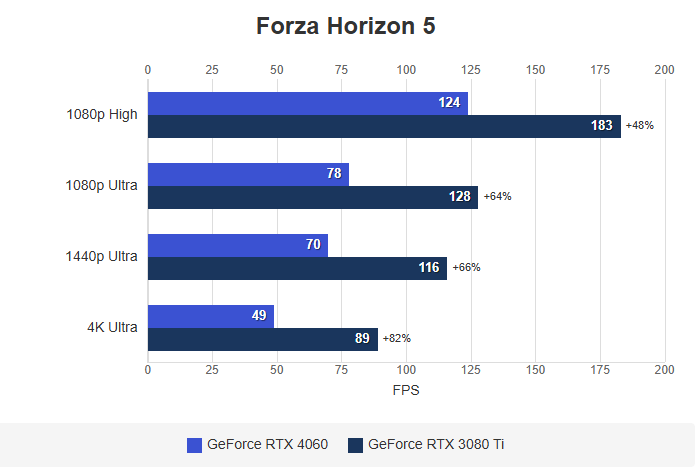
The chart compares gaming performance between the GeForce RTX 4060 and GeForce RTX 3080 Ti in Forza Horizon 5 across multiple resolutions and graphics presets. At 1080p High, the RTX 3080 Ti reaches 183 FPS, outperforming the RTX 4060’s 124 FPS by approximately 48%. The performance gap widens at higher settings, with the RTX 3080 Ti delivering 128 FPS vs 78 FPS (+64%) at 1080p Ultra and 116 FPS vs 70 FPS (+66%) at 1440p Ultra. At 4K Ultra, the RTX 3080 Ti maintains a strong lead with 89 FPS, compared to 49 FPS on the RTX 4060, resulting in an 82% performance advantage. Overall, the results highlight the RTX 3080 Ti’s superior raw performance and scalability at higher resolutions, while the RTX 4060 remains suitable for smooth 1080p gaming but shows limitations at 1440p and 4K.
Ray Tracing & DLSS
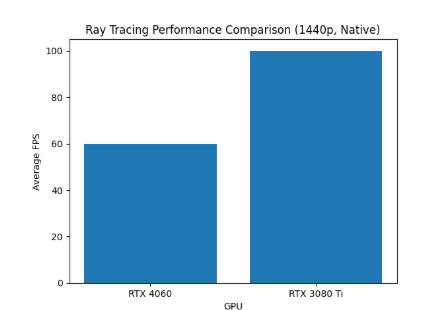
The average frame rates of the two graphics cards in native 1440p Ray Tracing scenarios show that the RTX 3080 Ti achieves approximately 100 FPS, while the RTX 4060 achieves approximately 60 FPS, demonstrating that the RTX 3080 Ti has about a 65% performance advantage in ray tracing. This intuitively reflects the RTX 3080 Ti's stronger native computing power under high-resolution, heavy ray tracing workloads, while the RTX 4060 is more suitable for mainstream resolution use cases that rely on DLSS technology.
Price & Value: RTX 3080 Ti vs RTX 4060
Price Positioning
The RTX 3080 Ti launched as a high-end flagship GPU with an original MSRP around $1,199. In today’s market, it is mainly available through remaining stock or the second-hand market, where prices typically range from $500 to $800+, depending on condition and brand.
The RTX 4060, by contrast, is positioned as a mainstream, value-oriented GPU. Its official MSRP is $299, and real-world prices usually fall between $270 and $350, making it significantly more affordable and easier to justify for most users.
Value for Money
From a pure performance-per-dollar perspective, the RTX 4060 offers much stronger value. While it delivers lower raw performance than the RTX 3080 Ti, the price difference is large enough that the RTX 4060 often achieves better efficiency per dollar spent—especially at 1080p and 1440p resolutions.
The RTX 3080 Ti, however, still provides substantially higher overall performance, wider memory bandwidth, and stronger results in 4K gaming, heavy rendering, and professional workloads. Its value improves only if you can find it at a significantly discounted price.
Power Efficiency & Long-Term Costs
Another factor in value is power consumption.
- RTX 3080 Ti draws much more power, often requiring a stronger PSU and generating higher long-term electricity costs.
- RTX 4060 is extremely power-efficient, which lowers system requirements and ongoing operating costs.
For users building a new system or upgrading an older PC, the RTX 4060’s lower power draw adds meaningful long-term value.
Overall Value Verdict
- RTX 4060: Better choice for budget-conscious users, offering excellent price-to-performance, low power consumption, and strong performance for modern 1080p and 1440p gaming.
- RTX 3080 Ti: Better choice for users who prioritize raw performance over cost, especially for 4K gaming or demanding creative workloads—but its value depends heavily on finding the right price.
Price Comparison
| Platform | RTX 3080 Ti | RTX 4060 | Price Difference (USD) | Price Difference (%) |
|---|---|---|---|---|
| Official MSRP | $1,199 | $299 | $900 | 301% |
| eBay (Used / Mixed) | $420 | $230 | $190 | 83% |
| Amazon (New) | $965 | $299 | $666 | 223% |
RTX 3080 Ti vs RTX 4060 – Pros & Cons
| GPU | Pros | Cons |
|---|---|---|
| RTX 3080 Ti | ✅ Higher memory bandwidth and wider bus, giving it an edge in bandwidth-heavy and classic rasterization workloads ✅ Still delivers strong 1440p and capable 4K performance in many traditional titles ✅ Well-suited for rendering pipelines and older engines that favor raw throughput ✅ Widely available on the used market, often with negotiable 3080 ti price |
❌ Very high power consumption and lower efficiency compared to newer GPUs ❌ 12GB VRAM can feel limiting in modern AAA titles and AI workloads ❌ Older Ampere RT/Tensor cores lag behind Ada in ray tracing and AI efficiency ❌ Original MSRP was high, reducing value outside the used market |
| RTX 4060 | ✅ Excellent power efficiency and low operating costs ✅ Ada Lovelace architecture delivers stronger ray tracing and DLSS 3 / Frame Generation support ✅ More affordable pricing makes it highly competitive in the mainstream segment ✅ Ideal for 1080p and 1440p gaming, compact builds, and quieter systems |
❌ Narrow 128-bit memory bus limits bandwidth in demanding scenarios ❌ 8GB VRAM can become a bottleneck in newer AAA games and content creation tasks ❌ Noticeably weaker raw rasterization performance compared to RTX 3080 Ti ❌ Not well suited for native 4K gaming without heavy upscaling |
RTX 3080 Ti vs RTX 4060 GPU Hosting
When it comes to GPU hosting, the choice between RTX 3080 Ti and RTX 4060 depends largely on workload type, performance requirements, and cost efficiency.
The RTX 3080 Ti GPU hosting solution is better suited for users who need high raw compute power, wide memory bandwidth, and strong rasterization performance. It performs well in tasks such as 3D rendering, video processing, traditional game servers, and bandwidth-heavy workloads. However, its higher power consumption and operational cost make it less ideal for long-running, efficiency-focused deployments unless performance is the top priority.
On the other hand, RTX 4060 GPU hosting focuses on energy efficiency, modern AI features, and cost control. With Ada Lovelace architecture support, including newer Tensor cores and DLSS 3 capabilities, RTX 4060 servers are well suited for AI inference, lightweight training, cloud gaming, and scalable application hosting, especially where lower power draw and stable long-term operation matter more than peak performance.
For a reliable and flexible GPU hosting provider, Database Mart is a strong recommendation. Database Mart offers a wide range of RTX GPU server hosting options, transparent pricing, and enterprise-grade infrastructure, making it easy to deploy RTX 3080 Ti or RTX 4060 GPUs based on your specific performance and budget needs. Whether you prioritize maximum throughput or long-term efficiency, Database Mart provides scalable GPU hosting solutions suitable for gaming, AI, rendering, and cloud workloads.
Conclusion
The RTX 3080 Ti and RTX 4060 represent two very different GPU philosophies. The RTX 3080 Ti is built around raw performance, offering significantly higher memory bandwidth and stronger rasterization power, making it well suited for 1440p and 4K gaming, rendering, and bandwidth-intensive workloads—especially when purchased at a competitive used price.
In contrast, the RTX 4060 focuses on efficiency, modern features, and value. With lower power consumption, newer Ada-generation ray tracing and AI capabilities, and strong price-to-performance, it is a smarter choice for 1080p–1440p gaming, AI inference, and long-term deployments where operating costs matter.
Ultimately, choose the RTX 3080 Ti for maximum performance and the RTX 4060 for better efficiency and value—the right option depends on whether raw power or long-term cost effectiveness is your top priority.
3080 ti vs 4060, 4060 vs 3080 ti, rtx 3080 ti vs rtx 4060, 3080 ti vs 4060, rtx 3080 ti, rtx 4060, nvidia 3080 ti, nvidia geforce rtx 3080 ti, nvidia 4060