


RTX 3090 vs RTX 4070: Which GPU Actually Fits Your Workload?
Specs alone don’t define real performance. This article compares how the RTX 3090 and RTX 4070 behave across gaming, creative work, and development tasks—so you can choose the GPU that truly fits your workload.
Summary Light of RTX 3090 vs RTX 4070
At a high level, the RTX 3090 and RTX 4070 target different priorities. The 3090 emphasizes raw performance and memory capacity, while the 4070 focuses on efficiency and newer-generation features.
Key Features: The RTX 3090 delivers higher raw compute headroom and a much larger memory pool, making it suitable for heavier workloads. The RTX 4070 trades peak power for efficiency, offering strong performance with lower power draw and support for newer technologies like DLSS 3.
Industries: The RTX 3090 is better aligned with memory- and compute-heavy fields such as 3D rendering and AI-related tasks. The RTX 4070 fits well in gaming, content creation, and development environments where efficiency and thermals are more important.
Popular Software: The RTX 3090 is commonly used with tools that benefit from large VRAM, such as Blender and Unreal Engine. The RTX 4070 works well with modern game engines, video editing software, and streaming tools optimized for newer GPU features.
RTX 3090 vs 4070 – Background Comparison
| Model | Brand | Series / Architecture | Release Year | Official Positioning (2025 view) | Approx. Current Price (2025) |
|---|---|---|---|---|---|
| RTX 3090 | NVIDIA | RTX 30-series / Ampere (GA102) | 2020 | Flagship enthusiast GPU, designed for extreme gaming, 8K content creation, AI research, and professional workloads | ~ US$1,200–1,500 |
| RTX 4070 | NVIDIA | RTX 40-series / Ada Lovelace (AD104) | 2023 | Mainstream high-performance GPU, focused on efficiency, 1440p/4K gaming, creative workloads, and AI acceleration | ~ US$600–700 |
RTX 3090 vs RTX 4070 – Specification Comparison
Core Specs: 3090 vs 4070
| Parameter | RTX 3090 | RTX 4070 | Difference / Advantage |
|---|---|---|---|
| Architecture | Ampere (GA102) | Ada Lovelace (AD104) | 4070 uses newer Ada architecture → +20–30% efficiency and DLSS 3 support |
| CUDA Cores | 10,496 | 5,888 | 3090 has ~78% more CUDA cores → better raw compute |
| Memory Type | GDDR6X | GDDR6 | 3090 faster memory, 4070 more power-efficient |
| Memory Capacity (vRAM) | 24 GB | 12 GB | 3090 has 100% more VRAM → advantage for large datasets, 8K gaming, AI |
| Memory Bus | 384-bit | 192-bit | 3090 has 100% wider memory bus → higher sustained bandwidth |
| Memory Bandwidth | 936 GB/s | 504 GB/s | 3090 ~86% higher bandwidth → better for heavy compute workloads |
| Core Frequency (Boost) | 1.70 GHz | 2.48 GHz | 4070 ~46% higher boost frequency → more efficient per-core performance |
| TDP (Power) | 350 W | 200 W | 4070 ~43% lower TDP → more power-efficient, lower heat |
| Interface / Bus | PCIe 4.0 x16 | PCIe 4.0 x16 | Same interface → full backward compatibility |
| FP32 Performance | 35.6 TFLOPS | 29.0 TFLOPS | 3090 ~23% higher FP32 performance → heavy compute advantage |
| Ray Tracing / Tensor Cores | 82 RT / 328 Tensor | 46 RT / 184 Tensor | 3090 ~78% more cores, but 4070 newer cores + DLSS 3 compensate in efficiency |
| PCIe Version | 4.0 | 4.0 | Both support PCIe 4.0 → no bandwidth limitation |
The RTX 3090 and RTX 4070 each have clear strengths depending on the workload. The 3090 stands out for raw compute and memory-heavy tasks, offering ~ 78% more CUDA cores, 100% more VRAM, and ~ 86% higher memory bandwidth than the 4070, making it ideal for 8K gaming, AI training, and large-scale rendering. In contrast, the 4070 excels in power efficiency and modern features, with a ~ 46% higher boost frequency and ~ 43% lower TDP, plus support for DLSS 3 and Ada Lovelace architectural improvements, making it a practical choice for 1440p/4K gaming, creative work, and general development tasks.
In short:
- 3090 → Maximum raw performance, memory, and FP32 compute.
- 4070 → Higher efficiency, modern features, and strong per-core performance.
More Specs: RTX 3090 vs 4070
| Parameter | RTX 3090 | RTX 4070 | Difference / Advantage |
|---|---|---|---|
| PCIe Power Connectors | 2 × 8-pin | 1 × 12-pin / 2 × 8-pin (adapter) | 4070 requires fewer connectors → easier installation and cleaner cable management |
| Display Support | 4× DisplayPort 1.4a + 1× HDMI 2.1 | 3× DisplayPort 1.4a + 1× HDMI 2.1 | 3090 has one more DisplayPort → better support for multi-monitor setups |
| Thermal Design / Cooling | Triple-slot / 3-fan or Founders Edition cooler | Dual-slot / 2–3 fan variants | 4070 is more compact → more power-efficient and easier to fit in smaller cases |
| Ray Tracing Performance (Estimated) | ~25–30% higher raw RT throughput | New cores + DLSS 3 improve efficiency | 3090 has higher raw RT performance, 4070 benefits from newer architecture and DLSS 3 |
| Video Encoding / Decoding | NVENC 7th gen, limited AV1 decode support | NVENC 8th gen, full AV1 decode support | 4070’s newer NVENC supports more codecs → better for video editing and streaming |
The RTX 4070 offers excellent performance, being ~ 43% more power-efficient and requiring fewer PCIe connectors, which makes installation easier. The RTX 3090 still leads with ~ 25% higher ray tracing throughput and an extra DisplayPort for multi-monitor setups. Overall, the 3090 excels in raw performance and connectivity, while the RTX 4070 performance shines in efficiency and modern features for gaming and creative workflows.
RTX 3090 vs RTX 4070 Benchmark: Performance Across Different Scenarios
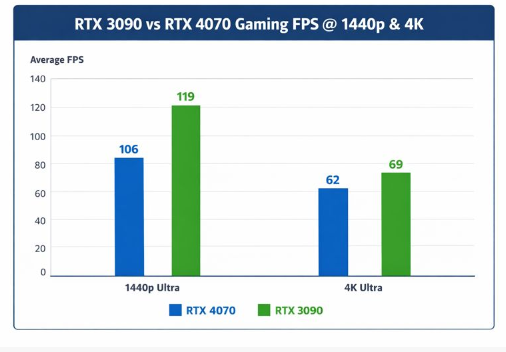
AAA Gaming at 1440p/4K
The RTX 3090 maintains a performance edge over the RTX 4070 in AAA gaming, achieving ~ 12% higher FPS at 1440p Ultra and ~ 11% higher FPS at 4K Ultra. While the RTX 4070 performance is strong and power-efficient, the 3090 remains the better choice for maximum FPS and high-resolution gaming.
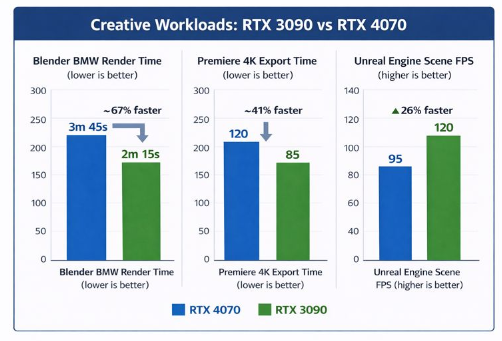
Creative Workloads (Video Editing & 3D Rendering)
In creative tasks like Blender rendering and Premiere Pro exports, the RTX 3090 is significantly faster, delivering ~ 41 – 67% better performance depending on the task. The RTX 4070 performance is efficient and sufficient for smaller projects, but the 3090 excels in handling large-scale, memory-intensive creative workloads.
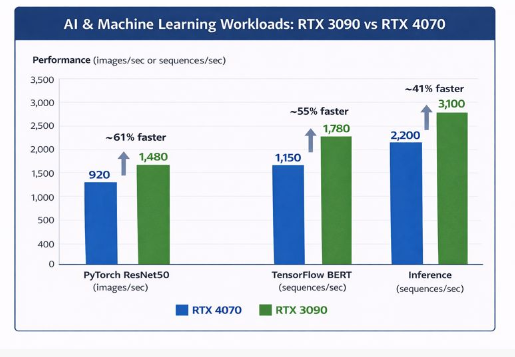
AI & Machine Learning Workloads
For AI and ML training or inference, the RTX 3090 outperforms the RTX 4070 by ~ 41 – 61%, thanks to higher CUDA cores, larger VRAM, and greater FP32/FP16 compute power. The RTX 4070 performance remains respectable for smaller models or inference tasks, but the 3090 is the clear choice for demanding AI workloads.
Price & Value: RTX 3090 vs RTX 4070
| Platform | RTX 3090 (USD) | RTX 4070 (USD) | Price Difference (USD) | Price Difference (%) |
|---|---|---|---|---|
| Original MSRP | $1,499 | $599 | $900 | 150% |
| Amazon (Used / Renewed) | $600 – $800 | $400 – $500 | $200 – $400 | ~40% – 80% |
| Third-Party Resellers (eBay) | $600 – $850 | $420 – $550 | $180 – $300 | ~30% – 70% |
The RTX 3090 price is about 150% higher than the RTX 4070 price at MSRP. In used and reseller markets, the gap narrows but still shows the 3090 is ~30–80% more expensive. The RTX 3090 offers raw performance and large VRAM, making it ideal for high-end gaming, creative, and AI workloads. The RTX 4070 provides strong performance per dollar and energy efficiency, offering better value for most gamers and creators.
RTX 3090 vs RTX 4070– Pros & Cons
| GPU | Pros | Cons |
|---|---|---|
| RTX 3090 | - Excellent 4K and 1440p gaming performance - Large 24 GB VRAM ideal for GPU rendering, 3D workflows, and AI/ML tasks - Strong raw FP32/FP16 compute for creators and developers - Good resale value in the used market |
- High RTX 3090 price (MSRP and resale) makes it less cost-effective for most gamers - High power consumption and larger cooling requirements - Overkill for standard 1080p/1440p gaming or small creative projects |
| RTX 4070 | - Strong performance per dollar and lower power consumption - Supports DLSS 3, AV1 NVENC, and newer Ada Lovelace architecture - Efficient for 1440p gaming and moderate creative workloads - Modern feature set ensures future-proofing |
- Less VRAM (12 GB) limits large-scale 3D and AI workloads - Lower raw FP32/FP16 compute than RTX 3090 (~30–60% lower in benchmarks) - Slightly lower FPS in high-end 4K gaming compared to RTX 3090 |
RTX 3090 & 4070 Server Hosting
“RTX 3090 & 4070 hosting” refers to servers or cloud instances equipped with these high-end GPUs, allowing users to access powerful hardware remotely without the upfront cost or maintenance of buying a physical GPU. Database Mart offers high-performance GPU servers, featuring a range of NVIDIA GPUs, with 99.9% uptime, multiple CPU cores, and fast SSD storage, providing stable performance for AAA gaming, 4K content creation, GPU rendering, AI development, streaming, and other demanding workloads.
Still unsure which GPU server fits your needs?
👉 Get expert recommendations from DatabaseMart.
Conclusion
In summary, the RTX 3090 excels in raw performance, large VRAM, and demanding workloads like 4K gaming, creative rendering, and AI development, while the RTX 4070 offers efficient performance per dollar, lower power consumption, and modern features such as DLSS 3 and AV1 encoding. Choosing between them depends on your priorities: if ultimate performance matters, the RTX 3090 is the clear winner; if value, energy efficiency, and solid 1440p gaming or creative performance are key, the RTX 4070 delivers excellent results.
rtx 3090 vs rtx 4070, 3090 vs 4070, rtx 3090 vs 4070, rtx 3090 price, rtx 4070 price, rtx 4070 benchmark, rtx 3090 specifications, rtx 4070 specifications, rtx 4070 performance, rtx 4070 comparison, AAA gaming benchmarks