


RTX 4060 vs RTX 4060 Ti – The 2025 Mid-Range GPU Battle You Shouldn’t Miss
As we move deeper into 2025, the RTX 4060 Ti vs RTX 4060 debate continues to capture attention across the gaming community. With NVIDIA rolling out steady driver updates and optimizing both GPUs, the GeForce RTX 4060 and 4060 Ti now perform closer than ever—especially after recent price drops. For gamers upgrading from an older RTX 3060, this comparison has become even more relevant, as both cards promise major leaps in frame rates, ray tracing, and DLSS 3 performance. Whether you’re building a new mid-range PC or replacing your RTX 3060, understanding the latest 4060 vs 4060 Ti benchmarks and real-world gaming performance will help you decide which RTX 4060 GPU delivers better value in 2025.
Summary of NVIDIA 4060 vs 4060 Ti
Main Features:
Experience immersive gaming, seamless streaming, and accelerated creative workflows with the GeForce RTX 4060 Ti and RTX 4060, both powered by NVIDIA’s ultra-efficient Ada Lovelace architecture.
These RTX 4060 GPUs bring next-generation performance with ray tracing and DLSS 3, delivering smoother gameplay and AI-enhanced frame generation for the latest games. Whether you’re gaming, live streaming, or editing high-resolution content, the 4060 vs 4060 Ti lineup enables you to play and create without compromise. With NVIDIA Studio support, creators also benefit from faster rendering, greater stability, and professional-grade performance for demanding workloads.
Distinct Positioning:
In the GeForce RTX 4060 vs 4060 Ti lineup, the positioning of each card is clear
- RTX 4060 Ti is ideal for gamers seeking high-frame-rate 1440p performance or creators who need multitasking power during live streaming.
- RTX 4060 excels in 1080p gaming and everyday creative tasks, offering higher energy efficiency and a more budget-friendly price, making it a natural upgrade from the RTX 3060.
Shared Advantages:
- Next-Gen Gaming Performance: Both GPUs support ray tracing and DLSS 3, delivering smoother frame rates and immersive gameplay for modern titles.
- AI-Powered Acceleration: AI-enhanced features speed up content creation, rendering, and streaming workflows.
- Energy Efficiency: Built on NVIDIA’s Ada Lovelace architecture, both cards offer high performance per watt.
- Versatile for Multiple Tasks: Suitable for gaming, live streaming, and creative applications like video editing, 3D modeling, and graphic design.
- NVIDIA Studio Support: Optimized for creative software, ensuring faster rendering, better stability, and professional-grade performance.
Overall, the RTX 4060 Ti focuses on high-performance gaming and demanding creative workloads, while the RTX 4060 GPU delivers excellent value, efficiency, and solid performance for casual gaming and content creation.
Background Comparison: RTX 4060 vs 4060 Ti
| Item | GeForce RTX 4060 | GeForce RTX 4060 Ti |
|---|---|---|
| Launch date | June 2023 | May 2023 (8 GB) July 2023 (16 GB) |
| Launch MSRP | $299 | $399 (8 GB) $499 (16 GB) |
| Architecture | NVIDIA Ada Lovelace | NVIDIA Ada Lovelace |
| Positioning | Mainstream 1080p gaming & everyday creators | High‑frame‑rate 1440p gaming & multitasking creators |
| Context | More affordable entry into RTX 40 series | Higher performance tier, higher cost |
From the table above, it is clear that while both the RTX 4060 and RTX 4060 Ti share the same Ada Lovelace architecture, they target different segments. The RTX 4060 is positioned as a cost-effective option for 1080p gaming and everyday creative work, launching at a lower price point. The RTX 4060 Ti, on the other hand, aims at gamers seeking higher performance for 1440p gaming and creators needing more multitasking power, with a higher launch price and VRAM options. Understanding these background differences is important before evaluating benchmarks and real-world performance.
RTX 4060 Ti vs RTX 4060 Specifications
| Parameter | RTX 4060 Ti | RTX 4060 |
|---|---|---|
| GPU Model | AD106‑350 / AD106‑351 (8GB / 16GB) | AD107‑400‑A1 |
| Architecture | Ada Lovelace | Ada Lovelace |
| CUDA Cores | 4,352 | 3,072 |
| Memory Type | GDDR6 | GDDR6 |
| Memory Capacity | 8GB / 16GB | 8GB |
| Memory Bandwidth | ~288 GB/s | ~272 GB/s |
| Core Frequency (Base/Boost) | 2.31 / 2.54 GHz | 1.83 / 2.46 GHz |
| TDP | 160 W | 115 W |
| Interface | PCIe 4.0 x8 | PCIe 4.0 x8 |
| FP32 Performance | 22.6 TFLOPS | 15.1 TFLOPS |
| Tensor Cores | 4th Gen (353 AI TOPS) | 4th Gen (242 AI TOPS) |
| PCIe Version | PCIe 4.0 | PCIe 4.0 |
Specs Comparison
- CUDA Cores & Performance: RTX 4060 Ti has ~41% more CUDA cores and much higher FP32 performance (22.6 vs 15.1 TFLOPS), giving it better raw computational power.
- Memory: RTX 4060 Ti offers optional 16GB GDDR6, compared to 8GB on the RTX 4060, making it more suitable for high-resolution gaming and creative workloads.
- Frequency & Bandwidth: Higher base/boost frequencies and slightly wider memory bandwidth on 4060 Ti support faster rendering and smoother gameplay.
- Power & Efficiency: RTX 4060 is more energy-efficient (115W vs 160W), suitable for budget-conscious builds and 1080p gaming.
- Upgrade Recommendation from RTX 3060: For users upgrading from an RTX 3060, RTX 4060 offers a smooth and efficient performance boost with lower cost and power consumption, while RTX 4060 Ti is recommended if higher FPS at 1440p or heavy creative workloads are needed.
4060 vs 4060 Ti Benchmark: Performance Across Different Scenarios
3DMark Benchmark
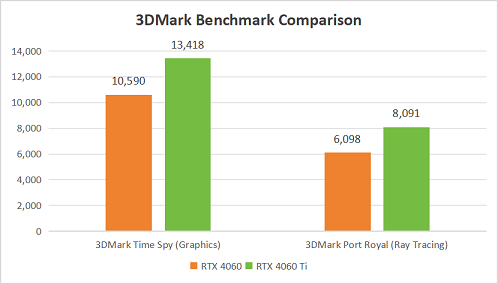
In 3DMark benchmarks, the GeForce RTX 4060 Ti and 4060 comparison shows the 4060 Ti leading clearly. Time Spy scores are 13,418 vs 10,590 ( ~26.7% higher), and Port Royal scores are 8,091 vs 6,098 ( ~32.7% higher). This demonstrates the RTX 4060 GPU Ti version has a significant edge in graphics computation and ray tracing.
Cyberpunk 2077 DLSS Performance Test
Cyberpunk 2077 — Ray Tracing ON
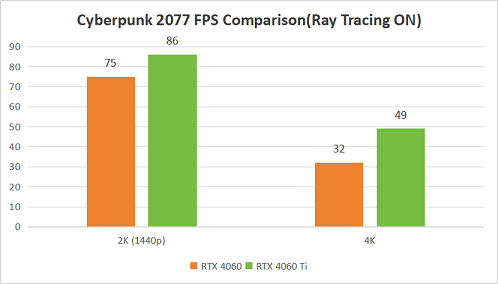
With ray tracing enabled, the performance of the 4060 and 4060 Ti differs notably. At 2K, 4060 Ti reaches 86 fps vs 75 fps for 4060; at 4K, 49 fps vs 32 fps. This comparison delivers smoother gameplay at higher resolutions with ray tracing.
Cyberpunk 2077 — Ray Tracing OFF
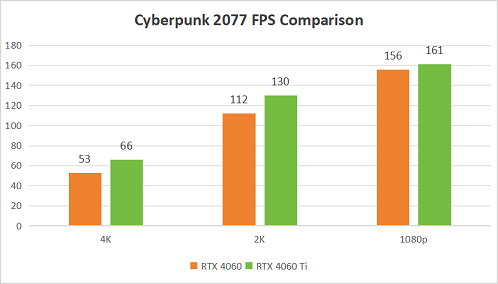
Turning off ray tracing narrows the gap. RTX 4060 Ti reaches 161 fps at 1080p, 130 fps at 2K, and 66 fps at 4K; 4060 reaches 156, 112, 53 fps. This comparison between the RTX 4060 and 4060 Ti benchmarks shows that the 4060 remains strong for 1080p or 2K gaming without ray tracing.
System Power & Temperature
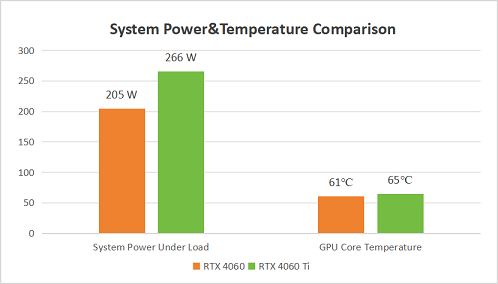
RTX 4060 4060Ti reddit discussions often highlight power efficiency. RTX 4060 consumes ~205W vs 266W for 4060 Ti, with slightly lower temps (61°C vs 65°C). Users prioritizing power and cooling may prefer 4060.
AI / Machine Learning Performance
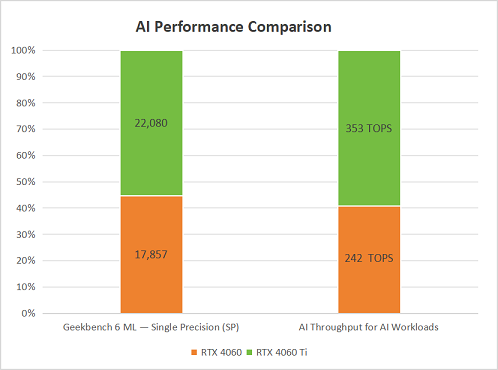
In AI and machine learning tests like Geekbench 6 ML, the RTX 4060 Ti scores approximately 22,080 compared to around 17,857 for the RTX 4060, representing a performance increase of about 24%. In AI-specific metrics such as TOPS, the 4060 Ti reaches roughly 353, while the 4060 achieves around 242, indicating that the 4060 Ti has a clear advantage in AI inference and low-precision computation.
RTX 4090 Price vs RTX 4080 Value
| Graphics Card | Official MSRP | Amazon / Official Channel Price | Third‑Party / Reseller Price |
|---|---|---|---|
| RTX 4060 8 GB | $399(NVIDIA) | $619 (Amazon.sg) | $319 used(eBay) |
| RTX 4060 Ti 8 GB | $299(NVIDIA) | $527 (Amazon.sg) | $329 used(eBay) |
Value Summary
- If your budget is tight and you primarily game at 1080p, or you engage in everyday content creation with moderate workloads, the RTX 4060 is the most sensible choice. Its lower MSRP and better energy efficiency make it ideal for mainstream users.
- If you are focused on higher‑resolution gaming (1440p or above), ray tracing, or you perform heavy creative or AI work, then the RTX 4060 Ti offers better performance for its higher price. The extra investment is justified for users who need the additional headroom.
Always consider the actual market price: if the retail or third‑party price of the higher‑tier card approaches or exceeds that of the lower tier by too much, the value advantage may diminish.
For gamers upgrading from a previous generation (for example an RTX 3060), choose the RTX 4060 for balanced improvement, and choose the RTX 4060 Ti only if you anticipate demanding usage scenarios.
GeForce RTX 4060 vs 4060 Ti: Pros & Cons Comparison
| Model | Pros | Cons |
|---|---|---|
| RTX 4060 | ✅ Lower MSRP makes it budget-friendly for 1080p gaming and general content creation. ✅ Good rasterization performance at 1080p–1440p. ✅ Lower power consumption and heat output, suitable for small/compact builds. ✅ Balanced performance-per-dollar for mid-range users. |
❌ 8 GB VRAM may limit high-resolution or VRAM-heavy workloads. ❌ Ray tracing performance moderate; DLSS 3 frame generation slower than Ti. ❌ Fewer CUDA cores and Tensor cores, less AI acceleration. |
| RTX 4060 Ti | ✅ Higher performance for 1080p/1440p gaming and ray tracing. ✅ DLSS 3 and Tensor cores enable AI acceleration and smoother frame generation. ✅ Better for multitasking, creative workloads, and AI-assisted rendering. ✅ Stronger performance-per-dollar at higher-end mid-range. |
❌ Higher MSRP compared to RTX 4060. ❌ 8–16 GB VRAM (depending on model) may still be limiting for 4K gaming or very VRAM-heavy tasks. ❌ Higher power consumption and heat output than RTX 4060. |
RTX 4060 Server Hosting
Beyond retail graphics cards, using an RTX 4060 server hosting solution provides significant advantages for gamers, creators, and developers. By hosting on Database Mart’s RTX 4060 GPU Server Hosting, users can avoid the high upfront cost of purchasing a GPU while gaining flexible and scalable access to the RTX 4060’s Ada Lovelace architecture.
Users can fully leverage 3,072 CUDA cores, 96 Tensor cores, and 8 GB GDDR6 memory for tasks such as AI model training, 3D rendering, high-resolution content creation, or large-scale simulations.
In addition, the hosting environment ensures optimal cooling, stable power delivery, and high-speed network connectivity, allowing workloads to run continuously without the limitations of local hardware. For those seeking GPU performance with a subscription-based model, RTX 4060 server hosting is an ideal choice.
Conclusion
Based on the above comparison, we can conclude that for users seeking cost-effective 1080p/1440p gaming, moderate AI/3D tasks, or budget-conscious performance, the RTX 4060 is the ideal choice.
For those aiming for higher frame rates, ray tracing, AI/3D-intensive workloads, or high-performance creative tasks, the RTX 4060 Ti is better suited, ideal for building a new high-performance system.
In summary, whether upgrading your RTX 3060 series or building a new system in 2025, the final choice depends on your specific use case and budget priorities: choose RTX 4060 for cost-efficient, high-performance 1080p/1440p workflows, or RTX 4060 Ti for high-end gaming, AI acceleration, and creative workloads. For users with budget constraints, Database Mart’s RTX 4060 and 4060 Ti server hosting plans provide a flexible, subscription-based way to access GPU power.
RTX 4060 vs RTX 4060 ti, 4060 Ti vs 4060, 4060 vs 4060 ti, geforce rtx 4060 vs 4060 ti, 4060 vs 4060 ti reddit, nvidia geforce 4060, 4060 4060ti, 4060 vs 4060 ti benchmark, rtx 4060 gpu