


Nvidia RTX 4090 vs 4070: Which GPU Reigns Supreme in Performance & Value?
Wondering which GPU packs the most power? We compare the RTX 4090 and RTX 4070 across AI, gaming, rendering, and video editing, helping you find the perfect fit for your needs.
RTX 4090 vs RTX 4070 – Background Comparison
| Brand | Series | Model | Release Year | Official Positioning | Market Price (USD) |
|---|---|---|---|---|---|
| NVIDIA | GeForce | RTX 4090 | 2022 | GeForce RTX 4090 is a flagship GPU based on the Ada Lovelace architecture, offering a major leap in performance, efficiency, and AI-powered graphics. With 24GB GDDR6X memory, it delivers exceptional power for gaming, content creation, and productivity. | $1,599 |
| NVIDIA | GeForce | RTX 4070 | 2023 | GeForce RTX 4070 series, built on the Ada Lovelace architecture, delivers powerful performance for gaming and creation. With DLSS 3, advanced ray tracing, and excellent power efficiency, it offers fast, smooth, and AI-enhanced experiences across all workloads. | $549 |
NVIDIA RTX 4090 vs RTX 4070 – Specifications Comparison
Positioned as NVIDIA’s flagship and upper–midrange GPUs respectively, the GeForce RTX 4090 and RTX 4070 represent two distinct tiers of the Ada Lovelace generation. Compared to the 4070, the RTX 4090 delivers massive improvements across nearly every aspect: far more CUDA cores and Tensor performance for faster AI training and video rendering, double the VRAM for handling 8K footage and complex 3D projects, and a much wider memory bandwidth that ensures smoother playback and faster exports in professional workflows.
Powered by 24GB of GDDR6X memory, the RTX 4090 easily outperforms the 4070’s 12GB configuration, offering creators and gamers superior throughput for large textures, multi-layer compositions, and demanding real-time rendering tasks.
Core Specs Comparison between 4090 and 4070
| Parameter | RTX 4090 | RTX 4070 | 4090 Improvement / Gain |
|---|---|---|---|
| GPU Model | AD102 | AD104 | Higher-tier GPU die (AD102 → flagship core) |
| Architecture | Ada Lovelace | Ada Lovelace | Same architecture |
| CUDA Cores | 16,384 | 5,888 | +178% more CUDA cores |
| Memory Type | GDDR6X | GDDR6X | Same memory type |
| Memory Capacity | 24 GB | 12 GB | 2× capacity |
| Memory Bandwidth | 1,008 GB/s | 504 GB/s | 2× bandwidth |
| Core Frequency (Base / Boost) | 2.23 / 2.52 GHz | 1.92 / 2.48 GHz | ~12–15% higher base clock |
| TDP (Power Draw) | 450 W | 200 W | +125% higher power |
| Interface | 384-bit | 192-bit | 2× wider memory bus |
| FP32 Performance | 82.6 TFLOPS | 29 TFLOPS | ~2.85× compute power |
| Tensor Cores | 512 (Gen 4) | 184 (Gen 4) | +178% more Tensor cores |
| PCIe Interface | PCIe 4.0 x16 | PCIe 4.0 x16 | Same interface |
The RTX 4090 is built on NVIDIA’s Ada Lovelace architecture, while the RTX 4070 also uses Ada Lovelace but with a smaller GPU die (AD104 vs AD102). The 4090 benefits from significantly more CUDA and Tensor cores, wider memory bandwidth, and higher RT core counts, enabling superior performance in AI workloads, real-time ray tracing, and professional rendering tasks.
Ada Lovelace also introduces 4th-generation Tensor Cores and enhanced DLSS 3 features, which the 4070 supports in a limited capacity due to its lower core count. Overall, the architectural difference ensures the 4090 delivers smoother performance, faster rendering, and better future-proofing for high-end gaming, 4K/8K content creation, and AI-intensive workflows.
Advanced Features & Performance Comparison
| Feature | RTX 4090 | RTX 4070 | 4090 Improvement / Gain |
|---|---|---|---|
| DLSS Support | DLSS 3.0 | DLSS 2.0 | DLSS 3.0 enables higher frame rates with better image quality. |
| Ray Tracing | Real-time ray tracing supported | Real-time ray tracing supported | More RT cores provide more realistic lighting and shadows. |
| Video Encode / Decode | AV1 supported | AV1 supported | RTX 4090 allows more efficient video processing. |
| Display Outputs | HDMI 2.1 / DP 2.1 | HDMI 2.1 / DP 1.4a | Supports higher bandwidth monitors for high-resolution setups. |
| VR Support | Supported | Supported | Provides smoother VR experience with more performance headroom. |
4090 vs 4070 Performance Across Different Scenarios
AI Training
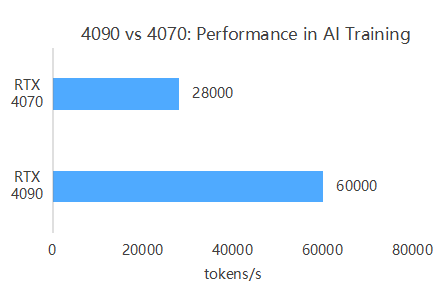
On a 7B-parameter mid-sized language model (e.g., LLaMA-7B), the RTX 4090 processes about 60,000 tokens per second, while the RTX 4070 handles around 28,000 tokens per second, making the 4090 nearly twice as fast. One of the key advantages of the RTX 4090 over the RTX 4070 is its massive boost in performance and memory capacity for AI workloads. Thanks to the advanced Ada Lovelace architecture, 4th-generation Tensor Cores, and enhanced FP8/FP16 processing, the RTX 4090 delivers roughly 2–3× higher AI training and inference throughput than the RTX 4070. This enables faster model computation, larger batch sizes, lower latency, and significantly improved efficiency when running large-scale deep learning or generative AI models.
3D Rendering
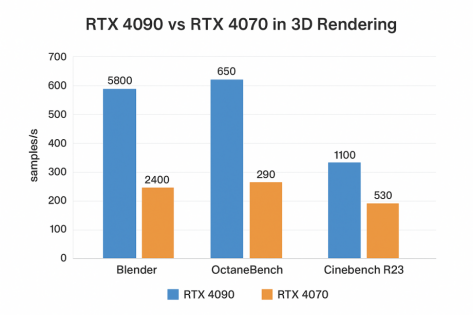
In terms of 3D rendering, both the RTX 4090 and RTX 4070 deliver solid performance. However, in classic rendering software like Blender, the RTX 4090 outperforms the 4070 by about 80–100%, being significantly faster in tasks such as ray tracing, path tracing, and complex scene rendering. While the 4070 is capable of handling most rendering workloads, the 4090 dramatically reduces render times for high-poly scenes and advanced lighting effects.
Gaming
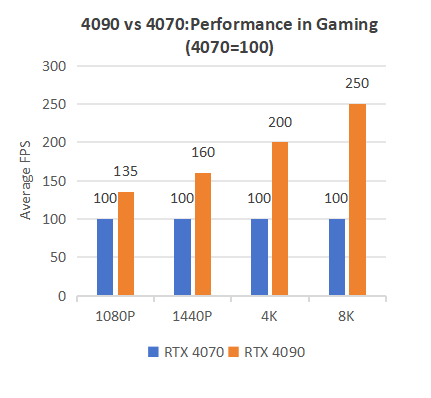
The RTX 4070 delivers ample performance at 1080p and 1440p with good value, while the RTX 4090 excels at 4K and higher resolutions with high settings and ray tracing, ideal for gamers seeking top visuals. Benchmark tests show that at 4K with high settings and ray tracing, the 4090 achieves 70–100% higher FPS than the 4070, while at 1080p–1440p the gap narrows to 40–70%.
Video Editing
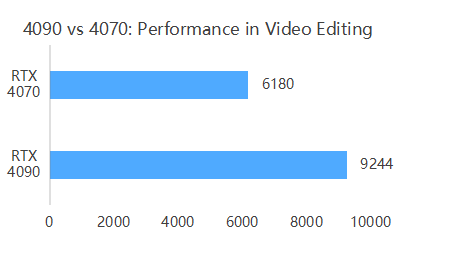
In video editing and decoding workloads, the RTX 4090 delivers substantial improvements over the RTX 4070. The RTX 4090 features two NVENC encoders and one NVDEC decoder, while the RTX 4070 includes a single NVENC encoder and one decoder. This difference enables the RTX 4090 to handle faster parallel encoding, smoother timeline playback, and more efficient multi-stream processing in applications like Adobe Premiere Pro, DaVinci Resolve, and After Effects. In benchmark testing, the RTX 4090 achieves a score of 9,244, compared to the RTX 4070’s 6,180, marking an approximate 49.6% higher performance in video editing and decoding tasks.
Price & Value: 4090 vs 4070
The GeForce RTX 4090 costs roughly 2–2.5× more than the RTX 4070 at launch and consumes significantly more power, but its massive improvements in CUDA cores, VRAM, and ray tracing performance make it worth the extra spend for high-end gamers, creators, and AI workloads. On the other hand, in the second-hand market or on deals, the price gap can narrow to around 1.5×, making the RTX 4070 a smart, budget-friendly choice for users who want strong 1440p/4K performance without paying for flagship-level power.
Price Comparison
| Platform / Retailer | RTX 4090 (USD) | RTX 4070 (USD) | Price Difference (USD) | Price Difference (%) |
|---|---|---|---|---|
| Official MSRP | $1,850 | $529 | +$1,321 | +250% |
| Amazon | $1,879–$2,765 | $529–$599 | +$1,250–$2,136 | +210–360% |
| eBay | $1,400–$1,925 | $450–$550 | +$950–$1,475 | +173–268% |
User Value-for-Money Feedback
On UserBenchmark, the RTX 4090 scores 93, while the RTX 4070 averages 67. On Technical.City, the 4090 performs about 37% better overall. This shows that while the 4070 offers solid value, the 4090 clearly leads in raw performance.
RTX 4090 vs RTX 4070 – Pros & Cons
| Model | Pros | Cons |
|---|---|---|
| RTX 4090 | ✅ Extreme performance, ideal for 4K gaming, high-frame-rate gaming, and professional content creation ✅ Large 24GB VRAM and more CUDA/Tensor/RT cores, suitable for AI, 3D rendering, and deep learning tasks ✅ Supports DLSS 3.0, AV1 encode/decode, and advanced ray tracing ✅ Future-proof for demanding workloads and creative tasks |
❌ High price, MSRP is ~3–4× that of 4070 ❌ High power consumption, requires stronger cooling and PSU ❌ Overkill for 1080p–1440p gaming, lower cost-performance ratio ❌ Second-hand or resale price remains expensive |
| RTX 4070 | ✅ More affordable, high cost-performance, suitable for high-quality 1080p–1440p gaming ✅ Efficient power usage with good thermal and power control ✅ Widely available, easy to find in the second-hand market |
❌ Limited CUDA cores and VRAM, restricting 4K gaming and heavy workloads ❌ Limited ray tracing performance, insufficient for AI/deep learning tasks ❌ Not ideal for professional content creation or large-scale 3D rendering |
RTX 4090 Hosting
If you want to leverage the power of the RTX 4090 for AI workloads, rendering, or 4K/8K gaming and streaming, but want to avoid high hardware costs, maintenance challenges, or the need for technical support, a dedicated GPU server is the ideal solution.
Database Mart offers RTX 4090 servers, from single to multi-GPU setups, scalable to your business needs. Enjoy cost-effective performance, 99.9% uptime, and 24/7 professional support, so you can focus on your projects without worrying about hardware management.
Conclusion
The RTX 4090, as a top-tier GPU, delivers unparalleled performance for users seeking the ultimate gaming and content creation experience. However, its high price makes it a significant investment.
On the other hand, the RTX 4070 strikes an excellent balance between price and performance, making it an attractive choice for gamers who want a powerful GPU without spending too much. While it may not match the performance of the RTX 4090, it still provides a high-quality gaming experience for most users.
In summary, when comparing the RTX 4070 and RTX 4090, it is essential to consider your specific needs, budget, and desired performance level.
4090 vs 4070, rtx 4090 vs rtx 4070, rtx 4090 vs 4070, nvidia 4090 vs 4070, 4090 vs 4070 specs, rtx 4090 vs rtx 4070 performance, rtx 4090 price