


RTX 4080 vs RTX 4090: Which GPU Is Worth Buying in 2025?
While NVIDIA’s next-generation RTX 5090 and 5080 have already taken the spotlight in 2025, the comparison between the RTX 4080 and RTX 4090 remains highly relevant. These two Ada Lovelace powerhouses continue to define high-end gaming and professional content creation performance standards. Even as newer models emerge, discussions around 4090 vs 4080 performance—from real-world gaming benchmarks to AI workloads—still dominate communities like Reddit. Understanding their core differences in architecture, memory, and efficiency helps users determine whether the 4090’s extra power justifies its higher cost.
Summary of NVIDIA 4080 vs 4090
Main Features:
Both the NVIDIA RTX 4080 and RTX 4090 belong to the GeForce RTX 40 Series GPUs, engineered to provide an exceptionally smooth experience for gamers and creators alike. Powered by the ultra-efficient Ada Lovelace architecture, these GPUs deliver next-level ray tracing, DLSS 3, and AI-driven rendering efficiency.Revolutionary new creative workflows with unprecedented speed and efficiency.
Users can explore lifelike virtual worlds, enjoy ultra-high FPS gaming, and accelerate AI image generation or video production workflows. Whether you choose the RTX 4080 or the flagship RTX 4090, both deliver cutting-edge performance — but at different price and power levels.
Industry Applications
Both cards excel in:
- Gaming and real-time ray tracing
- Content creation, rendering, and AI acceleration
- Professional streaming, multi-monitor setups, or high-refresh-rate workflows
Applications like Adobe Creative Suite, Blender, DaVinci Resolve, TensorFlow, and PyTorch perform flawlessly on both GPUs. However, for AI image restoration or model training, the RTX 4090’s 24GB VRAM and greater CUDA core count make it more suitable for large datasets and deep learning projects.
Background Comparison: RTX 4080 vs RTX 4090
| Aspect | RTX 4090 | RTX 4080 | Comparison Summary |
|---|---|---|---|
| Release Time | October 2022 | November 2022 | Both belong to the NVIDIA RTX 40 series, released at the back, and both use the Ada Lovelace architecture |
| Development Background | Designed to replace the previous generation flagship RTX 3090 Ti, it is designed for ultra-high-end users and the professional content creation market. | Positioned as a sub-flagship, it aims to strike a balance between performance and price, inheriting the RTX 3080's mainstream high-end market position. | The 4090 emphasizes "extreme performance", while the 4080 focuses on "high performance and energy efficiency" |
| Core Architecture | The AD102 chip has the most CUDA cores and Tensor cores; it focuses on improving AI, ray tracing, and multitasking performance. | AD103 chip, same architecture but smaller core size; optimized power consumption and cost | Both belong to Ada Lovelace, but at different levels |
| Design Philosophy | "No Compromise" flagship concept, pursuing extreme performance and future compatibility (8K gaming / AI computing / 3D rendering) | "Balanced Power" concept, achieving the golden ratio between performance, power consumption and budget | The two complement each other to meet the needs of users at different levels |
| Target Audience | AI developers, 3D artists, film and television post-production studios, top players | High-end gamers, creators, independent designers, engineers | The 4090 is designed for professional and extreme performance scenarios, while the 4080 is designed for users who require high performance but focus on cost control. |
| Market Position | Flagship GPU, representing the pinnacle of NVIDIA technology | High-end mainstream GPU, targeting the mass high-performance market | The 4090 offers ~25–35% performance advantage, but is ~30–40% more expensive. |
| Market Price | $1,599 | $1,199 | 4090 more expensive, higher performance |
The RTX 4090 represents the pinnacle of NVIDIA’s Ada Lovelace architecture, designed to handle high-demand workloads such as AI inference, deep learning, and 8K rendering, making it ideal for professional developers and studios who require top-tier performance and cutting-edge hardware.
In contrast, the RTX 4080 continues the flagship architecture while optimizing power efficiency and cost, providing high-performance gaming and efficient content creation for advanced users. It offers the best balance between high-end performance and budget-conscious value.
RTX 4090 vs RTX 4080 Specifications
| Specification | RTX 4090 | RTX 4080 |
|---|---|---|
| Graphics Processor | AD102 | AD103 |
| Architecture | Ada Lovelace | Ada Lovelace |
| Process Node | TSMC 5nm | TSMC 5nm |
| CUDA Cores | 16,384 | 9,728 |
| RT Cores | 128 | 76 |
| Tensor Cores | 512 | 304 |
| Base Clock | 2,235 MHz | 2,205 MHz |
| Boost Clock | 2,520 MHz | 2,505 MHz |
| Memory | 24GB GDDR6X | 16GB GDDR6X |
| Memory Speed | 21.2 Gbps | 22.4 Gbps |
| Memory Bandwidth | 1,018 GB/s | 735.7 GB/s |
| Memory Bus | 384-bit | 256-bit |
| TDP | 450W | 320W |
Note: The above are specifications for the Nvidia Founders Edition versions of these GPUs. Cards from board partners will have different core and memory speeds, and possibly TDPs, too.
Spec Analysis
The differences between RTX 4090 and RTX 4080 are evident from the start.
- CUDA Cores:
RTX 4090 has over 68% more CUDA cores than the 4080, giving it a substantial advantage in most games and compute-heavy tasks, even though the base and boost clocks are only slightly higher. - RT and Tensor Cores:
Both GPUs feature the latest generation cores (3rd-gen RT and 4th-gen Tensor), but the 4090 significantly outperforms the 4080. This means that while standard rasterized games show some competition, the 4090 dominates in ray-traced and AI-accelerated workloads. - Memory:
RTX 4090 comes with 8GB more GDDR6X memory than the 4080. Although the 4080 memory is slightly faster at 22.4 Gbps versus 21.2 Gbps, the 4090’s wider 384-bit memory bus dramatically increases total bandwidth. - Power & Efficiency:
The 4090’s flagship performance comes at the cost of higher power consumption (~450W), approaching the limits of practical use. The RTX 4080 is more power-efficient, typically around 300W in gaming, making it a better choice for users prioritizing efficiency while still offering high-end performance.
RTX 4080 vs RTX 4090: Gaming Performance Comparison
Average FPS and Cost per Frame Across Resolutions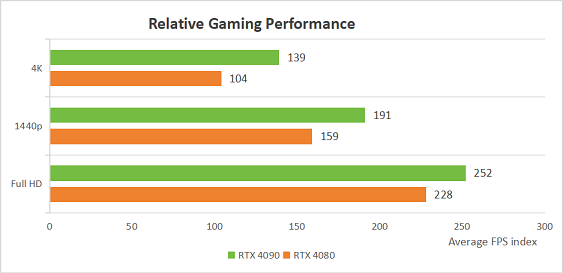
FPS Performance:
RTX 4090 consistently achieves higher average FPS across all resolutions, with the largest relative improvement at 4K (+33.7%), followed by 1440p (+20.1%) and 1080p (+10.5%).
Cost per Frame:
Despite its higher performance, RTX 4080 offers better value per frame at lower resolutions:
- 1080p: RTX 4080 reduces cost per frame by ~21% compared to 4090.
- 1440p: RTX 4080 reduces cost per frame by ~11%.
- 4K: Cost per frame is almost identical for both GPUs.
Practical Insight: For Full HD and 1440p gaming, RTX 4080 offers an excellent balance of performance and cost efficiency, while RTX 4090 shines at 4K gaming where maximum FPS is the priority.
3D Rendering & AI Image Generation Benchmarks
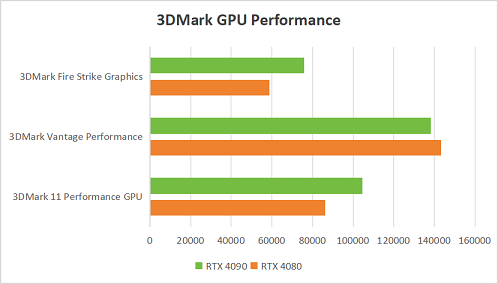
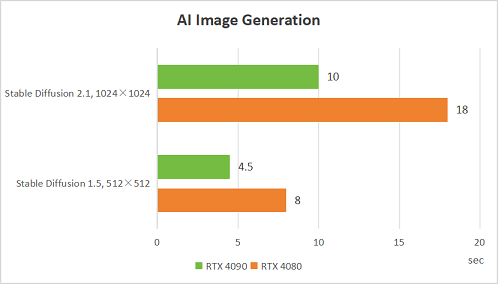
The NVIDIA RTX 4080 and RTX 4090 both deliver excellent performance for 3D rendering, AI image generation, and professional workloads. However, the RTX 4090 leads across all benchmarks with its stronger Ada Lovelace architecture, higher core count, and larger 24GB GDDR6X VRAM (vs 16GB on the RTX 4080).
In tests like 3DMark Fire Strike and Blender Cycles, the RTX 4090 outperforms the RTX 4080 by over 40%, and achieves 63% higher scores in OctaneBench. When running Stable Diffusion 1.5 or 2.1, it nearly halves generation time—ideal for AI artists and machine learning developers.
The RTX 4090’s 512 Tensor Cores (vs 304 on the 4080) enable faster AI training, inference, and 8K rendering. In creative tools like Adobe Premiere Pro, DaVinci Resolve, and Autodesk Maya, it delivers smoother editing and real-time playback.
RTX 4090 Price vs RTX 4080 Value
| Model | MSRP (Launch Price) | Amazon / Channel Price | Third-Party / Reseller Price |
|---|---|---|---|
| RTX 4080 | US $1,199 | Around US $1,849 on Amazon | Around US $899 on eBay and other clearance listings |
| RTX 4090 | US $1,599 | Around US $2,749 on Amazon | Around US $2,399 on Newegg |
Value Summary
Official MSRP: RTX 4090 launched at a significantly higher MSRP than the RTX 4080, reflecting its top-tier performance and market position.
Market Pricing: In real-world retail listings, the RTX 4080’s price has dropped closer to US $1,849 in some stores, while the RTX 4090 still sits around US $2,749 or higher — well above its original MSRP.
Price-to-Performance Ratio: The RTX 4080 offers stronger value per dollar, making it a more reasonable choice for gamers and creators seeking high performance without overspending.
Performance & Future-Proofing: The RTX 4090, though more expensive, provides superior memory capacity, bandwidth, and processing power — ideal for AI workloads, 8K rendering, and professional-grade creative use.
Recommendation: Choose based on your needs — if you prioritize efficiency and affordability, go for the RTX 4080. If you need maximum raw performance and future headroom, the RTX 4090 remains unmatched.
RTX 4090 vs RTX 4080: Pros & Cons Comparison
| Model | Pros | Cons |
|---|---|---|
| RTX 4090 | ✅ Unparalleled gaming and rendering performance — ideal for 4K/8K and professional workloads. ✅ 24GB GDDR6X VRAM provides exceptional headroom for AI and deep learning. ✅ Outstanding ray tracing and DLSS 3 performance. ✅ Best choice for future-proof, long-term performance investment. |
❌ Extremely expensive — significantly higher MSRP and retail prices. ❌ Very high power consumption (450W typical). ❌ Requires large PSU (at least 850W–1000W) and advanced cooling solutions. ❌Physically large card, not ideal for small PC cases. |
| RTX 4080 | ✅ Excellent gaming performance up to 4K with lower power draw. ✅ High efficiency — offers excellent performance-per-watt. ✅ More affordable than RTX 4090 while still being a high-end GPU. ✅Compact size compared to 4090; easier to fit in standard builds. |
❌ 16GB VRAM limits performance in some AI and 8K workloads. ❌ Noticeably slower than RTX 4090 in raw compute and ray tracing tasks. ❌ Still expensive compared to RTX 4070 Ti and lower-tier cards. ❌ Less suitable for long-term “future-proof” use. |
RTX 4090 Server Hosting
Hosting an NVIDIA RTX 4090 server with Database Mart unlocks extreme performance for professionals and innovators. Powered by the NVIDIA Ada Lovelace architecture, the RTX 4090 features 16,384 CUDA cores and 24GB of GDDR6X memory, delivering industry-leading speed for AI model training, deep learning, 3D rendering, and 8K graphics workloads.
With exceptional ray tracing, tensor processing, and parallel computing capabilities, Database Mart’s RTX 4090 hosting ensures consistent, dedicated GPU performance — far superior to shared environments. It offers full hardware control, on-demand scalability, and optimized reliability, making it the perfect choice for developers, researchers, and creative studios who demand the best in performance and stability.
Conclusion
With the launch of NVIDIA’s 50-series, the RTX 5090 has further surpassed the RTX 4090 in performance, making it the ultimate choice for those seeking extreme power.However, for most users, the RTX 4090 and RTX 4080 remain the most accessible high-end GPUs and ideal for enjoying a wide range of demanding games.
When choosing between them, the RTX 4090 clearly stands out, offering higher value for money while outperforming the RTX 4080. It is well-suited for high-end gamers and professional creators. In terms of frame rates, the RTX 4090’s performance and value actually exceed that of the RTX 4080 at current prices, making it the most worthwhile top-tier GPU on the market today.
rtx 4080 vs 4090, nvidia 4080 vs 4090, 4090 vs 4080 performance, 4090 vs 4080 reddit, rtx 4090, rtx 4090 price