


RTX 5060 vs 4090: Speed and Performance Battle
Compare the RTX 5060 and RTX 4090 in AI inference, gaming, and 3D rendering. See real-world benchmarks, memory advantages, CUDA/Tensor core performance, and find out which GPU delivers the best speed, efficiency, and stability for your needs.
RTX 5060 vs RTX 4090 – Background Comparison
| Brand | Series | Model | Release Year | Official Positioning | Market Price (USD) |
|---|---|---|---|---|---|
| NVIDIA | GeForce | RTX 5060 | 2025 | The GeForce RTX 5060, powered by the Blackwell architecture, bring advanced AI features, faster performance with DLSS 4, realistic ray tracing, and enhanced creative capabilities with NVIDIA Studio. | Starting at $229 |
| NVIDIA | GeForce | RTX 4090 | 2022 | The GeForce RTX 4090 is a flagship GPU delivering a major leap in performance and efficiency. Powered by the Ada Lovelace architecture and equipped with 24GB of G6X memory, it offers ultra-high-performance gaming, highly detailed virtual worlds, enhanced productivity, and new creative possibilities. | Starting at $1599 |
NVIDIA RTX 5060 vs RTX 4090– Specifications Comparison
The RTX 4090 significantly outperforms the RTX 5060 across nearly all key metrics. With over 4× more CUDA, Tensor, and RT cores, 3× larger memory, and more than double the memory bandwidth, it delivers vastly higher compute power, ray tracing performance, and AI acceleration. While the 4090 consumes more power, its raw performance and capability make it ideal for 4K/8K gaming, heavy AI workloads, and professional creative tasks, whereas the 5060 is targeted at mainstream 1080p–1440p gaming and lighter creative work.
Core Specs Comparison between RTX 5060 vs RTX 4090
| Specification | RTX 4090 | RTX 5060 | RTX 4090 Improvement / Gain |
|---|---|---|---|
| GPU Model | AD102-300 (Ada Lovelace) | GB206 (Blackwell) | — |
| Architecture | Ada Lovelace | Blackwell | — |
| CUDA Cores | 16,384 | 3,840 | ≈ 4.3× more CUDA cores |
| Memory Type | GDDR6X | GDDR7 | — (different generation) |
| Memory Capacity | 24 GB | 8 GB | 3× larger VRAM |
| Memory Bandwidth | 1008 GB/s | 448 GB/s | ≈ 2.25× higher bandwidth |
| Base / Boost Clock | 2235 / 2520 MHz | 2280 / 2497 MHz | Similar boost clock |
| TDP (Power Draw) | 450 W | 145 W | ≈ 3.1× higher power budget |
| PCIe Interface | PCIe 4.0 x16 | PCIe 5.0 x8 | 4090 has wider x16 lane width |
| FP32 Performance | 82.6 TFLOPS | 19.2 TFLOPS | ≈ 4.3× higher compute |
| Tensor Cores | 512 | 120 | ≈ 4.2× more Tensor cores |
| RT Cores | 128 | 30 | ≈ 4.3× more RT cores |
The RTX 4090 excels far beyond the RTX 5060 in advanced features. Despite the 5060 having some newer technologies like DLSS 4, PCIe 5.0, and NVENC 9th-gen, the 4090 delivers vastly higher AI processing power, ray tracing performance, path tracing capability, and VR readiness, making it ideal for 4K/8K gaming, professional creative workloads, and heavy AI tasks. In contrast, the 5060 is designed for mainstream gaming and light creative work, handling lower-resolution rendering and moderate AI workloads.
Advanced Feature Comparison between RTX 5060 vs RTX 4090
| Advanced Feature | RTX 4090 | RTX 5060 | RTX 4090 Improvement / Gain |
|---|---|---|---|
| DLSS Version | DLSS 3.5 (Frame Generation, Ray Reconstruction) | DLSS 4 (AI model upgrade) | 5060 has newer DLSS, but 4090 provides far higher raw performance |
| Ray Tracing Generation | 3rd-gen RT cores | 4th-gen RT cores | 5060 has newer gen, but 4090 is 4.3× more RT cores and much higher RT throughput |
| Max Rendering Resolution | 8K gaming capable | 1440p performance target | 4090 handles 8K workloads, 5060 is mid-range FHD/1440p |
| AI Processing Power (Tensor) | 4th-gen Tensor, extremely high throughput | 5th-gen Tensor (Blackwell) | 5060 has newer gen, but 4090 has far more Tensor cores + higher FLOPS |
| NVENC / Video Encode | Dual 8th-gen NVENC + AV1 | 9th-gen NVENC + AV1 | 5060 has newer encoder; 4090 doubles encode engines |
| Display Output Support | DP 1.4a, HDMI 2.1 | DP 2.1, HDMI 2.1 | 5060 has newer standard (DP 2.1) |
| Max GPU Temperature | 90°C typical | 86°C typical | Similar thermal envelope |
| Compute Capability (CUDA) | 8.9 | 9.0 | Newer capability on 5060 |
| AI Upscaling Performance | Extremely high due to GPU raw power | Mid-range | 4090 delivers several-fold higher AI throughput |
| Rendering (Path Tracing) | Fully capable (Cyberpunk RT Overdrive at high FPS) | Entry-level path tracing | 4090 massively higher PT performance |
| VR Performance | High-end VR (Varjo, 8K VR) | Standard VR / entry performance | 4090 supports professional VR workloads |
| Target User | Enthusiasts, creators, AI, 4K/8K gamers | Mainstream gamers, light creators | — |
RTX 5060 vs RTX 4090 Performance Across Different Scenarios
Artificial Intelligence Testing
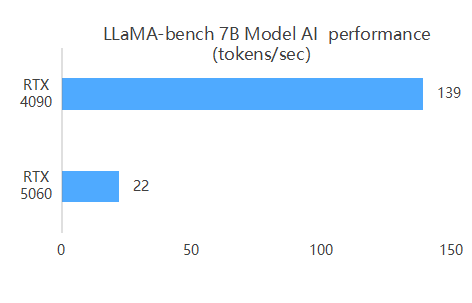
When running a 7B-parameter language model, the RTX 4090 achieves around 139 tokens per second (batch 1–4, INT4/FP16, TensorRT acceleration), while the RTX 5060 reaches only about 22 tokens per second (batch 1, INT4, quantized). This makes the RTX 4090 roughly 6.3× faster than the 5060 for LLM inference.
The RTX 4090’s larger memory, more CUDA/Tensor cores, and optimized inference support enable larger batches, lower latency, and higher throughput, making it ideal for high-performance LLM inference and large-scale AI workloads.
Gaming Performance
To evaluate real-world gaming performance, we benchmarked Red Dead Redemption 2, one of the most demanding modern titles, across multiple resolutions.
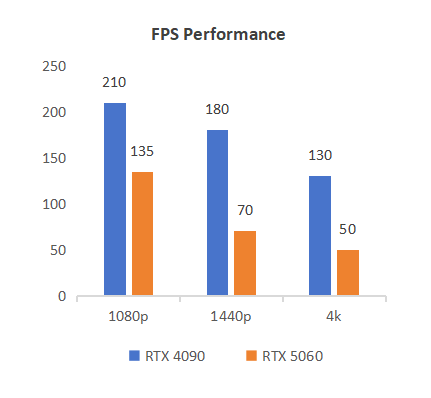
Our tests show that the RTX 4090 significantly outperforms the RTX 5060, achieving 70–120% higher FPS at 1080p, 1440p, and 4K settings. This substantial advantage comes from the 4090’s much higher CUDA core count, larger memory bandwidth, and superior ray tracing and DLSS capabilities. The 4090 easily handles ultra settings and ray-traced effects at high resolutions, delivering a nearly flawless experience even at 4K or 8K. The 5060, while still capable of smooth gameplay, is better suited for mid-to-high settings at 1080p or 1440p, offering a more budget-friendly option for gamers who don’t require top-tier performance.
3D Rendering
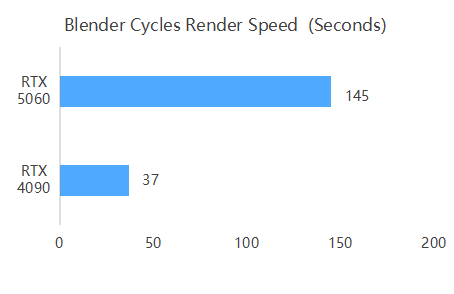
In Blender Cycles rendering, the RTX 4090 is about 3.9× faster than the RTX 5060. This is mainly due to its higher number of CUDA cores, greater floating-point performance, larger memory and bandwidth, and stronger RT and Tensor cores, combined with software optimizations that significantly accelerate ray tracing and complex scene processing.
Price & Value: RTX 5060 vs RTX 4090
The RTX 4090 is significantly more expensive than the RTX 5060, often 6–8× higher in price across official, retail, and secondary markets. Despite the steep cost, the 4090 delivers dramatically superior performance in 3D rendering, video editing, AI workloads, and gaming, making it the clear choice for extreme performance needs, while the 5060 remains a more budget-friendly option for moderate workloads.
Price Comparison
| Platform / Retailer | RTX 4090 (USD) | RTX 5060 (USD) | Price Difference (USD) | Price Difference (%) |
|---|---|---|---|---|
| Official MSRP | ~$1,599 | ~$249 | +$1,350 | +542% |
| Retail (Amazon / Newegg) | ~$1,500–$2,000 | ~$229–$269 | +$1,230–$1,770 | +500%–+650% |
| Secondary / Marketplace | ~$1,600–$2,200 | ~$200–$300 | +$1,300–$1,900 | variable |
User Value-for-Money Feedback
User feedback indicates that the RTX 4090 delivers roughly 7–10× higher performance than the RTX 5060, especially in 3D rendering, video editing, AI workloads, and high-end gaming. For moderate tasks, 1080p gaming, or smaller projects, the RTX 5060 provides adequate performance and much better value; however, if budget allows and future-proofing or handling extremely demanding workloads is a priority, the RTX 4090 is the superior investment.
RTX 5060 vs RTX 4090– Pros & Cons
| Model | Pros | Cons |
|---|---|---|
| RTX 4090 | ✅ Extremely high performance in 3D rendering, video editing, AI workloads, and high-end gaming compared to RTX 5060 ✅ 24GB GDDR6X VRAM allows handling massive scenes and ultra-high-resolution projects ✅ Massive number of CUDA, RT, and Tensor cores greatly accelerate computation and ray tracing ✅ Excellent future-proofing for demanding workloads and upcoming software |
❌ Very high price, significantly more expensive than RTX 5060 ❌ High power consumption (~450W), requires robust cooling and PSU ❌ Overkill for casual gaming or light workloads, not cost-effective for moderate tasks |
| RTX 5060 | ✅ Much lower price and more budget-friendly than RTX 4090 ✅ Lower power consumption (~160–170W) and easier thermal management ✅ Adequate for moderate 1080p/1440p gaming, video editing, and small-to-medium 3D projects |
❌ Limited VRAM (8–12GB) may restrict very large scenes or high-resolution textures ❌ Fewer CUDA, RT, and Tensor cores result in slower rendering and AI computation ❌ Not ideal for extreme workloads or future-proofing demanding projects |
RTX 5060 & RTX 4090 GPU Hosting
The RTX 5060 and RTX 4090 cater to different levels of performance needs, making them suitable for a range of workloads from mid-level projects to extreme computing tasks.
For individuals or teams who need powerful GPU resources without investing in local high-end hardware, GPU hosting provides a flexible and convenient solution. Hosted RTX 5060 and RTX 4090 servers allow users to run 3D rendering, video editing, AI workloads, and other compute-intensive tasks remotely, eliminating local hardware limitations, high upfront costs, and power constraints.
Database Mart offers both RTX 5060 GPU servers and RTX 4090 GPU servers, providing a cost-effective way to access high-performance GPUs. The RTX 5060 is ideal for moderate workloads, 1080p/1440p gaming, and small-to-medium rendering or AI projects, offering a balance of performance and affordability. The RTX 4090, with vastly higher cores, VRAM, and computational power, is suited for large-scale projects, extreme rendering tasks, AI research, and future-proof workloads. Selecting the right GPU server depends on your performance requirements and budget, ensuring you choose the most suitable setup for your tasks.
Conclusion
RTX 5060: Budget-friendly, efficient, good for 1080p/1440p gaming, light editing, and small AI tasks.
RTX 4090: High-end, powerful, ideal for 4K/8K gaming, heavy 3D rendering, large-scale AI, and future-proof workloads.
In short: The 5060 offers great value for mid-range gaming and light creative work, while the 4090 provides top-tier performance for demanding games, professional content creation, and large AI projects.
RTX 5060 vs RTX 4090, rtx 4090 vs 5060, 5060 vs 4090 benchmark, 5060 vs 4090, 5060 vs 4090 performance, 4090 vs 5060 price, 4090 vs 5060 specs, nvidia geforce rtx 4090 vs 5060