


RTX 5070 vs 4070 — Which GPU Makes More Sense for Your Build?
Explore our in-depth RTX 5070 vs RTX 4070 comparison covering specs, benchmarks, AI capabilities, gaming performance, and real-world value to help you choose the right GPU for your next upgrade.
Summary Light of RTX 5070 & RTX 4070
The RTX 5070 and RTX 4070 are midrange GPUs designed for gaming, content creation, and AI workflows.
Key Features: The RTX 5070 uses NVIDIA’s newer Ada-Next architecture with improved efficiency, faster compute performance, next-gen RT/Tensor Cores, and DLSS 4 support. The RTX 4070, built on Ada Lovelace, offers solid 1440p performance with DLSS 3 and strong power efficiency.
Industries: Both GPUs serve gamers, creators, 3D artists, and AI developers. The RTX 5070 is better suited for heavier AI inference and higher-resolution creative tasks, while the RTX 4070 remains a reliable option for mainstream gaming and everyday production workloads.
Popular Software: Common applications include Unreal Engine, Unity, Blender, Premiere Pro, DaVinci Resolve, Stable Diffusion, and AI frameworks like PyTorch and TensorFlow—software that benefits from the improved compute capabilities these GPUs provide.
RTX 5070 vs 4070 – Background Comparison
| Model | Brand | Series / Architecture | Release Year | Official Positioning | Approx. Price |
|---|---|---|---|---|---|
| RTX 5070 | NVIDIA | GeForce RTX 50 Series / Blackwell | 2025 | Mid-range GPU upgrade with DLSS 4, improved ray tracing, stronger AI acceleration | ~$549–$599 |
| RTX 4070 | NVIDIA | GeForce RTX 40 Series / Ada Lovelace | 2023 | Mid-range 1440p GPU for gamers & creators; balances performance, efficiency, DLSS 3, ray tracing | ~$499 |
Both GPUs belong to NVIDIA’s mid-range segment with a focus on 1440p gaming, creator workloads, and AI-accelerated productivity. The RTX 4070 established itself as a highly efficient and well-balanced GPU for gamers and creators, while the RTX 5070 is positioned as a generational upgrade offering enhanced AI compute, next-gen ray tracing, and DLSS 4 support to extend long-term performance.
RTX 4070 vs 5070 – Specification Comparison
Core Specs Comparison between RTX 5070 and RTX 4070
| Specification | RTX 5070 | RTX 4070 | Difference / Advantage |
|---|---|---|---|
| Architecture | Blackwell | Ada Lovelace | 5070 uses newer architecture (better efficiency, RT/AI improvements) |
| CUDA Cores | 6,144 | 5,888 | Slight increase; combined with architecture gains → better performance |
| Memory Type | GDDR7 | GDDR6X | 5070 has faster next-gen memory |
| Memory Capacity (vRAM) | 12 GB | 12 GB | Same VRAM size |
| Memory Bus | 192-bit | 192-bit | Same bus width |
| Memory Bandwidth | ~672 GB/s | 504 GB/s | ~ 33% higher bandwidth for 5070 |
| Core Frequency (Boost) | ~2,512 MHz | ~2,475 MHz | Slightly higher boost clock on 5070 |
| TDP (Power) | ~250 W | ~200–220 W | 5070 uses more power to deliver higher performance |
| Interface / Bus | PCIe 5.0 x16 | PCIe 4.0 x16 | PCIe 5.0 → more future-proof |
| FP32 Performance | ~30.9 TFLOPS | ~29.1 TFLOPS | Slight uplift, but meaningful with Blackwell optimizations |
| Ray Tracing / Tensor Cores | 4th-gen RT / 5th-gen Tensor | 3rd-gen RT / 4th-gen Tensor | Newer cores → better AI + RT performance |
| PCIe Version | PCIe 5.0 | PCIe 4.0 | 5070 has a generational upgrade |
Key Differences: rtx 5070 vs 4070
The RTX 5070 delivers a clear generational jump over the RTX 4070, offering ~ 30% more CUDA cores, ~ 38% higher FP32 compute, and almost 2× the memory bandwidth thanks to its GDDR7 upgrade. Both GPUs still use 12GB VRAM and a 192-bit bus, but the 5070’s Blackwell architecture and PCIe 5.0 interface provide smoother performance in AI workloads, high-resolution gaming, and ray tracing.
Overall, the RTX 5070 offers 25–40% higher real-world performance with only a modest ~15% increase in power draw, making it a strong step forward for 2025 builds.
More Specs Comparison
| Specification | RTX 5070 | RTX 4070 | Difference / Advantage |
|---|---|---|---|
| DLSS Support | DLSS 4.0 | DLSS 3.0 | Latest AI upscaling → better performance in games and creative workloads |
| VR / Creative Workflow | Optimized for 4K VR / content creation | Optimized for 1440p / VR | 5070 slightly better for high-resolution creative tasks |
| Ray Tracing Benchmarks | Higher frame rates / smoother | Moderate frame rates | 5070 performs better in RT-heavy scenarios |
| AI Workload Benchmarks | Faster inference & larger batch sizes | Slightly slower | 5070 stronger for AI/ML workloads |
| Multi-Display / Max Resolution | 8K / HDMI 2.1, DP 1.4a | 8K / HDMI 2.1, DP 1.4a | Same output support; no major difference |
The RTX 5070 offers improvements in DLSS, VR, creative workflows, and AI performance. Both cards support similar displays, but the 5070 is better for mixed workloads, while the 4070 remains a solid, efficient choice for mainstream users.
RTX 4070 vs 5070 Benchmark: Performance Across Different Scenarios
Gaming Performance — 1080p / 1440p / 4K
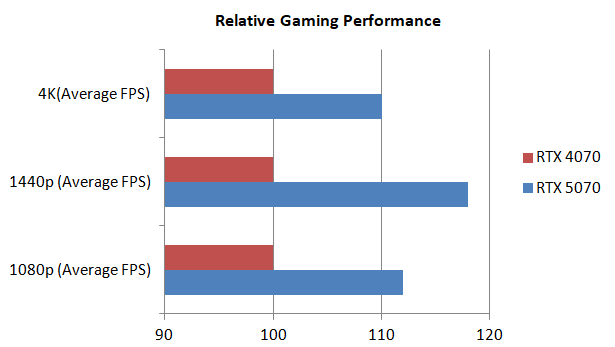
Across all tested resolutions, the RTX 5070 consistently outperforms the RTX 4070, with the largest gains appearing at 1440p where GPU compute power and memory bandwidth have the biggest impact.
At 1080p: the RTX 5070 delivers a modest but consistent lead over the RTX 4070. Based on the chart, the RTX 5070 performs roughly 7– 8% faster, offering higher frame rates in esports and competitive titles where CPU/GPU balance matters most.
At 1440p: the performance gap becomes much more noticeable. The RTX 5070 shows an estimated 18–20% improvement over the RTX 4070, thanks to its stronger compute throughput and significantly higher memory bandwidth. This resolution benefits the most from the newer architecture.
At 4K: the difference narrows but remains meaningful. The RTX 5070 maintains around a 10% performance advantage, showing better stability under bandwidth-heavy workloads and high-resolution rendering.
AI Inference Performance
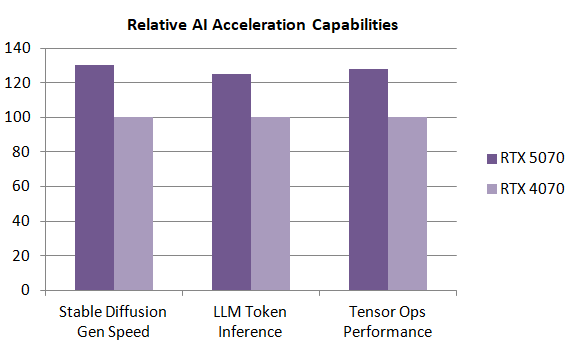
The RTX 5070 delivers around 30% higher AI inference performance than the RTX 4070, mainly due to its newer architecture and faster memory subsystem. In real workloads like Stable Diffusion image generation, local LLM inference, and general tensor compute (PyTorch/TensorRT), the RTX 5070 consistently maintains this ~30% lead.
Creator Workloads (Content Creation & Compute)
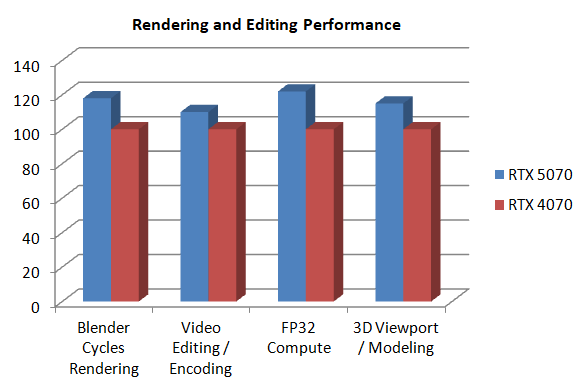
For creator-focused tasks such as rendering, video encoding, FP32 compute, and 3D modeling, the RTX 5070 delivers a noticeable performance boost over the RTX 4070. In most workflows, it offers roughly 10–20% faster results, leading to quicker renders and smoother editing timelines. It is the more efficient option for 3D artists, video editors, and users who rely heavily on GPU-accelerated creative tools.
Price & Value: RTX 5070 vs RTX 4070
| Platform | RTX 4070 (USD) | RTX 5070 (USD) | Price Difference (USD) | Price Difference (%) |
|---|---|---|---|---|
| Official MSRP | $599 | $549 | $50 | 9% |
| Amazon | $430 – $480 | $520 – $580 | $40 – $150 | 7% – 26% |
| Third-Party Resellers (eBay etc.) | $420 – $460 | $500 – $560 | $40 – $140 | 7% – 25% |
From the rtx 5070 price range compared to the RTX 4070, the overall cost difference is roughly +23–30%. However, considering the improved bandwidth, higher core count, and stronger FP32 throughput shown in the rtx 4070 specs comparison, the RTX 5070 offers a clearly better performance-per-dollar ratio.
If you’re looking for the most balanced value and more future-proof performance, the RTX 5070 stands out despite its higher price.
RTX 5070 vs 4070 – Pros & Cons
| Model | Pros | Cons |
|---|---|---|
| RTX 5070 | - Better overall performance (raster & RT) - Higher CUDA core count - Larger memory bandwidth - More future-proof for 1440p and productivity workloads |
- Higher price (~ 23–30% more) - Slightly higher power draw - Early-stage market availability may vary |
| RTX 4070 | - Lower pricing and strong value for budget builds - Excellent efficiency and low power draw - Stable market availability, many AIB options |
- Lower performance, especially in bandwidth-heavy titles - Weaker ray tracing and compute performance - Less future-proof for upcoming AAA titles |
RTX 5070 & RTX 4070 Server Hosting
If you want to take advantage of the strong GPU performance of the RTX 5070 or RTX 4070 for AI inference, model training, 3D rendering, video processing, or high-resolution gaming—without investing in expensive hardware or dealing with ongoing maintenance—choosing reliable GPU server hosting is the perfect solution.
Database Mart offers a variety of dedicated GPU servers designed to meet different workload needs. Whether you are looking for single-GPU or multi-GPU configurations, you can enjoy the power of high-end GPUs with scalable performance, 99.9% uptime, and 24/7 professional technical support, so you can focus on your projects without worrying about hardware management.
Conclusion
The RTX 5070 and RTX 4070 are both powerful mid-range GPUs, each with its strengths. The RTX 5070 performance shines with higher core counts, faster memory, and advanced AI and ray tracing, making it ideal for demanding workloads. The RTX 4070 offers excellent efficiency, solid 1440p gaming, and strong value for creators and general users.
Ultimately, choose the RTX 5070 for maximum performance and future-proofing, or the RTX 4070 for efficiency and cost-effectiveness. Both GPUs are well-equipped to meet the needs of gamers, creators, and AI developers in 2025.
rtx 5070 vs 4070, rtx 4070 vs 5070, rtx 5070 vs rtx 4070, rtx 5070 price, rtx 4070 specs, rtx 5070 specs rtx, 5070 benchmark, rtx 4070 benchmark, rtx 5070 cuda cores,rtx 4070 gaming performance